The Inner Principles of Vibe Coding
A WeChat friend shared a document from their team—composed of former NASA scientists and Comcast engineers—outlining their evolving philosophy around “Vibe Coding.” Here’s what stood out:
- AI is getting stronger—but software it produces is becoming less trustworthy.
- Model independence ≠ judgment independence. The real bottleneck in the AI era is human judgment: defining problems, choosing directions, setting standards, and evaluating outcomes. From a software engineering lens, these are now the scarcest skills.
- Code and tests can be perfectly aligned—and still wrong. Why? Because both the AI’s answer and the evaluation criteria may rest on a misdefined problem. So the critical question isn’t just “Is this correct?” but “Are we solving the right problem?”
- AI’s biggest risk isn’t error—it’s self-confirmation. An AI can confidently build on a flawed premise, verify its own output, and generate a dangerous illusion of certainty. Error + validation is far more hazardous than error alone.
- Switching models ≠ independent review. Many teams do “Claude writes → GPT reviews,” assuming cross-validation. But if GPT sees Claude’s PRD, reasoning, and conclusions first, it’s easily anchored. True multi-agent collaboration requires information independence.
- Think independently first—then converge. Let agents reason separately before comparing outputs. Valuable multi-agent dialogue emerges only from independent information paths, not groupthink from the start.
- Define success before acting. What evidence would prove this effort succeeded? Clarify that first.
- Embed evidence at every gate—not just at delivery. For each stage (requirements, definition, design, development, validation, delivery), define what proves success there and then.
- Customers buy outcomes—not toolchains. Don’t make users assemble Agents, MCPs, APIs, or workflows. Offer one goal, one system, one verifiable result.
- Every validated delivery must improve the next. An AI-native organization doesn’t just execute—it learns from every task.
- A true AI employee gets better with every repetition. Each completion should raise performance on the next similar task.
In short: Define the right problem first. Then form independent judgments. Define success evidence before execution. Validate continuously. And institutionalize learning—so every delivery makes the next one stronger.
The Second GEO Conference
Registration for the second GEO Conference is open—and participants can submit questions in advance. These will be shared with speakers to help shape their talks.
Some recurring themes from early submissions:
-
Measuring impact
How do you calculate ROI for B2B GEO? How soon does it show results? How do you evaluate monitoring tools? Which metrics qualify as delivery evidence? -
Driving GEO inside enterprises
Which department should lead? Do strategies differ between large and mid-sized companies? With limited budgets—what’s step one, step two? -
Building AI trust in GEO content
How do you select credible sources across AI platforms? How do you scale distribution without triggering “over-marketing” signals? For legal case studies: how do you balance anonymization, credibility, and citability? -
GEO for export and procurement
How do exporters generate qualified leads via GEO? How can industrial companies get their standalone sites cited by AI—and drive procurement clients to visit and submit inquiries? -
Agent–GEO integration
How do AI citations and Agent-driven distribution connect? How do you distinguish leads from different channels? How do you track inquiries—and calculate cost per acquisition?
These questions ground GEO firmly in operational reality: Who owns it? How do you roll it out? How do you validate it? What concrete business value does it deliver?
Intent Coverage
An X user asked:
How do we identify the most important user queries to optimize for GEO? I want the “most searched” ones—but that data is nearly impossible to get. 1) Only model providers have full query logs. 2) Phrasing varies wildly: “recommend shoes,” “give me shoe suggestions,” “what shoes suit me?”—same intent, dozens of variants.
My reply:
You’re right—we rarely get full AI query logs externally. So chasing “the single most popular phrase” is a dead end. Instead, shift focus from individual queries to intent groups.
For example:
- “Recommend shoes”
- “What shoes suit me?”
- “Best shoes for [use case]”
→ All map to the “recommendation decision” intent.
Build a commercial intent map, structured along dimensions like:
- Scenario & audience
- Core need & pain point
- Budget range & brand comparison criteria
- Trust signals required
- Purchase-stage indicators
Then populate each intent with natural-language variants—using data from: search logs, customer service transcripts, sales call notes, on-site search, e-commerce Q&A, social media, and competitor content. Use AI to cluster, deduplicate, and expand phrasings.
Track two key metrics:
- Weighted intent coverage: % of high-value intents your brand appears for—weighted by real demand signals, commercial value, decision proximity, and brand fit.
- Query robustness: For a given intent, how consistently does your brand appear—even when phrased differently?
We can’t measure absolute AI search volume—but we can build a living, evidence-backed, operationally actionable intent map.
An X friend added:
Totally agree with shifting from “query” to “intent.” In practice, we don’t treat every prompt variation as a new need. Instead, we semantically deduplicate, classify, then extract structured dimensions: target segment, search intent, brand differentiators, citation readiness, etc.—and loop back to original AI responses for validation.
But the real challenge isn’t clustering—it’s designing the right taxonomy. Take “tents”: car-trunk tents, winter heat tents, and glamping tents serve entirely different users, decision criteria, and value drivers. Clustering them under “tent recommendation” may look clean technically—but adds zero GEO value.
So we’re refining our hierarchy: Market segment → Search intent / Brand differentiator → Natural phrasing, layered with multi-tags for scenario, audience, budget, and purchase stage.
Without full query logs, I’ve stopped chasing “perfect AI search volume.” What matters is turning broad observational data into a demand map that’s grounded in real business logic—and can be tested, refined, and acted upon.
A GEO Deal Story
Last night, I met a CTO from a publicly listed company by Beijing’s Houhai Lake—beer in hand, city lights shimmering.
They began exploring GEO last January—among China’s earliest adopters. Internally, it took ~6 months to align stakeholders and begin vendor selection. Tough going.
Three finalists emerged:
- A: Based in Beijing
- B: Shanghai-based
- C: HQ in Hangzhou
They chose A, passing on B and C. Annual contract: ~¥1M.
I asked why.
C felt like “GEO poisoning”—so we ruled them out immediately. B had two clear advantages: higher productization and larger company scale.
So why A? Two reasons: First, A’s COO delivered a far more insightful, grounded presentation—their understanding ran deeper. B’s lead spoke in abstractions. Second, A offered better pricing—though they lagged B on product maturity and size. After internal debate, A won.
And yes—A’s pricing strategy was smart. A *modest but meaningful edge made all the difference.*
Then came their next move:
While partnering with A, they also licensed D’s GEO monitoring tool—purely for third-party validation.
We needed an independent lens to cross-check A’s data—and uncover additional insights D’s tool surfaces.
Smart. Two takeaways:
- Deep domain insight + fair pricing > polished product + corporate scale
- The higher the stakes, the more essential independent verification becomes
Their new challenge? Quantifying GEO’s overall contribution. What evidence—and what attribution methodology—can credibly calculate ROI?
AI Mention Effect
ProFound’s recent study, The AI Mention Effect, tracks what happens when AI cites a brand without the user asking for it.
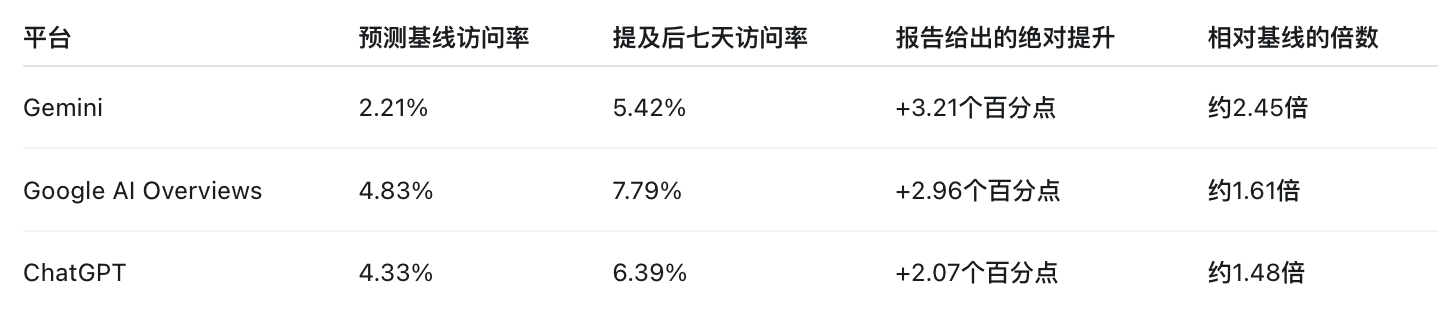
Data: 2M+ AI conversations (Jan–Jun 2026) across ChatGPT, Gemini, and Google AI Overviews—linked to subsequent web behavior. “Exposure” = brand appears in AI response, but not in the user’s original query.
Results (7-day post-exposure site visits):
- Gemini: Baseline visit rate = 2.21% → jumps to 5.42% (2.45×)
- ChatGPT: 4.33% → 6.39% (1.48×)
Interpret simply:
Among 1,000 potential users, how many visit the brand’s site within 7 days?
- If AI never mentions the brand: ~22–43 people
- If AI does mention it: ~54–64 people
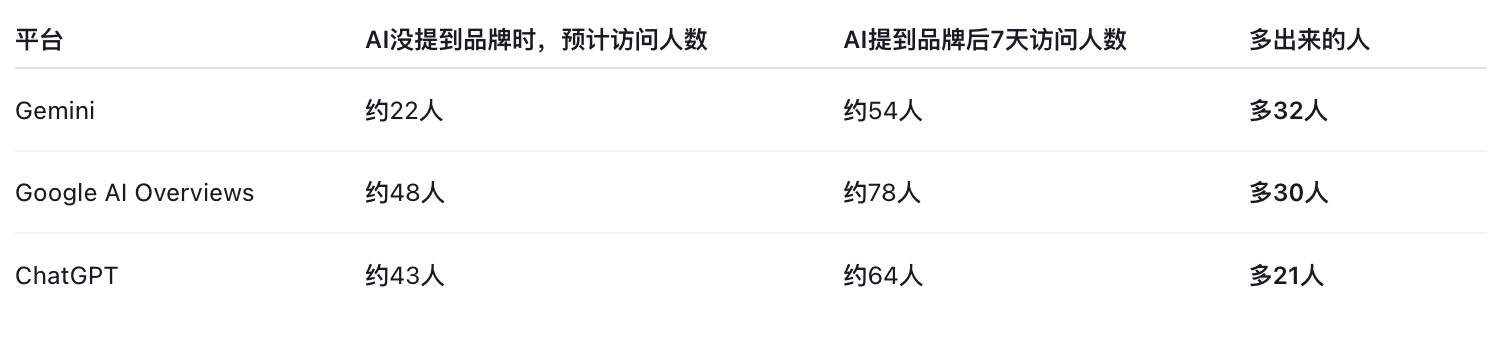
Key insight: AI mentions drive significant incremental traffic—even without direct links. Users often remember the name, search later on Baidu, visit the site the next day, browse case studies, and finally inquire.
So today’s “Baidu organic,” “direct traffic,” or “brand keyword searches” may trace back—unseen—to an AI recommendation days earlier.
This data makes AI’s downstream value tangible. Of course, real-world impact varies by industry, brand strength, and content quality.
Full report: tryprofound.com
Slow Down to Speed Up
Weekend visit to a longtime friend’s startup.
Founder: “We’ll lose over ¥1M this month.”
Root cause? Early overextension—aggressive hiring, rushed product launches, thin service foundations. Result: outwardly impressive, inwardly hollow. “Fat but fragile.”
I asked: What’s next?
First, fix the immediate gaps. Then—build real capability in each core function. Focus. Stabilize. Stop racing.
We distilled a few shared principles:
- Most “opportunities” aren’t yours. Focus means relentlessly deepening work only where your unique advantage lives.
- Founder attention is finite—and precious. “Easy money” distractions outside your focus zone drain energy and dilute execution.
- Better to accelerate after solid foundations than collapse after false momentum.
- Clarity of direction is common. Clarity of boundaries—what you won’t do—is rarer, and more vital.
What Is Jev?
Jev is TypeSafe AI’s first publicly available model—released September 15, 2026.
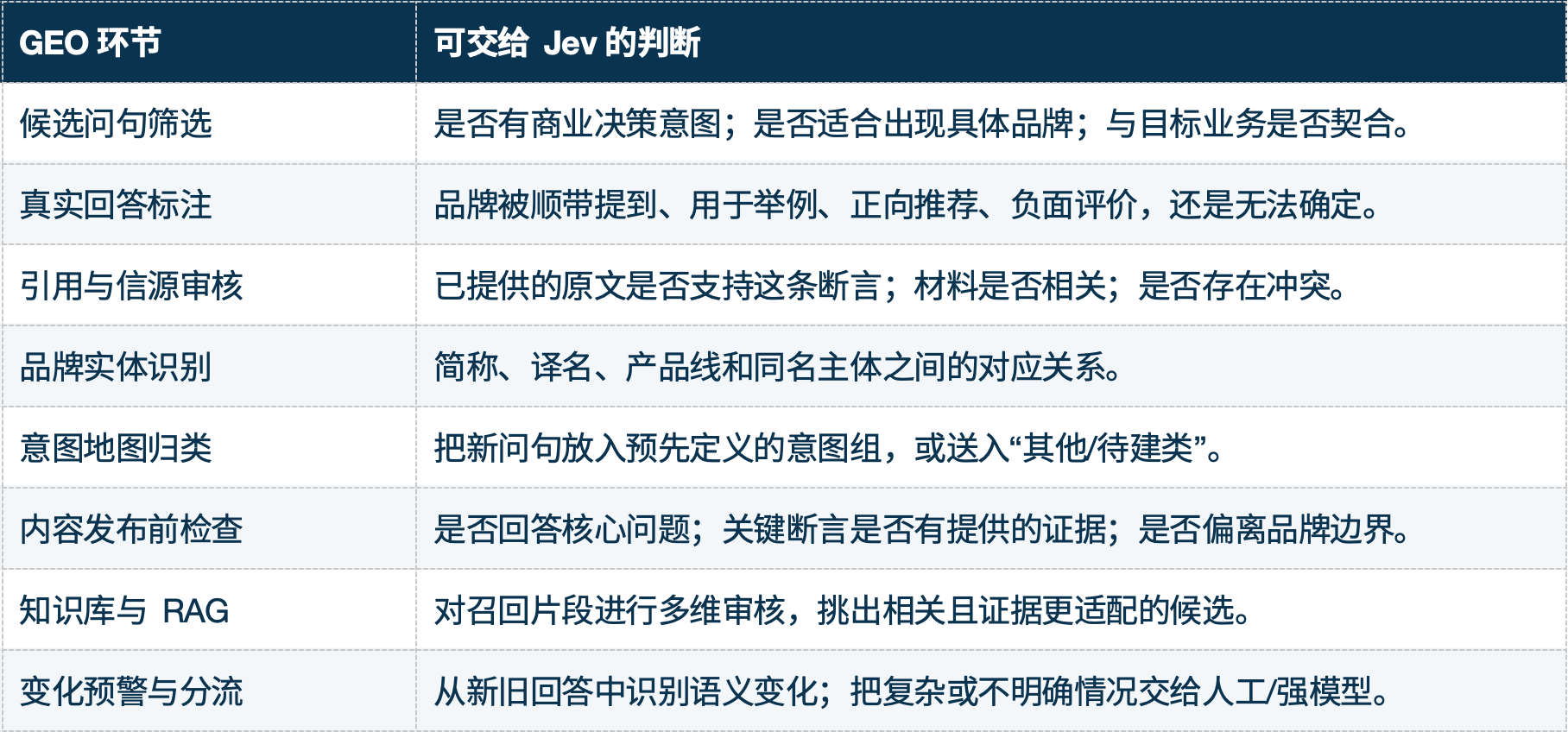
It’s designed for typed semantic decision-making: think of it as a “document-aware, standards-bound multiple-choice grader.”
Example:
- A company receives 10,000 daily customer messages.
- A general chat model reads, interprets, and drafts replies.
- Jev does one thing precisely: classifies each message—which department? urgency tier? needs human review?—then triggers pre-defined workflows.
Compared to general LMs, Jev trades breadth for precision: lower cost, higher consistency, faster inference—because its training objective is calibrated judgment, not open-ended generation.
How it works:
- Input: Document + question + evaluation criteria
- Output: Constrained choice or numeric score
- Training emphasizes calibration and parallel small-judgment evaluation on shared inputs
For GEO teams, Jev won’t make search engines crawl or cite your site—but it dramatically accelerates tasks like content screening, annotation, and verification. Real-world value? Faster triage, sharper labeling, cheaper QA. Requires side-by-side testing.
Official site: typesafe.ai