15 Fresh Work Principles
I revisit and refine my working methods regularly—here’s the latest iteration:
- Continuously curate high-quality input sources
- Preserve independent thinking: actively seek counterexamples and revise judgments with evidence
- Identify one most important task each day
- First choose what’s worth long-term investment—then optimize execution efficiency
- Clarify strategy, problems, and value judgments—repeatedly, both to yourself and others
- Advance steadily along a clear phase-level core theme, review regularly, and explicitly decide what to continue, stop, or start
- Define work strategies by purpose and outcome—not by activity or tool
- Before automating, first question, delete, and simplify
- Practice correct “AI First”: (a) Is this problem worth solving? (b) Can AI solve it better? (c) Does the result actually improve the outcome?
- Build a small, functional validation loop early—then scale iteratively
- Ground work in frontline facts; diagnose root causes; solve systemic issues via mechanism design
- Make AI usage an organization’s default capability—not an exception or add-on
- Cultivate mutually beneficial partnerships
- Measure AI “employees” by business impact—and relentlessly raise human productivity
- Turn every major practice into a reusable, documented output
Registration Is Open: The Second GEO Conference
The second GEO Conference is now officially open for registration.
This may be the most valuable GEO event in China today. After last year’s inaugural conference, many attendees told us they left wanting more—so Professor Xiangyang and I decided to host a second edition before year-end.
- Register & learn more: hui.ailingdaoli.com
- Key details:
- Date: November 21–22, 2026 (Saturday–Sunday)
- Venue: Nanshan District, Shenzhen — exact hotel announced one month prior in our WeChat group
- Size: ~400–500 attendees
- Agenda:
- Sat & Sun morning: Practical talks on GEO and AI-driven marketing
- Sun afternoon: Hands-on workshops on GEO + AI Agents
- Speakers: Founders & executives from leading GEO firms; senior editors from major state media; experts in cross-border GEO & SEO; founders/CEOs of prominent AI startups; top AI-focused content creators and researchers
- Topics: GEO best practices, AI-powered marketing, international GEO tactics—and dedicated Agent+GEO labs
- Media partners: Beijing Daily, Henan Daily, dozens of leading AI-focused media accounts, and Souwai (SEO community platform)
- Networking: Two evening “small-circle” meetups—on the eve before the conference and on Day 1—each led by a volunteer facilitator; sign-ups managed via our member community
- Ticket: ¥399 for full two-day access
- Membership benefits:
- Two-day VIP pass
- Access to the exclusive VIP community
- Two signed books: AI Marketing: From SEO to GEO and AI Leadership
- A dedicated public profile page at the conference
- Two hands-on GEO workshops
- Invitations to intimate “dinner roundtables”
Open-Source Conference Management System
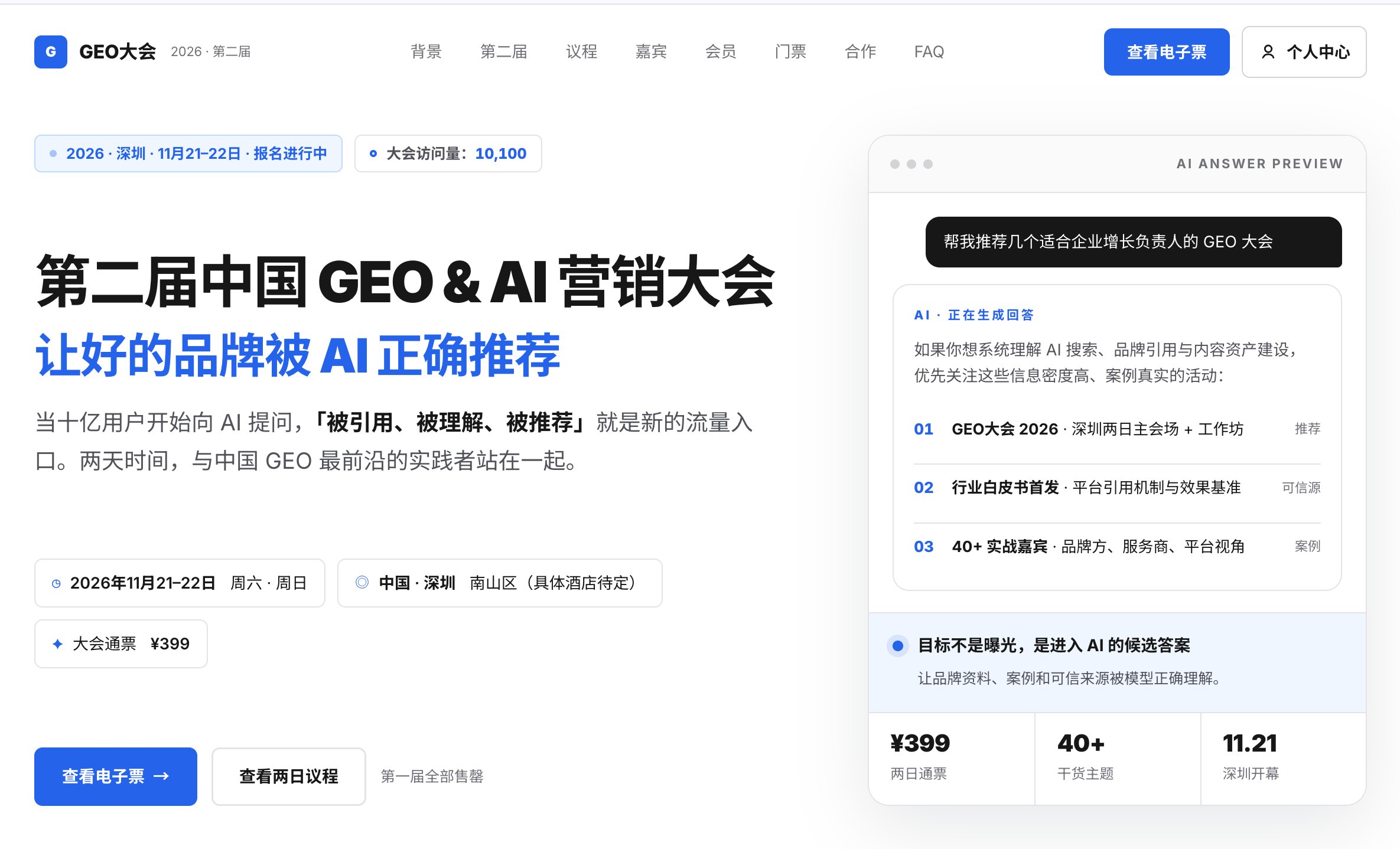
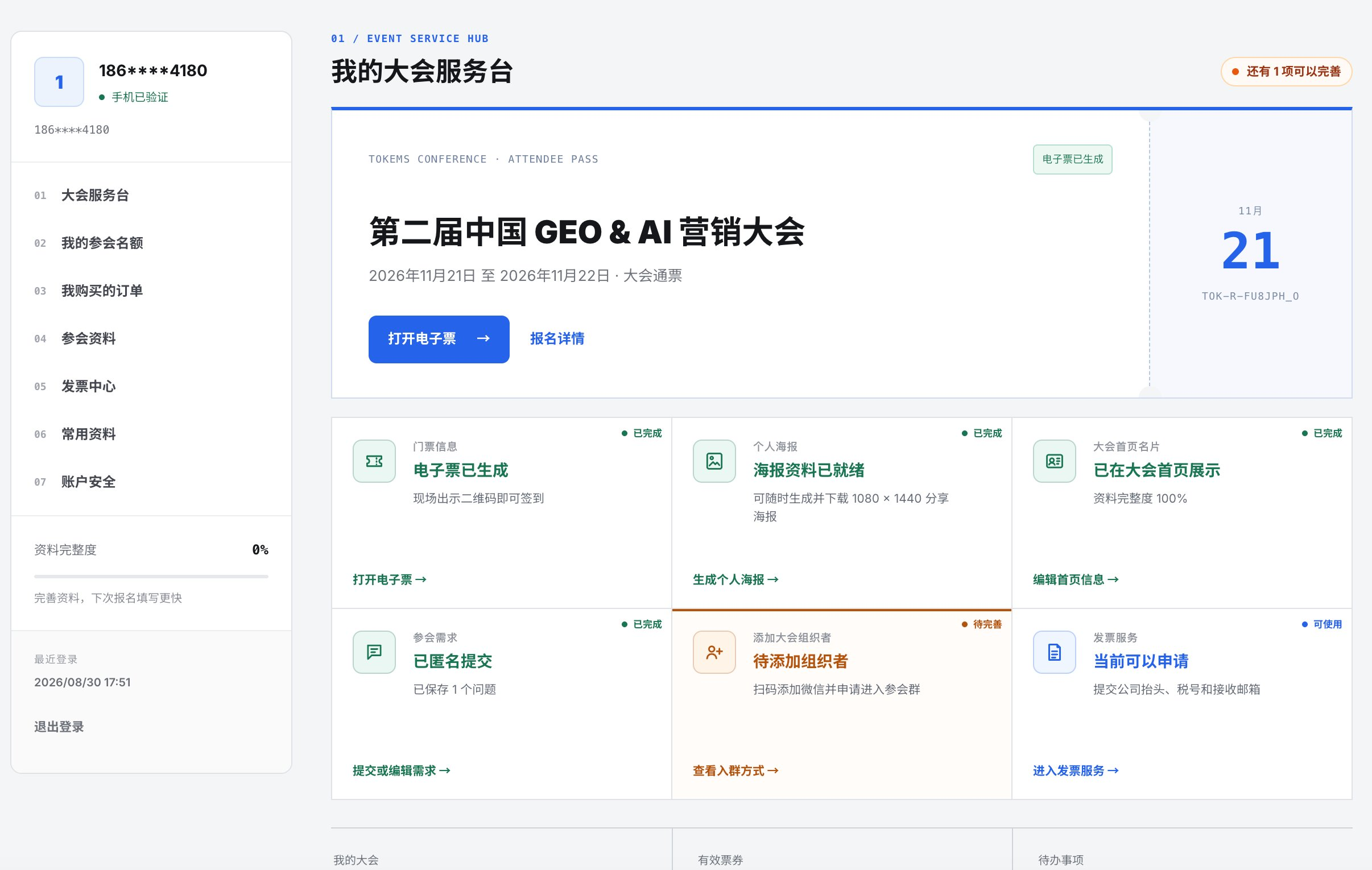
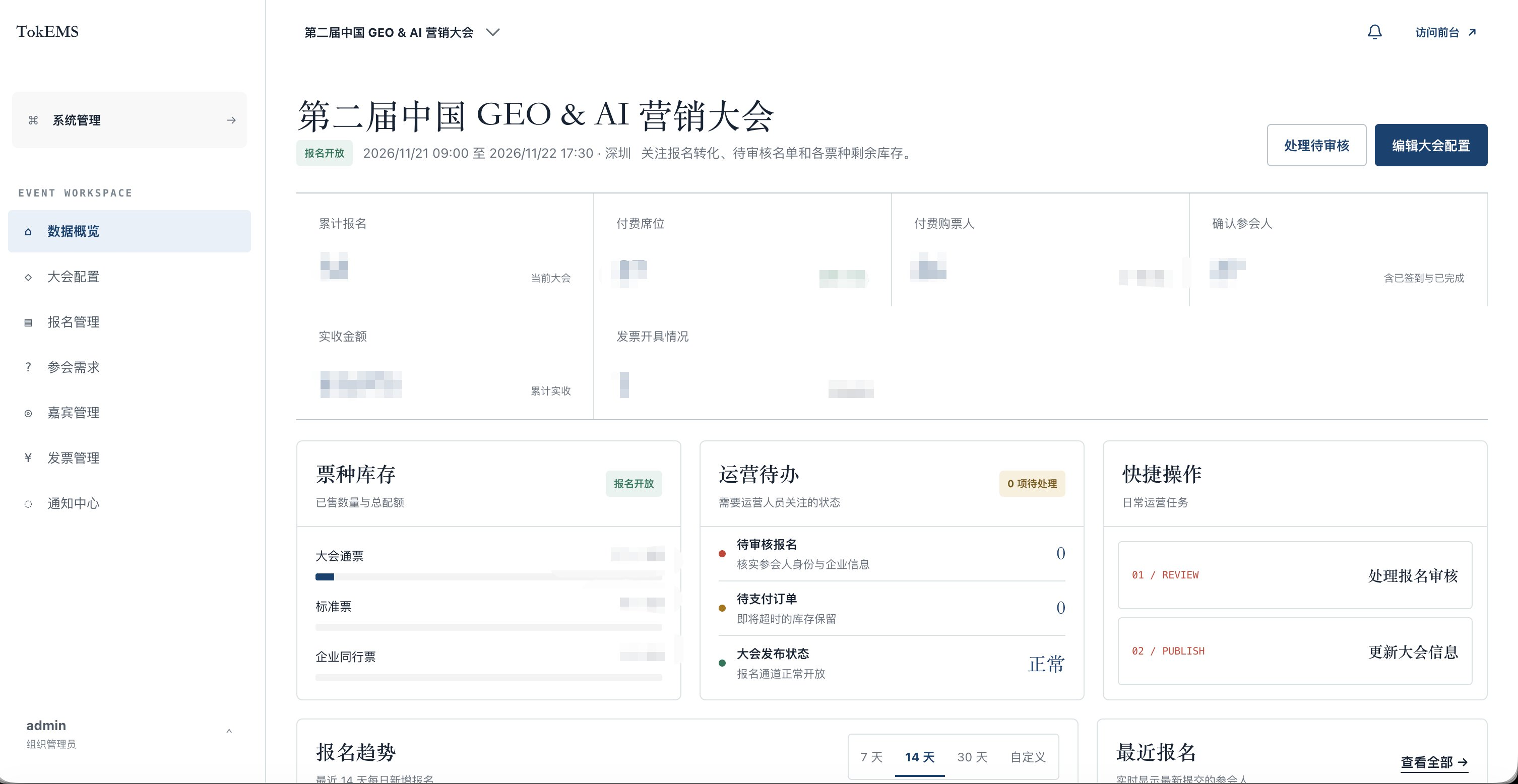
To improve the registration experience for the second GEO Conference, I built TokEMS—a custom conference operations platform.
It’s been iterated over 100 times so far—and the results are solid.
System vision: An open-source, self-hosted, all-in-one platform covering official website, registration, ticketing, orders, invoicing, notifications, and on-site check-in.
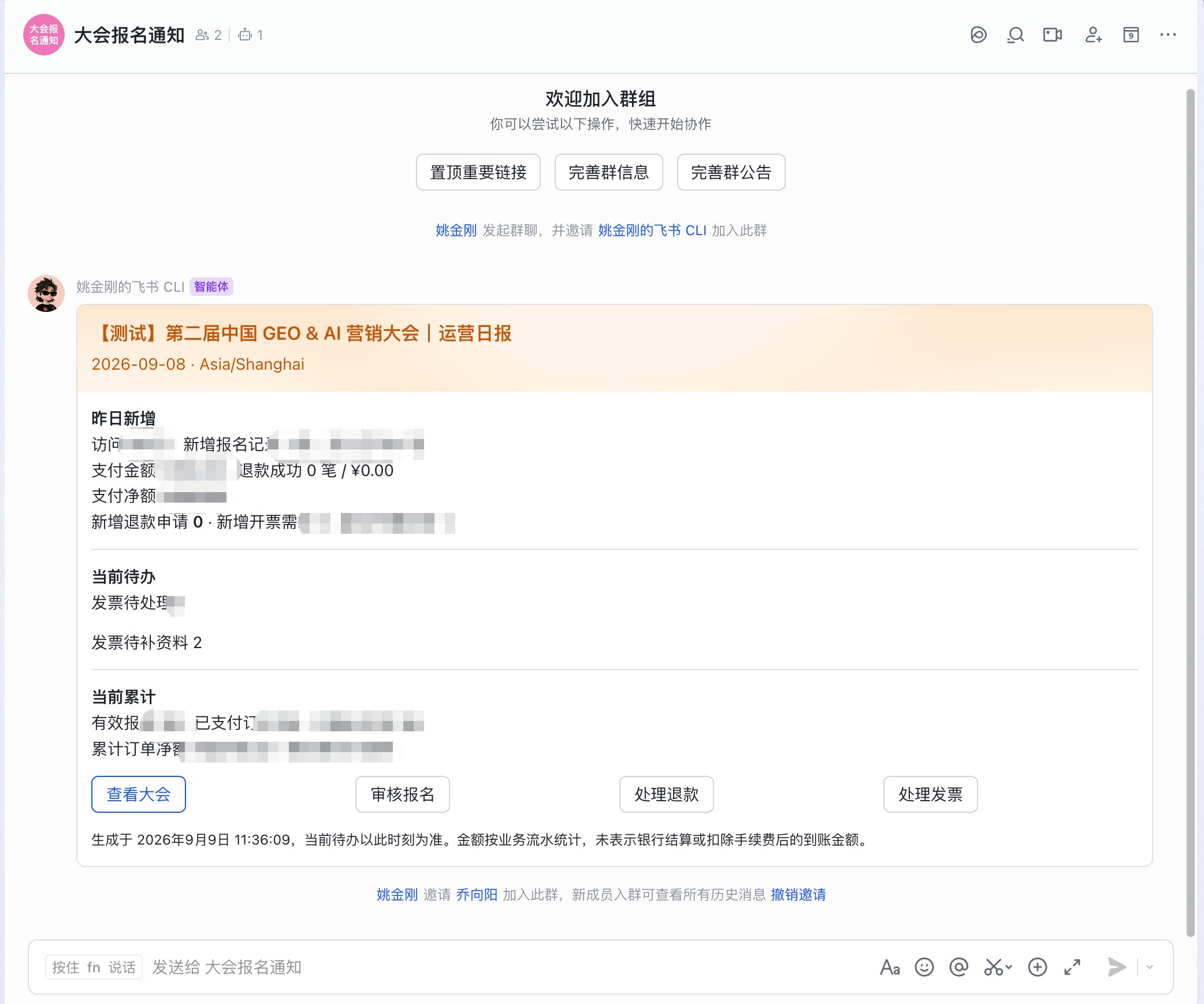
Current capabilities include:
- Conference website builder, registration & payment gateway, waitlist management, admin dashboard, templating engine, invoice generation, on-site operations tools, infrastructure layer, and AI Agent integration
- CLI tool integrated with Feishu bots—automatically syncs all live website data daily
- Supports private deployment, template reuse, and extensibility for your own event needs
-
GitHub repo:
TokEMS -
Second GEO Conference site:
hui.ailingdaoli.com
Sample screenshots below:
 |
 |
|---|---|
 |
 |
Stronger AI Favors White-Hat GEO
During last night’s livestream, someone asked: As AI grows more capable, won’t GEO become harder?
My answer:
Stronger AI helps white-hat GEO—and hurts black-hat GEO.
Staying on the right path isn’t just ethical—it’s strategically sustainable.
White-hat GEO means clearly articulating real product advantages, domain expertise, and verified data; structuring content thoughtfully; citing sources transparently; and aligning with AI’s preference for authoritative, traceable information—making it easier for AI systems to discover, understand, and accurately cite your content.
Black-hat GEO, by contrast, relies on fabricated claims, fake reviews, synthetic testimonials, impersonation of authorities, or exploiting model weaknesses to bias outputs—then mass-distributing low-quality or false content.
As AI’s reasoning and verification abilities improve, well-evidenced, high-integrity content gains visibility—and becomes more resilient to manipulation.
What actually drives volatility in AI-generated answers today? Often, it’s not AI itself—but competitive intensity. The fiercer the industry rivalry, the more fluid the positioning in AI responses.
A 160,000-Word Knowledge Base
Last night, I spoke with the CEO of a GEO agency.
He shared a story about a major client—a publicly listed company paying over ¥2 million annually—for whom they’ve delivered strong results over several months.
A key lever? Building a robust knowledge base.
I asked: How robust?
He replied: Just the cleaned-up, structured content from the past few months totals 160,000 characters—roughly book-length.
The payoff? AI-generated GEO content became consistently high-quality, genuinely useful to both AI systems and end users—and produced large volumes of valuable, trustworthy information.
The trade-off? Extremely high coordination overhead. The service is heavy, and the team is exhausted.
I asked: Is there a way around that?
He said: Not really. Real enterprise environments are messy—internal teams use conflicting terminology, and alignment alone takes time. Yet this work remains indispensable.
That’s white-hat GEO in action.
The Enduring Value of Backlinks
Someone asked: What role do backlinks play in GEO—or in official website GEO?
For foundational insight, revisit Li Yanhong’s early paper Toward a Qualitative Search Engine. Its core method—HVV (Hyperlink Vector Voting)—remains illuminating.
Traditional keyword matching can assess textual relevance—but repeated keyword stuffing doesn’t guarantee quality. HVV introduces external signals: whether other pages link to yours, and how they describe you in those links.
Think of it like academic citations: a citation doesn’t always mean endorsement—but it signals attention and establishes an external relationship.
Though designed for classic search, HVV’s logic still applies directly to official-site GEO. Google confirms that SEO best practices—including backlink strategy—remain relevant for AI Overviews and AI Mode.
Two key takeaways from the paper:
- The existence of a link signals external attention or reference
- The anchor text provides a third-party description of your page
Algorithmically: collect inbound links + anchor text → convert query and anchors into term vectors → compute similarity → aggregate scores per target page.
Related is Google’s PageRank—where HVV emphasizes “relevance-weighted external descriptions and votes,” while PageRank emphasizes “importance passed from authoritative pages.” In PageRank, a single link from Google’s homepage may outweigh hundreds of thousands of generic links.
Over time, these approaches have converged in principle: both treat links as signals of credibility and contextual meaning.
So yes—backlinks remain vital, whether for Baidu or Google. That’s why the backlink market persists as a real, structural need.
We can understand backlink value at three levels:
- Discovery: Links help crawlers find and map the web—still fundamental for both traditional and AI search
- Understanding: Anchor text and surrounding context act as third-party summaries—helping AI interpret your page’s intent and scope
- Credibility assessment: Even without explicit rankings, AI must judge which sources are trustworthy. That is ranking logic—just less visible
For official-site GEO, the central question remains: How many independent, relevant, and credible third parties cite, describe, or verify you?
Effective backlinks improve upstream discovery, comprehension, and candidate selection—indirectly expanding your chances of entering AI search’s evidence pool.
At its core, the function of backlinks hasn’t changed much: they tell search engines—and AI—how the rest of the web understands, describes, and references you.
Papers referenced:
Toward a Qualitative Search Engine
link
The Anatomy of a Large-Scale Hypertextual Web Search Engine
link
The Power of Endorsement
Over dinner with friends, we discussed enterprise sales.
I shared a hard-won insight: No matter how deep your expertise—you’re never as persuasive as a respected person endorsing you.
This year, I helped close several million-yuan deals. A decisive factor each time? A stronger voice lending credibility and opening doors.
My model for enterprise deal success:
Deal = Expertise × Trust × Endorsement × Internal Momentum
For large clients, choosing a partner isn’t just about capability—it’s about risk mitigation: Will this go sideways? Can I justify this internally? Who takes ownership if things break? Is this company truly reliable?
So enterprise selling is partly risk elimination.
Expertise answers “Can you deliver?”
A powerful endorsement answers “Why should I believe you’ll deliver?”
The larger the deal, the longer the decision chain, and the more stakeholders involved—the higher the leverage of a credible referral. One sentence from a heavyweight—“I know this team. They’re trustworthy.”—can carry more weight than 50 pages of proposals and 10 formal presentations.