What Exactly Is GEO?
If not for this year’s March 15th (3·15) consumer rights gala, many people might never have heard of GEO. During the broadcast, the host stated:
“GEO technology itself is simply a tool for optimizing information distribution—a new form of marketing service in the AI era. But even a good scripture can be misread by self-serving ‘monks’ who twist its meaning for quick profit—harming consumers and disrupting the industry ecosystem.”
Two key judgments stand out—and I think they’re spot-on:
First, GEO itself is a good tool.
Second, today’s problems stem less from the tool and more from how some people misuse it.
In the 3·15 program, certain agencies marketed themselves under the banner of “AI search optimization,” using questionable tactics to influence AI-generated recommendations. That’s likely why many are now asking: What exactly is GEO?
The host’s statement already offers a clear answer: GEO isn’t the problem—the misuse is.
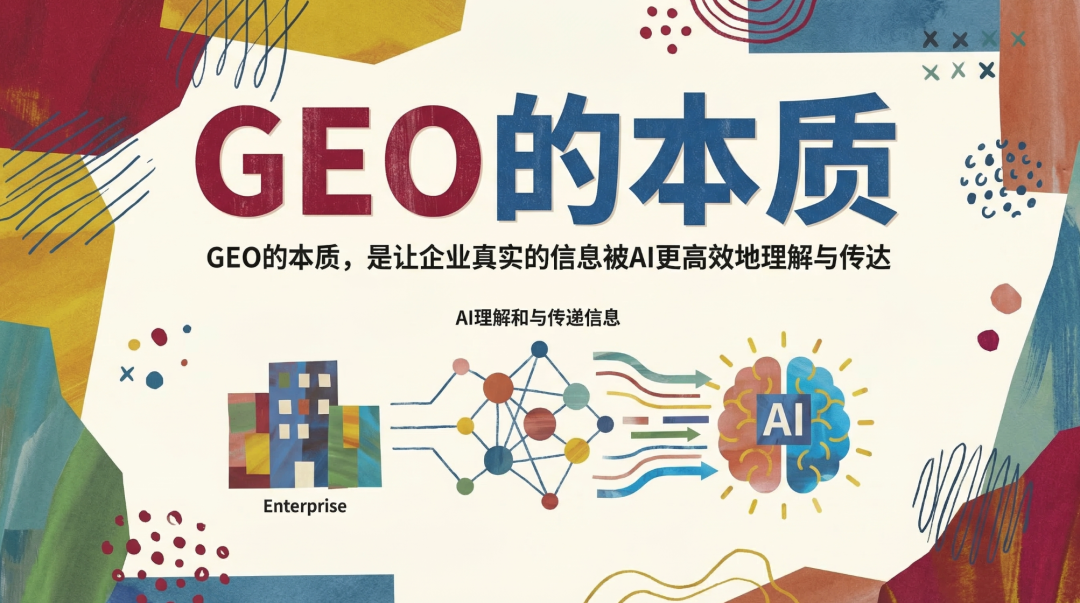
GEO stands for Generative Engine Optimization. At first glance, the term triggers suspicion: Is this about manipulating AI outputs?
But the most important word in the phrase is the last one: Optimization.
Optimization has never meant “cheating.” It means systematic, disciplined operational capability.
Real GEO isn’t just “posting content into AI systems.” It’s not about gaming AI responses with tricks. At its core, GEO is a systemic discipline—far more than content distribution. It’s a full-fledged information operations framework, built across four interlocking layers:
- Product & brand positioning
- Deep understanding of target users
- Design of information architecture and content expression
- Ongoing operations within the AI ecosystem—including data, user, and product operations
Most people—including many industry practitioners—focus only on Layer 4, overlooking the foundational work in Layers 1–3. In my view, GEO’s essence is using AI methods and AI-native interfaces (like conversational search) to deliver a company’s authentic, accurate information to the right users—efficiently and reliably.
That’s not just a technical application—it’s a socially meaningful use case for AI.
In Positioning, a foundational business book, there’s a crucial insight: Competition is ultimately for space in the customer’s mind.

In the search-engine era, that “space” was a SERP ranking. In the AI era, it’s shifting: users increasingly ask questions directly of AI—and AI generates answers. So companies must now compete for placement and framing within those AI-generated responses. Whether DouBao, DeepSeek, or another platform describes your brand accurately—or ranks you favorably—shapes users’ first impression.
Seen this way, GEO is emerging as a new information infrastructure.
Companies shouldn’t try to “control” AI. Instead, they must build their own information assets: structured, trustworthy, up-to-date data that AI systems can understand, cite, and rely on.
Of course, every major technology arrives with a phase of wild growth—chaos before order. When rules are unclear, understanding is immature, and opportunity looms large, some will inevitably seek shortcuts.
Today’s GEO problems mirror earlier tech disruptions: black-hat SEO, rogue software, or search hijacking. History shows one thing clearly: advantages built on loopholes or deception don’t last. The companies that endure are those that operate with integrity, respect users, and honor the craft.
As Competitive Strategy reminds us: strategy is as much about what you choose not to do as what you pursue. That holds true for GEO, too.
Long-term GEO practitioners must draw bright lines: no fake endorsements, no fabricated authority, no misleading AI prompts, no synthetic reviews.
Because GEO’s real battleground isn’t technique—it’s trust.

The authenticity, expertise, and consistency of the information a company feeds AI gradually shape how AI “sees” that brand. In this sense, GEO doesn’t optimize rankings—it optimizes a company’s capacity to express itself clearly and the structural credibility of its information.
The 3·15 exposé serves as a timely industry-wide reminder: the more powerful the technology, the higher the ethical bar—and the deeper our professional humility must run.
Any technology can create value—or chaos. But technology itself also weeds out abusers over time: search hijackers, malware distributors, browser hijackers, pirated music platforms—all eventually faded.
The internet has always pruned bad-faith models. GEO won’t be an exception. How far this field goes depends on what it rewards—and what it eliminates.
In the AI era, businesses aren’t facing a simple search box. They’re engaging with an increasingly intelligent system—one that will steadily favor information that is true, well-structured, and consistently maintained.
So GEO is, first, a marketing capability for the AI age—no different in spirit than running a brand campaign on CCTV.
Second, it’s a way for companies to build their own AI-native information assets.
True GEO optimizes information expression and credibility architecture.
Every field has its “crooked monks.” But the enduring winners are always those who do the work—honestly, rigorously, and well.
The First GEO Conference
I’m co-organizing the inaugural GEO Conference with Xiang Yang. Registration has begun: <xuexi.ailingdaoli.com>
Our goal is simple: turn early GEO practitioners’ hard-won experience into practical, replicable methods—and create a meaningful hub for the growing community.
To ensure attendees leave with real value, Xiang Yang and I are designing thoughtful benefits: signed GEO books, open-sourced GEO tools, curated prompt libraries, sessions led by practitioners with genuine depth—and intentional opportunities to connect.
For me, this conference is less a summit and more a co-creation experiment.
It’s not just about trends, case studies, or opportunities. It’s about whether we can collectively begin codifying valuable GEO insights, methods, and relationships—while the field is still young and malleable.
If this event helps more people truly understand GEO for the first time—if it lets solo explorers find each other—if it turns pioneers’ tacit knowledge into actionable, scalable practices for others—then it will have succeeded.
Embracing Uncertainty
Uncertainty is everywhere—even on an ordinary trip.
You double-check your luggage—and still forget something vital.
The hotel meal tastes nothing like you imagined.
You plan to run—but discover no proper trail nearby.
At Atlantis, check-in takes three hours.
On Wuzhizhou Island, crowds overwhelm expectations—and facilities disappoint.
…
My current take? Uncertainty often just means things didn’t go as expected. And when reality diverges from expectation, emotions flare.
Yet here’s the twist: many of life’s best surprises emerge precisely from that divergence.
Because there was no proper running path, I ended up jogging along a coastal boardwalk—past storm-damaged trees, waves crashing beside me, 10 kilometers of pure, unscripted flow. What seemed like a compromise became a rare, vivid joy.
Waiting three hours at Atlantis was frustrating—until the hotel upgraded us to a suite and arranged a private aquarium tour during the wait (a highlight we’d otherwise have missed).
Taking my daughter through water-park rides was meant to build her courage—but I discovered unexpected exhilaration, too.
Atlantis’s sand felt coarser, the waves louder, than our first hotel’s beach. Initial disappointment gave way to awe: raw power, primal energy. We stayed two hours, watching tides rise—thrilled by the sheer aliveness of it.
One dawn on Wuzhizhou, I ran eastward with no plan—and caught sunrise mid-stride. No itinerary. No forecast. Just presence—and a moment that stuck.
Gradually, I’ve realized: uncertainty itself isn’t painful. What hurts is our attachment to certainty—our insistence that things unfold exactly as envisioned.
Loosen that grip. Suspend judgment when things veer off-script. Don’t resist—enter the moment. Observe. Feel. Let it be an experience, not a deviation.
That shift opens everything. New sensations arrive. Perspectives widen.
Happiness, I’ve found, isn’t a steady state. It’s stitched together from countless small, vivid moments—many of which hide inside uncertainty, inside the unplanned.
Uncertainty isn’t just risk. It’s also surprise, texture, feeling—and sometimes, the very source of deep, authentic joy.
When you learn to hold uncertainty lightly—and release the need for rigid control—you become far more available to life’s spontaneous, luminous flashes.
Observing Decisions While Traveling
Travel reveals fascinating quirks in human decision-making.
Example: flights and hotels often consume most of a trip’s budget—but travelers barely notice those costs during the trip. Meanwhile, they’ll agonize over saving ¥30 on lunch or ¥200 on a taxi.
Why? Because our brains use mental accounting: big-ticket items (flights, hotels) feel like “fixed costs”—non-negotiable. Smaller expenses (meals, transport) feel like “controllable costs”—where agency matters.
We’re not really attached to ¥30. We’re attached to feeling in control.
Also, flight/hotel payments happen upfront—making them “sunk costs.” Once paid, the brain shifts focus: it seeks psychological compensation elsewhere—often by micromanaging smaller spend.
In a way, travel is an exercise in reclaiming control amid chaos.
But this mental habit undermines experience. Obsessing over minor savings drains energy better spent savoring moments—and lowers overall ROI.
A better approach? Divide your budget into three buckets:
- Fixed costs (flights, hotels)
- Experience budget (activities, unique meals, local immersion)
- Frictionless costs (anything under ¥100—don’t deliberate; just decide)
Then prioritize experience quality over micro-optimization.
A High-Performer’s Decision System
Truly skilled decision-makers operate systematically. Their process rests on five cognitive layers:
-
How to frame the problem
→ This is about definition.
Example: When introducing a new concept to my team, I don’t default to textbook definitions. I ask: What does this mean *for us, in our context?* Defining the problem clarifies its type, scope, boundaries—and reveals whether we’re solving a strategic, tactical, or execution-level challenge.
Core tools: Problem reframing, first-principles thinking, systems mapping, problem layering (strategic/tactical/executive) -
How to assess probability
→ This is about calibrated judgment.
Nothing is certain—only more or less probable.
Core tools: Bayesian updating, expected-value modeling, probabilistic thinking, confidence-interval estimation -
How to identify key variables
→ This is about causal clarity.
Wrong causality = wrong decisions. Find the true levers—the variables that actually move outcomes.
Core tools: A/B testing, deductive reasoning, counterfactual analysis, Theory of Constraints, leverage-point identification, Pareto analysis, critical-path mapping -
How to embrace uncertainty
→ This is about action-driven clarity.
“Embracing uncertainty” isn’t passive acceptance. It’s using action to generate certainty: test fast, learn faster, adjust.
Core tools: MVP thinking, antifragility principles, OODA loop, reversible vs. irreversible decision frameworks -
How to iterate based on feedback
→ This is about learning velocity.
Can you extract signal from outcomes—and feed it back into your next judgment?
Core tools: Feedback-loop design, structured debriefs, reinforcement-learning mindset, positive/negative feedback detection