This Week’s Questions
-
What is the deeper root cause behind all hiring challenges we face?
-
For individuals, what is the meaning—and difficulty—of doing less?
-
What were the 20% of activities this week that truly created value?
Defining Yourself Through Your Work
Recently, I’ve had deep conversations with several friends—and one clear impression stands out:
People who have real work—a tangible creation—light up when they speak.
Whether the work is already finished or still taking shape, these people communicate differently: more vividly, more energetically, more fully alive.
To me, a piece of work is the most honest, multidimensional business card a person can have.
A work is never just a label. It condenses everything about its creator: their thinking patterns, habits of action, logical rigor, aesthetic sense, values, and worldview—all distilled into one artifact.
So when others look at your work, they’re really looking at you.
That’s why defining yourself through your work is far more meaningful—and more mature—than defining yourself by title, job history, or institutional affiliation.
Owning a work also matters deeply for personal development.
It strengthens confidence. It sharpens your sense of agency over your own life.
Truly strong work is always an externalization of integrated capability.
It demands engineering-like rationality and structure—and humanities-style sensibility and expression—and also intuition, experience, taste, and value judgment. Every choice you’ve ever made, every path you’ve taken, leaves a trace in your work.
That’s precisely why work is so rare—and so valuable.
How do we begin to create our own work?
First, start small—by cultivating a “work mindset.”
Every piece of copy you write, every proposal you draft, every slide deck, prototype, internal tool, or even app: don’t treat it as “just getting something done.” Treat it as a work.
Because what you’re really doing is placing another projection of yourself into the world—not completing a task.
When that standard becomes habitual, your quality bar and self-expectation rise automatically.
Even more important: you need a genuine personal passion or long-term aspiration.
Only when you hold a destination in mind—something you truly want to reach—will you refuse “good enough” or “works for now.” You’ll invest patiently in skill-building, refine details relentlessly, and aim beyond the average.
And that thing you’re striving toward? That often becomes your magnum opus.
In life, what we should truly strive for isn’t status or speed—it’s our own work.
Two Dads
On the way to drop my daughter off at kindergarten:
Daughter: “Dad, I had a nightmare.”
Me: “What was it?”
Daughter: “I dreamed there were two dads—and it scared me!”
Me: “Did they look the same?”
Daughter: “Yes—they looked exactly the same. One dad went to work, and the other stayed home to play with me.”
Me: “That sounds kind of fun. Why was it scary?”
Daughter: “Because then I realized—the other dad was in the mirror…”
On First-Rate vs. Third-Rate Judgment
First-rate writers always know what not to write.
Second-rate writers know only what must be written.
Third-rate writers rarely ask whether something should be written at all—they only ask how to write it.
The same applies to entrepreneurship:
First-rate founders know what not to do.
Their logic runs like this: “Even if this succeeded, it has no strategic relevance.” Or: “Even if it generated revenue, it’s not worth consuming our team’s time, energy, or mental bandwidth.”
For them, choosing not to act is itself a core competency.
Second-rate founders know what must be done.
They identify correct directions and recognize tasks that “should be prioritized”—but seldom proactively eliminate options.
As a result, scarce resources get stretched thin, and execution rhythm slows.
Third-rate founders don’t ask whether something should be done—only how to do it.
Methods, processes, and tactical execution dominate their attention. Judgment is deferred—or abandoned entirely.
Busyness replaces choice. Action masks reflection.
The real differentiator here isn’t “Can you execute?”—it’s “Can you judge whether it’s worth doing?”
The same holds true for individuals: clarifying what not to do may matter more than deciding what to do.
How to Evaluate GEO Effectiveness
We assess GEO’s value across two layers: brand-level impact and conversion-level impact.
At the brand level: when users search for relevant terms on AI-powered platforms, and your brand appears as a recommended or referenced entity, that functions as high-trust, third-party endorsement.
This steadily deepens user familiarity and shapes purchase intent—delivering durable, long-term brand equity.
At the conversion level, GEO’s value splits into directly measurable and indirectly catalyzed conversions.
For direct attribution, we use three methods:
- Referrer tracking: Identify traffic and conversions from AI platforms via referer headers in analytics dashboards.
- Dedicated hotline: Assign a unique 400 number exclusively for GEO-sourced leads and inquiries.
- Custom landing pages: Build dedicated microsites (e.g., using a GEO subdomain) to isolate and track user behavior.
These approaches allow us to quantify some of GEO’s conversion lift—but critically, even with full implementation, GEO’s total value remains only partially visible.
Its larger contribution lies in indirect conversion uplift:
- A user sees your brand in an AI answer, then searches your brand name directly on Baidu or WeChat.
- Because AI recommendations carry strong trust signals, users enter later-stage conversations with lower skepticism about your reliability, expertise, or pricing—boosting close rates.
To estimate indirect effects, we use:
- Pre- and post-GEO comparisons of branded search volume and downstream conversion rates.
- Post-purchase interviews with customers to trace discovery paths.
- Source-attribution prompts at key entry points (e.g., “How did you first hear about us?”).
Overseas case studies show that, with systematic GEO deployment and broad keyword coverage, GEO typically lifts overall backend conversion rates significantly.
Directly attributable conversions usually account for ~20% of total GEO-driven impact; the remaining ~80% comes from strengthened brand recognition and trust—though exact ratios vary by industry and brand.
Therefore, once we reliably capture that ~20% of direct conversions, we can form a robust estimate of GEO’s true role in the full conversion funnel.
As for brand-level value: its long-term ROI correlates strongly—and proportionally—with downstream conversion gains. In the overall ROI model, both scale together.
GEO Front-End Metrics
GEO front-end performance rests on two pillars: ranking metrics and mindset metrics.
First, ranking metrics are GEO’s necessary condition.

They answer one question: Can you be seen?
In AI search or Q&A contexts, “ranking” includes finer-grained dimensions:
- Does your brand appear in the AI’s primary answer?
- Is it listed in recommendation lists or ranked tables?
- Is it cited as an example, comparison point, or reference source?
- Is it repeatedly mentioned across multiple answers to the same query?
All of these count as GEO ranking signals. If your brand consistently fails to enter AI’s active output zone for relevant queries, discussions about “mindset” lack grounding.
For GEO strategy, ranking is fundamentally about access—it determines whether you’re even eligible to compete for cognitive space.
Second, mindset metrics unlock GEO’s long-term leverage.
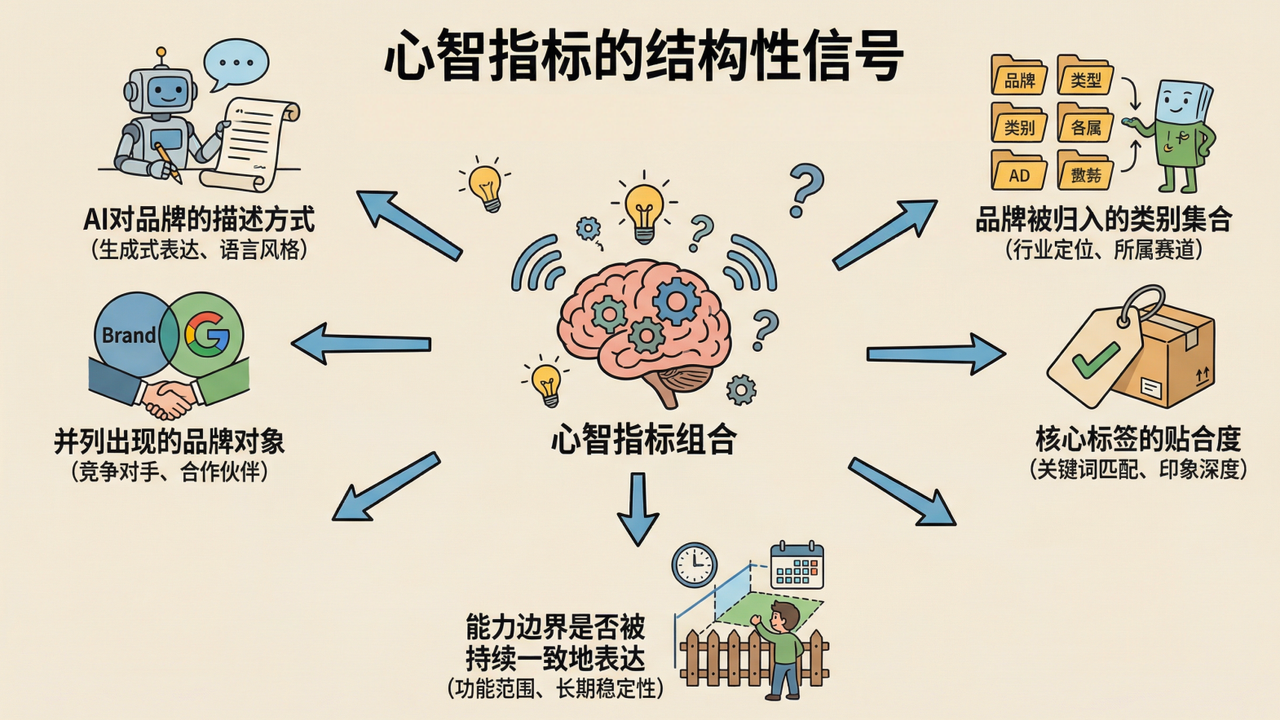
They answer: How are you understood—and remembered?
This isn’t a single metric but a cluster of structural signals:
- How does the AI describe you?
- Which category or cohort does it place you in?
- Which brands are you grouped with?
- What core labels does it attach to you?
- Is your scope of capability described consistently—and accurately—across queries?
If ranking is visibility, mindset is cognitive shape.
Being recommended once as “the representative solution” carries vastly different long-term weight than being named “one option among many.”
Many companies see unstable GEO results because they achieve mention—but not accurate understanding.
Third, combining both reveals the full picture.

Relying solely on ranking leads to short-term tactics—like chasing visibility for its own sake.
Focusing only on mindset, without ranking support, devolves into self-referential content creation.
The stronger approach treats front-end measurement as a dual-axis system:
- X-axis: Visibility (ranking metrics)
- Y-axis: Cognitive quality (mindset metrics)
The highest-value GEO work happens where high visibility meets consistent, precise, and differentiated framing.
How to Become Capital—Not Cost—for Your Company
Lately, I’ve spoken deeply with sales and business leaders—and been struck by a crucial insight: an individual’s value to an organization hinges on whether they generate assets, not just outputs.
Take salespeople, for example. Two archetypes stand out:
Type 1 hits targets.
They follow up leads, close deals, and complete assigned tasks. From an operational lens, they’re solid—even excellent—if ROI checks out. They’re measurable inputs.
Type 2 does more than hit targets.
While closing deals, they probe for latent potential: Could this client afford higher-tier offerings? Can this need be reframed? Can this customer segment be scaled?
Crucially, they feed those frontline insights back into product and strategy.
They’re not just selling—they’re helping the company understand the market, refine its offering, and evolve its product.
Superficially, both types “sell.” Fundamentally, they’re opposites: Type 1 is cost; Type 2 is capital.
Type 2’s value compounds.
They deliver not just immediate revenue—but also refined customer models, demand frameworks, pricing intelligence, product roadmaps, and higher lifetime value (LTV). These accrue in the company’s systems, becoming institutional capability.
The same logic applies to customer service.
Standard CSRs handle complaints, answer FAQs, and follow scripts. They remain cost centers.
But when a CSR begins doing more—
→ spotting unmet needs beneath complaints,
→ validating them through small experiments,
→ structuring feedback for product and ops teams,
→ and even using AI or automation to redesign workflows for better outcomes at lower cost—
—they stop being labor. They start building reusable systems.
At that point, their relationship to the company transforms—irreversibly.