1000 Kilometers
I restarted running last June. As of today, I’ve been running consistently for 1 year and 4 months.
I just realized: my total distance this year has surpassed 1,000 kilometers.
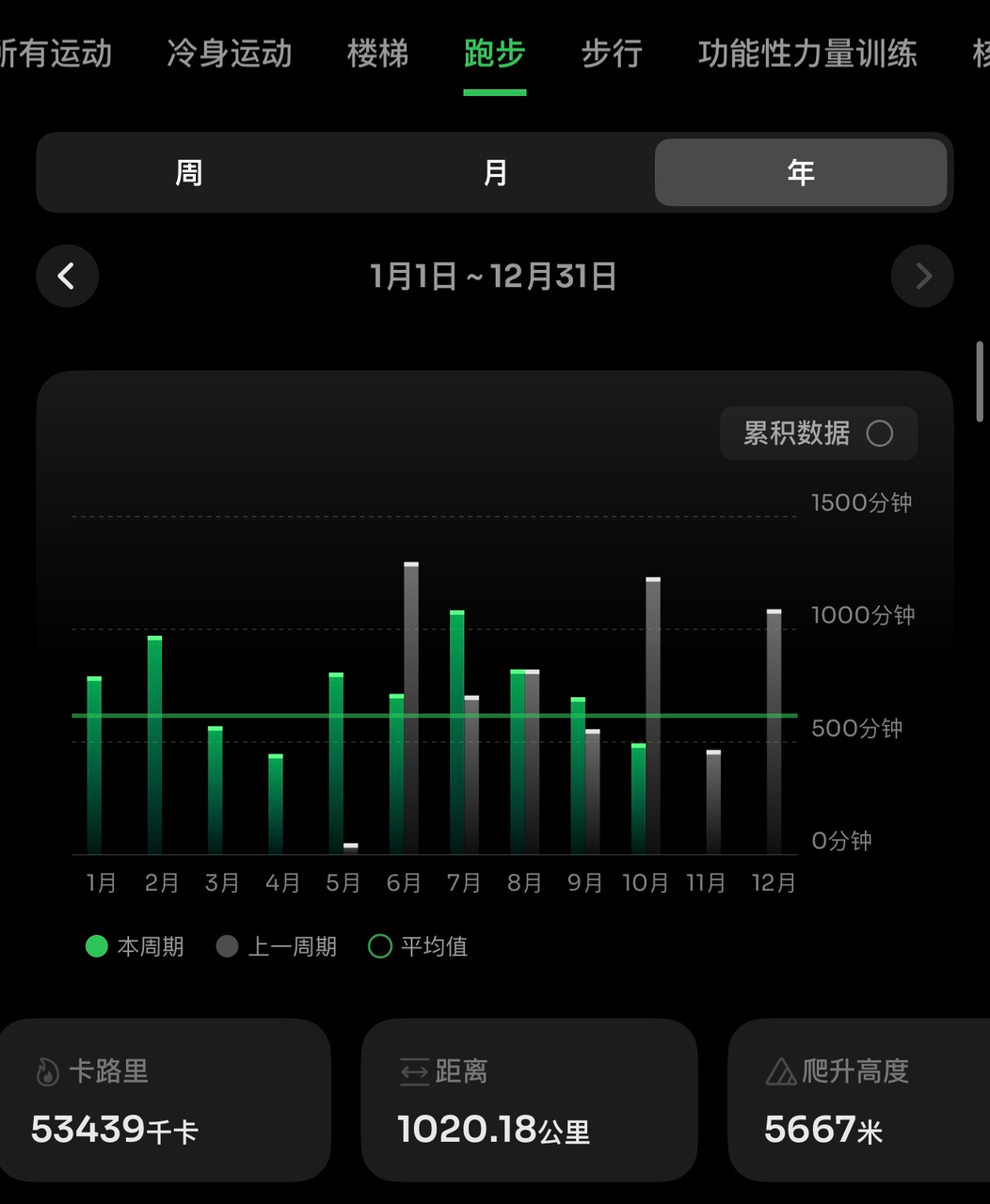
This is the first time my annual running volume has crossed that threshold—and for me, it’s a major personal breakthrough.
Running is now deeply embedded in my daily rhythm.
The benefits go far beyond physical fitness or mental refreshment. One less-discussed but profound effect is how it reshapes self-awareness: clarifying personal boundaries, refining desire management, and deepening introspection.
Especially when I observe myself from a third-person perspective—detached yet present—that sudden clarity can be genuinely surprising.
During long runs, it’s effortless to slip into self-dialogue and self-observation. There’s no external noise—only breath, stride, and thought.
You become both actor and observer: moving your body while simultaneously watching yourself move. That fluid shift in perspective is uniquely powerful for cultivating self-knowledge.
For me, running delivers more than health—it offers a new lens through which to examine life and understand myself.
Managing Assets
When managing a company, the most critical insight from a risk perspective is simple: running a company means managing risk.
From a growth perspective, however, one of the most important realizations today is equally clear: running a company means managing assets.
What do we mean by “assets” here?
An asset is any resource capable of generating future economic benefit—i.e., something that helps you earn money or save money. Either outcome qualifies.
Its defining traits are: controllability, measurability, and capacity to yield future returns.
So for companies—or individual founders—assets = resources that generate recurring cash flow, compound over time, or create strategic moats.
These include:
- Content assets: articles, videos, scripts, knowledge bases
- Technical assets: codebases, models, APIs, architectures, domain-specific systems
- Brand assets: reputation, influence, trust
- Relationship assets: customer lists, partner networks
- System assets: standardized workflows, automation tools
- Financial assets: stocks, funds, real estate, equity stakes
This framework applies equally to organizations and individuals.
And for individuals, asset-building grows more consequential with age. The good news? It’s never too late to start—because most people simply don’t prioritize personal asset management at all.
Vibe Coding
During the 8-day National Day holiday in October, I stayed in my wife’s hometown—a scenic suburb of Beijing. My main activities: foraging chestnuts, running, writing a book, and building tools.
Most of my time went into tool development.
Thanks to the rapid leap in AI coding capabilities, I—someone with no formal programming background—have seen my coding fluency accelerate dramatically over recent months using Vibe Coding.
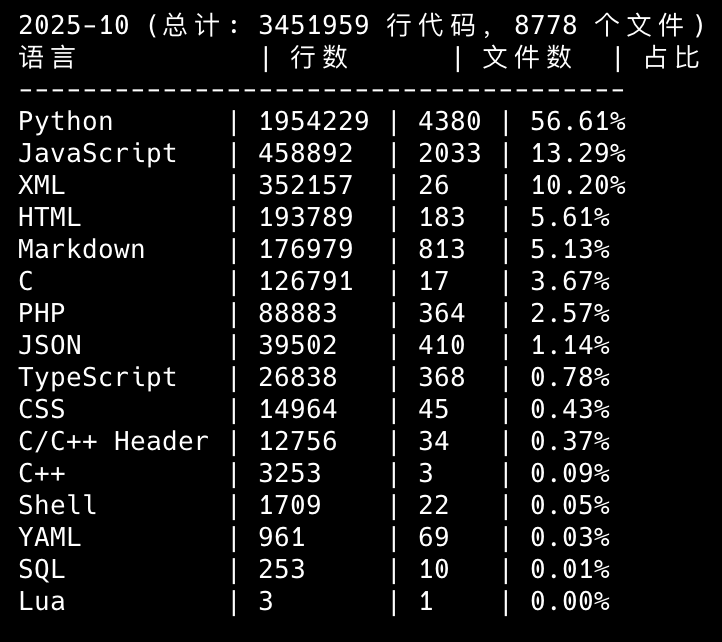
In under 10 days this October, I wrote over 3.45 million lines of code, and shipped four functional tools—including one with nontrivial complexity. Just mapping out its product logic and requirements took nearly an entire afternoon.
That made the holiday unusually joyful and rewarding.
Using AI to build tools isn’t just output—it’s also immersive learning. Through hands-on practice, my understanding of Vibe Coding evolved significantly.
The biggest challenge wasn’t writing code anymore. It was defining standards:
How do we judge whether a feature, UI style, or tool is “good”?
How do we translate our intuitive sense of “good” into precise prompts or engineering plans that AI can reliably interpret and execute?
At its core, this circles back to aesthetics, logic—even philosophy. It’s about values, direction, and commercial insight: understanding users, industries, and what truly matters.
On Growth
What does real growth look like?
True growth isn’t just about acquiring new users. It’s about making people want to return.
The world’s top products share one trait: exceptional retention.
So for product growth, retention is the real leverage point.
Retention, in essence, reflects authentic value creation.
A product with poor retention—even if it acquires users brilliantly—will inevitably run dry. Its vitality is fragile.
Two foundational principles drive strong retention:
- Systematic growth experiments, not isolated tests
- Systematic reuse of validated insights, not one-off wins
Single-point experiments are unstable—they rely too much on intuition or luck. Systematic experimentation, by contrast, maps all plausible levers, then tests them in parallel to gather rich, actionable data quickly.
Based on this, a complete growth system must integrate four dimensions:
- Value dimension: The product must continuously deliver value—so users can’t help but come back or keep collaborating. This demands deep user empathy and a defensible core competency.
- Method dimension: Rely on data-driven experimentation—not gut feeling—to guide decisions.
- Scale dimension: Turn proven tactics into standardized, modular, repeatable units—and deploy them broadly.
- Time dimension: Real growth is cyclical: test → learn → adapt → repeat. It never stops.
GEO vs. SEO
- Whether for SEO or GEO, content quality remains one of the top factors determining whether AI will cite or reference it.
- GEO is a new form of content marketing—one designed specifically for AI retrieval and generation.
- Problem-driven, not keyword-driven: SEO centers on keywords; GEO centers on full user questions. This shift mirrors AI’s vastly improved ability to parse complex semantics.
- Structure saves AI compute: Clear sections, bullet points, data tables, and JSON markup make content easier for AI to parse and quote.
- AI favors professional, authoritative, verifiable sources—e.g., peer-reviewed research, official standards, government data—with transparent attribution.
- Information gain is a key GEO differentiator. In an era of low-cost AI generation, unique insights and deep empirical validation are increasingly rare—and valuable. Examples: benchmarked performance data, counterintuitive findings, documented failures, reproducible experiments.
- Due to AI search’s “zero-click” behavior, GEO impact leans heavily toward brand awareness. Users often stop at the AI’s answer and rarely click through—unless they seek deeper exploration. At that point, they’ll likely search your brand name. So GEO’s primary ROI is being seen, even without high click-through rates: repeated AI mentions shape perception powerfully.
- SEO remains a foundational layer for GEO—traditional search rankings strongly influence AI’s likelihood of retrieving and citing your content.
- Getting your brand’s content ingested into AI training data is slow, unpredictable, and largely out of your control. For GEO, real-time search is the main battlefield. Being included in base model training is near-impossible—so the pragmatic path is optimizing for real-time retrieval via SEO.
- Multimodal content is the future—but for now, text-based content creation and optimization delivers the highest ROI. Build that foundation first, then expand into audio, video, and interactive formats.
- Domestic AI hallucinations stem partly from cost constraints and limited search service depth. Models often produce shallow, aggregated summaries—which increases error risk. We’ve even run GEO “domination” experiments exploiting this tendency.
- In a recent GEO experiment focused on AI-generated summaries, we found their influence on AI search ranking is significantly stronger than expected.
On AI Search
This episode of Future Silicon World featured two technical experts from Xiaosu Technology, diving deep into AI search. Here’s a distilled summary—generated by GPT-5 from the live session:
Q1: What is AI search—and how is it different from Google or Baidu?
Traditional search matches keywords—you scan 10 results to find your answer.
AI search is question-first: you ask, and AI synthesizes and answers directly.
Example:
- Search “Who is Apple’s CEO?” on Baidu → list of links
- Ask AI search → “Tim Cook,” plus context on his tenure and recent news
Key difference: AI doesn’t just retrieve—it understands and generates.
Q2: What does “Infra” mean in AI search?
“Infra” = infrastructure—the nervous system and toolkit behind AI search.
It includes:
- Search engine APIs
- Web page rendering, PDF parsing, HTML extraction
- Data recall, ranking, caching, and semantic understanding modules
Together, these let AI “read pages,” “grasp context,” and “cite sources” like a human.
Q3: How do developers and regular users interact with AI search differently?
- Developers: Focus on “how to make my AI search.” Join Xiaosu’s dev community, apply for API access, get docs.
- Users: Just want smarter answers—use an AI search app or ask during events.
In short: developers build wheels; users drive.
Q4: Why distinguish ToC search vs. ToAI search?
They serve entirely different audiences:
- ToC search: Designed for humans → returns concise summaries
- ToAI search: Designed for AI → returns full text or structured data
Example: - Baidu gives you “Huawei launches new phone” (headline)
- ToAI search gives AI the full press release—so it can write an analysis
AI needs machine-readable content, not clickbait.
Q5: What happens inside AI search—from question to answer?
- Question understanding: Does it need live data?
- Decomposition: Break complex queries into sub-questions
- External search: Fetch via API (web, DB, etc.)
- Recall & ranking: Filter and prioritize relevant content
- Answer generation: Synthesize and verbalize
Think of it as an “AI search squad”: model = brain, tools = hands and feet.
Q6: Why does AI need full text—not just summaries?
Because AI needs semantic reasoning, not just facts.
Summaries give conclusions; AI needs context to infer causality, nuance, and provenance—just like a researcher reading original papers.
Q7: What makes Xiaosu’s search tech distinctive?
- Multilingual support: Only domestic vendor offering robust multilingual search
- Fully in-house stack: End-to-end self-developed—from crawlers and indexing to recall and semantic models
- Low latency: Average response in hundreds of milliseconds
- Flexible deployment: Serves both AI chatbots and intelligent agents
Q8: How does AI know if “Apple” means fruit or company?
Via semantic understanding:
- Intent detection
- Tokenization + disambiguation
- Contextual semantic matching
E.g., “Apple’s market cap?” → automatically routes to financial data on Apple Inc.
Q9: Does AI search rely on outdated info?
No. Systems assess temporal relevance:
- Timeless queries (“Earth’s radius”) → served from cache
- Timely queries (“Today’s A-share index”) → pull latest indexed data
- Temporal signals are even weighted higher in ranking.
Q10: With billions of pages, how does AI pick the right ones?
Hybrid matching: semantic + keyword.
Plus two-stage recall:
- Offline: Filter out low-quality, spammy, or unsafe sites
- Online: Dynamic re-ranking per query
Final candidates: <10% of initial hits—but highest quality.
Q11: What about AI-generated web content?
Not inherently bad—but quality matters.
Systems evaluate logic coherence, factual accuracy, and originality.
Low-value AI “spin-offs” or stitched-together content gets filtered out.
Bottom line: AI writing is fine—if it’s correct.
Q12: Can AI tell good writing from bad?
Yes. Models learn human judgment patterns:
- High information density
- Clear logical structure
- Credible, cited sources
- Originality, no plagiarism, no fluff
These features are quantified and scored to identify high-value content.
Q13: How do you handle black-hat SEO?
Dedicated anti-abuse team.
Black-hat pages, fake content, scraper sites—all removed offline, before indexing.
Exact algorithms are confidential—but the mission is clear: keep the AI search ecosystem clean and trustworthy.
Q14: Could AI search surface non-compliant content?
No.
Domestic operations strictly follow Chinese laws and values.
Overseas deployments comply with local regulations.
Different regions use region-specific APIs and data stacks—ensuring local legality, global compliance.
Q15: What’s the current business model—and will it change?
Today: API-based pricing.
Future: Potential partnerships with AI apps (ads, knowledge subscriptions)—but no direct ad injection like Baidu.
Why? ToAI search is B2B infrastructure—not a C2C traffic portal.
Q16: Can AI search reveal real-time trend data?
Not yet—but if developers or enterprises request it, Xiaosu can build custom dashboards: e.g., “AI Trend Index,” “Top Questions for Agents.”
Crucially: trends reflect real demand, not vanity metrics.
Q17: Does AI search crawl Xiaohongshu or Douyin?
No unauthorized scraping.
Xiaosu respects platform policies and only partners with willing, high-quality content providers.
As co-founder Guo Gengliang put it: “We’d rather have less data—so long as it’s clean.”
Ongoing negotiations aim to license more structured vertical content.
Q18: How widely is AI search used—and will it replace traditional search?
Current data: ~30% of AI Q&A calls external search.
That share will rise as models better grasp context.
But full replacement of Google/Baidu? Unlikely—for now. AI search is a new layer, not a replacement layer.
Q19: If AI has memory, why still search the web?
Because memory and search serve different purposes:
- Fixed knowledge (e.g., physics constants, historical dates) → stored internally
- Dynamic data (weather, stock prices, policy updates) → fetched live
They’re complementary.
The future lies in intelligent balancing between internal knowledge and real-time external inputs.