Marketing’s Four Ps
Recently, we began collaborating with a team from Peking University on a vertical AI education initiative. We’re providing strategic, technical, and systems support for the AI layer—and also advising on marketing design and business model architecture.
In the process, I’ve been reminded that while AI unlocks vast imaginative potential—and many traditional products do deserve a full AI-native redesign—their go-to-market logic still rests on timeless fundamentals. Ignoring those basics in favor of AI-fueled optimism often leads to unrealistic expectations.
It doesn’t matter whether your project is AI-powered or not: clarity on marketing dramatically increases your odds of success.
At its core, marketing is simply this: delivering the right value, in the right way, at the right time and place, to the right person—and ensuring both sides benefit before, during, and after the transaction.
That’s where the classic 4Ps come in: Product, Price, Place (distribution/channel), and Promotion (communication).
Think of the 4Ps as four cards in your hand. Knowing whether each card is a 3 or an Ace determines how you play them—and what combinations you can build. Some players hold four Kings; others hold a single 8 and three low cards. Their strategies—and their odds—aren’t comparable.
So the baseline principle is clear: aim to upgrade your hand. Build stronger differentiation, better products, more compelling pricing, IP authority, or concentrated resource deployment—like going “all-in” on one high-impact channel or campaign.
Take Xiaomi Auto as a concise 4P case study:
- Product: Benchmarked against top competitors—and engineered to outperform peers.
- Price: Slightly below comparable models—not so low as to undermine perceived value.
- Place: Leverages Xiaomi’s massive IP equity + integrated social media ecosystem + direct-owned physical stores.
- Promotion: High-production offline launch events paired with live-streamed digital broadcasts.
Now consider Xibei Restaurant Group:
- Product: Not just northwestern Chinese cuisine—but the entire restaurant experience as the product.
- Price: ~¥60 average spend per person.
- Place: Locations anchored in high-foot-traffic areas—main streets and shopping malls—where customers already are.
- Promotion: Traditional advertising, placed where the audience lives and moves.
As companies scale and markets shift, these four elements evolve too. So the 4Ps aren’t static—they demand a dynamic, adaptive lens.
Returning to the PKU AI project: applying the 4P framework surfaced blind spots—untapped advantages, overlooked tactics, and even pricing assumptions rooted more in AI hype than real-world willingness-to-pay.
GEO Strategy
GEO: Generative Engine Optimization
A content marketing manager at Surfer shared a telling data point: their site receives ~500 daily clicks from ChatGPT—about 7% of total daily traffic.
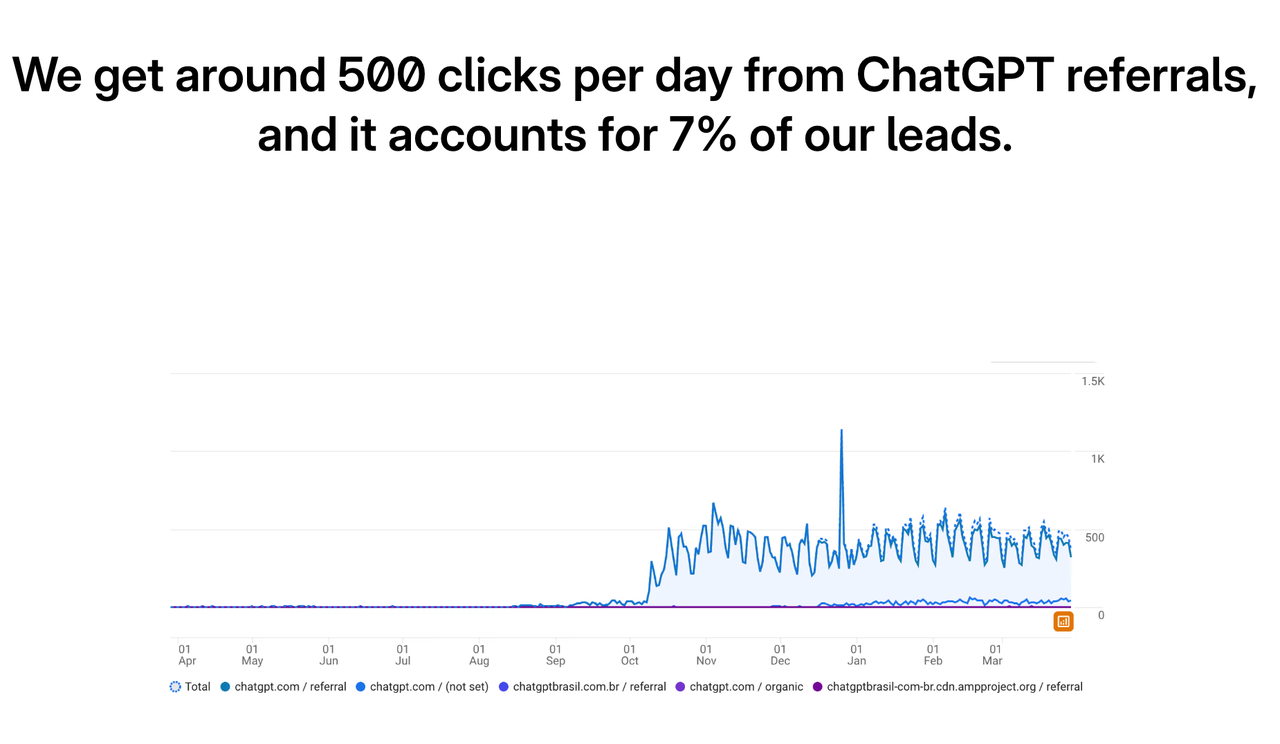
Why? Because when users ask questions in ChatGPT—and especially when they toggle the “Search the web” option—the model cites relevant web pages. If the answer resonates, users often click through for deeper context:
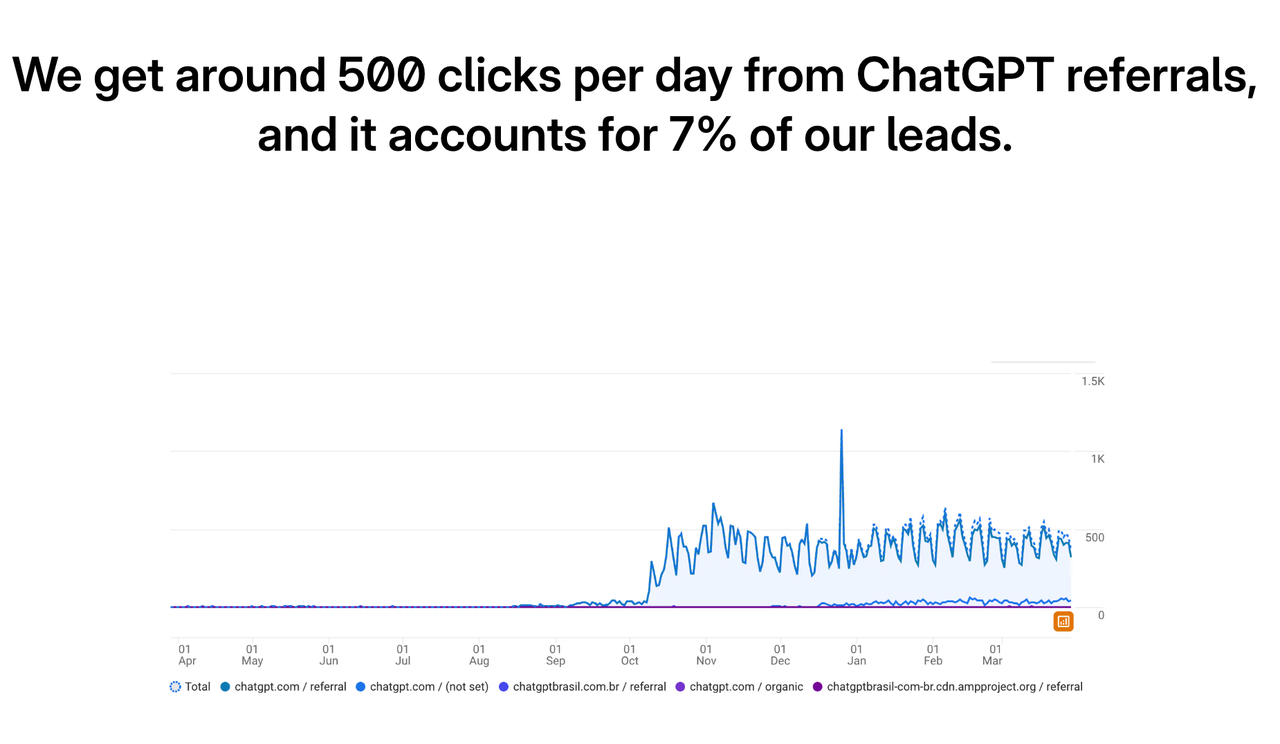
When an AI response cites your content, even a 10% click-through rate implies outsized brand impact—far beyond the visible traffic share. And this is only two years into the AI search era.
GEO is poised to become a dominant new acquisition channel.
How does it differ from SEO?
One sentence: SEO competes for position; GEO competes for citation.
SEO aims to get users to click through. GEO aims to get the AI to say your words first—collapsing the click path to zero.
Key shifts:
- Behavioral shift: AI search compresses “ask → answer → decide” into a single-screen conversation. Click intent plummets. Gartner forecasts that by 2028, traditional search traffic will fall by 50%—or equivalently, half of user attention will migrate to AI-generated answers.
- Algorithmic shift: SEO relied on PageRank, keyword density (TF-IDF), etc. GEO prioritizes entity consistency, contextual completeness, and source credibility—valuing factual accuracy over keyword stuffing.
- Indexing shift: Traditional search crawls, indexes, then ranks. AI search draws from pre-trained knowledge and real-time retrieval—so your content must be present in both training corpora and live crawl targets to maximize citation odds.
The marketing mindset must evolve accordingly: from ranking thinking to citation thinking. That’s the core of the next wave of AI-native traffic.
The Capacity to Iterate
I recall repeatedly using the word “iterate” during livestream conversations with Xiangyang about our AI courses. It’s become a mantra—not because it sounds trendy, but because it works.
For example:
- When team performance falls short, we resist blame and instead probe root causes—then iterate on processes, strategy, or hiring criteria.
- When an AI project stalls in marketing execution or business model validation, we don’t scrap it—we ask: Are we leveraging our true strengths? What assumptions need stress-testing?
- Even for products and projects already “working,” we ask: What hidden risks exist? Where could we sharpen our edge?
Iteration isn’t just tactical—it’s rooted in a growth mindset: seeing everything as a dynamic process, not a fixed outcome.
People with growth mindsets believe abilities develop through effort—not destiny. That belief reshapes habits:
- Viewing challenges as learning opportunities
- Extracting lessons from setbacks
- Seeking improvement continuously
- Welcoming feedback, even when uncomfortable
- Persisting through difficulty
Every obstacle becomes process feedback—data that fuels growth. In that light, iteration isn’t just a method; it’s growth mindset made operational. It assumes room for progress—and builds the systems to realize it.
A Methodology for Growth
This year, 12.22 million Chinese university graduates entered the job market—the highest number ever recorded. This scale will persist for at least a decade.
Many relatives and friends face imminent graduation—and mounting employment pressure.
Our chairman once shared his own story: shortly after graduating, he became chief orthopedic surgeon at a top-tier hospital in Northwest China. Yet he walked away from rapid promotion to move to the U.S.—starting from dishwashing. He landed at a Fortune 500 company, began at the most junior level, and rose steadily—eventually becoming one of the youngest VPs in the group’s history.
His guiding principle? Ignore salary. Focus on how much you can take on.
He knew: scope of responsibility determines role level—and role level determines compensation, benefits, and influence.
So he adopted a simple heuristic: Say yes first. Figure out how to deliver later. Even if he couldn’t fully execute, the cost of trying was low—but the upside of visibility, trust, and stretch was enormous.
Result? More responsibility → larger team and budget → higher compensation → greater reputation → international recognition → appointment to China’s State Council as its youngest expert member.
Yet many recent grads invert this logic: salary first, title second, responsibility last.
That’s backward. Whether in corporate roles or startups, the people who earn trust—and opportunity—are those who step up first. Initiative signals capability. Consistent delivery builds credibility. Timing then aligns naturally.
So professional growth follows this chain:
→ Take on more work
→ Strengthen capabilities
→ Earn higher roles & resources
→ Command greater compensation
→ Unlock broader opportunities
The alternative path—avoiding responsibility—leads to stagnation across every dimension. Obvious in theory. Rarely practiced in reality.
Which reveals another critical skill: high-level listening.
Some hear this story and dismiss it (“another tall tale”). Others listen beneath the narrative—to detect underlying patterns—and cross-check them against personal or observed cases. That’s how insight forms.
I recall a colleague at a “unicorn” startup saying, after a year: “This company isn’t special.” So we revisited shared experiences—same events, wildly different interpretations. Without curiosity and cognitive humility, even rich input yields shallow returns.
This discipline echoes core habits from The 7 Habits of Highly Effective People: being proactive, seeking win-win outcomes, empathic listening (“seek first to understand”), and synergistic problem-solving.
This logic applies equally to students before graduation:
- Intern meaningfully—even unpaid—if the work builds skills or connections.
- Contribute to a respected practitioner’s project—even as a volunteer.
- Launch a niche-focused newsletter or social account and grow real engagement.
More responsibility → faster growth → higher personal value.
The Cost of Absence
Mind-wandering—when attention drifts from the present task—is common, universal, and costly.
A landmark 2010 study, “A Wandering Mind Is an Unhappy Mind,” analyzed 250,000 real-time reports and found:
- People’s minds wander nearly half the time—46.9% across all activities (except sex).
- Wandering reduces happiness, regardless of activity. Even pleasant daydreams fail to lift mood; neutral or negative ones sharply lower it.
- Our brains evolved to wander—but that capacity carries emotional costs. As the paper concludes: “A wandering mind is an unhappy mind.” Presence, by contrast, correlates strongly with well-being.
Depression amplifies this effect: sufferers’ mind-wandering frequency doubles—and 42% of those episodes carry negative affect, versus just 10% in healthy controls.
Philosophical and contemplative traditions have long emphasized presence as a path to peace. Today, however, presence demands deliberate practice—especially amid the dopamine-driven, attention-shredding logic of short-form video.
From my own experiments, three practices reliably strengthen presence:
- Pursue work that merges passion and viability—even if it takes time to find. Until then, keep searching with intention.
- Practice “micro-meditation”: formal sitting helps, but presence is portable. Fully inhabit routine acts—eating without screens, walking without headphones, listening without rehearsing your reply. Yesterday, I savored lunch slowly: no phone, just taste, texture, aroma. It felt deeply nourishing.
- Move your body: exercise elevates mood, energy, and focus—making mental drift less likely and recovery faster.
Happiness, ultimately, is measured in moments—moments we’re truly here for.
Quantity Is the Foundation of Quality
A friend at a major tech firm described his team’s product rhythm: weekly iterations. Each week includes new feature ideation, design, prototyping, testing, and production release—a tight, feedback-rich cadence.
Other teams move slower—biweekly or monthly cycles.
The weekly pace delivers more frequent, actionable feedback. That accelerates learning, sharpens judgment, and compounds advantage. Over time, slower teams fall decisively behind—not in ambition, but in real-world product maturity.
The underlying logic is clear:
High-frequency iteration → firsthand experience → authentic insight → robust methodology
It’s a virtuous, self-reinforcing loop—and closely aligned with the principles of deliberate practice: quality depends on volume plus timely, specific feedback.
Without feedback, volume is noise. Without volume, feedback has nothing to act upon. Quality emerges only where both converge.