Steve Jobs: “In the end, it all comes down to taste.”
This week’s WeChat articles (AI Reverse-Thinking Series):
- Can images be “decompiled”? This prompt engineering tutorial teaches you visual reverse engineering! link
-
From zero to one: Write a high-quality prompt set in 10 minutes—100% passes AI detection. Here’s how to write prompts efficiently with Trae.
mp.weixin.qq.com -
How to create viral AI videos! Learn to write high-quality prompts using reverse decomposition.
mp.weixin.qq.com - On knowledge-base–driven AI writing.
mp.weixin.qq.com
The Solo Company
A conversation with a friend about the “solo company” concept left me deeply reflective.
In recent years, “solo company” has become a buzzword—and increasingly, a lived reality—especially amid the AI boom. Yet despite widespread enthusiasm, failure rates remain high.
Why? Several common misconceptions stand in the way:
- Misreading “solo” as “solitary”: Many assume “solo company” means doing everything alone—sales, design, coding, customer service—without building any external scaffolding.
- Chasing tactics over substance: Learning launch frameworks or making short videos while neglecting foundational inputs: deep reading, mentorship, deliberate practice, and iterative learning.
- Underestimating product sense: Lacking the ability to design, ship, and refine a virtual product—even a simple one—with real competitive edge.
- Ignoring leverage: Failing to assemble a personalized “leverage stack”—tools, systems, and partnerships that multiply output without linear effort.
- Skipping differentiation: Not clarifying what unique value only you can deliver—your irreplaceable perspective, experience, or insight.
These missteps point to five missing capacities: collaboration, input quality, product thinking, leverage design, and differentiated positioning. Jumping into “solo company” mode before cultivating these is like launching a rocket without testing its guidance system—it may lift off, but where it lands is anyone’s guess.
-
Collaboration
A “solo company” isn’t a one-person island. Rather, it’s a lean core—often just 2–3 people—anchoring a flexible, intentional collaboration network: freelancers, tools, communities, even AI agents. The goal isn’t isolation; it’s orchestration. -
Input
High-quality, sustained input fuels everything: reading widely, seeking out experts, shipping fast and learning faster. Too many fall into the “learning trap”—consuming endlessly without output—or worse, consume little at all, or consume low-signal noise. Input without output is inertia. Output without input is empty motion. -
Product
Virtual products—courses, templates, micro-SaaS, toolkits—are ideal entry points for early-stage solo companies. To sharpen this muscle, I wrote Course Marketing, a practical guide to designing, packaging, and launching digital offerings—not as theory, but as field notes from my own experiments. -
Leverage
Naval identifies four classic levers: labor, capital, software, and media (books, blogs, videos, podcasts). In the AI era, there’s a fifth: agents—autonomous AI workflows that act as your 24/7 virtual team. Most still use AI as a fancy autocomplete. Real leverage means weaving AI deeply into your workflow—automating research, drafting, QA, reporting—so it doesn’t just assist, but extends your capacity. That’s our next frontier. -
Positioning & Differentiation
Many chase “solo company” without asking: What problem do I solve uniquely well? What perspective do I hold that no algorithm or generalist can replicate? In an age of information overload, clarity of purpose and distinctiveness aren’t nice-to-haves—they’re survival conditions.
Everyone Is a Manager
Granola CEO (an AI-powered note-taking startup) recently shared insights in an interview—several align closely with our course’s underlying philosophy:
- Engineers are evolving into managers: They increasingly rely on AI tools not just to code, but to plan, prioritize, and evaluate.
- Future AI tools must intelligently surface relevant context—not just dump data—to make human-AI collaboration feel seamless and controllable.
- The best thinking tools don’t replace humanity—they amplify it: enhancing empathy, judgment, and creative spark.
- Small teams can now build massively impactful products—but organizational structures and role definitions will shift dramatically.
- Competitive advantage will pivot from data moats to product experience and taste.
The first point resonates strongly: In a WeChat chat with Tony, we agreed—the core idea behind our “AI Leadership” framework is simple: In the AI era, everyone is a manager.
For engineers, that means shifting from “coder” to “AI project conductor”:
▫ Defining clear goals and success criteria
▫ Selecting and configuring the right AI tools
▫ Reviewing, refining, and integrating AI outputs
▫ Orchestrating timelines, quality checks, and stakeholder alignment
They become leaders of an AI-augmented team—not line workers executing instructions.
This applies equally to PMs, marketers, ops specialists, data analysts—any role where judgment, synthesis, and contextual awareness matter more than rote execution.
Which confirms a growing truth: AI leadership isn’t a job title. It’s a universal skill—one that will define professional relevance in the decade ahead.
Original post: mp.weixin.qq.com
Balancing the “Useful” and the “Useless”
Two kinds of utility shape meaningful work:
-
The “useful” use: Goal-oriented, measurable, and time-bound—e.g., shipping a feature, closing a deal, mastering a new framework. Its strength is immediacy and clarity. Its danger? Obsession with the urgent, sacrificing depth for velocity, and mistaking busyness for progress.
-
The “useless” use: Activities with no direct, immediate output—reading philosophy, walking without headphones, journaling, meditating, or simply staring out the window. These appear unproductive. Yet they’re often the source of compound returns: insight, resilience, creativity, and moral clarity.
Three principles for balance:
- The 7–3 Rule: Allocate ~70% of your time to “useful” work, 30% to “useless” cultivation. As you age, gradually increase the latter—especially if you price your time highly (e.g., $500/hour). That price tag makes “busywork” instantly visible and unsustainable.
- Rhythmic Switching: Alternate “useful” and “useless” tasks within the day—e.g., write code → walk → draft email → sketch → review metrics → sit quietly. This prevents cognitive fatigue and sparks unexpected connections.
- Mission Anchoring: Regularly revisit your deeper mission and long-term vision. When “useless” activities align with that north star—like studying history to inform strategy, or practicing patience to improve leadership—they cease to be “useless.” They become infrastructure.
As Zhuangzi wrote: “The ‘useless’ is precisely where the greatest utility lies.” In our hyper-optimized world, protecting space for the seemingly unproductive may be the most strategic act of all.
My First Mini-Program
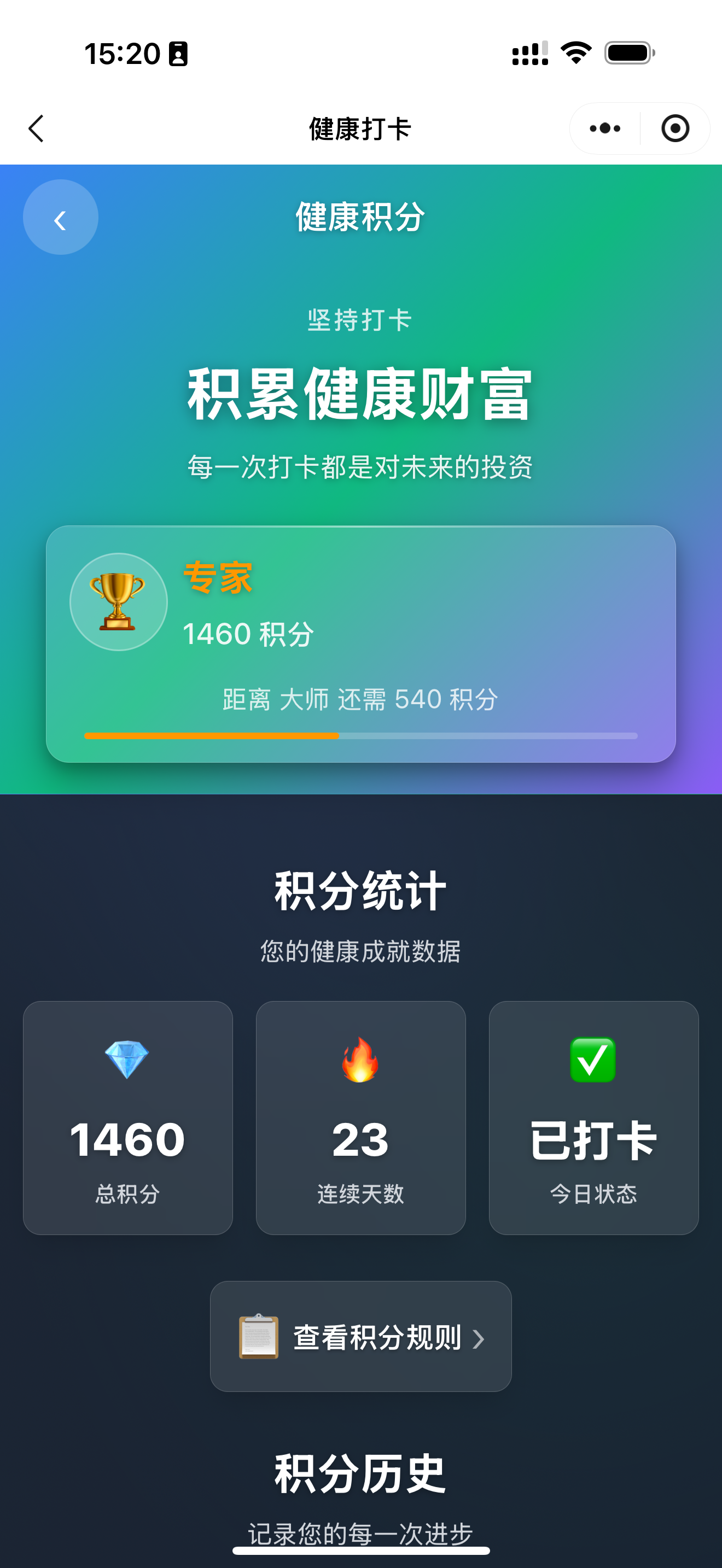
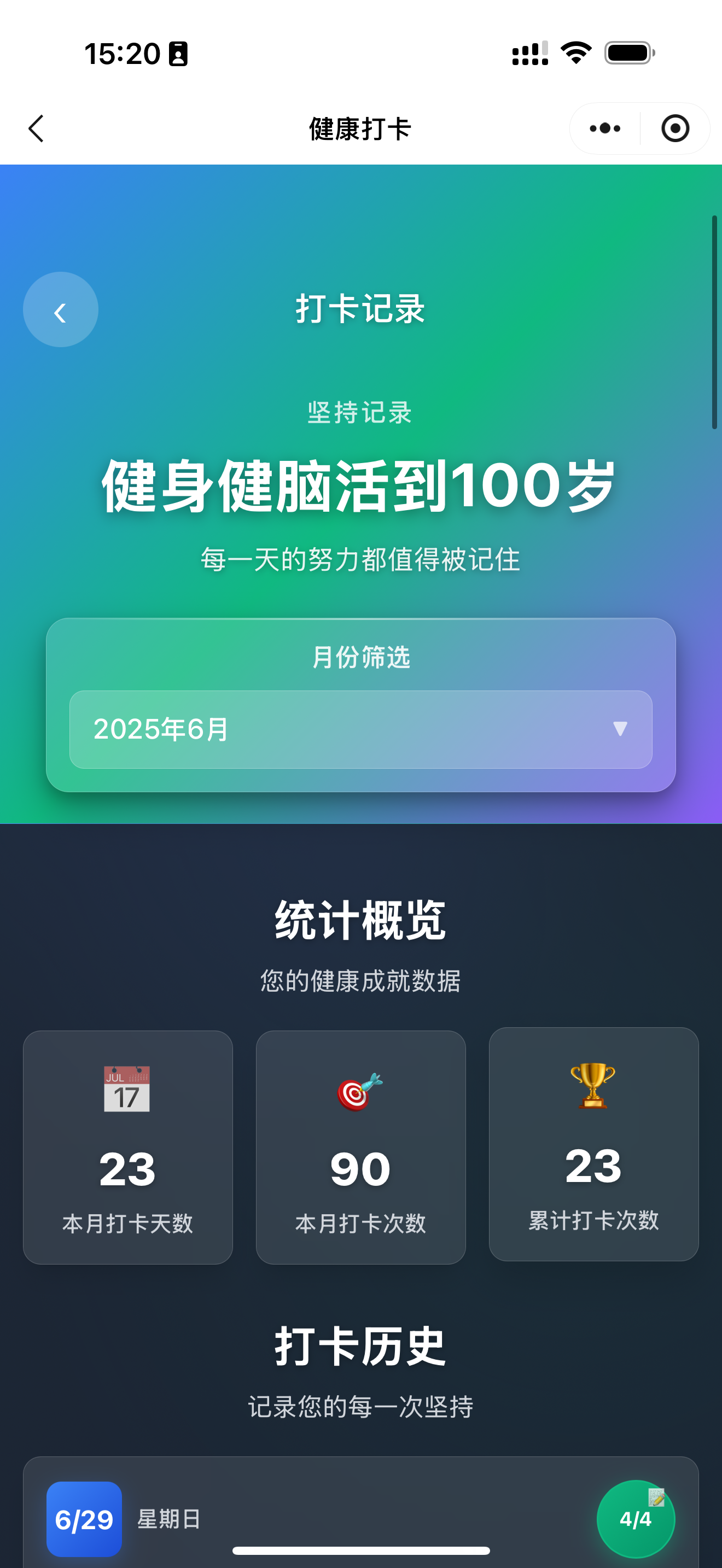
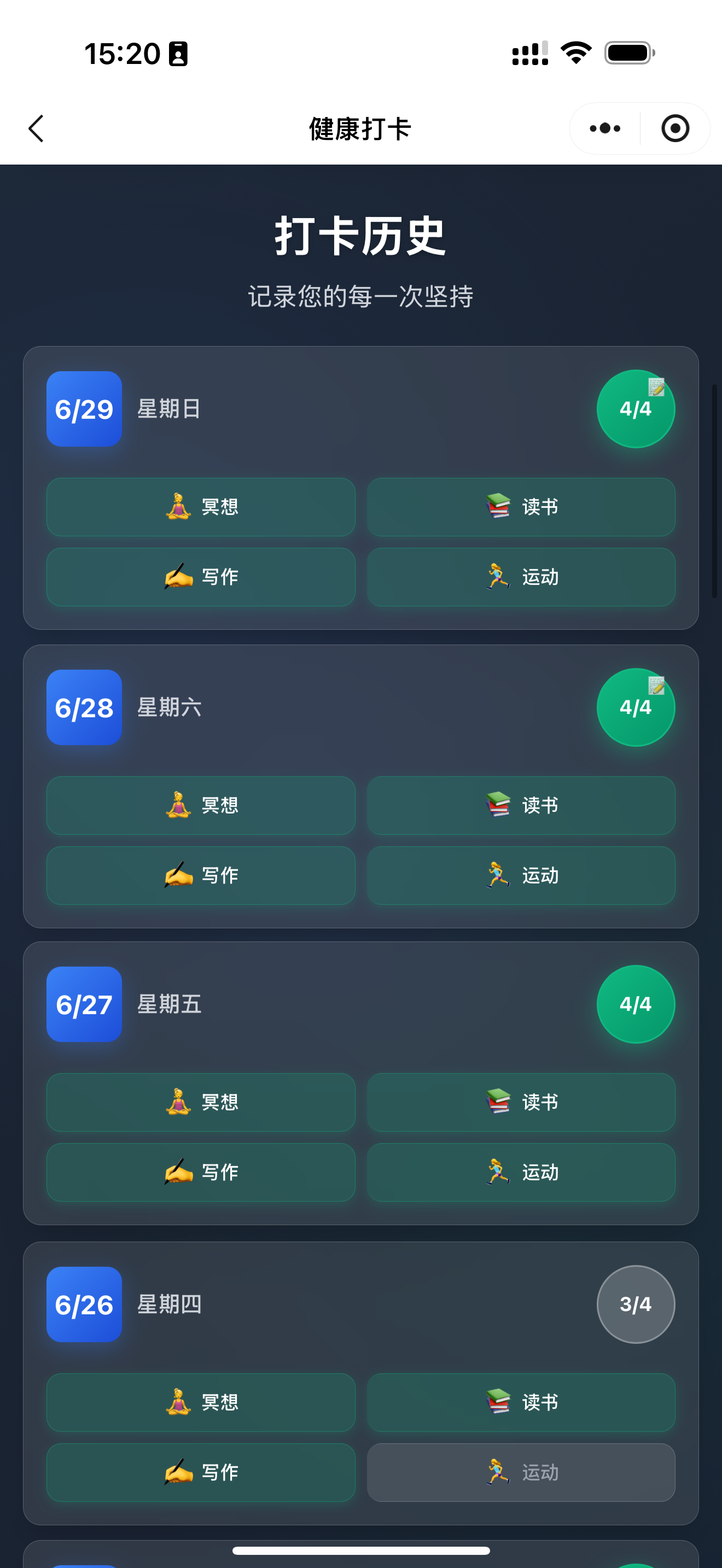
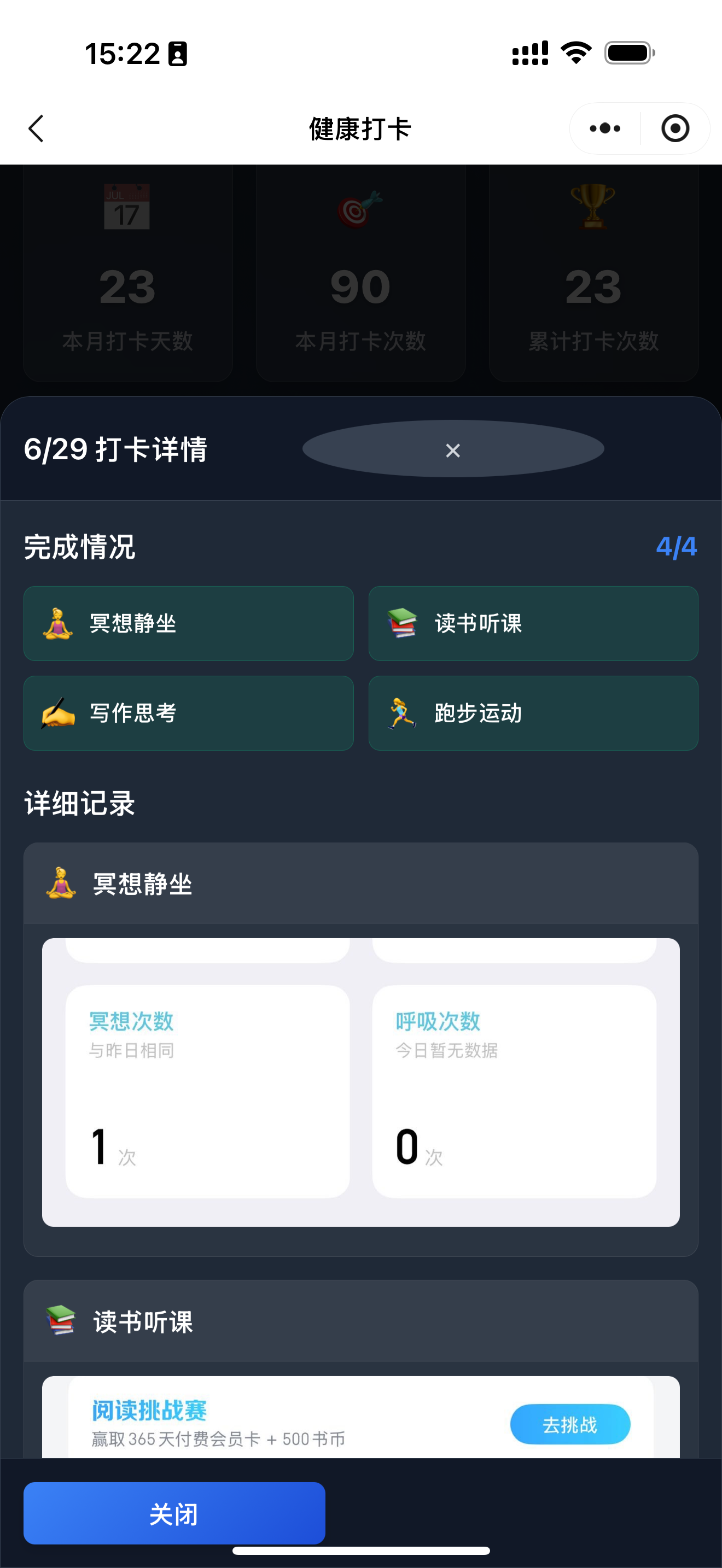
Early this month, I co-launched a small health-focused WeChat group with Xiangyang—29 members so far. One key ritual: daily health check-ins. To streamline it, I decided to build a mini-program—no hesitation, just start.
Within days, Version 1 was live. Over the past two weeks, I completed a full rewrite and major upgrade. And yes—this is my first independent WeChat mini-program, built entirely with AI-generated code.
Here’s how it looks:

Building my first “complex” standalone tool with AI taught me three hard-won lessons:
- Code is just the tip: A working mini-program requires frontend + backend logic, database setup, domain configuration, SSL certificates, WeChat platform filing, server deployment, environment variables—and more. For someone with zero prior experience, the hidden operational overhead is steep. AI lowers the coding barrier—but not the systems barrier.
- Version control is non-negotiable: With no Git history, my second iteration became chaotic. I’d dumped too many changes into one prompt, and AI rewrote core logic without preserving structure. Without backups or a map of data flow and caching rules, every new request risked breaking something silently. Lesson learned: Start versioning before the first commit—even if it’s just naming folders
v1,v2. - Tool choice matters: Cursor is now one of my highest-leverage AI tools—not just for coding, but for prompt engineering, prompt library management, and rapid prototyping. Its tight integration with local files and context-aware editing makes it indispensable.
Iterating Yourself—Like an AI Model
A mental RL (reinforcement learning) loop lit up:
Reality → Evaluate → Tune Parameters → Execute → Reality
Insert you into that loop—and every day becomes a training cycle.
One habit that reliably powers this: structured reflection (retrospective). Four principles:
- Record the sharpest feedback—the comment, bug report, or internal cringe that stings most. Pain is often the highest-fidelity signal.
- Make action measurable. If you can’t quantify it—“spend more time on strategy,” “improve communication”—it’s not actionable. No metric = no log = no iteration.
- Schedule “major version upgrades”: Quarterly deep resets—review goals, prune habits, rewire systems, relearn fundamentals.
- Apply Occam’s Razor regularly: Cut assumptions, dependencies, and complexity—not just in code, but in plans, processes, and even self-concept. Simplicity isn’t minimalism. It’s precision.