Philosophical Literacy
Philosophical literacy matters deeply—but it’s easy to miss why it matters, or what it truly means to possess it.
In my AI leadership course with Xiangyang, AI Leadership, we define philosophical literacy like this:
“Philosophical literacy is, at its core, a way of thinking and a stance toward the world. It goes beyond surface-level observation to ask about essence, meaning, and value. In the AI era, this capacity is both especially vital—and especially rare.”
That definition still feels abstract. So let’s ground it.
Wu Jun shared two illuminating examples in his audio series—simple, real-life moments where philosophical reflection transforms shallow learning into durable wisdom.
Example 1: You buy a cheap item, it breaks quickly. How do you learn?
- Ordinary reflection: “I’ll be more careful next time,” or “That seller is terrible.”
- Philosophical reflection: “Assume ‘cheap’ implies compromised quality—no exceptions. If it seems too good to be true, it is. Missing out isn’t loss; it’s alignment with principle.”
Example 2: You arrive late at the airport and miss your flight. How do you learn?
- Ordinary reflection: “I’ll leave five minutes earlier next time,” or “Bad luck.”
- Philosophical reflection: “The final five minutes before any time-bound event aren’t yours—they belong to uncertainty. Plan as if they’re already gone.”
Same logic applies elsewhere:
- Over-enrolling a child in summer classes
- Ordinary reflection: “Next time, sign up for fewer.”
- Philosophical reflection: “Desire is infinite; attention is finite. Real growth demands the courage to subtract—not the illusion of adding everything.”
- Burning pizza while distracted on your phone
- Ordinary reflection: “Set a timer next time,” or “Just watch it closely.”
- Philosophical reflection: “Systems that degrade gradually—heat, money, mood—are invisible until it’s too late. Rely on external alarms, not internal willpower, for all ‘stealth curves.’”
- Buying a gym membership after seeing friends’ fitness posts—then quitting in three days
- Ordinary reflection: “Start slower next time.”
- Philosophical reflection: “Action isn’t powered by intention—it’s sustained by inertia. Without built-in rhythm or systems, even grand goals collapse into one-off enthusiasm.”
The Right Way to Use AI
Microsoft’s May 2025 paper, LLMs Get Lost in Multi-Turn Conversation, reveals a critical insight:
When tasks aren’t inherently sequential, state your full request in one go.
Their experiments across major LLMs show: users who clarify requirements over multiple turns suffer >30% lower average performance, compared to those who deliver precise, self-contained instructions upfront.
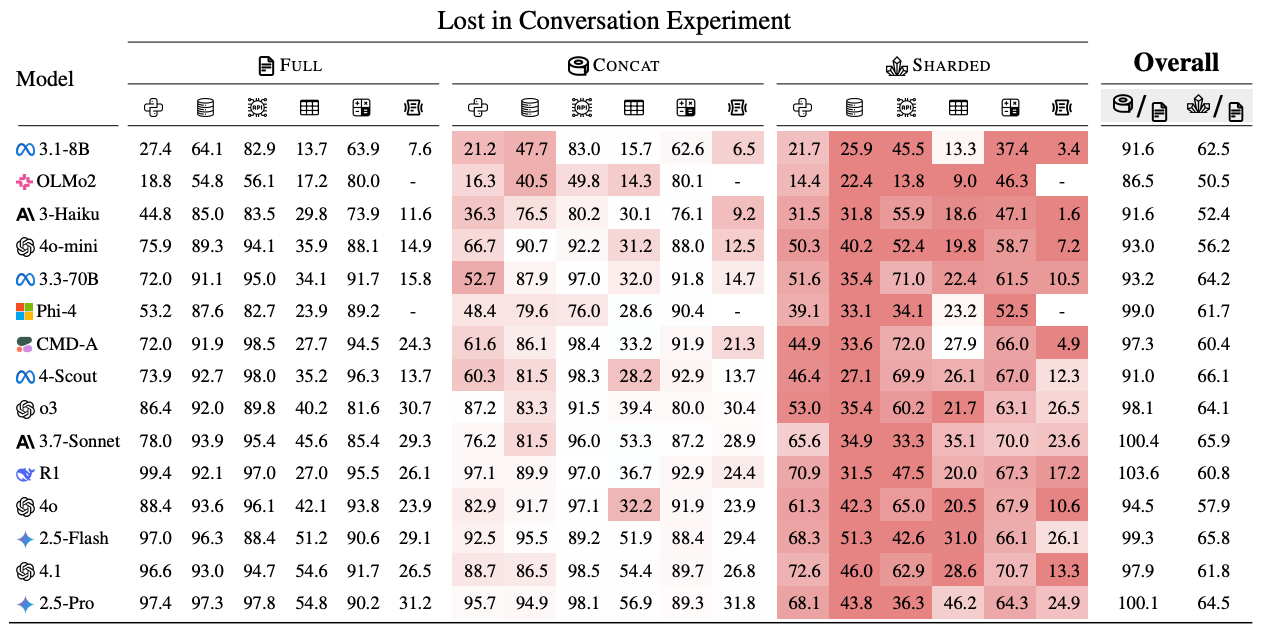
Why? Because if the first prompt lacks sufficient detail, the model fills gaps with assumptions—many of which misalign with reality. That’s the start of hallucination. And each follow-up reply leans further on those early assumptions—compounding errors with every turn.
That’s why mastering prompt writing matters—not just for output quality, but for cognitive hygiene.
For practical guidance, see: ailingdaoli.com
Paper PDF: arxiv.org/pdf/2505.06120
A Prompt for Writing Prompts
I’ve restarted my newsletter—with a new goal: solve 100 small, concrete problems using AI. Xiangyang encouraged this experiment, and I’m confident it’ll deepen both my AI fluency and my understanding of its limits.
Two big hurdles emerged: choosing meaningful topics, and writing effective prompts—fast. So I built a meta-prompt: a “prompt for writing prompts.”
It follows four constraints:
- RTF structure only: Role → Task → Format (no fluff, no ambiguity).
- Occam’s Razor applied: Remove every non-essential word or instruction.
- Pyramid Principle alignment: Lead with the clearest, most actionable directive—then support, never bury.
- Fogg Behavior Model integration: When prompting for behavior change, anchor to motivation, ability, and trigger—not just “do this.”
All four frameworks were central to our AI Leadership course. That’s the power of mental models: they systematize thinking and travel across domains.
Principles of Community Building
Xiangyang introduced me to Brad Qiang—a community operator whose WeChat group stands out for its unusually high engagement and signal-to-noise ratio. He added me to the group—and I watched closely.
Two principles emerged—deceptively simple, brutally hard to sustain:
1. Give feedback
→ Essence: Make everyone feel seen.
Every message—no matter how small—gets acknowledged: a reply, an emoji, or even a tap on the sender’s avatar (“poking”). That minimal gesture satisfies deep emotional needs: I matter. I’m noticed. And that fuels participation.
2. Give value
→ Essence: Make everyone feel gained.
Red packets, curated resources, fresh insights, practical templates—these are all forms of “input value.” They answer the quiet question: What did I get from being here?
Great strategy is simple—Occam’s Razor again. But consistency demands discipline. Brad spends ~50% of his daily energy on this group. That’s not scalable for everyone—but it is replicable in spirit. I’ve started applying both principles immediately.
Occam’s Razor in Practice
Today, Xiangyang and I executed a plan we’d drafted months ago—and afterward reflected. Three takeaways stood out:
-
Occam’s Razor works—especially when it feels unnatural.
We stripped today’s project plan down to its absolute essentials. It felt uncomfortable—like removing scaffolding mid-construction. But the result? Immediate lightness. We now plan quarterly “Razor Sessions”: ask “If we cut this, what serious consequence follows?” If the answer isn’t concrete and urgent—we cut. -
Adopting a third-person—or even ‘God’s-eye’—view is transformative.
It’s hard. But it’s learnable—through deliberate practice: stepping outside your own narrative, observing your habits like data, using meditation to widen perspective. Shift the lens, and the problem often solves itself. -
That elevated view reveals your truly transferable core skills.
Today, we identified two: course design and information retrieval. These aren’t roles—they’re engines. From them, we can build courses, newsletters, tools, workshops—any format that expresses the same underlying capability. Like ByteDance’s “recommendation algorithm” or Hangzhou Ruiqi’s “image-to-object recognition”—the capability is the product; the form is just packaging.
Recent AI Reflections
Google just launched several stunning new AI products. The “old Google”—bold, technically brilliant—is back. And the pace of releases from all major players is accelerating. As founders or professionals, it’s dizzying. Anxiety is understandable.
But turbulence is precisely when we must slow down—to study history, map our domain expertise, clarify personal interests, and assess long-term trends.
With AI, the real leverage isn’t chasing tools. It’s cultivating enduring capacities:
- Discerning why to use AI—not just how.
- Judging which tool creates maximum value in which context.
- Designing human-AI collaboration, not replacement—blending human judgment, creativity, and empathy with AI’s speed and precision.
That’s why AI Leadership exists: to build that foundation.
A few grounded thoughts:
- Small founders: avoid generic agents—and think twice before building vertical ones. Competing head-on with industry giants rarely ends well.
- As Tony said on WeChat: “Think small” is a strategic superpower. Big shifts begin with tiny, precise interventions.
- Anchor to unchanging human needs—then apply new tools to reimagine specific, high-friction scenarios.
- Purpose precedes technique. Don’t count tools mastered—ask instead: Where does this create irreplaceable value?
- Build collaborative workflows, not solo AI tricks. 1 + 1 > 2 only when roles are clear, strengths complementary, and outcomes co-owned.
An Agent Worth Trying
This week, Skywork went viral—and for good reason. Early users report exceptional output quality with minimal setup. New signups receive generous free credits.
👉 Register via invite link: skywork.ai/home?invite_code=01efeecdd09ee82a12b9709081767695

My test: I asked Skywork to read my Cognitive Notes archive, extract 50 AI-related themes, and generate a polished presentation. Result? A production-ready PDF—minimal edits needed.


Full PDF available here: [link]