Texas Hold’em
I’m a beginner at Texas Hold’em—but I’ve been playing frequently lately, and already feel its distinct intellectual pull.
What makes Hold’em special is that it magnifies both weaknesses and strengths.
Its greatest value lies in training how to make optimal decisions under imperfect information—a low-cost, high-feedback arena that rapidly exposes flaws in judgment, cultivates systems thinking, and rewards disciplined reasoning. In real life, we almost never have perfect information—yet we must decide now.
Once you drop the gambling mindset and treat poker as a mirror for self-awareness and decision hygiene, its meaning transforms entirely.
In recent play, I’ve noticed recurring patterns in my own behavior:
- Irrational impulsivity: Blindly following the crowd into all-ins; betting louder when others cheer
- Excessive caution: Avoiding calculated risks—even when expected value (+EV) clearly favors action
- Overconfidence or thrill-seeking: Making huge raises with weak hands; chasing near-zero-win scenarios without factoring in ICM (Independent Chip Model)
- Loss aversion: Doubling down after losses with “just one win to break even”—deepening the hole
- Ego-driven folds: Refusing to fold despite clear disadvantage—forgetting that folding is often +EV, not surrender
- Confirmation or probability bias: Falling for pretty-looking hole cards while ignoring their actual equity (e.g., A-J offsuit vs. tight range)
- Cognitive hijacking: Letting emotion override reason the moment rational control slips
Core Principles I’m Practicing:
- For each hand: Ask only, “Given what I know now, is this decision +EV?” Past wins/losses are noise—not data.
- Set hard all-in caps and stop-loss thresholds before sitting down.
- Always assess position first: Expand aggression in late position; fold fast in early or blind positions.
- Think in ranges vs. ranges—not “my hand vs. your hand”—when reading opponents or sizing bets.
- If revenge impulses or fear spike past your personal threshold: pause, step away, reset.
- After consecutive losses: don’t chase. After consecutive wins: don’t inflate confidence into overreach.
- “Winning badly” counts: Review hands where luck masked poor play—and fix the process, not just the outcome.
- Write down betting formulas; log HUD stats; calculate odds manually—train your brain to think in numbers, not gut feelings.
- Long-term patience: You’re not playing one night—or one month—but a lifetime of 1 million hands. Short-term variance is tuition, not verdict.
A recent insight: Many poker apps display real-time draw probabilities—e.g., “18% chance of a straight.” But I’ve started mentally flipping that: “So there’s an 82% chance it *won’t happen.”* That reframing alone changes how I weigh risk and commit chips.
Being a rational, intelligent person isn’t about knowing more facts—it’s about holding more cues in working memory, and dynamically adjusting their weight based on context to tilt odds in your favor.
The opposite? Fewer cues, plus emotional over-weighting of one signal—leading straight to impulsive, costly choices.
The Ten Commandments of Management
The Ten Commandments of Management, by former Coca-Cola CEO Donald Keough, lays out eleven common managerial failures—not ten, despite the title. Keough argues these pitfalls apply equally to Fortune 500s, early-stage startups, and even self-management.
The eleven “commandments” are:
- Refusing to take any risk
- Rigid, self-reinforcing thinking
- Isolating yourself completely
- Denying mistakes; dismissing feedback with arrogance
- Prioritizing growth over ethics
- Acting without understanding—half-knowledge, full execution
- Outsourcing judgment entirely to “experts”
- Letting bureaucracy bloat teams and slow decisions
- Misaligned information flow; broken communication
- Paralyzing fear of the future; chronic pessimism
- Losing passion—for work, for people, for life
In the foreword, Warren Buffett writes: “When I’m with Donald Keough, I always learn. He sees potential in me—and helps me see it too. He expands my vision and deepens my confidence in myself and the world. If Donald were beside you, you’d walk away inspired. He’s a peerless leader. The highest mark of great management is *wu wei—effortless governance. Donald built that capacity: attracting world-class talent who chose to help him succeed. I’ve watched several of his top lieutenants become extraordinary leaders in their own right.”*
The book grew from a 2002 keynote Keough delivered in Miami titled “The Ten Commandments of Business Failure.” He later expanded it into this compact, brutally honest guide.
His core thesis—“Studying failure is more valuable than studying success”—resonates deeply with me.
I asked ChatGPT o3 to cluster and illustrate the eleven commandments with concrete examples:
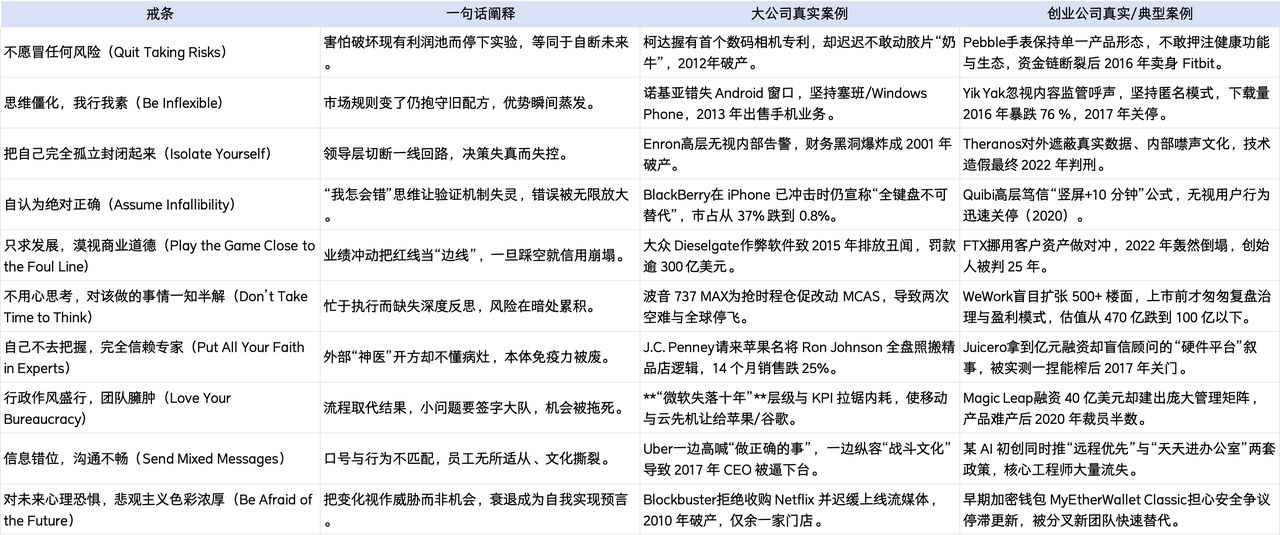
Reading it, I kept recalling real moments—from pre-startup days to current AI ventures. Its warnings feel especially urgent today.
Just last week, Bird Brother (a trusted mentor) said something simple but sharp: “If you want to earn money, you have to carry some risk.”
What Lies Beneath Competitiveness
Conversations with Bird Brother are reliably illuminating.
He visited our office Thursday—not just to workshop his new idea, but to share distilled reflections. One stood out:
On core competitiveness, he put it plainly:
True advantage comes from being either significantly faster—or radically cheaper.
That maps cleanly onto business’s two foundational dimensions: efficiency and cost.
Take OpenAI: Technical moats erode fast. Their real edge? Releasing new models at a pace competitors can’t match.
This echoes a conversation I had recently with a ByteDance engineer: “We ship one meaningful iteration per week. That rhythm *is our competitive engine—and it compounds directly into product strength.”*
It’s a cascade:
→ Team cadence → Team competitiveness → Product competitiveness
Li Xiang (founder of Li Auto) made a similar point: “Great products aren’t won by ‘product sense’ or engineering prowess alone—they’re won by organizational capability. By leadership.”
In the AI era, that becomes AI leadership: building teams that learn, adapt, and execute faster than the rate of change itself.
Engineering Culture
Top tech companies—Google, Baidu, early Meta—share a strong engineering culture.
Its hallmarks: logic over hierarchy, data over dogma, optimization over ritual. Engineers there speak truth to power, obsess over precision, embrace experimentation, and treat “done” as a starting point—not an endpoint.
At its core, engineering culture is three things:
- Using scientific, rational thinking to explore reality
- Solving problems with open, iterative, collaborative mindsets
- Pursuing excellence—not perfection—as a daily practice
The benefits are tangible: speed, innovation, and consistently rational decisions.
A former boss—ex-Baidu tech executive—told me: “At Baidu, engineers had real authority. Operations ran on code, not memos. Tech drove everything.”
Still, engineering cultures aren’t monolithic. Some lean into deep research; others prioritize shipping velocity; others obsess over UX fidelity. Diversity within the culture is healthy.
Which is why, in building our AI project operations team, I now prioritize hiring people with engineering mindset—not just degrees. That means rigor, data fluency, comfort with ambiguity, and bias toward action.
Of course, non-engineers can embody this too. So “engineering mindset” here really means hybrid thinkers: those who fuse engineering discipline with commercial intuition—systems thinkers who speak both code and customer.
The Essence of Decision-Making
Every decision is a choice. Every choice reflects your best judgment at that moment—a weighted trade-off across incomplete signals.
Sustaining high-quality decisions is hard because:
- We conflate reward, risk, time horizon, and emotion—without calibrating their relative weights
- We estimate probabilities and outcomes using narrow, anecdotal experience—not statistical models
- Our attention and memory are bounded—producing what Nobel laureate Herbert Simon called “bounded rationality”
Examples? Choosing between:
- Joining a startup as co-founder
- Taking a senior role at a mature tech firm
- Launching solo on a validated opportunity
Or: owning three apartments across different cities—each with trade-offs in rent yield, appreciation potential, and liquidity. How do you choose?
Decision quality shapes trajectory. Major setbacks—career stalls, financial loss, broken partnerships—often trace back to one poorly weighted choice.
Understanding the underlying mechanics of choice, then, isn’t academic. It’s life leverage.
Modern neuroscience reveals something elegant: No matter how many options or variables you face, your brain uses one system to decide—the value system, anchored in the ventromedial prefrontal cortex and ventral striatum.
This system continuously computes weighted value scores. What feels like “free will” is actually your brain outputting the option with the highest current weighted score.
And value is deeply subjective. What’s high-value to you may be neutral—or negative—to me.
That subjectivity is why decisions are so influenceable. To shift someone’s choice, you don’t argue facts—you identify which inputs they overweight, then adjust those weights.
That requires empathy. Psychological insight. And quiet observation—not persuasion.