High-Level Happiness
Once material needs are met, one of the best ways to master desire is to pursue higher-level happiness.
This kind of happiness rests on foundational capacities: aesthetic sensitivity, moral intentionality (toward goodness), and intellectual honesty (in pursuit of truth).
Yet these vital capacities—so central to human flourishing—are systematically neglected throughout formal education and upbringing.
Take architectural aesthetics as an example.
After developing even modest architectural literacy, I begin noticing layered beauty everywhere: sunlight shifting across bookshelves on a balcony; subtle applications of symmetry, repetition, contrast, and intimacy in built form; and the quiet harmony between structure and landscape.
These deep aesthetic experiences arise not from passive observation—but from cultivated perception and understanding.
Even when words fail to capture the feeling, once this aesthetic intuition takes root, it opens a new window onto the world—revealing countless small, resonant moments of beauty in ordinary life.
The interplay of light and shadow, proportion and integration with nature—these aren’t just design features. They elevate mood, deepen presence, and sustain a quiet, enduring sense of well-being.
The same holds true for the happiness that flows from choosing kindness or pursuing truth.
Dropping My Daughter Off in the Morning
Every morning, walking my daughter to kindergarten, we pass the neighborhood waste station. She waves and says cheerfully to the attendant: “You’re working here today~!”—as if greeting an old friend.
The woman beams back: “Off to school so early~?”
“Yep!” my daughter replies—and skips away.
The kindergarten is inside our compound—just a five-minute walk.
Along the way, neighbors greet her constantly: elderly residents, cleaning staff, parents of classmates, and kids from her class or others.
Each morning, I hear her name called out—“Yao Ruiyi…”—from different voices, in different tones, with genuine warmth.
Healthy social connection—and being seen—remains one of life’s simplest, most reliable sources of happiness.
On this, my daughter is my teacher.
A Life Formula
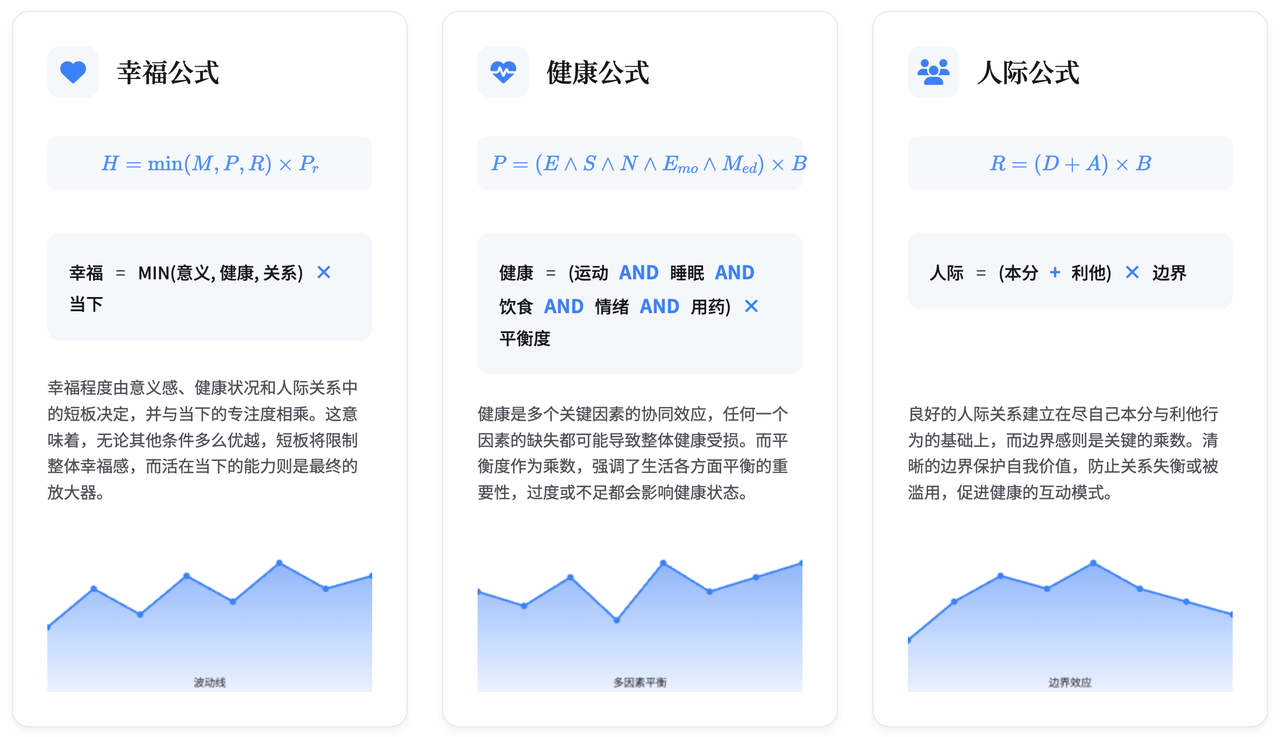
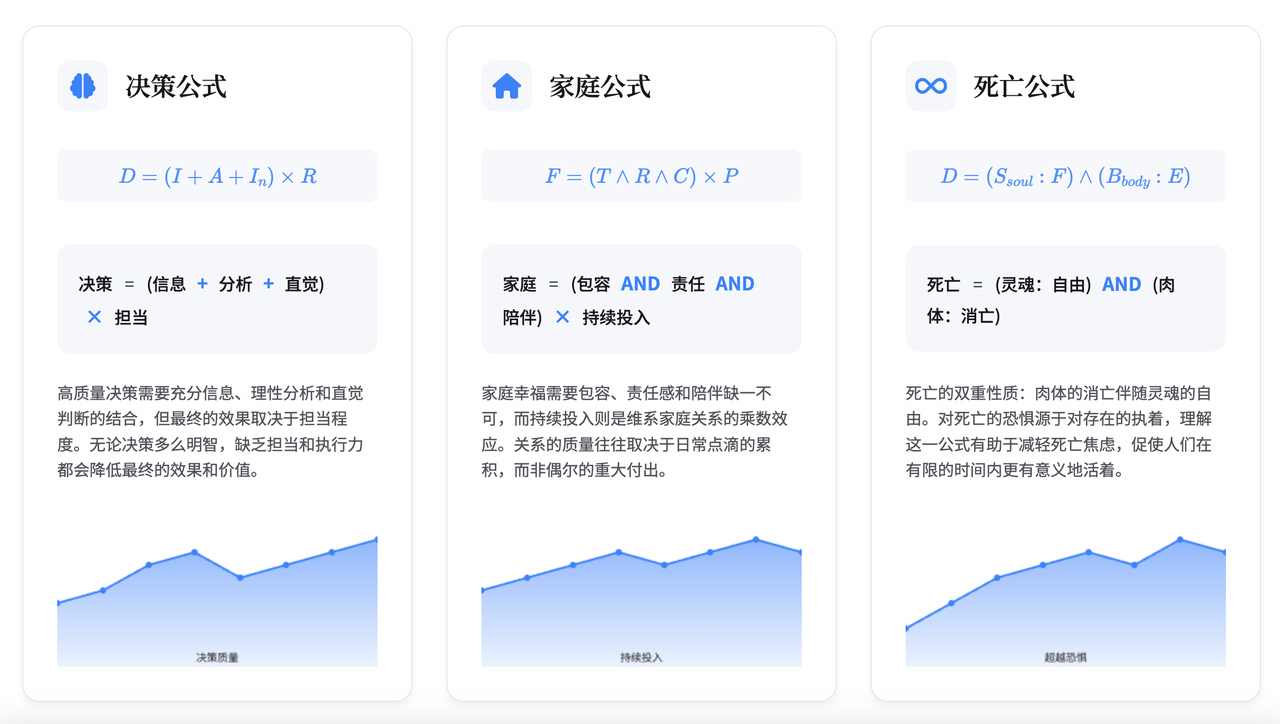
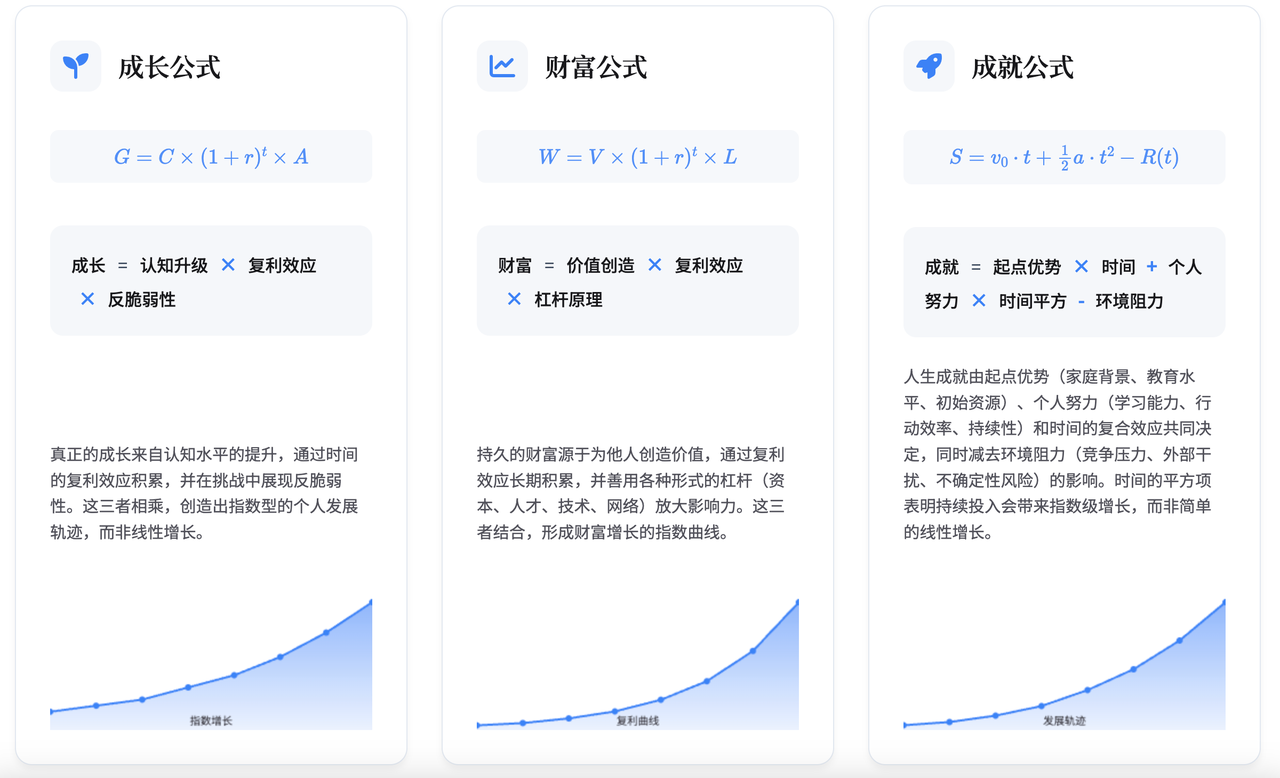
Expressing core life insights through mathematical formulas strikes me as an exceptionally powerful strategy.
A good formula is clear, systematic, and actionable—it distills complexity into abstraction.
Curating such formulas is itself a form of abstract thinking training.
In our new book AI Leadership, co-authored with Xiangyang at the start of this year, we highlight why abstraction matters:
- See essence through noise: Extract key elements and underlying patterns from overwhelming information.
- Transfer across domains: Apply knowledge from one field to another.
- Simplify complexity: Break tangled problems into manageable, intelligible modules.
- Build reusable mental models: Integrate fragmented experience into coherent, portable frameworks.
As Adler writes in The Nature of Communication: “Abstraction is a simple way to generalize similarities among objects, people, ideas, or events.” It lets us grasp what something is—not just how it appears. This ability lies at the heart of human intelligence—and remains one AI still struggles to replicate fully.
Early this year, I drafted several “life formulas.” Recently, I revisited them, selected nine, refined each, and asked AI to generate an interactive web page visualizing them. The result was surprisingly effective:
xiaohongke.com
Efficient Information Acquisition
To sharpen cognition, broaden perspective, strengthen output, and improve decision-making, one non-negotiable principle stands out: raise the quality of information you consume.
Today’s global information output exceeds any single person’s capacity to process—even if they read 12 hours a day.
So the ability to acquire information well isn’t just useful—it’s essential.
Yet doing it well proves harder than expected. Four persistent barriers stand in the way:
- Noise overload: Far more irrelevant, low-value content floods your attention than what you truly need—especially passive inputs like gossip, sensational news, or “mental junk food” (which, ironically, often feels like active engagement).
- Source discovery friction: Finding high-signal sources—like finding great books—requires method, trial, and patience. Human inertia makes even modest friction a real bottleneck.
- Absorption efficiency: Even after identifying strong sources, absorbing their value efficiently demands experimentation—finding your optimal rhythm and format (e.g., skimming + note-taking vs. audio replay + reflection).
- Dynamic maintenance: Sources evolve. Your needs shift. Effective information intake must be continuously iterated—not set-and-forget, but treated like product development: no “final version,” only “better for now.”
These four factors—noise, sourcing, absorption, iteration—make high-quality information intake unusually demanding.
My countermeasures:
- Shift from passive to active intake: Subscribe to premium newsletters (e.g., GetIt’s paid columns); log daily questions and dialogue with top-tier AI models; pin trusted accounts and review them at fixed times. Active habits naturally pressure-test and upgrade your source stack.
- Iterate sources deliberately: Use proven methods—peer recommendations, keyword searches, curated lists—but always anchor them in your current priority: What problem do you need to solve right now? What gap are you trying to close?
- Absorb by doing and sharing: Two of the strongest absorption levers are applying new insight immediately and rephrasing it for someone else. Both force synthesis and expose gaps.
- Prioritize signal over volume: Filter ruthlessly. Reject vague platitudes, recycled jargon, or unsubstantiated claims—they don’t just waste time; they pollute your mental model.
Given my current focus on AI applications, here are seven WeChat Official Accounts I recommend:
- Xiangyang Qiaomu
- AI Product Uncle Huang
- Hanqing Talk
- Kuaidao Qingyi
- Xiao Hu AI
- Digital Life Kazuke
- Orange Soda Shop
Their common strength? Original thinking or hands-on implementation—not just commentary.
Other high-signal formats I rely on:
- Text-based: WeChat Official Accounts, X.com (curated accounts only)
- Video & live streams: Chaos App
- Communities & feeds: WeChat Moments, niche group chats
- Audio: GetIt App, Xiaoyuzhou (podcast platform)
Take One Step, See Three
A friend asked: “What’s a solid action strategy?”
Assuming the value of action itself is already clear, I’d argue the most important tactic is: Take one step—see three.
Here’s what I mean:
- Take one step: Start. Move. Action remains irreplaceable.
- See three: Don’t just ask, “What does this step accomplish?” Ask instead, “What does this step imply for steps two and three—and what might the ‘third-step landscape’ look like?”
Benefits? Your actions gain deeper meaning, become easier to sustain, and invite richer, more strategic iteration along the way.
This isn’t static planning. It’s a dynamic balancing act—reapplied at every step, adjusting course based on emerging clarity.
Like chess: You play the move in front of you—but only after imagining how the board shifts two or three moves ahead.
The main drawback? Initial pace slows slightly. But long-term, “slow is fast”: fewer detours, steadier momentum, and greater odds of reaching ambitious goals.
For instance, recent work with Xiangyang:
- When launching our first AI course, we simultaneously explored how the Manus model could evolve into a two-sided knowledge platform—so course iterations weren’t just tactical tweaks, but probes into scalable methodology.
- While designing a 100-day AI content series, we kept asking: What does this enable next?—how it scaffolds our AI course platform, informs book structure, or seeds community growth.
The Opportunity in WeChat Official Accounts
Over lunch, a friend declared: “This year is WeChat Official Accounts’ second spring—full of untapped potential.”
China has ~100 million dedicated Official Account readers—people who rarely leave the platform.
They largely ignore short videos. Their attention span, reading depth, and willingness to pay for quality content make them arguably the highest-value user cohort in China’s 1.4-billion population—the country’s intellectual and professional core.
From a business standpoint, they’re ideal: rational, systems-minded, and ready to invest in substance.
Five forces are driving this renaissance:
- Algorithmic fairness: Even small accounts gain visibility—if the content resonates.
- Precision audience pool: 100 million deeply engaged users—higher commercial value than Xiaohongshu’s broader, more fragmented base.
- AI’s unexpected boost: As short video dominates, AI tools are lowering the barrier to high-quality text creation—and raising its perceived value. Counterintuitive, but real.
- Platform support: WeChat’s recent updates—including direct publishing from personal accounts—signal Tencent’s renewed commitment to nurturing serious content ecosystems.
- Search momentum: WeChat’s “Search” feature sees rising DAU and usage frequency—while Baidu’s continues declining. A stark divergence.
The core strategy? Consistently publish good content.
That reduces to two essentials: consistency and goodness.
- Consistency means showing up daily—not for vanity metrics, but to build trust and refine voice.
- Goodness means one litmus test: Does this help the reader?
How to Read a Good Book
Early this year, a friend and I began planning a book—and coined the term AI Leadership.
From that concept, we distilled a practical AI learning methodology. So far, it’s guided our own work effectively.
Yesterday morning, I met with an editor from Posts & Telecom Press at a café downstairs. Here’s what I shared:
- Purpose: To translate our frontline experience with AI application—not theory—into a foundational methodology anyone can use.
- Modeling ambition: We looked to classics like The Pyramid Principle and Deliberate Practice. Their power lies in offering a clear, reusable mental framework for universal problems—not just one-off tips. We aim for the same: broad applicability, strong transferability.
- Go-to-market design: To achieve longevity, we’re pairing the book with a companion course—mirroring successful “book + course” models in the market. Promotion and monetization strategy are part of the architecture, not afterthoughts.
- Concept propagation: Ideas stick only after repeated, contextual exposure. We’ll deploy the AI Leadership concept across talks, workshops, articles, and social posts—aiming for ~10,000 touchpoints to forge recognition and shared understanding.
- Implementation rigor: A great framework must land in practice. Next, we’ll run real-world pilots using the methodology—testing, refining, and documenting concrete steps so readers know exactly how to begin.