What Is Happiness?
At the end of 2024, I reviewed my annual “New Year Formula”—a distilled set of expectations for 2025.
The formula for happiness reads:
Happiness = MIN(Meaning, Health, Relationships) × Presence
(The full set of formulas is available in Yao Jingang’s Cognitive Notes.)
How do we interpret it?
The MIN function means that happiness is capped by the weakest of the three pillars—meaning, health, and relationships. All three are non-negotiable.
- Meaning: Your sense of purpose and value in life. Without it, even abundant material comfort rarely yields deep satisfaction. Research consistently shows that living with meaning correlates strongly with longer lifespan and higher quality of life.
- Health: Physical and mental well-being—the foundational “1” upon which all other “0s” (wealth, status, achievement) depend.
- Relationships: Family, friendship, love. As social beings, we wither without connection and mutual support.
“Presence” acts as a multiplier: no matter how high your scores in the three pillars, if you’re chronically distracted, anxious about the future, or ruminating on the past, your lived experience of happiness shrinks.
So—if our aim is to live happiness, not just theorize it—this formula offers a practical compass:
- Cultivate all three dimensions in balance. No single pillar can compensate for the collapse of another.
- Practice presence deliberately—not as an afterthought, but as core discipline. Otherwise, effort compounds slowly, if at all.
Of course, the model omits factors like self-actualization or economic security. But as a simplified heuristic, it isolates what matters most—especially when facing pivotal life choices.
Xiang Yang recently shared Naval Ravikant’s latest interview on his WeChat public account “Xiang Yang Qiao Mu Tui Jian Kan” (“Xiang Yang Recommends Reading”). Naval’s take on happiness echoes similar logic:
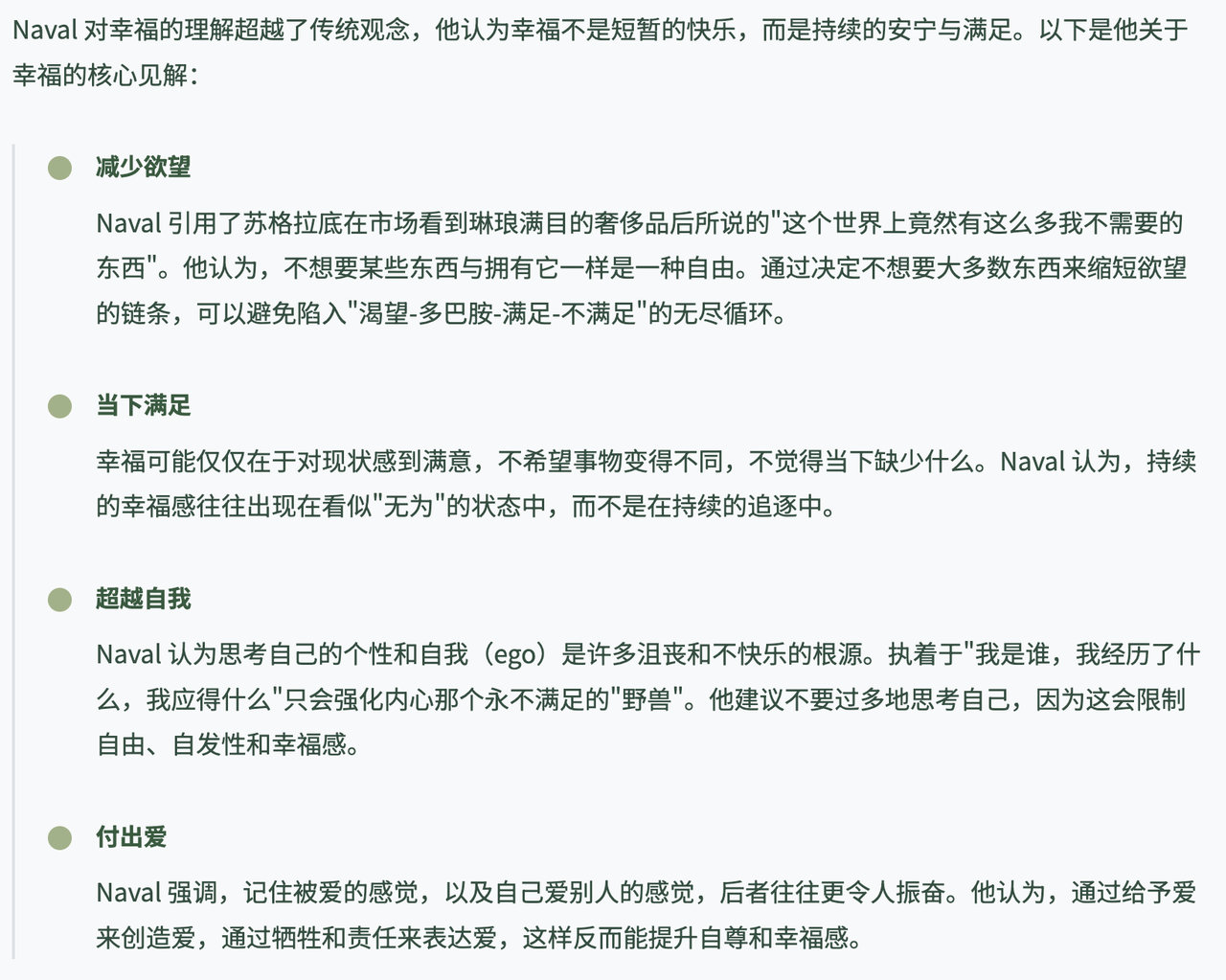
Naval defines happiness not as fleeting pleasure, but as inner stillness: feeling at ease with your current reality—neither resisting it nor wishing it were different. True wisdom lies in knowing both how to achieve your goals and what goals are truly worth pursuing. Life is short; don’t settle for mediocrity—but also avoid chasing “consolation prizes”: things that look attractive on the surface but deliver no real value.
He poses a sharp question: If happiness is the ultimate goal, why don’t we pursue it directly? Too often, we sacrifice happiness for success—believing happiness will follow. In reality, people who are already happier tend to be more successful—because they sustain focus, resilience, and creativity in work they genuinely care about.
Original interview: youtube.com
Transcribed version: 32kw.com
Entrepreneurship: The Last Few Years
Today was light on meetings—I spent the whole day packing up the office. We’re moving to a much lower-cost space.
Looking back on these years of entrepreneurship: I’ve stepped into nearly every pitfall imaginable. Yet I don’t regret it. Within manageable risk, experiencing them firsthand has likely been invaluable—for what lies ahead.
Examples include:
- Launching full-scale projects before validating the MVP—leading to multiple million-RMB losses. One such loss is tolerable; two or three aren’t.
- Running too many initiatives in parallel—none deeply executed or seen through to completion.
- Spending recklessly—without granular cost control. Rent alone, looking back, wasted several million RMB over the years.
- Neglecting operational details or delegating too loosely—resulting in critical decision gaps and repeated million-RMB missteps.
For a small, unfunded company—still operating post-“Double Reduction” policy, surviving repeated losses—it’s frankly astonishing we’re still here.
Since last autumn, I’ve conducted serious reflection and root-cause analysis. Gradually, I’ve recognized recurring patterns in my errors—and begun large-scale adjustments: process redesign, tighter financial discipline, clearer delegation protocols.
This isn’t just damage control. It’s become one of my most valuable assets. At least this year, my judgment across domains feels markedly more grounded and mature.
AI Course Launch
Today, the adult-focused AI course AI Leadership, co-designed with Xiang Yang, officially launched in select WeChat groups.
From concept to delivery, it took us roughly three months.
Early user feedback has been encouraging—and we’re already iterating rapidly based on input. Overall, the reception has been positive.
In early-stage products, user participation—even amid imperfections—greatly elevates perceived value. There’s a well-documented psychological effect: when users feel like co-creators, their tolerance rises, and they develop a sense of ownership.
For me, launching this course delivered four concrete benefits:
- Deeper AI understanding: Designing the curriculum forced us to clarify AI’s internal logic—proof again that teaching is the best way to learn. Like when I first studied SEO: writing a book and teaching others accelerated my own mastery far beyond passive learning.
- Faster productization: The course pushed me to turn abstract insights into tangible offerings. One paying user added me on WeChat—he’s building AI applications himself. My immediate advice? Leverage AI now to build AI tools. Don’t wait.
- Network expansion: Through this work, I’ve met passionate, thoughtful people exploring AI in earnest. New friendships—and unexpected collaborations—are already emerging.
- Strategic clarity: Deeper immersion sparked fresh ideas for AI applications—and clarified next-step priorities. That kind of clarity is rare and precious.
AI is triggering a new wave of productivity revolution across industries. To participate—not just observe—and ship small, meaningful works that nudge the field forward? That’s deeply worthwhile.
AI-Powered Content Creation
AI + content creation will dominate mainstream media operations starting this year.
Why? Because the efficiency gains are staggering—confirmed repeatedly in our own practice and friends’ experiments. Used well, results are exceptional.
WeChat Official Accounts deserve special attention.
It remains the only major platform that permits unrestricted QR-code sharing for private traffic acquisition. Every other platform actively suppresses this.
That distinction is decisive: non-suppression enables conversion efficiency tens of times higher—assuming comparable traffic volume.
Also, WeChat’s current algorithm has largely neutralized follower count as a performance lever. If your article doesn’t land in recommendation feeds, follower-driven views vary little—even accounts with just a few hundred followers can reach thousands or tens of thousands via recommendations and organic resharing.
The underlying logic is simple:
- Automate repetition with AI: Today’s AI tools can handle every step—from ideation and drafting to editing and formatting. You just need to invest time learning how to use them effectively.
- Own strategy iteration: Only your evolving cognition and deliberate experimentation can raise the ceiling on what AI helps you achieve. Efficiency compounds only when your thinking does.
Who to Hire
This week, I interviewed intensively—and welcomed our first cohort of eight new hires. Once again, I was reminded: selecting outstanding people is both critically important and profoundly difficult.
All candidates met our baseline: proven ability to leverage AI to solve real problems.
Here’s what I now prioritize:
-
Logical clarity
If someone can’t articulate thoughts coherently in an interview, their work will likely lack structure—or descend into chaos.
During one management-track interview, the candidate’s explanations were so muddled I later described their thinking as “mush.” Working closely with them would, I’m certain, test my patience daily.
Ding Lei (NetEase’s founder) once said on a talk show: logical rigor is his top hiring filter—and most people fail it. Disorganized logic leads directly to disorganized execution. It’s that consequential. - Problem-solving ability
Excellence shows in:- Accurately identifying the core problem—not mistaking symptoms for causes.
- Applying systems thinking—analyzing from multiple angles.
- Proactively sourcing resources and methods, rather than waiting for instructions.
- Demonstrating grit when obstacles arise.
- Generating unconventional, creative solutions.
- Weighing trade-offs and making sound decisions under complexity.
(Test this via behavioral questions or scenario-based interviews—ask for full narratives of past problem-solving.)
- Professional ethos
- Focus and commitment: Do they immerse themselves fully?
- Relentless standards: Do they reject “good enough”?
- Attention to detail: Can they spot and fix subtle flaws?
- Time discipline: Do they deliver high-quality work on schedule?
- Self-motivation: Do they push forward without external prompting?
- Accountability: Do they own outcomes—both wins and missteps?
- Growth mindset: Do they actively seek learning and improvement?
- Professional ethics
- Integrity: Are words and actions aligned? Do they avoid distortion or omission?
- Responsibility: Do they stand by their work—and its consequences?
- Confidentiality: Do they safeguard sensitive information?
- Team orientation: Do they share credit and shoulder collective burdens?
An Organization’s First Task
An organization’s primary mission is to earn money—legally.
As long as it operates within the law, every other objective must be subordinate to revenue generation.
Why does earning money matter?
Because sustainable profit signals real value creation. If you’re merely redistributing existing value—or destroying it—you cannot survive long.
What is the essence of earning money?
It’s the consistent delivery of net new value. Zero-sum or negative-sum games are inherently unsustainable.
Counterexample:
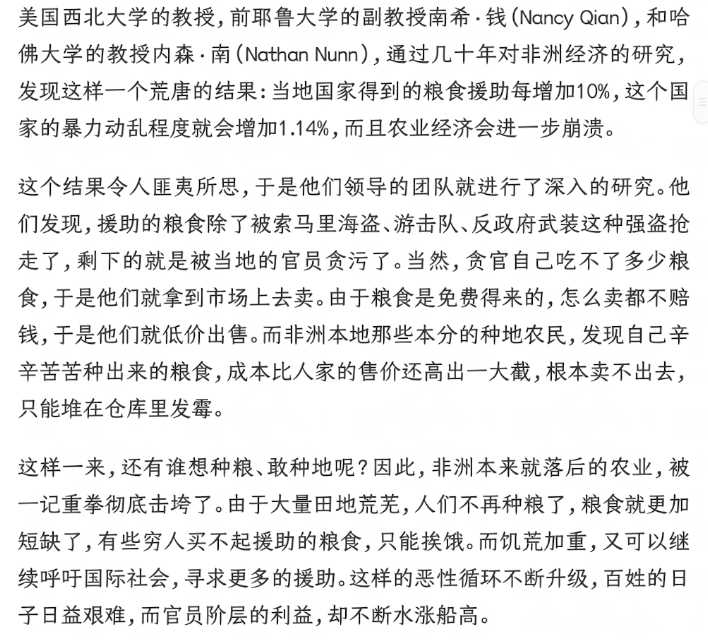
Why?
When enterprises ignore market fundamentals and chase “social responsibility” at the expense of viability, they divert finite resources into building an unstable, self-defeating system.
As Master Shi Yongxin put it: “Make great products. Make solid profits. That *is the greatest good.”*
The same holds true for individuals and families: economic stability isn’t optional—it’s the necessary foundation for everything else.
The harder question—how to earn money well, especially today—is another discussion entirely.
Yet too often, we forget our first task altogether.