The Deluge of AI-Generated Information
Overseas, ultra-short videos wildly synthesized by AI—think surreal, hyper-exaggerated clips—have become a new traffic “key.” If you accidentally linger for a few seconds, or watch one twice out of shock, personalized recommendation algorithms take note. Congratulations: your feed will soon flood with similar AI-generated grotesqueries—your new mental pollutant.
This kind of illogical, over-the-top content is bound to multiply—not because it’s meaningful, but because it’s addictive. Addiction fuels engagement; engagement fuels algorithmic amplification; and amplification fuels more addiction.
For adults, children, and seniors alike, such content offers no benefit—only cognitive pollution or, worse, a slow erosion of judgment.

Domestically, the internet feels comparatively healthier. Extremely vulgar or sensational AI clips often get taken down after just a few user complaints. Yet AI-synthesized short videos still saturate platforms—especially re-edited versions of classic films and TV shows. Some reinterpretations show real creativity; most veer into crass parody—like “Empress Dowager Cixi wielding a machine gun.”
Beyond video, text-and-image content is even more deeply compromised.
That’s because today’s dominant AI—large language models—is fundamentally a text-generation engine. With proper prompting, AI output routinely surpasses 90% of ordinary human writers in fluency, speed, and surface polish.
On WeChat Official Accounts and Xiaohongshu, AI-generated posts (combining text and images) have become unavoidable hotspots of low-signal noise.
Tencent recently launched a free online AI detector that identifies whether images or text are AI-generated. Our team uses it regularly—and I check things myself, often.
AI-generated content remains the most widespread application of AI today. Faced with this deluge, I hold two clear positions:
First, if you’re consuming AI work purely for light entertainment—AI micro-dramas, AI fairy tales—it’s fine. No harm done.
Second, if you’re relying on AI to solve problems, find actionable insights, or inform real decisions, then sourcing information demands rigor. Three filters matter:
- Authority & authenticity: Prioritize first-hand, verifiable sources—original books, primary documents, or reporting from trusted institutions and outlets.
- Human authorship: Avoid anything AI-generated or AI-processed. If a creator habitually outsources their writing or editing to AI, mute or block them immediately. Due to AI hallucination, such content cannot serve as a reference—not yet, at least.
- Selective curation: Don’t chase volume. Invest time and attention only in high-signal, personally relevant sources—even if that means discarding >90% of what’s available. For any individual, that’s more than enough.
Lately, I’ve also been asking myself: Is generating low-value AI content a kind of moral failure—or even a quiet form of “crime”? How can we harness AI not to dilute meaning, but to deepen it? I don’t yet have answers.
Some Plain Truths
Today, I visited two veteran educators with colleagues.
Both have operated in their niches for over a decade—and delivered tangible results: one runs a ¥1 billion annual revenue business; the other leads the undisputed #1 player in a narrow education segment (most competitors have already folded).
What stood out wasn’t flashy strategy—but simple, grounded truths: love, conviction, persistence, pragmatism, and staying rooted in reality.
- Commit to something—and stick around. Staying in the game is how you earn your shot.
- Passion and purpose fuel endurance—but they’re not enough alone.
- Pragmatism matters: knowing when to monetize, when to scale, when to pause.
- Chasing trends isn’t shallow—it signals real demand and better conversion.
- Truly valuable trends also reflect deeper shifts—like DeepSeek’s breakout.
- Survival comes first. So balance short-term execution with long-term vision.
These ideas sound obvious. But executing them—especially amid uncertainty or hardship—is extraordinarily hard. Precisely because they’re hard, their impact dwarfs intelligence, talent, or effort alone.
As for insight and judgment? They emerge naturally—not from theory, but from sustained immersion in a domain.
Declining Reasoning Capacity
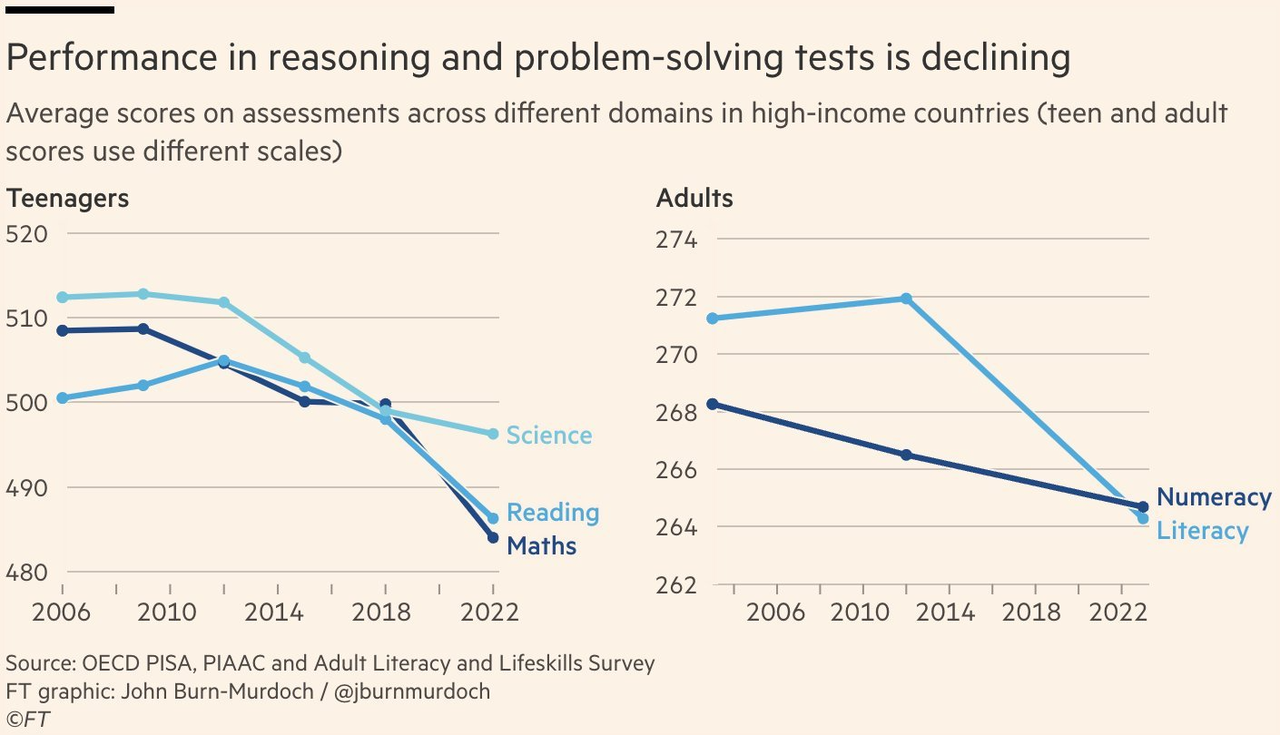
The average person’s ability to process information, reason, and solve problems is eroding—across age groups.
Look at the chart: after 2018, math and reading proficiency dropped sharply. I suspect this correlates strongly with the mass adoption of short-video platforms. These apps consume hours once spent reading, reflecting, or practicing deliberate thought—time that does not build cognition. In fact, passive scrolling actively crowds out the mental rehearsal needed for analytical muscle.
Now AI has arrived—and this trend will likely accelerate.
Why sift through options when AI delivers one answer instantly? Sifting itself is a skill—one now being outsourced.
Calculators replaced rote arithmetic. AI replaces higher-order cognition: analysis, evaluation, judgment, decision-making. That’s the core of thinking.
Cognition, like muscle, atrophies without use.
The double danger? Short video fragments attention and starves deep thought. AI risks outsourcing the entire thinking process.
So my stance isn’t “avoid AI”—it’s “master AI.” Use it as a tool, not a crutch.
Energy Allocation
Lately, my workload has surged—and daily plans consistently collapse. My energy feels scattered, misallocated.
Reviewing my task list, I realized my time management still has room for real improvement.
Setting deadlines for each item is a proven tactic. Psychologically, it leverages our innate response to time pressure: deadlines trigger adrenaline, sharpening focus and output.
I already maintain a daily task list—but upon reflection, two elements were missing:
- Energy-aware planning: Before listing tasks, ask: When am I sharpest? When do I need rest? What matches my mental bandwidth right now?
- Time-aware structuring: Then assign deadlines—not arbitrary ones, but ones aligned with the Pomodoro principle: each task capped at ≤30 minutes, ensuring intense, uninterrupted focus.
Also, apply the “2× Rule”: double your initial time estimate when scheduling. That builds in realistic buffer.
Finally—reward yourself. A cup of coffee counts.
Expertise Remains Scarce
Over lunch with ByteDance folks, we discussed what kinds of creators big AI companies value most.
Their answer was unanimous: only those with deep, authentic expertise—and the deeper, the better.
Why? First, experts persuade. Second, expertise is rare—and rarity carries weight far beyond generic “viral” content.
Here, “expertise” isn’t just knowledge or skill stacked up. It’s a compound capability forged over years: explicit technical mastery plus tacit experience, calibrated judgment, and distinctive problem-solving intuition.
From supply-demand dynamics: new domains keep emerging, but cultivating true expertise takes time—creating natural lag. Meanwhile, tech evolves faster, raising the bar continuously. Scarcity compounds.
And scarcity, inevitably, translates to value.
But becoming that rare expert quickly demands exceptional learning agility—the ability to rapidly internalize, adapt, and apply.
Is scarcity inevitable? Often, yes. Those who already possess deep expertise adapt faster to change—and expand into adjacent fields more fluidly. So scarcity may intensify.
If expertise is inherently scarce, then for individuals: relentless learning isn’t optional—it’s existential.
For organizations: talent development and retention aren’t HR chores—they’re strategic imperatives.