Living Joyfully and Efficiently
Staying focused requires having focus to begin with.
Do the most important thing—and only one thing at a time.
Add small rituals to anchor your day. For example, I now start each workday with a cup of coffee—a simple, intentional cue that signals: Let’s begin.
Define your own time principles—and practice saying no. Two practical techniques help:
- Price your time: Assign a concrete monetary value to an hour of your attention.
- Hardcode priority tiers: Classify incoming tasks by type (e.g., “strategic creation,” “urgent maintenance,” “optional noise”) and treat those categories as non-negotiable filters.
In today’s world—where AI delivers instant information and passive fragmentation is the default—focus isn’t just useful. It’s rare. And therefore, valuable.
Investing serious time and energy into building your focus muscle yields exceptionally high returns.
Look forward: The future can be better than the past—if you steer attention toward what truly matters. So ask yourself: What are the things that matter most—to me?
Countdown tools add gravity to life management. Imagine an app quietly reminding you: You have fewer than 20 more in-person visits left with your parents. Would that shift how you show up this time?
The same applies to partners, children, friends. Many shared moments—unnoticed—are, in fact, your last.
Guard your autonomy over time.
Use money to buy back time—not just trade time for money. And when you do exchange time for money, make sure you genuinely enjoy the process.
Keep life aspirational—but lower the bar on material goals. Set growth targets that fit your pace and values—and savor the journey, not just the milestone.
Four Money-Near Capabilities
Leverage AI to build competence in four high-ROI domains: AI-powered media, AI-powered sales, AI-powered tools, and AI-powered courses.
Why these four?
- Traffic: Use AI to batch-generate and manage content across dozens or hundreds of social media accounts—solving low-cost, high-efficiency audience acquisition.
- Conversion: Deploy AI to handle mid-to-lower-funnel sales (e.g., chat-based lead nurturing, follow-up sequences)—turning traffic into revenue with minimal human overhead.
- Retention: Build or re-engineer tools that directly solve painful, underserved user scenarios—using AI to slash development cost and deepen stickiness.
- Products: Generate highly personalized, production-ready courses in days—not months—by combining AI scripting, voice cloning, and automated video assembly.
From here, two high-leverage actions emerge:
- AI + IP: Launch “everyday person” account matrices to amplify a single creator’s reach—or scale an existing IP across niches and platforms.
- AI + Courses: Spot emerging trends, lock in a course topic within 24 hours, then generate full scripts, visuals, and launch pages—all within one week.
Core logic? Scale + automation = lower marginal cost per unit of output → higher leverage, faster iteration, real competitive advantage.
Account Moats
Imagine owning 1,000 stable, consistently publishing social media accounts across platforms. That volume itself becomes a defensible moat—even if every account is run by an “unknown” person.
At scale, 1,000 coordinated, quality accounts can match—or exceed—the output and influence of a single mega-influencer.
Historically, this model was prohibitively expensive: content creation + account management + cross-platform scheduling added up fast.
Now? A single operator + an integrated stack (AI content engine + RPA automation + unified dashboard) makes it feasible.
But scale without standards breeds noise. To avoid becoming a “content landfill,” two conditions must hold:
- Consistent quality: Fine-tune AI models on domain-specific data so outputs meet a clear bar—high signal, low fluff, zero spam. If AI can’t reliably hit that bar, stop scaling.
- RPA operations: Automate publishing, comment triage, analytics pulls, and basic engagement—freeing humans to focus on strategy, creative direction, and relationship-building.
Cost Efficiency, Not Just Cost Cutting
“Cost efficiency” should be baked into your operating DNA—not treated as a quarterly initiative.
Cost reduction ≠ slashing budgets. It means refusing to spend on anything that doesn’t serve your core mission.
Efficiency gain ≠ moving faster for speed’s sake. It means asking: Does this acceleration create real, measurable value—or just busywork?
True efficiency is value efficiency: output per unit of meaningful input (time, capital, attention).
A friend recently shared how his team had devolved: the only person who got yelled at daily was the only one doing actual work. Others stayed quiet—and unscolded—so they gradually stopped working altogether. That silent, idle headcount? Pure, unproductive cost.
Another example: office rent. If utilization is low and vacancy high, even “modest” rent is wasteful—especially when repeated across years. In my own startup journey, we’ve burned several million RMB on underused office space alone. A brutal, expensive lesson.
By contrast, investing in AI automation is value-efficient—it compounds: one script replaces 100 hours of manual labor, and improves accuracy, repeatability, and scalability.
Why Learn AI Programming?
This afternoon, an AI coding instructor visited our office. He’s deeply immersed in teaching the craft—but he’s stuck on one question: What’s the real point of learning AI programming?
That question struck me.
Right now, many learners jump in for hype or anxiety relief—not clarity. And while AI coding looks easy, his teaching experience shows otherwise: most struggle to ship even moderately complex projects quickly.
This confirms what we’ve seen elsewhere: AI won’t replace programmers—but it will massively accelerate those who know how to wield it well.
For non-programmers, the productivity leap remains narrow—for now. Consider a tiny barrier: registering for VolcEngine, then retrieving a Doubao API token. That single step stalls hundreds.
So the real question isn’t “Should everyone learn AI coding?”
It’s: What’s the realistic capability boundary—for different people?
- For absolute beginners: The boundary is narrow. Don’t aim for full-stack apps. Focus on single-point wins: auto-generating a social post, drafting a client email, designing a landing page headline. Even that level of agency transforms daily work.
- For experienced engineers: The boundary expands dramatically—custom agents, multi-step workflows, domain-specific fine-tuning.
The key is matching tools to real human contexts. Our upcoming courses will reflect this: each one targets a specific user profile, their recurring pain points, and their achievable next step—not abstract theory.
A Rational Decision Framework
Most poor decisions stem not from ignorance—but from skipping rationality. I’ve made plenty: acting on gut, emotion, or urgency—then realizing, in hindsight, that pausing for one minute of structured thought would’ve prevented the mistake.
A common trap? Being hyper-rational about trivial choices (“Which brand of coffee pod?”) while making life-altering ones (“Should I quit my job and start a company?”) purely on instinct. That imbalance keeps people trapped in cycles of scarcity.
Research shows a simple intervention works surprisingly well: Before deciding, write down 2–3 explicit reasons or criteria—even if they’re imperfect. That tiny act pulls the brain out of autopilot and into evaluation mode.
To reduce decision errors, try this:
- Slow down big decisions: High-stakes choices (e.g., buying property, hiring a co-founder, relocating offices) demand cognitive bandwidth. Rushing them guarantees regret.
- Build and use a decision tool: Design a lightweight framework—and make using it mandatory before any major call.
For instance, during our recent office relocation, this framework proved invaluable (see image below):
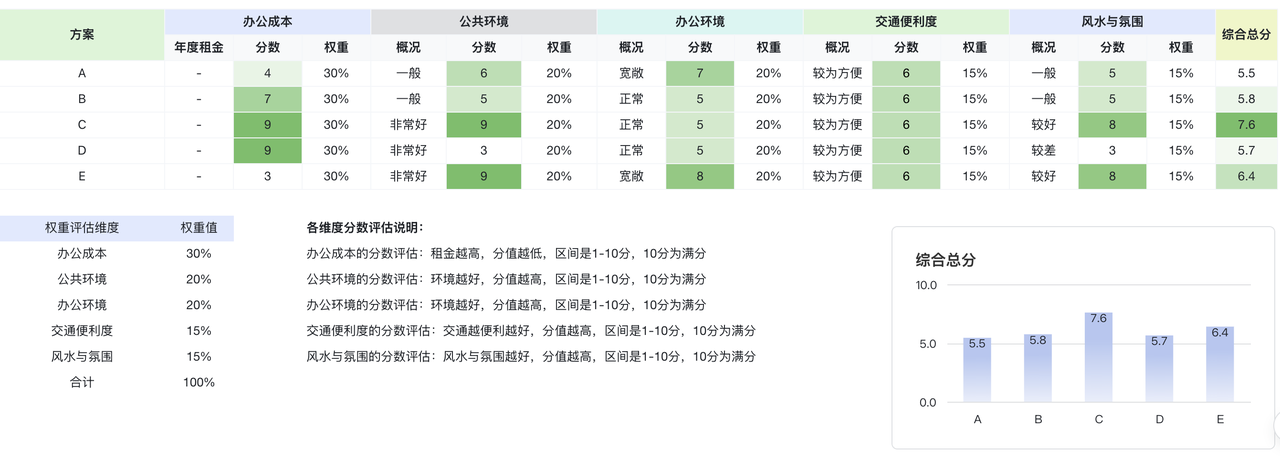
With such a tool, you evaluate options across objective dimensions—cost, commute, flexibility, team morale—instead of getting swept away by a charismatic landlord’s pitch.
Even if your final choice aligns with your gut, the process changes everything: it grounds confidence, surfaces hidden trade-offs, and turns luck into intention.