Three Startup Stories
I recall a talk by Jack Ma:
“A harsh reality: of 100 people who start businesses, 95 die—and you won’t even know they existed. Of the remaining four, you watch them fail. Only one survives. That person isn’t necessarily the hardest-working or the smartest. Luck, timing, and countless invisible factors converge to let them succeed.”
This week, I spoke with three very different founders—each once successful, each once profitable. Yet over the past two years, a single misstep pushed all three into deep personal debt.
That’s when it clicked: for most, real entrepreneurship is nine-out-of-ten.
First, the founder of an education company. Early this year, its cash flow dried up overnight. After two months of struggle, he shut the company down decisively—mortgaging two Beijing apartments to cover severance and closure costs. Just like that, he carried tens of millions in personal debt.
Two months earlier, he was still a functioning CEO—no debt, no crisis. But without positive operating cash flow, and with monthly payroll burning through millions, collapse arrives without warning.
Second, a portfolio company in Xiaomi’s ecosystem. Once high-flying, it collapsed under low gross margins, excessive R&D spend, and—critically—a promised local government investment that never materialized. Cash ran out. Layoffs followed. And layoffs without cash are excruciating: unpaid wages, delayed severance, mounting legal liabilities.
Over drinks, the founder described his raw disappointment—not just at the situation, but at his two co-founders. When severance payments fell short by a few hundred thousand RMB, they sued him into becoming a “discredited debtor.” The irony stung: during the pandemic, while he stayed in China managing everything, his co-founders remained overseas—and he paid himself zero salary for a full year, despite earning over ¥1 million annually before. The betrayal cut deep.
Third, a longtime friend—a classic “local operator” who’d spent years cultivating regional relationships in education. When I visited him recently, he told me he had no education projects left. Schools had no budget. Parents couldn’t pay. Government procurement stalled. So he took a job repairing roads—for a cement factory.
I asked how he jumped so far across industries. He shrugged: “Education is dead right now. But the cement plant has budget—and pays fast.” He’s clear-eyed: land is cheap, and he keeps staffing lean and flexible.
What doomed the first two founders? A single point of failure: cash flow interruption. No cash → can’t pay salaries → forced layoffs or shutdown → massive personal liability. With 100 employees, standard N+1 severance alone runs several million RMB. Add unpaid vendor invoices, lease break fees, and litigation risk—and yes, ¥10M+ personal debt appears in an instant.
I’ve grown increasingly aware: as long as team costs stay high and revenue remains volatile, this risk hangs over every small business like a blade.
Labor law strongly protects employees—but offers little shelter to founders. When a company collapses, few staff pause to consider the founder’s exhaustion or sacrifice. They rightly focus on whether their severance complies with the law. (And yes—those employees face hardship too: unemployment, uncertain rehiring, shrinking options.)
So unless you’re building something with razor-thin overhead and predictable cash inflows, the math is unforgiving.
Lately, watching friends and peers, I’ve concluded: for many, the sanest path is to stay put—in mid-to-senior roles at large enterprises. From a risk perspective, big companies simply absorb shocks better. Take China’s “Double Reduction” policy: it flattened mid-sized tutoring firms almost overnight. Large players survived—not because they were smarter, but because they held enough cash to endure, pivot, and reinvest.
The Three Stages of Marketing
Marketing, at its core, is the process by which organizations—or individuals—identify, create, communicate, and deliver value to meet customer needs, build brand loyalty, and sustain profitability over time.
I map its evolution across three conceptual stages: Scientific Management, Marketing Management, and Positioning Theory.
All three engage the classic 4Ps (Product, Price, Place, Promotion)—but their emphasis shifts dramatically.
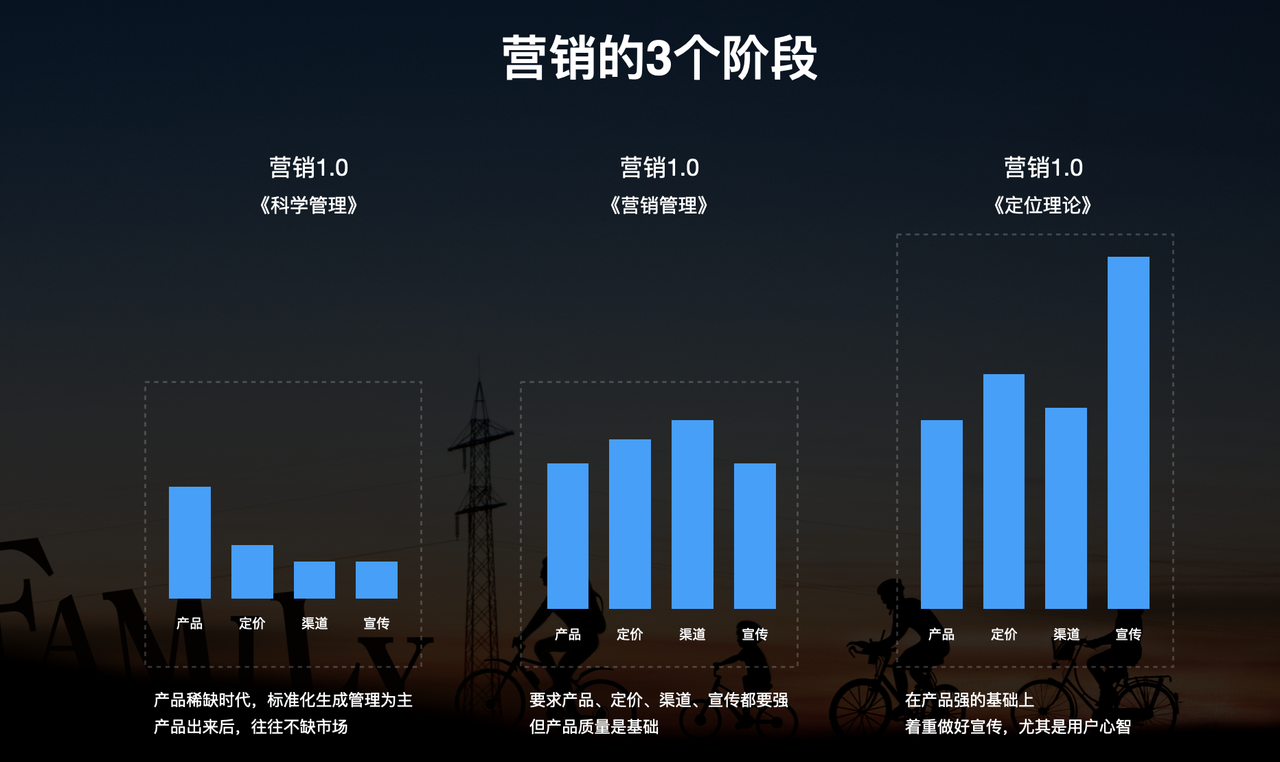
In Marketing 1.0, scarcity ruled. The priority was internal efficiency: optimizing production lines, cutting unit costs, scaling output. The assumption? If price is low and quality stable, demand will follow. Speed and cost dominated—“build it well and cheaply, and they will come.”
In Marketing 2.0, markets shifted from seller- to buyer-centric. Companies began listening: conducting surveys, segmenting audiences, tailoring products and messaging. Marketing became strategic—not just about making things, but about understanding who wants what, why, and how to reach them. Market share, not just output volume, became the metric.
In Marketing 3.0, differentiation became existential. With crowded, noisy markets, brands needed more than function or service—they needed a distinct place in the consumer’s mind. Positioning theory (by Trout & Ries) argues that marketing’s core task is mental real estate: identifying your unique advantage, anchoring it clearly, and reinforcing it relentlessly—so customers instantly associate you with a specific need or idea.
These stages trace marketing’s arc: from efficiency (1.0), to customer responsiveness (2.0), to mental ownership (3.0). Crucially, each stage builds on the last’s ceiling: today’s positioning only works if product and pricing are already solid. Don’t chase “positioning” while your product ships late and your pricing confuses buyers.
Choosing What to Do
When everyone around you is doing something—or when you see it happening nationwide—it’s already too late to join.
You’ll likely drown in inefficiency, margin erosion, or outright irrelevance.
So what should you do?
Do what others avoid—especially the hard, unglamorous, “unsexy” work nobody wants.
The payoff? If you solve it, you’ll often find no competition. And that silence—where others won’t go—is where leverage lives.
Awe
Wandering the abyss of ignorance,
I realize how little I truly know.
Only when I fully grasp my own blindness
do I begin to stand in awe—again.
The unknown stretches like stars—countless, cold, luminous—
illuminating corners of my mind I’d left dark.
To name ignorance is to root awe deep.
Life remains riddle. The world, mist.
But once ignorance is seen—not feared, not denied—
awe burns steady, unquenchable.