The Little Flying Insects While Running
Sunday—overcast, perfect for running.
I got up just after 6 a.m., warmed up, and ran 12 kilometers along the foothills of Beijing’s Bagu Mountain. Time: 1 hour 20 minutes. Total elevation gain: 226 meters. The road was empty—mine alone. A truly lovely run.
The first half was uphill. Ahead of me, several tiny black flying insects darted back and forth—so small they were almost invisible—hovering persistently just in front of my face.
At first, they disrupted my rhythm. I tried swatting them. That didn’t help. I even sped up, hoping to shake them off—but within minutes, they’d caught up again. Frustrating.
Then it hit me: this irritation wasn’t worth it.
These little insects were stealing my attention from the mountain air, the quiet, the physical flow—the very reason I’d laced up. And I couldn’t eliminate them, no matter how hard I tried.
I remembered pacemakers in marathons—those steady, unobtrusive guides who help runners hold pace. Suddenly, these insects became my free, unwitting pacemakers.
That reframing shifted everything: from resistance → acceptance → quiet gratitude.
Five minutes later, I stopped noticing them—even though they flew alongside me for at least half an hour.
Life is full of such “little flying insects”: minor but persistent irritants—delays, miscommunications, scope creep, unresponsive stakeholders, slow internet. We rarely control their existence. But we always control our stance toward them.
Choosing acceptance—not resignation, but active, curious acceptance—creates space to find meaning, rhythm, or even humor in the friction. It turns noise into texture.
Duty and Altruism
I organize my core values around four words: Duty, Altruism, Collaboration, Innovation.
Visually, they form a pyramid:
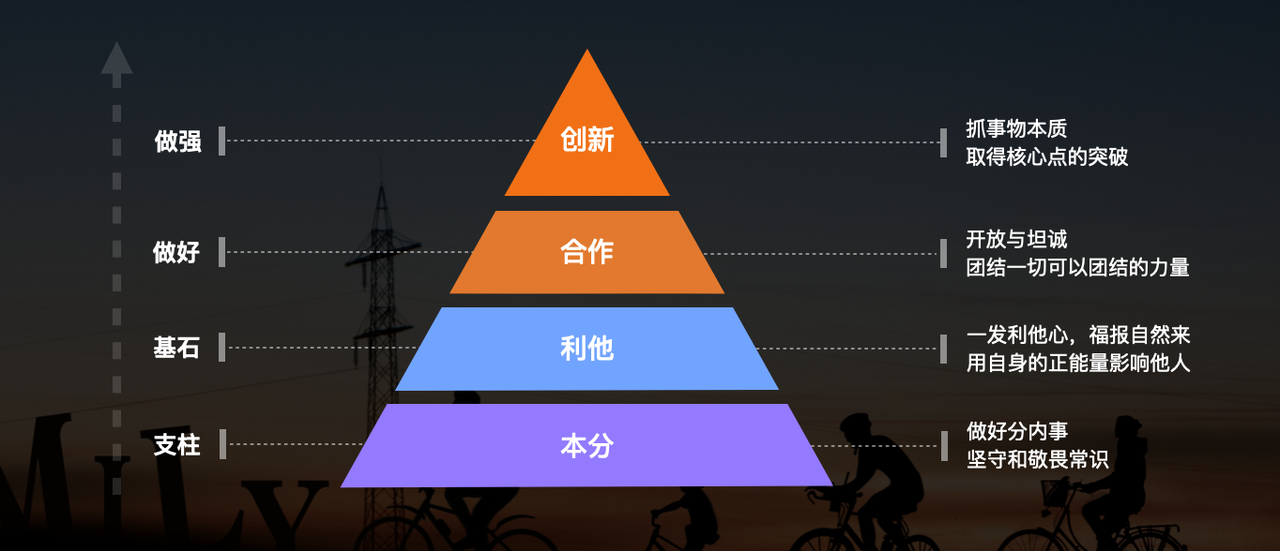
Duty is the foundation—the pillar. It means doing what’s yours to do, honoring common sense, and holding your role with humility and rigor.
Why does duty come first? Because altruism and collaboration only land when you’re qualified—when you’ve done your part well.
When duty is practiced deeply, altruism flows naturally—not as sacrifice, but as overflow.
Example: Prioritizing your own health isn’t selfish. It’s duty. When you exercise consistently, eat mindfully, and rest well, you reduce burden on loved ones and model resilience for them. That’s duty as altruism.
Another example: Committing to lifelong learning isn’t just self-improvement—it strengthens your capacity to listen, clarify, and uplift others. Your growth becomes their scaffolding.
This logic beats the hollow plea: “I can’t do it—but I expect you to.”
Preaching altruism without grounding it in duty often leads to burnout, resentment, or mutual disappointment. Real generosity begins with integrity—not exhaustion.
Single-Point Thinking vs. Systems Thinking
I recently read a passage that resonated deeply:
- Over time, I’ve noticed: people with systems thinking go farther than those stuck in goal thinking.
- “Lose 20 pounds” is goal thinking. “Build sustainable eating habits + consistent sleep + movement routines” is systems thinking. Goal-driven people often live in a loop of near-success and collapse.
- Systems thinkers wrestle with frustration at every inflection point—but that struggle builds emotional resilience and positive reinforcement.
- Directing finite energy wisely is non-negotiable. What you actually need isn’t a goal—you need a system that raises your odds of success.
- That means constantly learning, revising, and—when needed—destroying your own assumptions. The ability to dismantle your beliefs is among the rarest, most valuable skills.
- You must force yourself to confront opposing views. Only then does your system accumulate luck—and avoid stupidity.
Between goal thinking and systems thinking lies single-point thinking: identifying one lever (“cut carbs,” “hire a salesperson,” “launch on TikTok”) and pushing it hard. It’s fast, focused, and resource-efficient—great for quick wins.
But it’s fragile. Pull one thread, and the whole effort unravels.
Take weight loss again: “Lose 20 pounds” is the goal. “Starve for 8 weeks” is the single-point tactic. It can work—but rebound is likely, because nothing else changed.
Systems thinking asks: What supports lasting change? Nutrition literacy, meal rhythm, stress management, sleep hygiene, joyful movement—all interlocking. When the system holds, the result sticks—and feels sustainable.
So why don’t more people adopt systems thinking? Because it demands patience, deeper observation, and tolerance for delayed rewards. It’s less flashy—but far more durable.
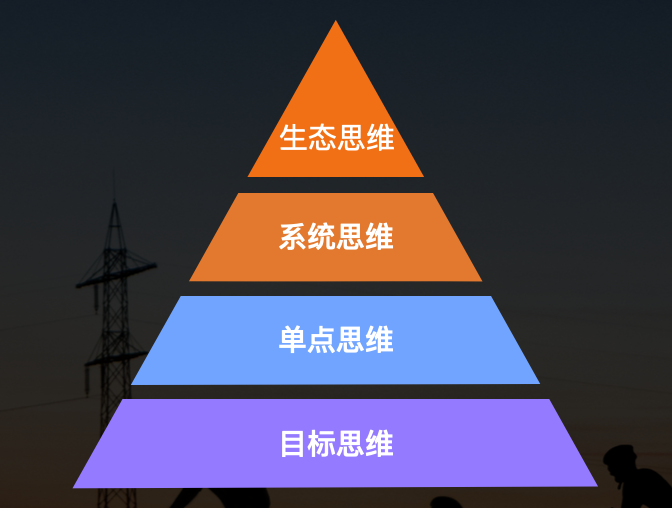
And beyond systems thinking lies ecosystem thinking: recognizing that your system itself lives inside larger systems—your team inside your company, your company inside its industry, its industry inside national policy and global supply chains. Humility grows here. So does strategic clarity.
The progression looks like this:
Stock Thinking vs. Flow Thinking
(“Stock” = cúnliàng, fixed existing assets; “Flow” = zēngliàng, newly created value)
Business partnerships, resource pooling, and “strong-strong alliances” are all forms of leverage. Good leverage delivers 1 + 1 > 2. Without that, it’s not synergy—it’s overhead.
Example: I excel at traffic acquisition. You close deals. They build products. Together, we outperform any solo effort. That’s real leverage.
Another: Company A values itself at ¥50M. Company B does too. If their merger unlocks new markets, tech integration, or cost synergies—and lifts combined valuation above ¥100M—that’s effective leverage.
If 1 + 1 ≤ 2, the partnership is inefficient—or worse, extractive.
The key to unlocking true leverage? Balancing stock thinking and flow thinking.
- Stock thinking asks: What can I take from your existing resources? (e.g., “Let’s share your customer list.”)
- Flow thinking asks: What new value emerges when our strengths combine? (e.g., “If your sales team co-trains with our product team, we’ll shorten sales cycles and improve feature adoption—creating revenue we couldn’t generate separately.”)
In practice, flow-focused partnerships are easier to negotiate. Why? Because they’re additive—not zero-sum.
I’ve watched skilled business leads pivot fast when their offering doesn’t create flow value: they dig deeper, reframe the use case, or co-design a pilot that generates new outcomes.
We say “win-win” all the time—but if both sides only eye each other’s stock, someone will lose. Focus on flow instead, and new ground opens up: shared metrics, joint experiments, unexpected adjacencies.
That’s where real collaboration begins.