The Quality of Life
China’s latest average life expectancy is 78 years—higher than the U.S.’s current 76. Globally, that’s an excellent figure.
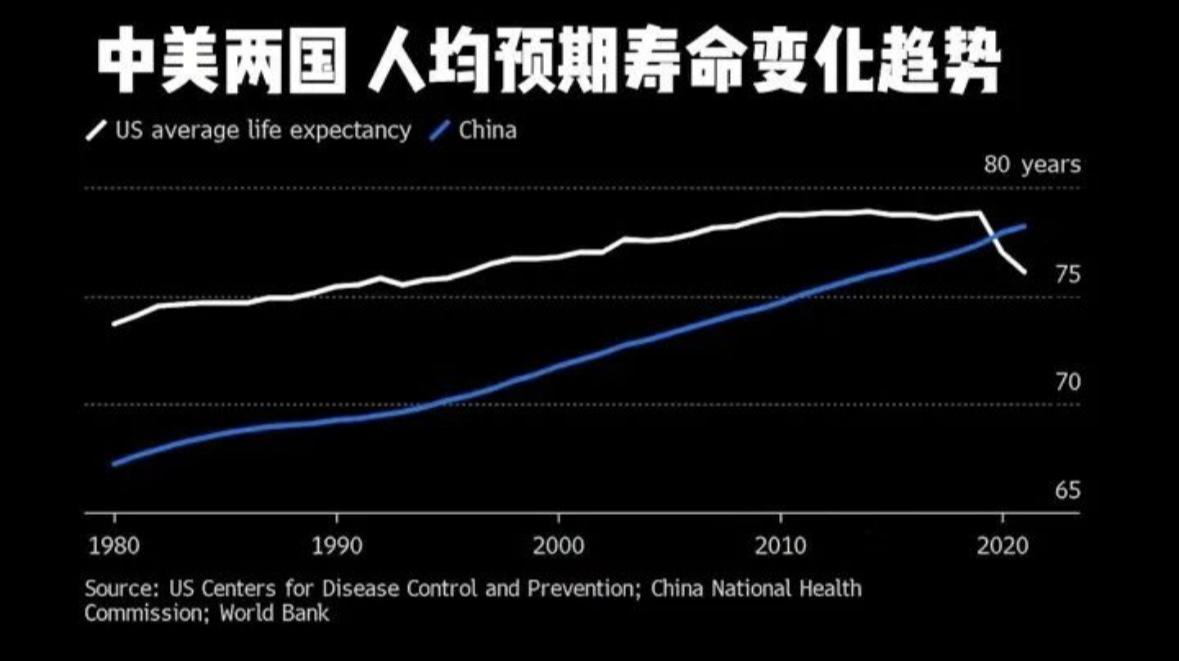
But there’s a critical difference: quality of life in old age.
Before life ends, most people endure years of chronic illness—what I call “low-quality life.” Estimates suggest Chinese seniors experience 3–5 more years of such suffering than their American counterparts. That gap isn’t random. It reflects how seriously we treated our bodies—and our lives—decades earlier.
We’re uniquely fortunate: today’s information abundance lets us foresee aging risks long before they arrive. Data and real-world cases are no longer scarce. What matters now is whether we convert that information into understanding, then into action.
After middle age, bodily functions gradually decline—chronic conditions accumulate, often erupting in later years and sharply eroding quality of life.
But we can intervene—through four pillars: sleep, diet, exercise, and emotional regulation.
High-quality sleep, evidence-based nutrition, consistent physical activity, and stable emotional states form the core of lasting health. These aren’t isolated habits—they reinforce each other. Better diet and movement improve sleep and mood; calmer emotions support healthier eating and more consistent training.
If you pick one entry point, start with movement. Cultivate a sport you enjoy. Study its theory deeply. Train steadily—not just to get fit, but to understand why certain techniques work, how recovery functions, how physiology adapts. Without theory, practice becomes blind or ineffective. With both, you begin to feel like a practitioner, not just a participant—a subtle but powerful shift that builds intrinsic motivation and a sense of agency.
These aren’t abstract ideals. They’re practical, high-leverage strategies—for living better now, and aging with greater resilience later.
Waiting until old age to begin? That’s not delayed action—it’s powerlessness. The best time to act is now: to notice your body, question your habits, and choose one small, sustainable change.
Poverty Makes Every Small Thing Feel Like a Crisis
As a child, I used shampoo too often—and my grandmother scolded me for “wasting it.” Back then, I thought it meant I wasn’t loved.
It meant we were poor.
Later, my parents’ arguments rarely centered on surface habits. They centered on scarcity—on how every penny stretched thin, how every choice felt like a trade-off, how even minor inconveniences triggered disproportionate tension.
That’s not moral failure. It’s what happens when a household operates at the poverty threshold. At that level, patience evaporates. Trust frays. Judgment narrows.
“Poor but upright”—I rarely see it. When I do, I’m deeply moved—and I’ll support it however I can.
Example: someone owes ¥3,000, yet has zero surplus after rent and food. How many will still pay on time—even by selling belongings or skipping meals—to protect their word? Very few. Most delay. Most evade.
So the foundational capacity of any family isn’t love, communication, or shared values—it’s economic capability. Without it, everything else wobbles. Only once material stability is secured can a family meaningfully pursue higher-order needs: learning, creativity, emotional safety.
My fitness coach recently shared his story: his wife wants divorce. Why? He lost over ¥1 million running a gym. Now he rents a tiny Beijing studio apartment, pays tuition, and shoulders massive debt. His salary alone would take ten years—at best—to clear it. His family no longer speaks to him with warmth. They’ve stopped believing he’ll recover.
Who does rebound from that—and still honors commitments, preserves dignity, and refuses to collapse inward? That person deserves deep respect.
Economics is the bedrock. Emotion is fragile. Without economic security, emotion becomes three times more fragile—even between blood relatives.
The first duty of any family is financial stability. Most breakdowns trace back to job loss, failed investments, or entrepreneurial collapse—events that trigger debt, scarcity, and shame. But if a family holds assets—if it can absorb a ¥100 million loss and still retain ¥100 million—the same crisis barely registers.
Money is a double-edged sword in relationships: it strengthens bonds when abundant, but exposes fault lines when absent—especially when one partner sees no path forward. Hopelessness, not conflict, is what unravels homes.
Leading by Doing, Not Just Talking
A powerful Thai public-service short film shows a low-income mother guiding her child—not by lecturing, but by modeling curiosity, patience, and hands-on problem-solving. The child learns by observing, trying, failing, and adjusting.
There’s truth in the idea that children mirror their parents—not because they copy consciously, but because early cognition forms through imitation. Children absorb worldview and values from the adults they perceive as authoritative.
Why “talking less” works better than “teaching more”? Because most adults lack the skill to teach well. “Lecturing” usually means reciting clichés or moralizing—neither of which lands. Truly effective verbal teaching requires empathy, narrative craft, and deep self-awareness—rare skills.
“Leading by doing” asks for something simpler—and harder: silence and action.
“Silence” means resisting the urge to explain, correct, or moralize.
“Action” means showing up—consistently—doing the thing you hope your child will value.
Want your child to move? Don’t say, “Exercise is good for you—don’t be lazy.” Just run, lift, stretch, walk—daily. Let them see your effort, your rhythm, your recovery. That’s what sticks.
This isn’t passive. It’s advanced pedagogy. And it creates role models—something sorely missing. A recent report found most Chinese children name celebrities or national figures as idols—not their own parents—even when those parents are CEOs, officials, or award-winning professionals. That says something about how we parent.
The Reward of Going Deep
To me, “professional” is always a compliment. It signals reliability, clarity, and craftsmanship.
Without professional grounding, people default to guesswork, indecision, conformity, or reactive panic. Why? Because expertise builds mental models—frameworks that let you interpret noise, weigh trade-offs, and act decisively.
Trusting true professionals yields the highest decision ROI. Yet doing so is harder than it sounds:
- Good professionals are scarce.
- Most people lack the judgment to spot real expertise.
My current approach:
- Reduce decisions, raise quality: Cut low-stakes choices to conserve energy for high-impact ones.
- Pay for expert access: Hire consultants, book 1:1 sessions with authorities—not for answers, but for calibrated perspective.
- Build “half-expert” speed: Sharpen learning + synthesis skills so I can rapidly grasp fundamentals in new domains. It’s work—but necessary.
- Go deep on what matters: For critical areas (health, finance, parenting), commit to sustained study and practice—until intuition aligns with evidence.
Becoming even a “half-expert” unlocks something rare: flow. That state—where focus, skill, and challenge align—is profoundly satisfying. In flow, conversations with peers become richer. Judgment sharpens. Decisions feel lighter, clearer, and more grounded.
Avoiding the “Greasy Guy” Trap
The six-word antidote for middle-aged men: “Move your body. Shut your mouth.”
Add three more: “Sleep well.” Sleep’s power is chronically underestimated.
So the full mantra is nine words: Move your body. Shut your mouth. Sleep well.
“Not greasy” isn’t just about appearance—it’s shorthand for life quality.
After 40, metabolism slows. Muscles weaken. Chronic issues creep in. Take sitting: it seems harmless—until your glutes atrophy. Those muscles anchor your pelvis, stabilize your spine, and transfer force between upper and lower body. Weak glutes destabilize posture, strain your lower back and knees, and even alter leg shape.
Most outdoor sports engage the whole body—making them ideal countermeasures. Movement isn’t optional. It’s maintenance.
Purpose Changes Everything
At the start of this month, I restarted running—gradually, deliberately—and signed up for my first half-marathon, scheduled for late August.
No grand ambition. Just one concrete goal.
And that changed everything. Without it, I’d likely skip days, cut workouts short, skip reading, and drift. With it, training became structured. Learning became urgent. Even my posture while walking improved—I noticed.
As I trained and studied, I absorbed more: biomechanics, pacing strategy, fueling windows, recovery science. Applying those ideas mid-run—feeling how stride length affects breathing, how cadence shifts fatigue—made theory visceral. That’s the joy of going deep: not just knowing, but experiencing the link between knowledge and embodiment.
Which brings me back to where I started: Enjoy the benefits of expertise. Either become skilled yourself—or find people who already are. Either way, choose depth over distraction.