Education in the Age of Artificial Intelligence
I watched a live stream by a Stanford PhD and jotted down some key insights:
- Our technology is accelerating rapidly. In 20–50 years, we may well build fully realized metaverse worlds.
- The speaker asked fellow scientists: Who influenced you most during your formative years? Eighty percent pointed to someone they met in elementary or secondary school—a teacher, neighbor, or parent—who, through a single idea or forward-looking insight, sparked a pivotal moment that reshaped their life trajectory.
- Learning has evolved: from pure text → illustrated books (where images often convey more than paragraphs) → digital books with embedded videos → and soon, augmented and immersive experiences (e.g., metaverse logic).
- What can the metaverse do for education? You could climb Everest, witness the Battle of Red Cliffs, shrink into a cell to tour its organelles—or expand infinitely to explore planetary scales. You become like Sun Wukong: infinitely small or infinitely large.
- Metaverse-based education is embodied, not abstract—it places you inside knowledge.
- In the AI era, the most vital skill is 0-to-1 creation: generating something truly novel from nothing. That leap isn’t incremental—it’s qualitative, unpredictable, and profoundly difficult.
- How do we nurture it? Traditional pedagogy often treats creativity as ineffable—“you just know it.” Stanford tackled this head-on with Design Thinking: not about graphic design, but a rigorous, teachable methodology for innovation.
- Many people today already lack the core competencies required by the AI age.
- Exceptional people hit targets others can’t see—and innovators hit targets others don’t even know exist.
The Difficulty of Subtraction
I set myself a simple rule: no more than three active tasks per day—and only one of them may be truly important.
Yet executing that rule proves surprisingly hard.
Drafting a daily to-do list takes minutes: meetings, calls, deliverables—easy to jot down.
Harder is applying the rule to that list: Which items must go to stay under three?
Hardest of all is choosing which one of those three deserves your full attention and energy today.
Subtraction is far harder than addition. Listing tasks is effortless; refining that list—identifying the single highest-leverage item and protecting your focus for it—is where real progress begins.
That choice hinges on clarity: What qualifies as important but not urgent? What yields compound returns over time?
Only consistent practice of this discipline builds true compounding advantage—in work, relationships, and life.
The Real Challenge of Education
A partner shared a vivid, practical approach to praising children: quantified praise.
Instead of vague affirmations like “You’re so smart!” or “Great job!”, try concrete, measurable language:
- “You’ve improved noticeably since yesterday.”
- “After ten days of steady effort, you’ve finally broken through.”
These methods are sound—but implementation is where most stumble.
Why? Because the core challenge of education isn’t technique. It’s patience.
With genuine patience, you wouldn’t skim a parenting book and dismiss it as useless.
You wouldn’t “accompany” your child while scrolling your phone—and then pat yourself on the back.
You wouldn’t reflexively blame, label, or criticize the moment your child falters—using their struggle as cover for your own avoidance.
Patience isn’t passive. It’s the bedrock capacity upon which all effective teaching rests.
Lei Jun’s Marketing Mastery
After the Xiaomi SU7 launch, Xiaomi’s official Weibo account posted rapid-fire updates:
- 10,000 pre-orders in 4 minutes
- 20,000 in 7 minutes
- 50,000 in 27 minutes
- The limited Founder’s Edition (5,000 units) sold out instantly
Lei Jun had delivered another textbook marketing case study.
Peter Drucker wrote: There are only two basic functions of a business—marketing and innovation.
In my view, Lei Jun ranks among China’s most exceptional marketers.
On the TV show Win in China, JD CEO Richard Liu told his team bluntly: “Don’t compete with Lei Jun on marketing—we simply can’t match them. Selling hundreds of billions worth of smartphones? That’s not ordinary talent.”
Recently, I saw a short video where Zhou Hongyi criticized the CEO of NIO’s rival, Nezha Auto:
“You’re doing everything backwards—making things awkward for customers, making names impossible to remember. Even the pronunciation feels off. From marketing to product planning, it’s all self-indulgent. What’s the point?”
It’s not just Nezha. Most Chinese companies operate in self-congratulatory mode—talking to themselves instead of customers. That’s why mastering marketing is rare: breaking out of self-reference is the first, hardest barrier.
The Xiaomi SU7 launch offers three clear lessons:
1. Precise Product Positioning
A sharp positioning claim lodges instantly in users’ minds—ideally, one or two words that resonate quickly and uniformly.
Think: Volvo = safety, Li Auto = extended-range + family car, NIO = battery swapping.
For me, Xiaomi SU7 now means youthful.
Every detail—exterior styling, interior materials, performance specs, even the brands it was benchmarked against at launch—reinforced that single word.
Beyond functional value, precise positioning delivers emotional value, which drives loyalty and stickiness far more powerfully.
So ask yourself: If your product had one defining word, what would it be—and would your users agree?
2. Effective Price Anchoring
Price was the launch’s biggest highlight—and arguably half its success.
Lei Jun repeatedly compared SU7 to Porsche and Tesla—not to suggest equivalence, but to raise price expectations.
In interviews and Weibo posts, he teased: “It won’t be cheap.” That built anticipation.
When the final price dropped, it felt unbelievably generous—triggering euphoria, not skepticism.
Remember: price isn’t cost-driven. It’s perception-driven. Every buyer carries an internal “fair price.” What matters is whether the purchase delivers perceived surplus value—that visceral “wow, this is worth way more than I paid” feeling.
3. Intensive Brand Amplification
Before launch, Lei Jun released a series of short videos titled “Lei Jun Takes You Inside the Car Factory.”
As shown below, this series generated the strongest engagement across all his content—precisely why Zhou Hongyi called out Nezha’s inward-looking approach.
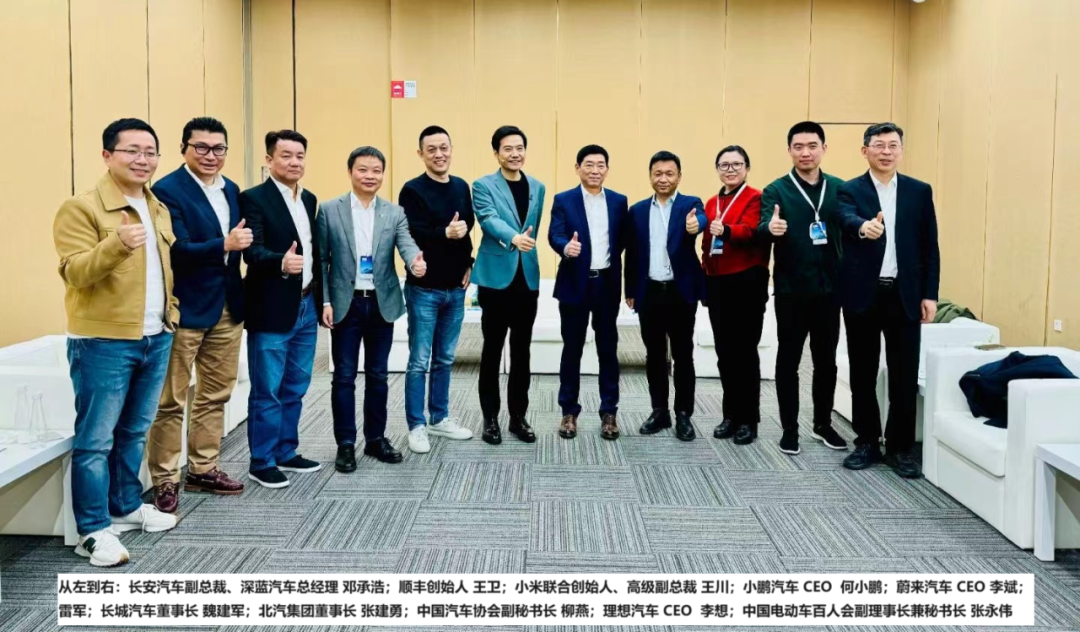
A widely shared photo also circulated before launch—featuring Lei Jun alongside industry leaders.
At the event itself, heavyweight peers were invited onstage, adding credibility and buzz.
Such amplification does more than boost visibility: it builds trust and authority.
Tsinghua Professor Zheng Yuhuang puts it plainly: “Everyone needs to understand marketing—yet 99% misunderstand it.”
Real marketing isn’t manipulation. It’s starting with the user—solving real functional and emotional needs. Most companies miss the latter entirely. That’s why so few succeed.
The “Not-To-Do” List
A cornerstone of strategic thinking is defining what you won’t do. That’s harder—and more powerful—than listing goals.
Apply this to life: clarify your boundaries, and complexity dissolves.
- Don’t believe in myths (e.g., overnight success, silver bullets)
- Don’t chase petty gains or gamble on shortcuts
- Don’t innovate for innovation’s sake
- Don’t start ventures without foundational preparation
- Don’t engage in unethical or harmful acts
- Don’t attack competitors—or speak ill of others behind their backs
- Don’t follow crowds or echo opinions without scrutiny
- Don’t waste time—on distractions, resentment, or unproductive rumination
The “Good Deeds Guarantee Good Returns” Fallacy
We’re taught early to cultivate empathy. But that lesson often carries a hidden trap:
If I treat you well, you must treat me well in return.
This implies “goodness” is transactional—and that moral behavior guarantees reciprocity.
Underlying this is a dangerous combo: empathy + fragility (“glass heart”).
Together, they breed disappointment, resentment, and conflict—visible in family rifts, workplace friction, and frayed friendships.
So what is empathy, really?
- Your kindness is yours alone—it doesn’t obligate others. Causality here is illusory; human responses are deeply uncertain.
- Empathy means stepping into another’s reality, not projecting your assumptions onto them. Doing what you think is kind is often just self-deception.
- True empathy is extraordinarily difficult—which is why the “I was nice → you owe me” loop persists: it’s easier than sustained, humble perspective-taking.
- Our education system rarely unpacks this. When we preach “good deeds bring good returns” without examining its logic or practicing alternatives, we plant seeds of cognitive distortion, emotional strain, and avoidable pain.