The Property Leasing Business Model
After the pandemic, many tenants vacated office and retail spaces en masse.
A friend seized that moment: he acquired large swaths of commercial buildings and malls—at low entry costs—totaling roughly 100,000+ square meters. Annual revenue now runs into several hundred million RMB.
Over the past few years, the model has stabilized and scaled profitably.
This business operates much like the trading intermediaries in the TV drama Prosperity: a modern-day comprador model.
The standard playbook? Leverage personal networks to identify undervalued assets, then lease them en bloc, outsourcing nearly all operations—property management, tenant services, maintenance—to third parties.
So aside from heavy capital requirements, the core team remains tiny—just a handful of people running a multi-hundred-million-RMB operation.
I asked him how they solved the capital problem.
He confirmed it’s the single biggest bottleneck—and cost. So they brought in a major backer. Given capital’s decisive role, the backer takes nearly half the profits; the rest is split among the team.
Beyond funding, the rest of the work is asset hunting: spotting high-quality properties at low prices, then moving fast to secure them.
But great assets at great prices attract fierce competition—so relentless relationship-building is essential. Dinner-and-drink sessions aren’t occasional; they’re routine.
When I met him, I asked if he’d like a drink.
He declined: “Can’t today—I had six bottles last night—with six people. My stomach’s wrecked.”
I joked, “Six bottles of beer?”
“No,” he said. “Six bottles of baijiu.”
Because of constant banquets, he shared an observation: small local restaurants are struggling, while top-tier establishments are booming.
Why? Because high-stakes dealmaking demands higher-grade settings. You can’t host five separate negotiation dinners at the same modest eatery—and you can’t downgrade the venue. The stakes raise the bar.
It really isn’t easy.
Music AI Tools
I tested Suno.ai’s V3—and was genuinely impressed. Try it yourself: <app.suno.ai>
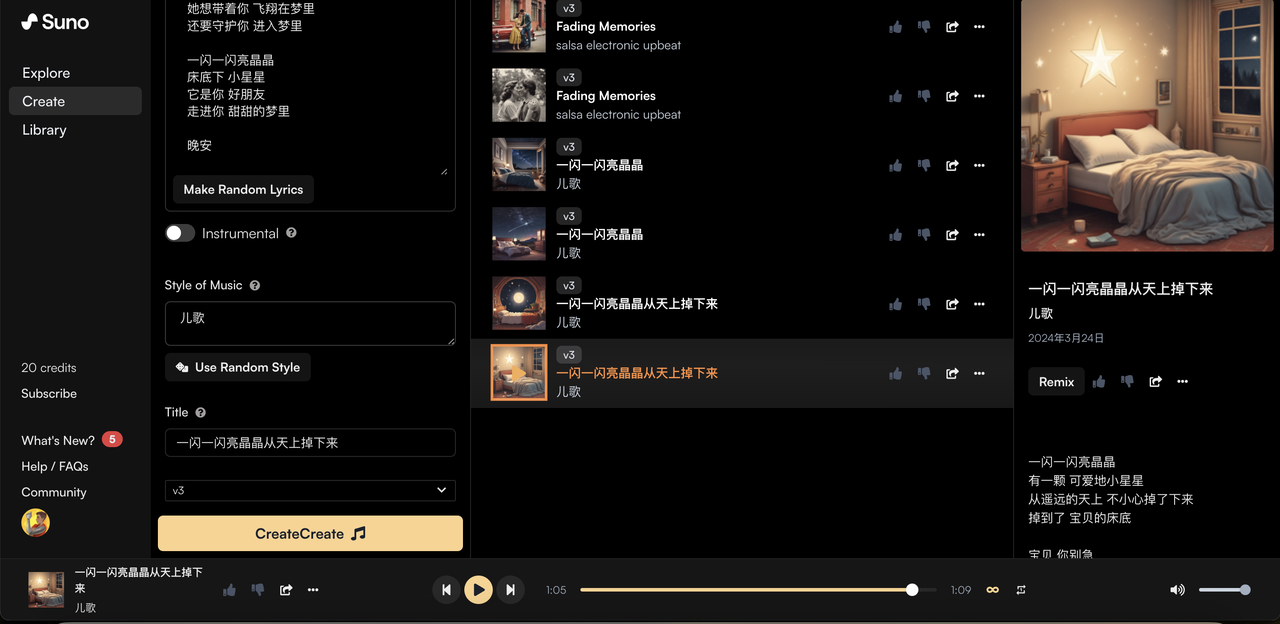
I entered lyrics and style prompts, clicked “create,” and got a polished track in seconds. I then imported it into CapCut, made a simple MV, and posted it on WeChat Video Channel “Old Yao’s Diary.”
The biggest shift I’ve felt this year? AI’s rapid, deep penetration across verticals—especially at the application layer. It’s accelerating far faster than last year.
How to Handle Workplace PUA
A niece called me, upset: her boss lacks competence—and regularly subjects her to psychological manipulation (PUA).
She listed examples. She wants to quit—but feels lost about how to respond. This is her first full-time job.
Finding a leader who truly sees, values, and supports you is rare. A great one can even redirect your life’s trajectory.
From her examples, it’s almost certainly PUA. Leaders with weak professional skills—or low self-confidence—often resort to undermining others to shore up their own sense of control.
So how should you respond? Here’s my take:
- Don’t follow a PUA leader. If you can’t change the environment, changing environments is the smarter move.
- PUA is rarely about objective critique—it targets people, not problems, because the perpetrator often lacks the ability to articulate facts clearly.
- Once you recognize that, your response becomes clear.
- Don’t fear it. PUA looks intimidating—but it’s hollow. Poke it, and it collapses.
- Letting someone unworthy sour your daily work experience is simply not worth it—mentally, emotionally, or professionally.
- So stand firm: when confronted, pivot straight to facts, specifics, and task-level discussion. Stay grounded in reality.
- Especially early in your career: be respectfully unapologetic. Prioritize your integrity and peace of mind. Even if you “lose” something in conventional terms—say, a promotion or bonus—you won’t regret it later.
The Maximum Regret Principle
If anxiety haunts you—even causing chronic insomnia—try this: the Maximum Regret Principle.
For any source of anxiety, ask honestly: What’s the absolute worst outcome? Can I truly bear it? If yes, stop worrying.
We must accept an objective truth: most things we attempt will fail—because failure is the default state of human endeavor.
Say a project risks losing several million RMB. If that loss is survivable, then anxiety serves no purpose. Clarity here eases mental strain—and cuts down massive, useless internal friction.
That doesn’t mean relaxing vigilance. Rather, it means cultivating calm first, so you can face risk and seize opportunity with clarity—not panic.
Overseas Blind-Box Business
A friend shared a venture: exporting China’s blind-box model overseas—and clearing $4–5 million USD in just a few months.
The model? An independent e-commerce site selling blind-box products. Customers select blindly online.
How did they drive traffic? The founder hired thirty native English speakers to livestream daily on TikTok—funneling viewers directly to the site.
Returns? Full no-questions-asked refunds—even for dissatisfied customers.
There’s real gambling energy here: some orders hit $10,000+ per customer.
A few takeaways:
- China is more competitive. Replicating hyper-competitive domestic models abroad—where saturation is lower—is a viable path.
- Regulatory environments overseas are often looser than China’s.
- Yes, “go global or die” is overblown—but the sentiment reflects reality: many overseas markets are less crowded, less regulated, and more open to experimentation.
- Want to test international waters? Start with a domain you already know well. Dive in—no need to wait for perfect conditions.
Who Should You Talk To?
- Seek out people who’ve delivered large, concrete results—not just ideas or theories.
- Ask two people to describe building a ¥100M project. One will say, “It’s doable,” and immediately outline three realistic paths—because they’ve done it. The other will hesitate, question feasibility, and get stuck in abstraction.
- That contrast builds real confidence—not false optimism, but grounded possibility. Even if your current skill set isn’t there yet, exposure to proven execution reshapes what you believe is possible.
- For example: when we pitched a new project, non-executors questioned its logic and scale. But founders who’d each built ¥300M+ businesses lit up—they saw the leverage points instantly and named the exact conditions needed to hit ¥100M. That kind of insight is irreplaceable.
Why Kids Lack Resilience
When children appear timid or indecisive outside the home, a key root cause is the sheer volume of daily negation they absorb.
Common reflexive phrases:
- “You can’t do that.”
- “Don’t do that—it’s dangerous.”
- “What’s the point of that?”
- “Look at you…”
- “Why are you always…?”
- “Don’t go…”
Accumulated over time, these statements don’t just correct behavior—they wire a child’s inner voice toward self-doubt and self-rejection.
Parents usually mean well. They call it “care.”
A better approach? Encourage principled risk-taking: safe exploration within clear boundaries.
In practice, though, most childhood “risks”—climbing, experimenting, negotiating, trying new social roles—are shut down before they begin.
Here’s the truth: every meaningful experience carries risk. Every meaningful growth involves discomfort—and sometimes pain.