Role Awareness and the Grand Time Perspective
There’s a kind of inner friction we call “serving Cao Cao while longing for Liu Bei.”
Most inner friction fits this pattern: thinking about work while at home; worrying about family while at the office.
The result? Poor performance in both domains—and often, self-deception disguised as virtue: “I’m just so conscientious.”
The ideal state is “serving Cao Cao with full presence”— a widely recognized idea: being fully here, now. That’s where flow emerges.
We all know it in theory—but practicing it consistently is the real challenge.
In my own experience, one method that’s proven effective is cultivating role awareness and a grand time perspective.
A role implies responsibility. Clear roles mean clear responsibilities.
No one lives a single-role life. You’re likely a son, father, grandfather, product manager, husband, teacher, student—sometimes all in one day.
We slip into roles instinctively—but mostly unconsciously, because we rarely pause to ask: What does this role truly demand of me? How do I do it well?
Doing any role well takes learning—even parenting, which spawns endless books precisely because it’s hard.
Role awareness is the first step. It’s not just about duty—it’s also about boundaries. Two main reasons people lack boundaries: (1) no role awareness at all, or (2) shallow understanding of their own role.
Time is irreplaceable and finite. A grand time perspective means knowing where your time must go—and where it actually goes. It means mapping time intentionally across your roles.
A quick audit reveals how scarce time really is. That awareness makes you cherish meaningful roles—and shed expendable ones.
You’ll savor moments with your child. You’ll protect time with your partner.
The Origin of Business
Over coffee with a seasoned strategist, we discussed an IP struggling to scale. His diagnosis cut deep: “Its intention isn’t big enough—and intention shapes commerce.”
I agreed completely. The origin of any business is its intention—the size of its “why.” That “why” determines its scope, resilience, and impact.
Intention arises from experience, passion, mission, and available resources.
Last year, a friend told me my company lacked a core. “What core?” I asked. He said: “A clear, compelling mission.” I spent weeks reflecting on that.
Zhang Bangxin, CEO of Haofuture, puts it plainly in internal talks: “The root of all roots is the original intention.”
Every problem traces back there. Intention is the core.
Intention is the future—because the future can act as cause, reshaping the present. You see it first; then you build it.
Yes, intention sounds abstract. But after years of navigating complexity, I’ve found it delivers concrete guidance at critical junctures—helping resist distractions, clarify trade-offs, and hold steady toward what matters.
Sources of Sustained Motivation
Jia Ling lost 100 pounds in one year for Hot Pepper Hot Pot—a feat worthy of admiration.
Two years ago, I lost over 30 pounds in three months—and kept it off.
My goal wasn’t appearance. It was health.
So I drafted a long-term principle and plan:
Principle & Goal: Achieve lasting physical health through science-based methods and sustainable habit formation.
Four Pillars of Health: Nutrition, movement, sleep, and emotional well-being.
- Balanced nutrition: Low-carb, low-oil, low-salt, zero added sugar—plus balanced micronutrients.
- Appropriate movement: Physical (aerobic + strength) + mental (mindfulness meditation).
- Restorative sleep: Deep, consistent, high-quality rest—trained via habits like napping for 5 minutes when drowsy.
- Positive emotion: Prioritize flow states, emotional stability, daily meditation, reading, learning, and doing what you love—fully immersed.
2023 Body Improvement Plan — Step-by-Step
- Nutrition (3 months): Shed excess fat by restructuring meals and building healthier eating habits.
- Emotion (ongoing): Train emotional regulation—through daily reading, learning, and mindfulness (to notice emotions as they arise).
- Sleep (ongoing): Improve quality—by adjusting bedtime, using meditation, and avoiding food 2 hours before bed.
- Movement — Strength (1 month): Daily morning knee and core exercises.
- Movement — Aerobic (ongoing): Three weekly morning runs + daily strength training.
- Nutrition (3 months): Gain lean muscle mass—while sustaining healthy eating, emotional balance, quality sleep, and consistent movement.
Progress So Far
- ✅ Lost 30 lbs in 3 months (Step 1).
- ✅ Emotional stability and regulation markedly improved (Step 2).
- ✅ Now sleep only 6 hours—yet deeply and restoratively; sleep habits steadily improving (Step 3).
- ✅ Knee and core strength increased—laying groundwork for aerobic endurance and long-term consistency (Step 4).
Some things look simple—until you try them. The biggest bottleneck? Not knowledge or willpower—but sustained motivation.
Once you commit to something, the hardest part isn’t starting—it’s not quitting. And the harder the goal, the more vital motivation becomes.
How to strengthen it? One of the most reliable ways is to assign clear meaning.
Example: Losing weight isn’t about the scale—it’s about becoming a healthier, more capable version of yourself.
Go further: quantify that meaning.
Example: Each pound lost = $5,000 of lifetime value. That changes everything.
The Life Index
I define the Life Index (I) by two dimensions: Length (T) and Quality (Q).
When we say someone “lived to 85,” we’re measuring T. With modern medicine, human lifespans don’t vary wildly.
What we overlook is Q—quality: physical health, sense of purpose (personal and social), depth of experience, richness of connection.
Together, they form a simple but powerful equation:
I = T × Q
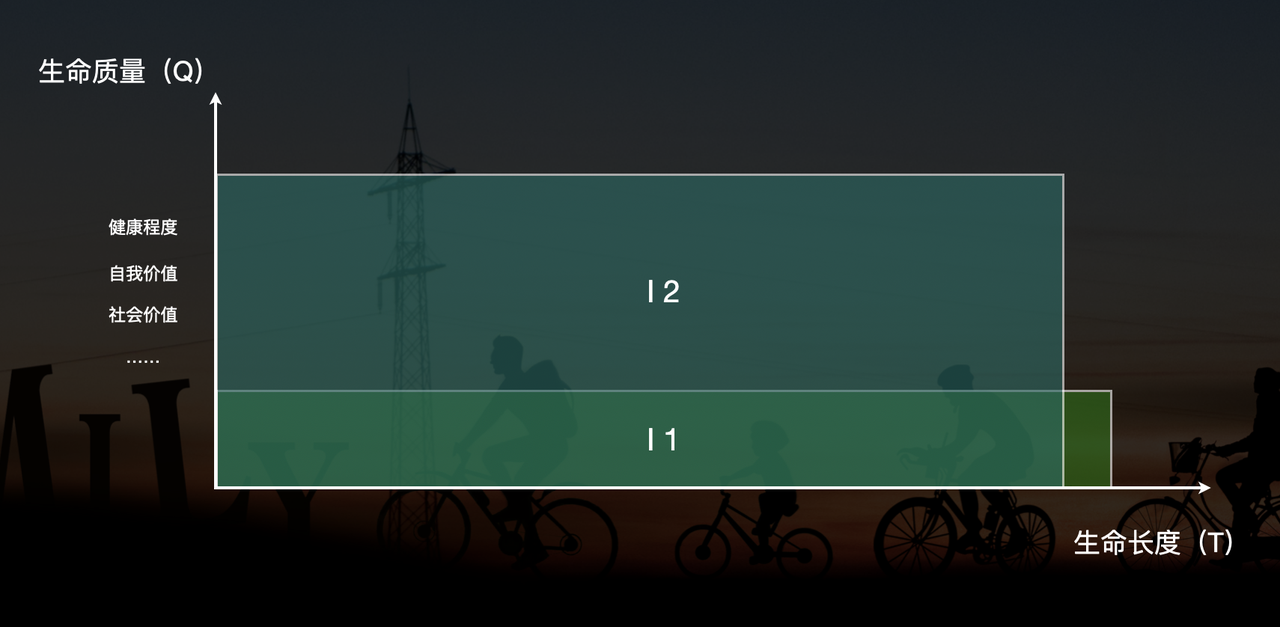
“Quality” is subjective—but the first step is recognizing its existence, its weight, and its personal significance. Standards differ. What matters is arriving at life’s end with quiet clarity—and no regrets.
On Intelligence
Re-reading a lecture on intelligence left me reflecting deeply:
- Intelligence isn’t magic—but without it, almost nothing works well.
- It’s the single strongest predictor of academic success—accounting for >50% of variance.
- Core components include attentional control, long-term memory, processing speed, working memory, logical reasoning, and spatial ability.
- High-IQ individuals tend to have more stable, fulfilling marriages. Low-IQ individuals are nearly 3× more likely to divorce within 5 years—and 16× more likely to father children outside marriage.
- Mortality risk for the lowest-IQ group is triple that of the highest-IQ group.
- High-IQ people demonstrate stronger risk awareness—e.g., far lower traffic-fatality rates.
- IQ is malleable: ~50% heritable; ~50% shaped by environment.
- Genes set the range; environment determines where in that range you land.
- Each additional year of formal education raises IQ by ~3.7 points.
- Non-educational “hacks” (e.g., music training, “right-brain” programs, breastfeeding) show little to no effect.
- Science-backed education—and lifelong learning—are the only reliably effective ways to raise intelligence.
- Higher IQ correlates strongly with higher emotional intelligence.