The Essence of Contracts: Protecting the Trustworthy, Deterring the Untrustworthy
A colleague once said, “Agreements are meant to guard against the trustworthy.”
I disagreed: the essence of an agreement is to protect the trustworthy—and deter the untrustworthy.
What does that mean? Simply this: when things go wrong, a well-structured agreement should maximize protection for the party acting in good faith.
Since its purpose is to protect the trustworthy, the agreement must be taken seriously—but only if you’re acting in good faith yourself, and only if you assume the other party is too.
In fact, an agreement reveals how the other side perceives you.
For example, if the other party bears zero risk—yet binds you with clauses requiring a ¥1 million penalty for breach, while facing no consequences themselves—that’s an asymmetrical clause. And it signals a clear assumption: they expect you to act in bad faith.
So one core principle in drafting agreements is reciprocity: risks and rewards must be balanced.
Lawyers often draft agreements assuming the other side is untrustworthy—loading them with lopsided terms from the start. Then both sides’ lawyers spend weeks negotiating, mostly undoing each other’s overreach. Time vanishes. Clarity suffers. Trust erodes before work even begins.
Designing a Course Syllabus
Over the weekend, I drafted a syllabus for new livestream hosts and signed IPs joining our company. But I held to one non-negotiable standard: this content must stand out in the open market—so compelling that, at first glance, it looks like better value than those ¥3,000+ courses flooding the internet.
Two principles guided the design: logic and plain language.
“Logic” means building a structure so clear and simple that both the designer and the learner feel cognitive certainty. That certainty isn’t just nice—it’s calming. It tells the brain: this makes sense; I can follow this.
“Plain language” means writing entirely from the learner’s perspective—using numbers, stating conclusions upfront, and showing concrete outcomes. No jargon. No fluff. Just what they’ll gain, and how fast.
Stick to these two rules, and your syllabus won’t be mediocre.
Here’s a comparison of two versions:
Version One
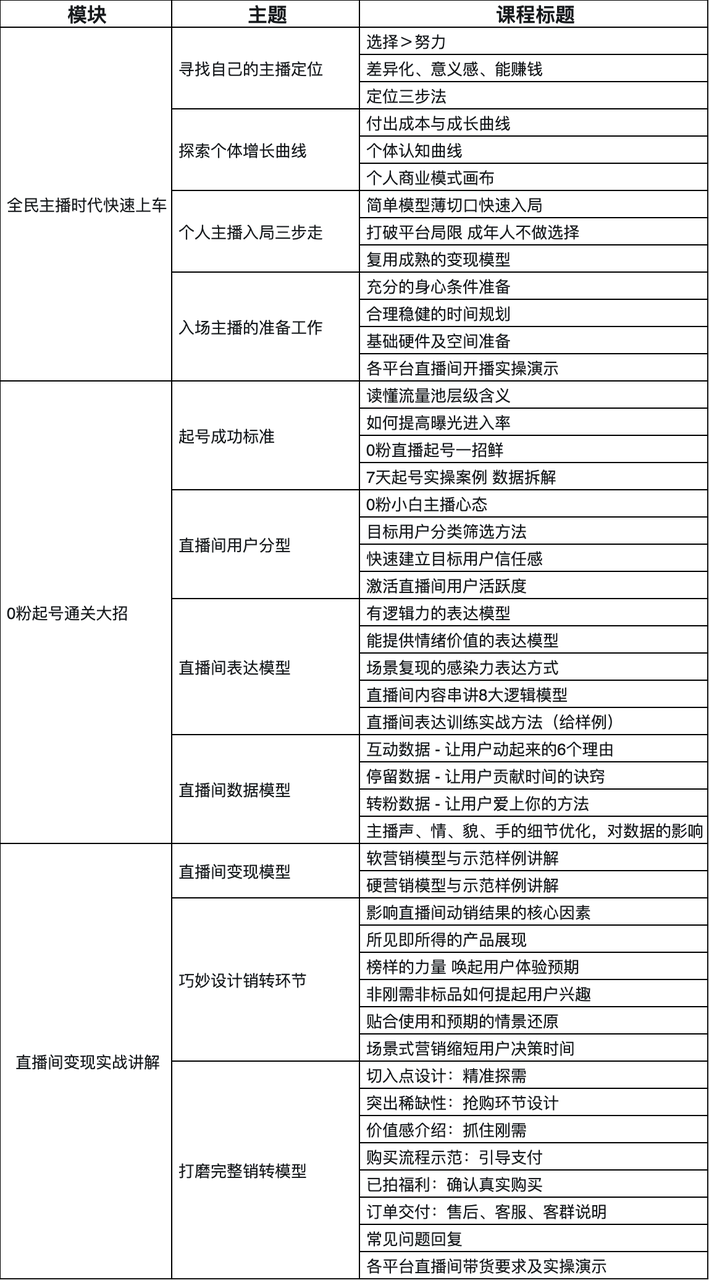
Version Two

Adding Friction to Decisions
We make countless decisions daily—often on autopilot. Speed feels efficient. But relying on instinct alone is precisely why many of us stay stuck in mediocrity.
Especially for high-stakes choices—buying a home, changing jobs, getting married, choosing a school—each one reshapes your life trajectory. Even I’ve caught myself defaulting to gut reactions in moments like house hunting.
To break free from shallow thinking, start with decision discipline. A wrong choice renders effort meaningless.
So deliberately add friction to your decision process.
For example: in conversations, force yourself to pause for three seconds before replying—not to delay, but to interrupt the reflex. Over time, your answers become sharper, less reactive, more reasoned.
Or for big decisions: impose a one-week cooling-off period, plus a simple pros/cons table. Do this consistently, and you’ll notice something startling—many “urgent” decisions shrink into irrelevance. They weren’t important. They were just loud.
Our company applies this too. Every host—whether signing a contract or joining full-time—must complete a 15-day intensive training period, followed by a formal presentation and Q&A. That barrier isn’t bureaucracy. It’s a filter—raising reliability, reducing churn, and boosting long-term collaboration efficiency.
In 2024, Earn Quietly
I chatted recently with a longtime friend via WeChat. His project has finally gained traction—and it’s now actively supporting our work.
Throughout our exchange, one phrase kept appearing: “earn quietly—don’t share.”
Truly profitable ventures rarely shout. They operate under the radar. If you hear about a “hot” money-making opportunity, it’s usually already saturated—or worse, engineered for others to profit off your entry.
My team and I see this constantly: the moment something feels obviously lucrative, it’s often too late. Jump in, and you’re likely the last to board—and the first to get burned.
Don’t Take Yourself (or Others) Too Seriously
This principle is simple but powerful: treat everyone the same—not because everyone is equal in status or output, but because over-indexing on status wastes energy.
We’re often kinder to strangers than to family—more patient with clients than with colleagues. That inconsistency drains us.
Or consider this: a teacher earning tens of millions annually piles on self-assigned titles, hires an “assistant,” and insists all small collaborations go through that assistant—as if the title itself proves competence. It doesn’t. It just adds noise, slows action, and feeds ego instead of impact.
Taking yourself too seriously—or others—distorts focus. Stay grounded. Prioritize the problem, not the person. In uncertain or difficult environments, that clarity is your only real leverage.