Three Years From AGI
Ray Kurzweil is one of the most representative futurists in the United States. In an interview, he shared the view that around 2045, humans plus AI may become a new species. Human intelligence as a whole could rise by 1,000 times. By then, we may enter a completely different world.
AGI means AI reaching human-level intelligence. More precisely, it means AI reaching expert level across all fields, not average human level.
For example: medicine means top doctor level, law means top lawyer level, and programming means top engineer level.
True AGI is not only strong in every field. It can also integrate insights across thousands of fields and make comprehensive judgments that no single human could make alone.
People no longer seriously debate whether AGI will arrive. The debate has shifted to whether AGI will be good or bad for humanity.
The next ten years will be an extremely important transition period. It may be understood as:
The next 10 years ~= the change of the past 100 years ~= the change of the past 100,000 years.
To live through these ten years is a rare kind of luck. We get to witness, and perhaps participate in, this super transition.
Three core logics help explain the next decade:
- The world grows exponentially, not linearly.
- Humans will not simply be replaced by AI. We will merge with AI. Human plus AI will become normal. In the future, you may not be able to tell whether an idea came from you or from AI. Computational intelligence may enter our nervous system through nanotechnology and become part of our thinking.
- The singularity is not one instant. It is a process. The AGI moment will happen gradually.
What will the impact be?
First, work will be reconstructed. Many people may no longer need traditional work, while material abundance increases.
Second, startup opportunities will explode. For entrepreneurs, this is a very fortunate moment. The future will be AI plus every industry.
Third, we will face a social problem, not just a technical one: adaptation. Humanity is not ready yet, or at least will adapt slowly. Many companies and many people are still in denial.
There is another shocking prediction: after 2032, we may reach longevity escape velocity. Every year, technology may extend life by more than one year. In theory, people could keep living indefinitely. That is startling.
The core reason is that AI can simulate biological systems and test millions of treatment plans in a week. Medicine becomes a computational problem, and computing power may become many times stronger than it is now.
We should work hard to live until 2032, then keep exercising and live well until 2230.
Video podcast: Kurzweil interview
Qiaomu’s interpretation: Qiaomu blog post
The Mindset of Health
Health cannot be emphasized enough.
Recently, I like to express it this way: build your own health system around five core elements: sleep, exercise, diet, emotion, and medicine.
They support one another.
The methods that are truly useful over the long term and create compounding effects for health usually do not require much money.
The key is long-term consistency.
Among these five elements, sleep is still seriously underestimated.
Sleep is not just rest. It is more like the base switch of the entire health system.
When sleep is good, the body has repair capacity, emotions have a buffer, the brain has judgment, exercise has recovery, and diet control becomes easier.
Finite Games and Infinite Games
Every person faces two kinds of games in life: finite games and infinite games.
Finite games pursue results and rely on competition.
Infinite games pursue the long term. They rely on win-win relationships, collaboration, and mutual nourishment.
In many situations, these two games exist at the same time.
A single deal, a bid, or a collaboration often has strong finite-game characteristics.
But a person’s reputation, an organization’s capability, an industry’s ecosystem, and a company’s brand clearly carry infinite-game characteristics.
The important thing is to do more infinite-game things even when you are playing a finite game.
More broadly, many things start with strong finite-game properties, but through better cognition and action, they can gradually move toward an infinite game.
Take relationships with competitors. At first, they often look like finite games.
Everyone focuses on the same customer or several projects, on immediate competition, and on short-term wins and losses.
But if you extend the time horizon, competitors can also become allies.
People can collaborate, share, help form industry standards, maintain the industry ecosystem, and make the market larger together.
In this way, what originally looked like a zero-sum relationship can grow new incremental value and even long-term friendship.
Another example is the relationship between a company and its employees. If it is only about salary, assessment, and control, it easily slides toward a finite game.
Both sides focus more on current gains and losses.
But if the relationship upgrades toward capability building, long-term incentives, and shared outcomes, such as building an AI agent organization together, it becomes a shared effort to construct new organizational capability.
Employees are no longer just executors. They become co-builders of new organizational capability.
The relationship becomes more stable, and the organization becomes stronger.
Strong players care more about how to keep themselves, their relationships, and their organizations at the table.
Community Advertising
This week, I saw two small advertising cases in group chats. The contrast was strong.
One was a positive case. One was a negative case.
- Positive case
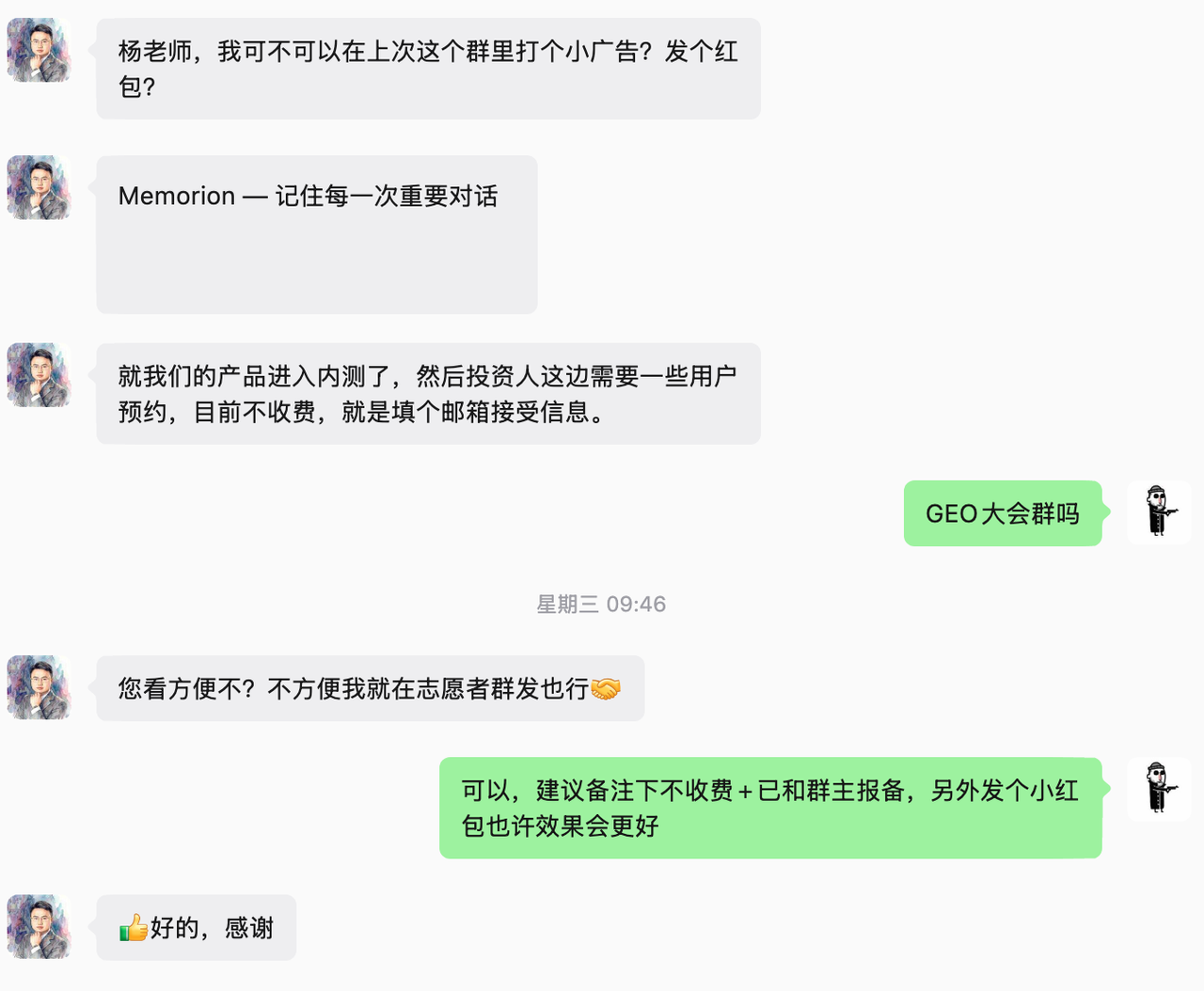
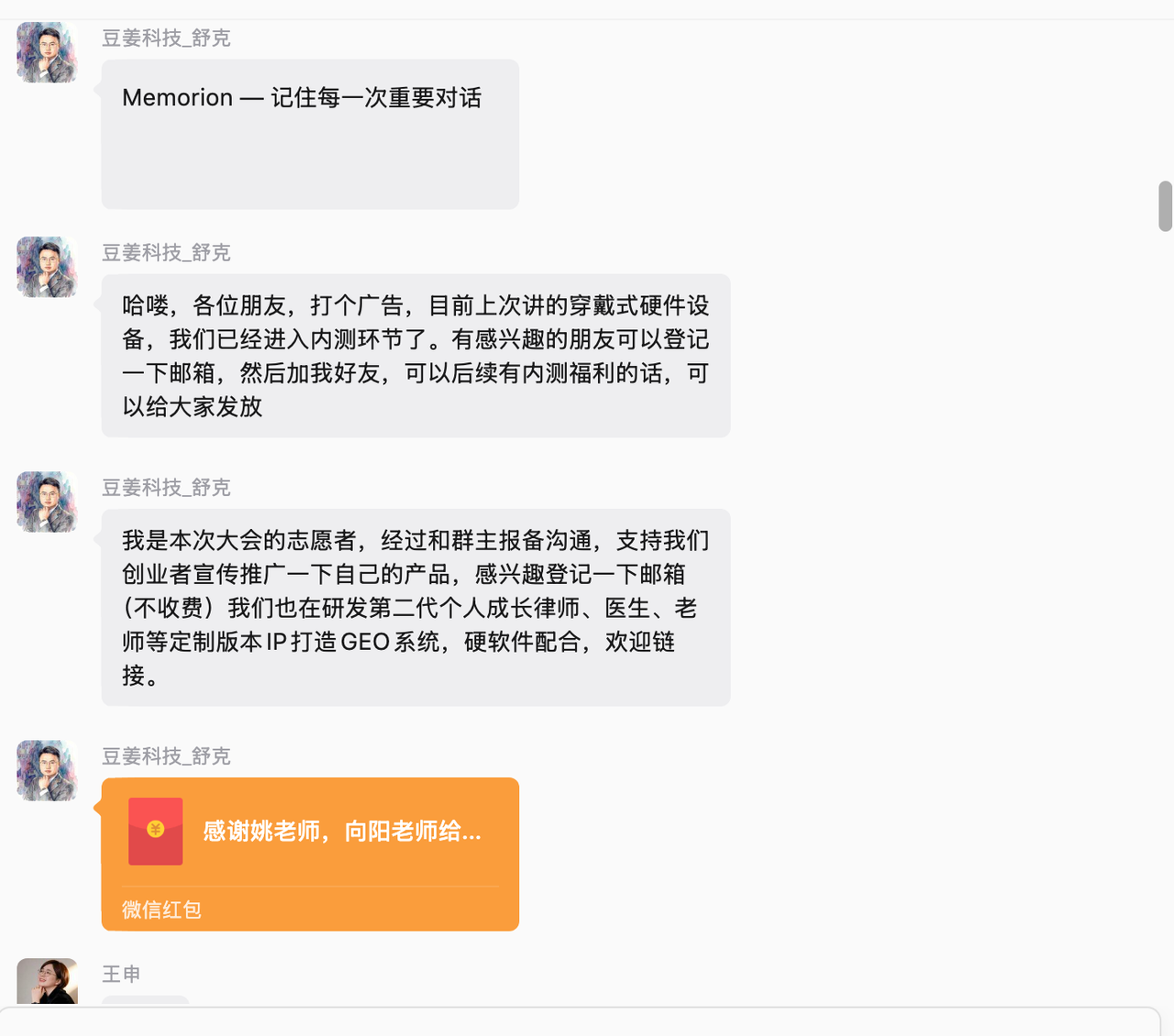
A volunteer friend from the GEO conference first messaged me privately, explained the need and background, and after getting my permission, posted a free beta-test message and a red packet in the large group. The result looked good.
- Negative case
In a quiet group, someone suddenly posted an unclear advertisement. Some people felt uncomfortable and blocked the person.
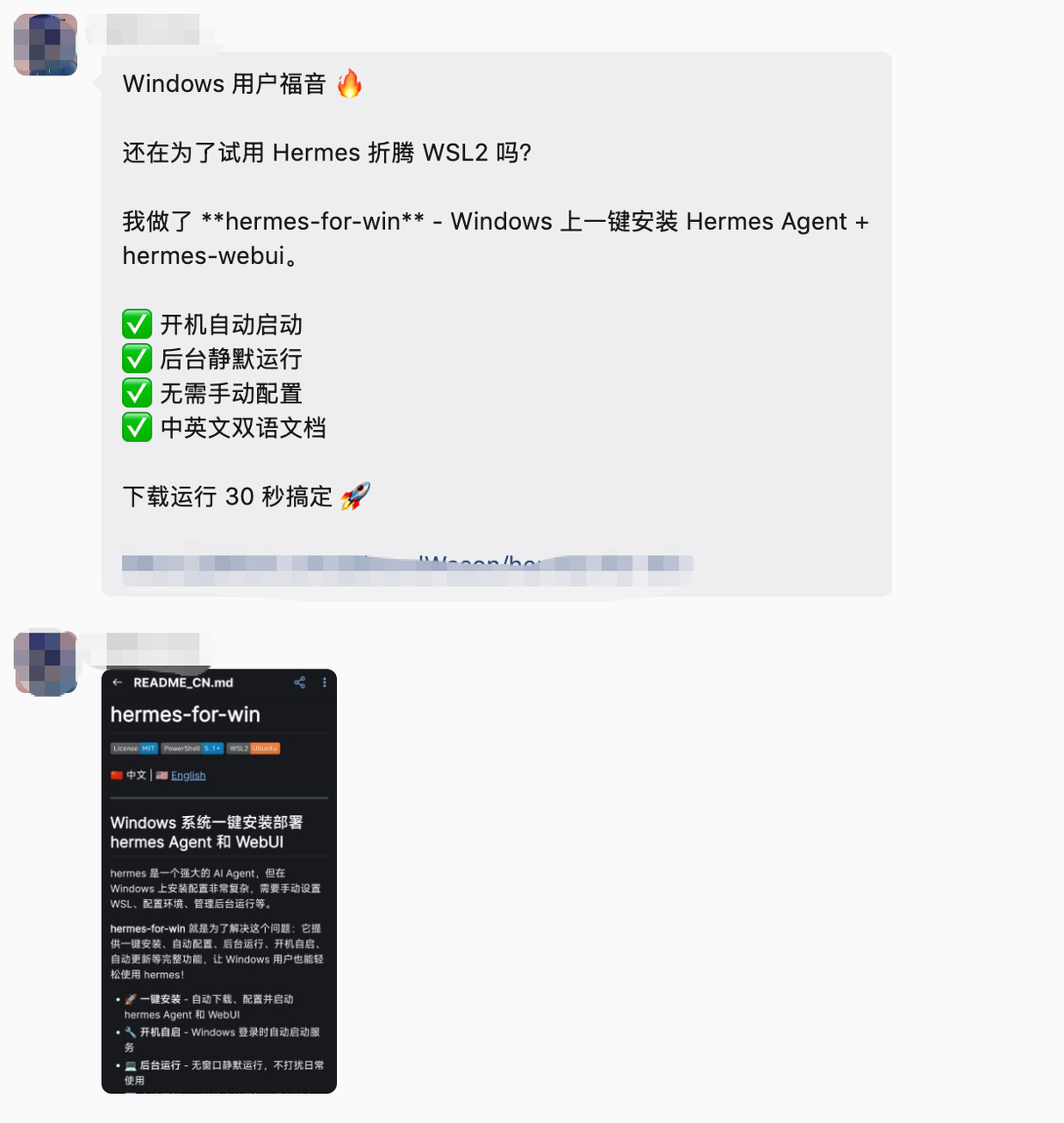
The problem was “suddenly breaking into someone else’s attention.”
A quiet group usually has an implicit order. Members do not expect to be sold to or promoted at.
In that situation, the first reaction is often not “what is this product?” but “why are you bothering me here?”
The key difference between the two cases is that the first completed “relationship and permission” before entering promotion, while the second rushed directly into transaction and extraction.
A group is essentially a small trust community.
This trust system usually depends on the group owner and members maintaining it together. Once ads and spam spread, trust collapses quickly, and the community dies.
For community advertising, the right order is: build the relationship, get permission, then talk about promotion and conversion.
When the order is right, an advertisement may be treated as useful information. When the order is wrong, it becomes interruption.
A group is not a traffic pool for harvesting. It is first a trust field. Only then can it possibly become a transaction field.
Feishu CLI
I needed to send quarterly bonuses to the team. This time I used Feishu CLI, and the efficiency was high.
The steps were:
- I used voice input to explain to AI the principles and logic behind this quarterly bonus distribution.
- Through Feishu CLI, I had AI fetch and organize each person’s daily work lists, outputs, projects, and OKR status from the past quarter. Then it scored them across six dimensions I cared about and calculated a weighted total.
- Based on this multi-dimensional weighted score table, it calculated each person’s quarterly bonus.
- I then adjusted weights, nonlinear rules, subjective factors, and rounding rules.
- After several rounds of adjustment, I asked AI to generate private Feishu messages for each person. After reviewing them, I used my Feishu CLI bot to send one-on-one messages to each person receiving a bonus.
- Finally, through
yao-meta-skill, I automatically generated a performance Skill.
If you care about building a team knowledge base, Feishu CLI is a very good experience.
A Story About My Daughter
1.
On the way to kindergarten, my daughter suddenly said, “I am a pig.”
I asked, “Why?”
She said, “Because I was born in the Year of the Pig.”
Then I asked, “What kind of pig are you?”
She said, “A human pig.”
I asked again, “What kind of human pig? For example, an understanding human pig, a clever human pig, a cute and smart human pig, or a curious human pig?”
I wanted to guide her toward giving herself some positive labels.
But she said, “I am a human pig who is on the way to kindergarten.”
That gave me three feelings:
- Live in the moment and do not be trapped by labels.
- Language creativity.
- Logic.
2.
My wife was helping our daughter with homework and scolded her until she cried.
My daughter felt wronged and went to the side to keep crying.
After a while, when she had calmed down, she walked to her mother and said calmly:
“Mom, next time can you not yell? If you speak normally, you can still achieve the goal.”
My wife said, “Okay. I will try to pay attention next time.”
What an angel child.
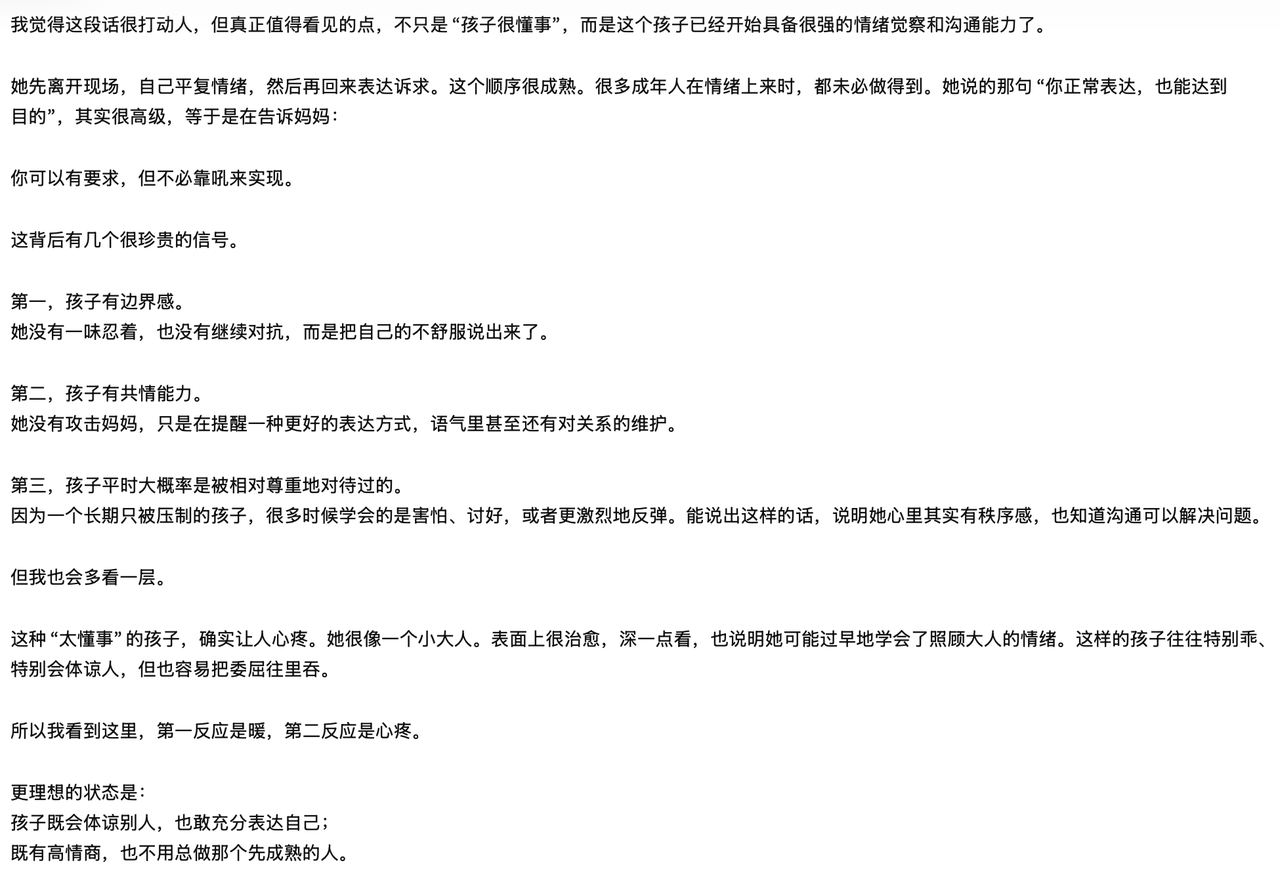
I asked GPT for its view. It replied: