The Essence of Open Source
Tom, founder of Open Design, recently appeared on WaytoAGI’s “Future Silicon World” podcast. His reflections on GitHub and open-source projects resonated deeply:
- Open source is, at its core, open collaboration—a consensus mechanism.
-
GitHub is far more than code backup. It provides a shared infrastructure enabling people across countries to co-create great products—because they share a common understanding of the problem.
Why do strangers collaborate? Because they’ve converged on a shared problem—and a shared vision for solving it.
-
The most vital metric of an open-source project is not stars or downloads—it’s contributor count. This number reflects real-world alignment: how many people globally have adopted the project’s purpose, built trust in its direction, and chosen to invest their time. That alignment is competitive advantage.
- With consensus established, energy shifts toward user value: solving real problems, validating meaningful code, and delivering tangible utility—not just technical elegance. These are the hardest, most essential skills.
Open Design is a local, free, open-source design tool powered by a local agent—built to replace Figma and Claude Artifacts. As a downloadable desktop app, it supports prototyping, admin dashboards, presentations, marketing landing pages, posters, and even HTML-based video.
Launched just over a month ago, it’s already garnered 60k GitHub stars and 338 contributors. Globally, only ~200 repositories have ever crossed 60k stars—and fewer than 10 have done so within one month. Open Design’s rapid traction isn’t pure luck—it’s the result of intentional design, clear positioning, and deep alignment with unmet needs.
Trust as Strategic Asset
Over dinner, a friend shared a telling anecdote:
He was stalled on a critical project step—directly blocked by the CEO’s hesitation. Weeks later, the CEO reached out unprompted: “I saw your name in a research paper featured in a Douyin short video. Let’s finalize the agreement—right away.”
Once the CEO had external validation—proof of authority, credibility, and relevance—the decision barrier dissolved.
That’s trust as strategic asset: not just personal rapport, but externally verifiable signals—published work, citations, public recognition, consistent output. These signals don’t replace dialogue—but they enable decisive action where ambiguity once paralyzed progress.
An Anti-AI Design Guide
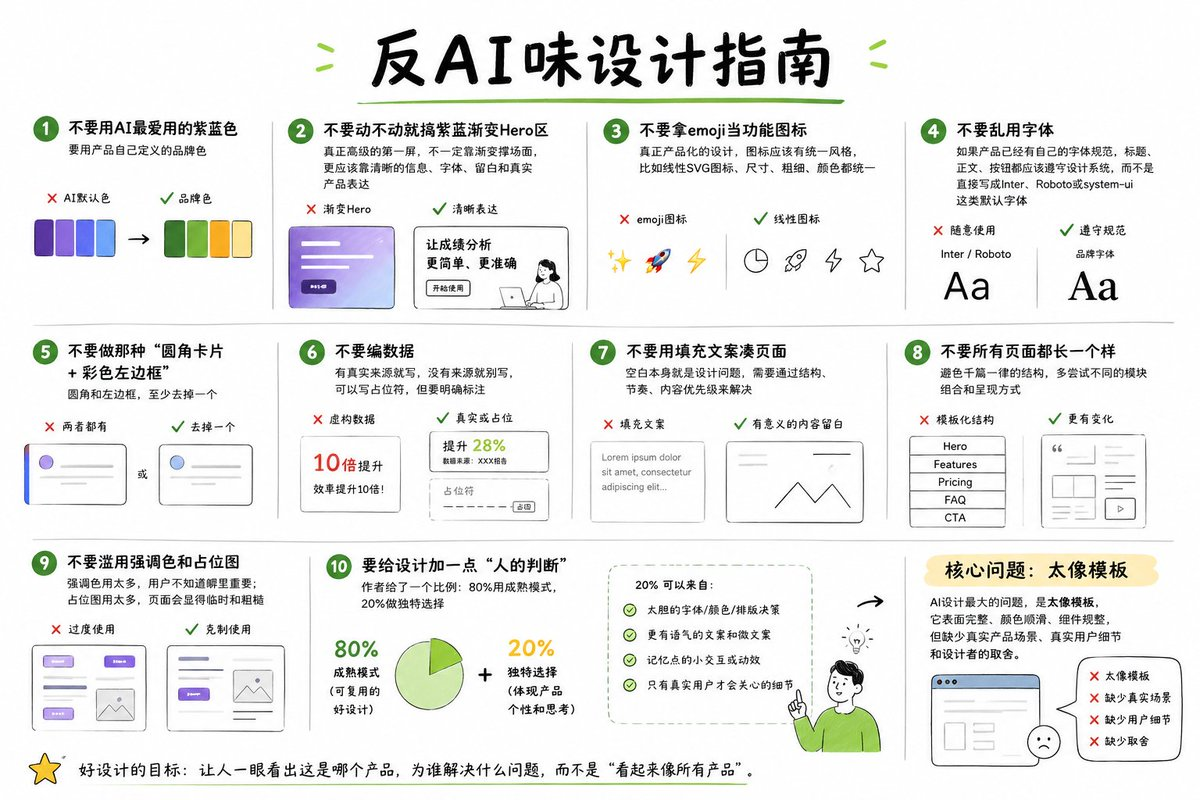
Open Design’s GitHub repo hosts a standout document: Anti-AI Slop Design Guide. Its principles cut to the heart of what makes design feel human:
- Ditch AI’s default purple-blue palette. Use your brand color—intentionally.
- Skip the hero-section gradient. Great first impressions come from clarity—not color transitions. Prioritize hierarchy, typography, whitespace, and authentic product expression.
- Replace emoji “icons” with cohesive, scalable SVG icons—consistent in weight, size, and tone.
- Stop defaulting to Inter, Roboto, or system-ui. Choose fonts deliberately—and justify why.
- Avoid the “rounded card + colored left border” cliché. At least one element must break the pattern.
- Never fabricate data. Cite sources—or label placeholders explicitly.
- Don’t fill voids with lorem ipsum. Emptiness is a design challenge—not a gap to patch. Solve it with structure, rhythm, and content prioritization.
- Resist visual uniformity across pages. Variation signals intention—not inconsistency.
- Use accent colors and placeholder images sparingly—not as crutches.
- Inject human judgment: aim for ~80% proven patterns, ~20% thoughtful deviation.
AI-generated design often looks polished—but feels hollow. It’s structurally sound, chromatically smooth, and component-perfect—yet lacks lived-in context, user-specific nuance, and the designer’s conscious trade-offs.
Three Stories of Elder Creativity
Story 1: An 81-year-old woman in South Korea lives alone—with Hyodol, an AI companion robot. It reminds her to eat and take medicine. When she returns home, it says, “Grandma, you’re back—I missed you.” She carries it on her back like a child. To her, Hyodol isn’t hardware—it’s kinship. Source: restofworld.org
Story 2: A nursing home in Australia built a full-scale replica train carriage—real seats, real tables, real afternoon tea. Outside windows? VR-rendered Alpine vistas. Residents dressed formally, sipped tea, and “traveled” across continents—reclaiming joy, memory, and agency. Source: cha.org.au
Story 3: A learner in my AI course—nearing 70—mastered vibe coding, iterated multiple versions, and launched a public eye-health website. Last week, she shared her story (x.com); this week, her traffic stats:
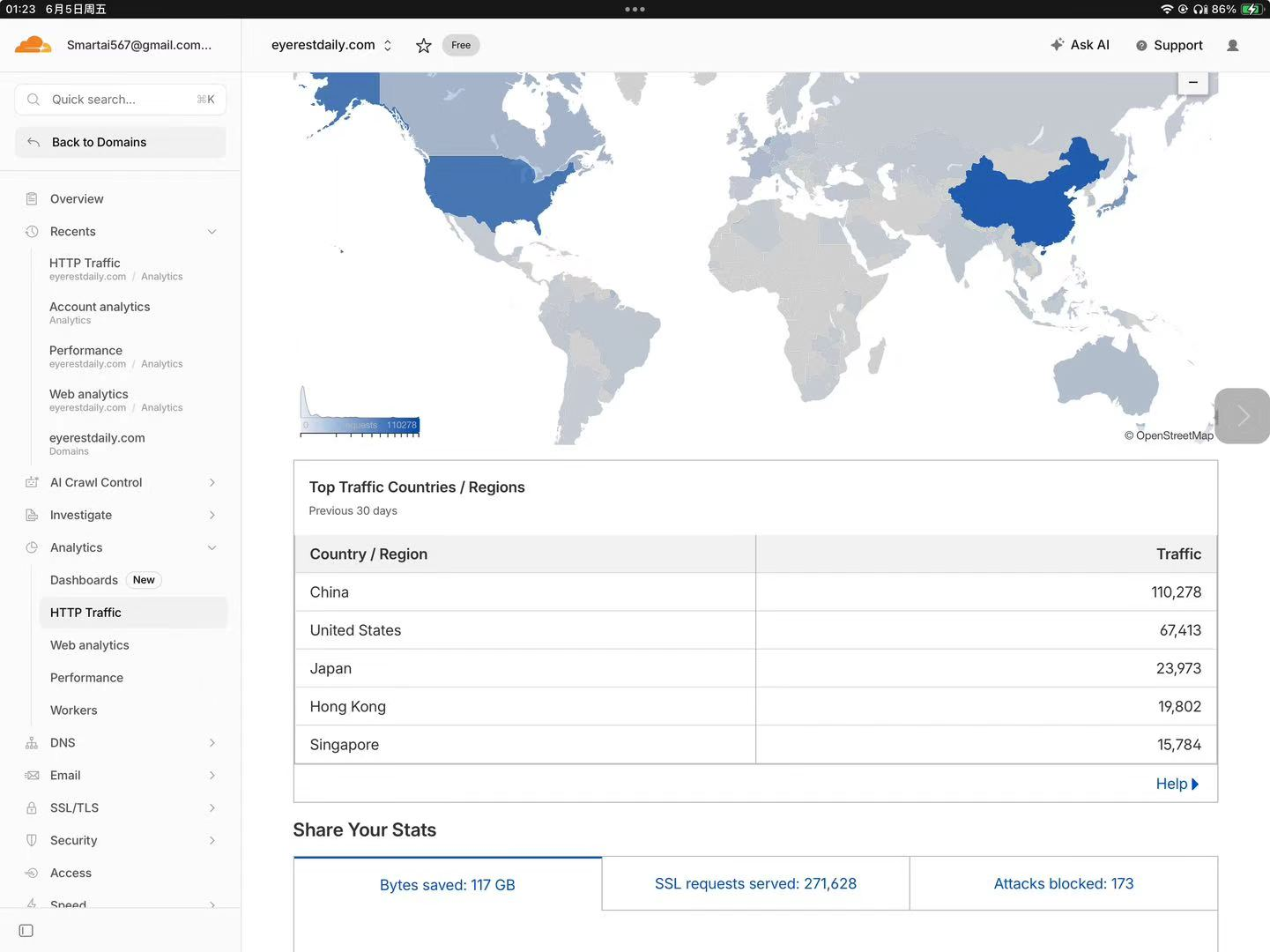

Elders need care—and they also crave creation. With AI as amplifier, their experience, taste, and judgment translate into real impact. That vitality is worth emulating.
A Five-Step Skill Design Method
Here’s how I now approach building high-leverage Skills:
-
Define the outcome.
Before writing a single line: What exactly should this Skill produce? What does “done” look and feel like? What are the non-negotiable standards?
-
Align on standards.
Test those criteria with AI—refine them through iterative dialogue until they’re concrete, measurable, and shared.
-
Conduct deep research.
Feed GPT-5.5 Pro (or equivalent) your outcome definition. Ask for: foundational theory, precedent cases, design logic, and—if internal docs exist—systematic synthesis + external benchmarking.
-
Digest into method.
Study the output. Extract principles, workflows, constraints, and mental models—not just facts, but how the domain thinks.
-
Codify with meta-Skill.
Use
yao-meta-skillto formalize the method: feed it your research, rationale, edge cases, and examples. Let Codex or CC generate the final Skill—grounded, extensible, and self-documenting.
Writing a Skill is intense “learning-by-teaching.” You can’t codify what you haven’t truly understood. By the time the Skill ships, your grasp of the subject is rarely shallow—it’s structured, tested, and actionable.
The Expert Skill
What defines true expertise? Two traits stand out:
- The ability to define boundaries—to say clearly what’s in and out of scope.
- The capacity to make accurate judgments under ambiguity—with minimal context, sparse data, or shifting conditions.
So: How do you rapidly master a new field? By building, in hours, a reusable cognitive scaffold: one that’s explainable, verifiable, and transferable.
The yao-expert-skill does exactly that:
- Input any industry or topic → AI maps its boundaries, then decomposes it into categories, value chains, key players, policy levers, risks, and opportunities.
- Outputs a learning-ready report—integrating value-chain analysis, competitive dynamics, lifecycle stage, regulatory barriers, keyword flashcards, a guided tutorial, and Feynman-style self-tests.
It doesn’t just summarize—it structures understanding. I tested it on GEO; the resulting report reshaped how I see the field—offering fresh angles, overlooked constraints, and immediate next steps.
GitHub repo: yao-expert-skill Reference materials: yao-expert-skill reference materials Sample report (GEO-China demo): GEO demo report
On Problems and Proposals
Spotting a problem is easy. Understanding it is hard.
Offering advice—especially without context, constraints, or history—feels helpful. But it’s often low-cost opinion masquerading as insight.
In teams, we constantly notice process gaps, collaboration friction, or structural inefficiencies—and instinctively reach for fixes. Yet if a problem persists, it’s rarely accidental. It may stem from:
- Skill gaps or incentive misalignment,
- Organizational inertia or legacy systems,
- Resource scarcity or competing priorities,
- Or—most likely—a pragmatic compromise under real-world limits.
So practice restraint:
- Notice the problem—but don’t rush to name it.
- Acknowledge it—but don’t rush to solve it.
- Sit with it. Probe gently: Why does this exist? What does it protect? What would breaking it cost?
Only after mapping causes, trade-offs, and hidden dependencies can your proposal be responsible—not just clever. And only then does change become possible.
In short: Before acting, think deeper.