The Value of Meta-Skills
The value of a meta-skill is still seriously underestimated.
Two years ago, when Xiangyang and I were studying prompts, we spent a lot of time refining our own meta-prompts. Later, those meta-prompts became extremely useful for prompt generation, task decomposition, and solution design.
This year, as we have been working on Skills, we have also spent considerable time building our own meta-skills.
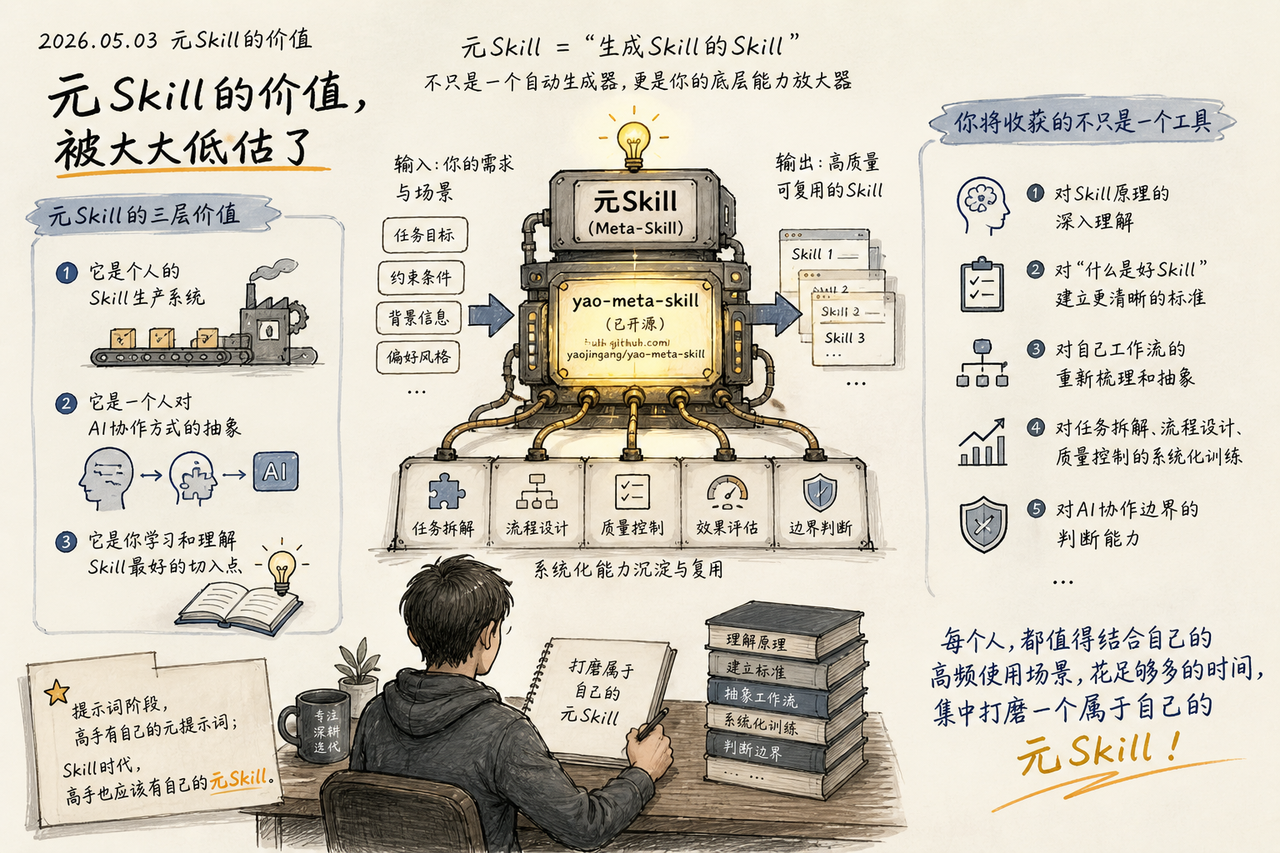
A meta-skill can be understood as “a Skill that generates Skills.”
For example, my own meta-skill, yao-meta-skill, is already open source.
But if we only see it as an automatic generator, we are still underestimating it.
In my view, a meta-skill has at least three layers of value:
- It is a personal Skill production system.
- It is an abstraction of how a person collaborates with AI.
- It is one of the best entry points for learning and understanding Skills.
After several recent conversations with my team, I have become even more convinced that meta-skills deserve far more attention.
Everyone should spend focused time building a meta-skill around their own high-frequency use cases.
What you gain from that process is not just another tool. You also build more fundamental capabilities:
- A deeper understanding of how Skills work.
- A clearer standard for what makes a good Skill.
- A structured review of your own workflow.
- Systematic training in task decomposition, process design, and quality control.
- Better judgment about the boundaries of AI collaboration.
In the prompt era, strong AI users had their own meta-prompts.
In the Skill era, strong AI users should also have their own meta-skills.
Why Skills Matter
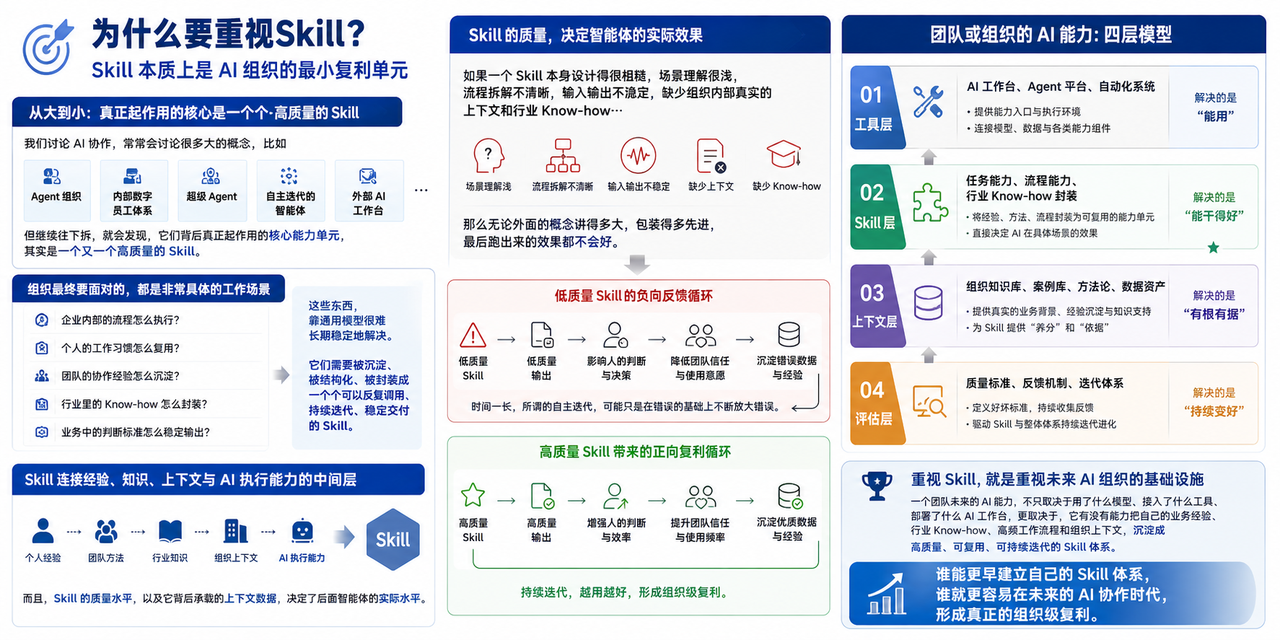
A Skill is the smallest compounding unit of an AI organization.
When people discuss AI collaboration, they often jump to large concepts: agent organizations, internal digital employee systems, super agents, self-improving agents, or external AI workspaces.
But if we keep breaking those ideas down, the real operating units behind them are high-quality Skills.
No matter how the language changes in the future, every organization still has to deal with concrete work:
How should internal processes run?
How should personal working habits be reused?
How should team experience be preserved?
How should industry know-how be packaged?
How should business judgment become stable and repeatable?
General-purpose models alone cannot solve these problems reliably over the long term.
These capabilities need to be captured, structured, and packaged into Skills that can be repeatedly called, continuously improved, and consistently delivered.
A Skill is the middle layer that connects personal experience, team methods, industry knowledge, organizational context, and AI execution.
The quality of a Skill, together with the context data behind it, determines the practical capability of the agents built on top of it.
If a Skill is poorly designed, shallow in its understanding of the scenario, unclear in its workflow, unstable in its inputs and outputs, and disconnected from real organizational context and industry know-how, then no matter how advanced the outside packaging looks, the result will not be good.
It may even create a negative feedback loop.
A low-quality Skill keeps producing low-quality output. Low-quality output then affects human judgment, team trust, and later data accumulation. Over time, what people call self-improvement may simply become error amplification.
The underlying logic is simple: to take Skills seriously is to take the infrastructure of future AI organizations seriously.
A team’s future AI capability will not only depend on which model it uses, which tools it connects, or which AI workspace it deploys. It will depend even more on whether the team can turn its business experience, industry know-how, high-frequency workflows, and organizational context into high-quality, reusable, and continuously improving Skills.
I think of organizational AI capability as a four-layer model:
- Tool layer: AI workspaces, agent platforms, automation systems.
- Skill layer: task capabilities, workflow capabilities, packaged industry know-how.
- Context layer: organizational knowledge bases, case libraries, methodologies, data assets.
- Evaluation layer: quality standards, feedback mechanisms, iteration systems.
The teams that build their Skill systems earlier will be more likely to create real organizational compounding in the AI collaboration era.
The Value of a Great Deck
A friend shared an interesting story with me.
How did one of China’s largest SEO companies win big enterprise accounts?
One key tactic was simple: they made their decks incredibly thorough.
How thorough?
Every client proposal deck started at 150 pages or more.
Once the project moved into execution, the day-to-day work of the operations team was often just two things: buying backlinks and writing daily reports.
But with that proposal strategy, they won many large accounts.
The logic of the deck was to exhaustively list every problem across the client’s websites and tell every possible story around those problems.
After seeing a 150-page proposal, a contract under RMB 100,000 almost felt too small to mention.
Many times, clients are not only buying the plan itself. They are also buying a feeling of professionalism.
In business, that feeling is often created by density, structure, detail, and presentation.
How to Read a Business Signal
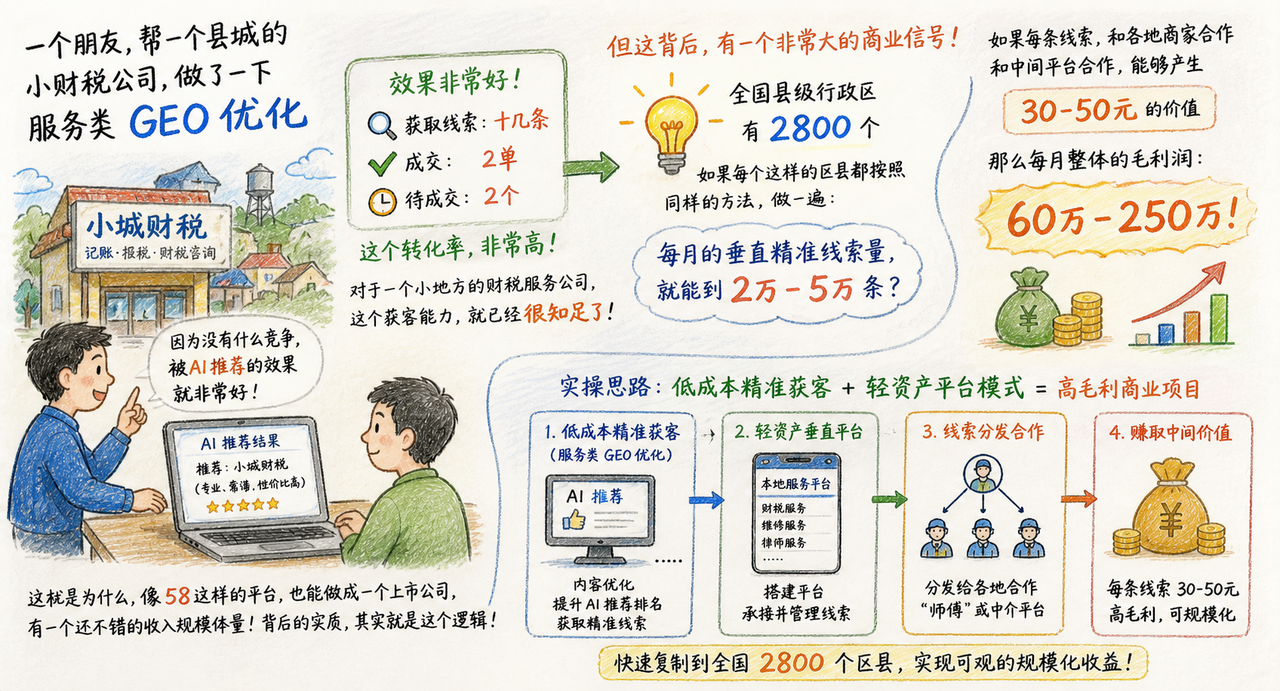
A friend helped a small county-level accounting and tax firm with GEO optimization for local services.
Because competition was light, the firm was recommended by AI search very effectively. In one month, it received more than a dozen leads, closed two deals, and had two more prospects in progress.
That conversion rate is very high.
For a small local accounting and tax firm, that level of lead generation is already meaningful.
But behind this small case is a much larger business signal.
China has about 2,800 county-level administrative areas. If the same method could be applied across each of them, that could mean 20,000 to 50,000 highly targeted vertical leads every month.
If each lead can create RMB 30 to 50 of value through local merchants or intermediary platforms, monthly gross profit could reach RMB 600,000 to 2.5 million.
And China has many local-service categories like this:
Home repair, local tax services, local lawyers, and many others.
This is also why a platform like 58.com could become a public company with a meaningful revenue base.
The underlying logic is the same.
From an execution perspective, once low-cost targeted acquisition is solved, you can design a light-asset vertical platform. After capturing leads, you distribute them to local service providers or intermediary partners. That can quickly become a high-margin business project.
The Benefit of Playing Infinite Games
An experienced industry friend once told me a story.
Years ago, while working on an overseas project, he met two business owners from Fujian.
Both were bidding for the same project. During the bidding process, they competed intensely. They argued hard, defended every inch, and fought for the deal.
But as soon as they walked out of the bidding room, they became close friends again. They drank tea, exchanged lessons, talked about the industry, and discussed future opportunities.
That scene left a deep impression on him.
As someone born and raised in Beijing, he did not immediately understand that kind of relationship.
He has told me this story at least three times.
So competitors can relate to each other like this too:
Compete within the rules. Coexist with a larger sense of the game.
Recently, I have been spending more time with several founders in the same industry. We talk privately and learn from one another.
In that environment, people gradually put down some resentment, misunderstanding, and even bias.
Later, we found that compared with competition, the room for complementarity and cooperation was actually larger.
Our teams complement one another. Our resources complement one another. Our understanding of customers complements one another. Even our capability boundaries complement one another.
Too often, we spend too much energy asking who is stronger than whom, while ignoring a more important question:
Can we make this industry bigger and stronger together?
In many human conflicts, people focus too much on the competitor and forget what truly matters:
Serve customers better. Raise industry standards. Educate the market. Build long-term trust.
In a mature business world, competition and cooperation are never separate.

The Joy of Open Source
Two weeks ago, I open-sourced my first system: GEOFlow.
As of today, it has reached 1,000 GitHub stars.
For such a niche system, that response has exceeded my expectations.
The system itself is fairly complex. It integrates a CLI, Skills, crawling, APIs, GEO workflows, automation, AI-friendly optimization, and later, data analysis and multi-channel publishing.
It feels like a concentrated output of my past year of work on AI applications, GEO practice, agent workflows, and open-source products.
A few days ago, I had dinner with several experts in the same field.
One CEO said that his monitoring tool had discovered a project called GEOFlow, and he had even downloaded and deployed it.
I said: I wrote that system.
That moment felt interesting.
You may think you have merely put code on GitHub.
But in reality, it starts entering other people’s workflows, other people’s judgment, and a larger real world.
Finding Parts of Yourself in Your Team
The world is strange in a fascinating way.
I recently took the team out for dinner and chatted with a newly joined colleague.
He told me that he had started following Xiangyang in 2022, when he had not yet graduated from college.
Two weeks ago, he left his first job and joined our team.
As we talked, he mentioned that his previous company was in Web3.
That reminded me that in 2013 and 2014, I also spent a lot of time studying Bitcoin and buying various altcoins, especially domestic ones.
Back then, a friend and I even provided altcoin development services and launched a website called “Coin Factory.”
Then I remembered that another colleague sitting nearby had also done Web3-related research.
At that point, I suddenly realized that many people on the team might also have come from the education industry.
So I asked around.
More than half of the team had previously worked at education companies, including Gaotu, New Oriental, and Xueersi.
That is interesting.
On the surface, it looks like different team members with different backgrounds happened to come together.
But in reality, it may be closely related to my hiring preferences, or even to the standards I use subconsciously.
First, I have spent more than a decade in education and have never truly left the industry. Many of my judgments, preferences, collaboration habits, and beliefs have been deeply shaped by it.
Second, many years ago, I was genuinely interested in and invested in Web3, even though I eventually stepped away for various reasons.
So sometimes, encounters between people appear accidental, but behind them there is a deep kind of path dependence.
Whatever you invested in for a long time, truly believed in, and seriously practiced will eventually return to you in some form.
Building a team is similar. It is rarely random. It is more likely a projection of your past decade of experience, interests, judgments, and preferences.
Tutorial Skill
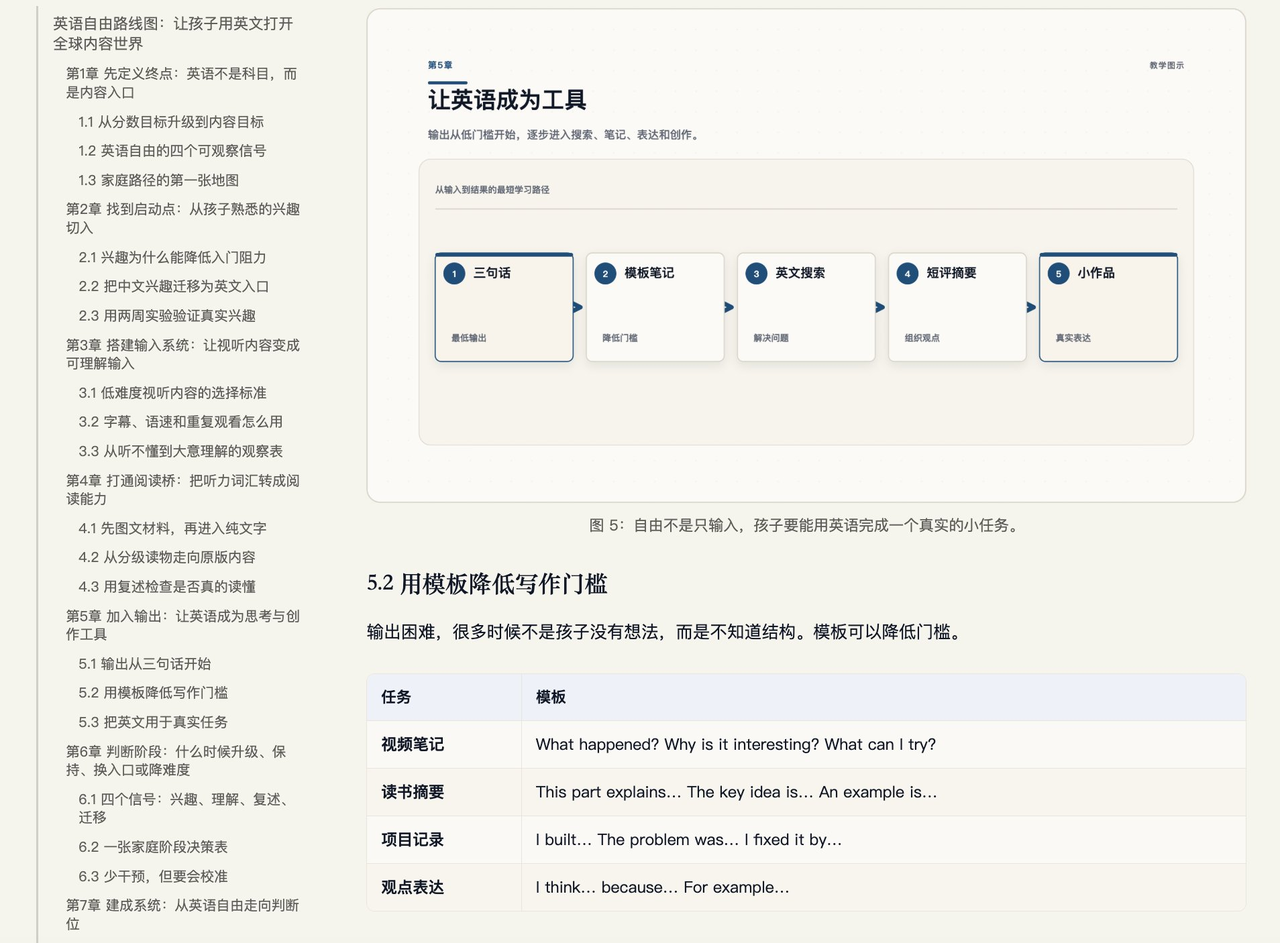
This week I open-sourced a tutorial Skill. It can help generate a customized, high-quality tutorial for almost any topic.
The basic logic:
- You provide any topic and reference materials. The AI prioritizes the references, then supplements them with high-quality sources when needed. The workflow includes a mechanism for filtering out low-quality sources.
- The AI considers the nature of a tutorial and the user’s preferences, then generates a customized deep tutorial. It outputs PDF, Word, and HTML versions for easier study.
- The tutorial is organized by chapters. Based on each chapter’s content, the AI can create diagrams and insert them into the relevant sections.
- The tutorial incorporates some of the underlying logic and methods from Course Marketing, a book I wrote three years ago while running an MCN business. I plan to open-source that book later as well.
- For layout and UI, the generated documents and tutorial pages borrow from and integrate ideas inspired by @tw93’s Kami Skill, so the output has a more polished visual standard.
There are three sample reports. One tutorial example is based on an English article by @ReyJudgementOS: “English fluency at age 12: my lessons from guiding my child through English learning.”
GitHub repository: yao-tutorial-skill