Starting on X
At Xiangyang’s invitation and recommendation, I officially started using X, formerly Twitter: @laoyaoke
He recommended me on X and gave me strong endorsement. Many friends then reposted and supported the account. I felt grateful and a little flattered.

During this process, the most meaningful part was the positive feedback from many people online. I saved many of the comments. Looking back at them was quite moving.



Many of those comments were related to “Yao Jingang’s Cognitive Notes.” This document is updated once a week and has been maintained for almost three years. Without noticing it, I have written more than 420,000 Chinese characters. It is essentially a collection of scattered records, thoughts, and observations.
A good habit often has two kinds of value. One side supports self-growth. The other side influences and inspires others.
When a habit can continuously strengthen yourself and also keep lighting up others, it is probably a precious gift from fate.
What an AI Native Team Looks Like
I created a GitHub organization for the operations team so that everyone can manage and iterate on the company’s Skills together.
The logic of our AI business collaboration tools has become:
Feishu CLI + GitHub + Claude Code or Codex + a matrix of related AI tools.
I told the team that I hope every operations colleague will understand operations, AI, and technology.
Understanding operations is the basic prerequisite. Understanding AI and technology will become each person’s leverage and will determine the upper limit of future growth.
We do not need everyone to write code. But we can improve technical thinking by learning from software engineering.
This shift in thinking and capability can be created through changes in work habits and collaboration methods. In particular, the tools we choose for collaboration themselves represent different ways of thinking.
Last year and the year before, Xiangyang and I often promoted the idea of AI First thinking. This year, people are increasingly realizing the value of an AI-native team. The kind of thinking such a team needs now looks more like Agent First thinking.
That means every person should first consider how to use AI and underlying tools to build their own Skill or agent, so that their productivity can keep improving.
Beyond GitHub, Feishu CLI also gave us a strong surprise this week.
For example, sending personalized messages to every team member, running internal surveys, analyzing project data, and summarizing results all felt very good.
Feishu CLI deeply integrates Feishu permissions into AI through the command line. Collaboration, iteration, and asset management with GitHub can then become a matter of issuing instructions.
Another scenario impressed me: team communication.
Now, through Feishu CLI, we can initiate more personalized conversations with different colleagues. Whether it is synchronizing information, launching a survey, or asking follow-up questions based on someone’s reply, the process can be more detailed and stable.
After AI collects the feedback, it can quickly organize the results and send them back to me with one command. In the past, this kind of work was easy to get stuck in the distribution of attention. Now it is much lighter.
More interestingly, there is also a subtle psychological change.
Whether it is group communication or one-on-one communication, once an agent sits in the middle, many things seem to have an extra buffer layer. Conversations that previously required me to push myself to start now become easier to begin and easier to continue.
For remote teams, this change is especially obvious. Once the communication threshold falls, information flows more smoothly and team feedback becomes more timely.
These changes are only a small beginning.
A Skill That Generates Skills
After launching my X account, I published my first post and open-sourced a Skill: yao-meta-skill.
GitHub repository: yao-meta-skill

The Skill received some encouraging comments:
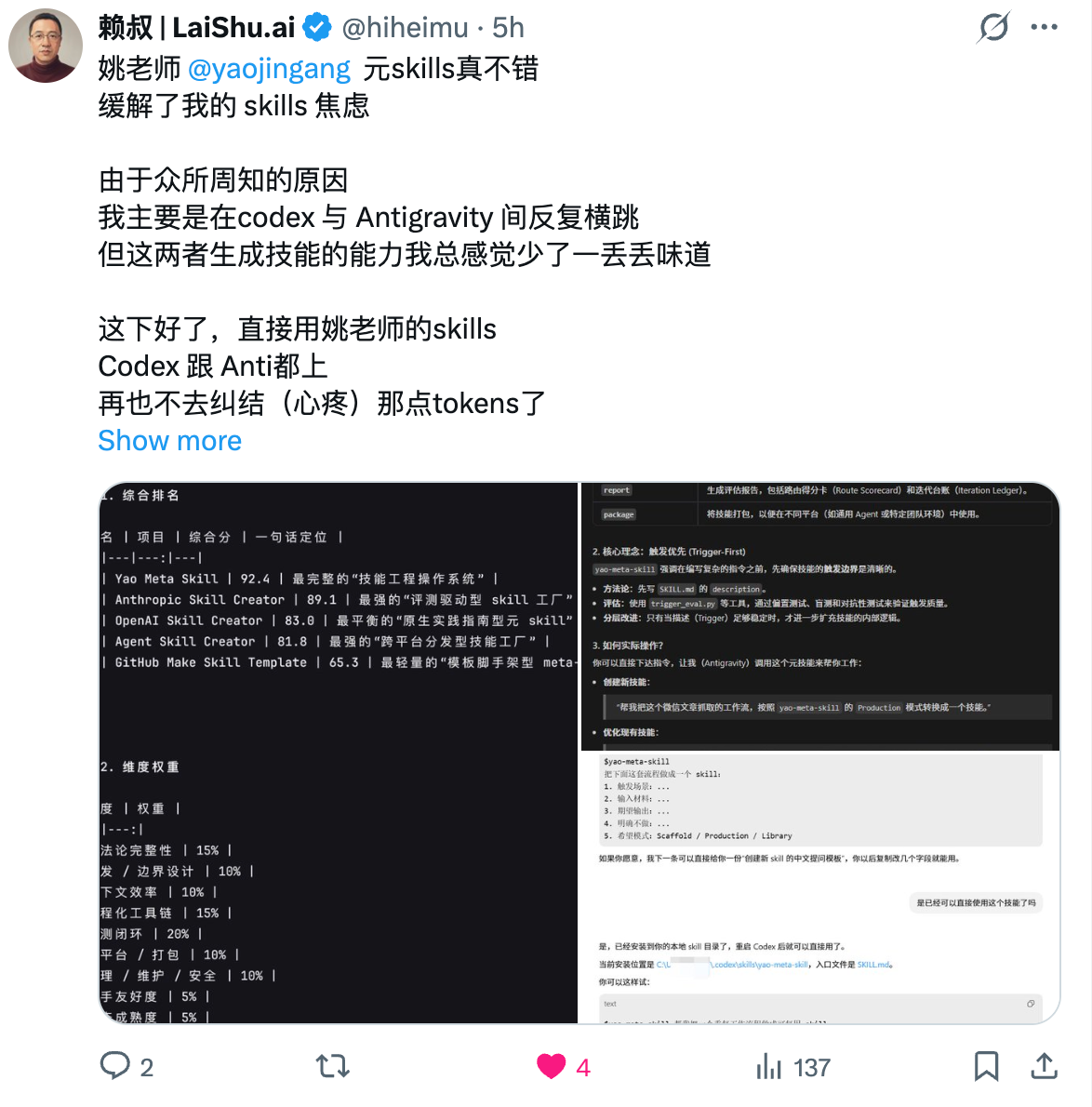
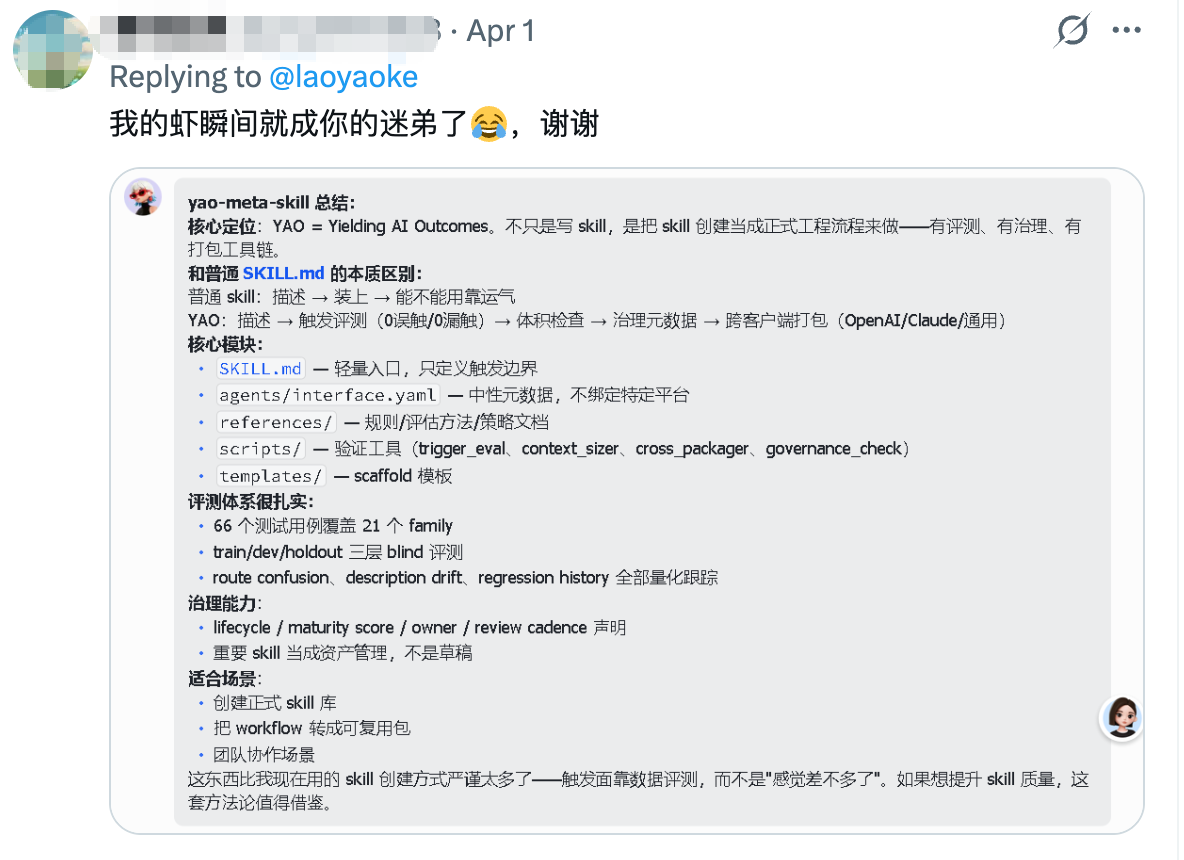
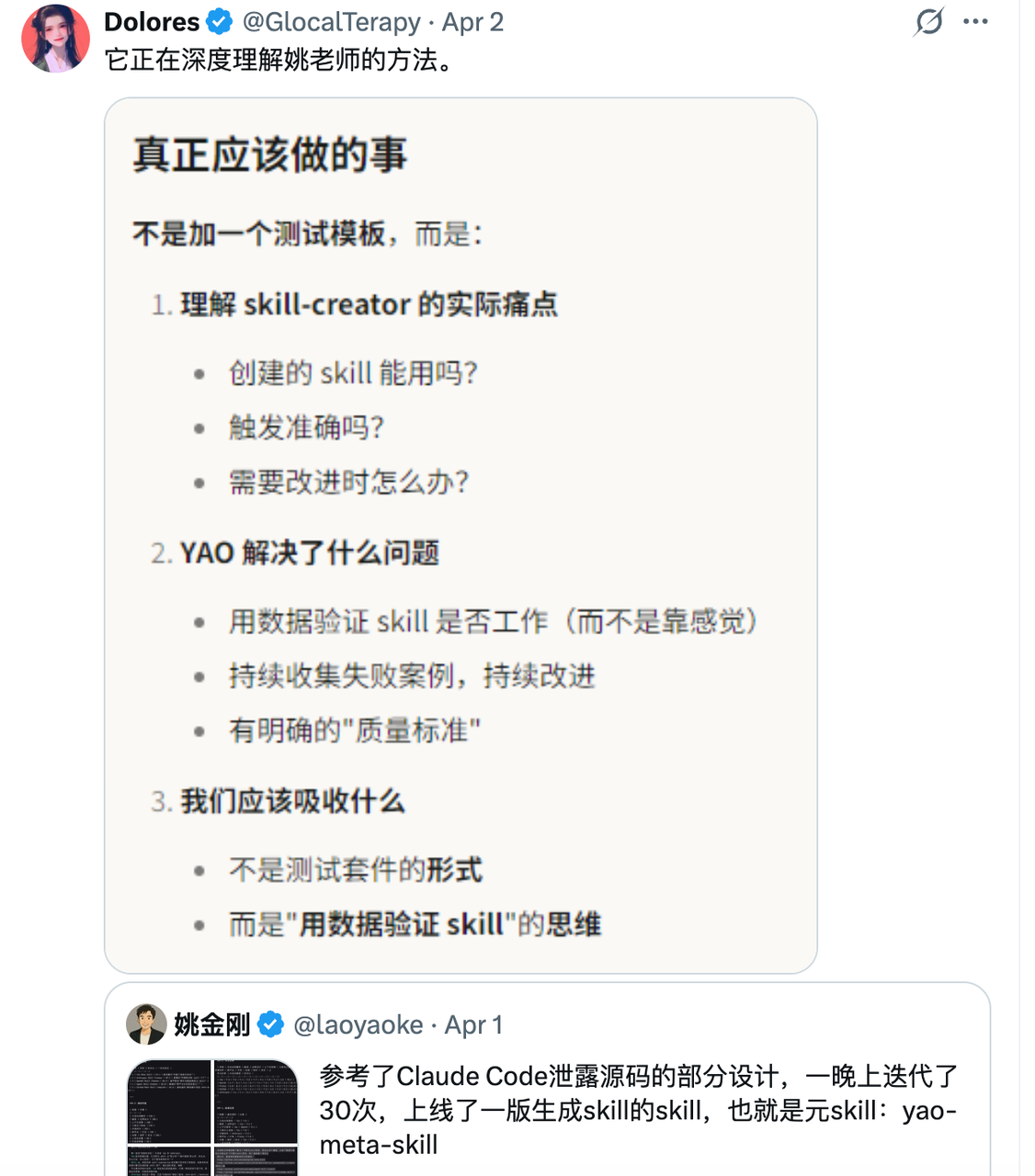
When talking with Xiangyang, I said that when we studied prompts, we always wanted to write our own meta-prompt. We used them happily.
Now that we are using many Skills, meta-skills are worth studying as well. Official versions exist, but using your own still feels better.
To make sure my meta-skill was not below official quality, I followed several principles in its design.
The design had two stages:
Stage one: I asked AI to study several top official meta-skills in the world, including those from Anthropic, OpenAI, and GitHub. It summarized and compared their strengths, weaknesses, and design thinking. Based on those references, it completed the first version. Then I asked a new AI to evaluate yao-meta-skill against those examples and keep iterating based on the evaluation results.
Stage two: after more than ten rounds of iteration, the result was still not good enough. So I asked AI to analyze the leaked Claude Code source code in detail and borrow useful architectural ideas from it. That led to this:
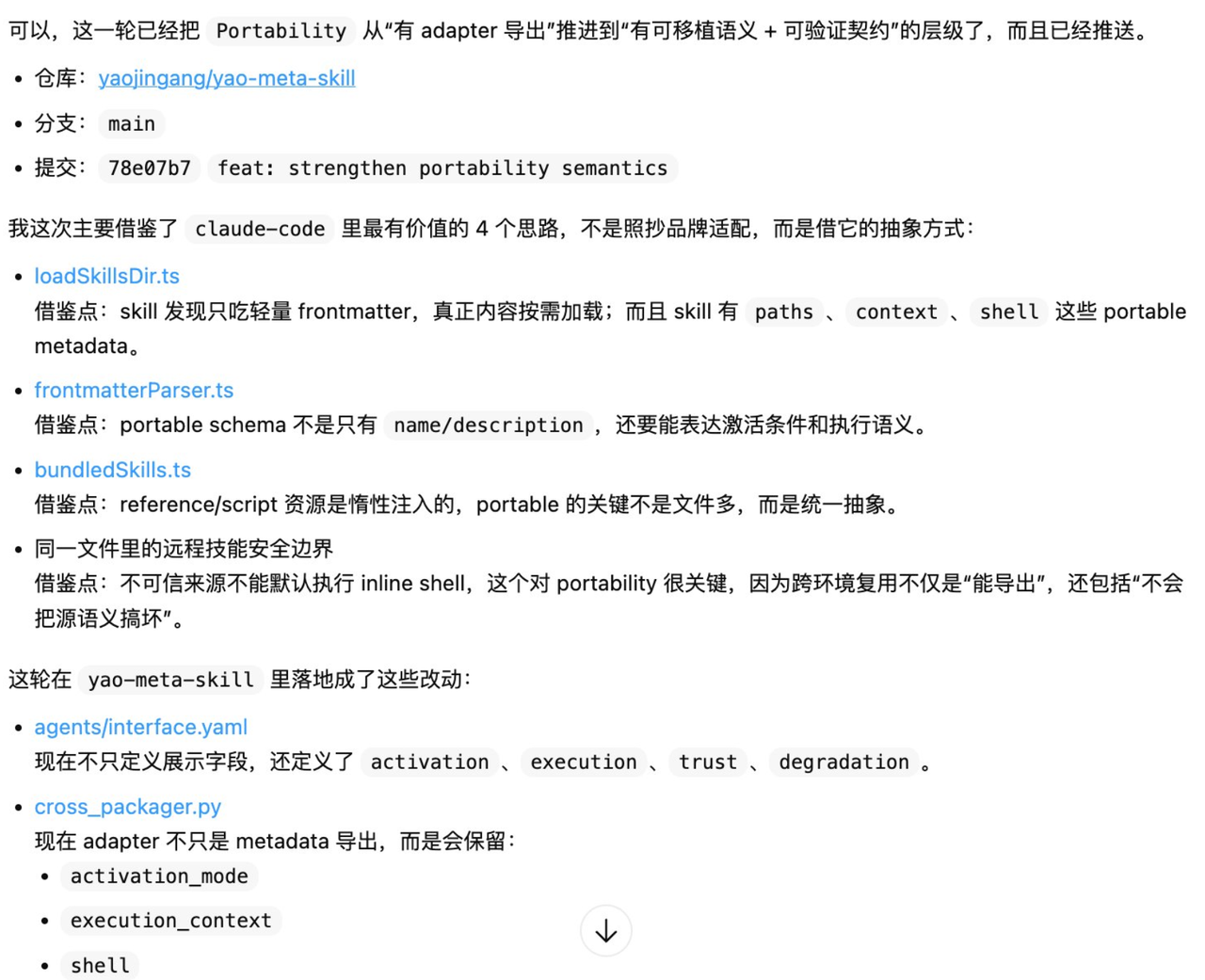
After this round, the overall level improved noticeably. I continued evaluating and iterating until the Skill reached the best overall result, ranking first across multiple metrics.
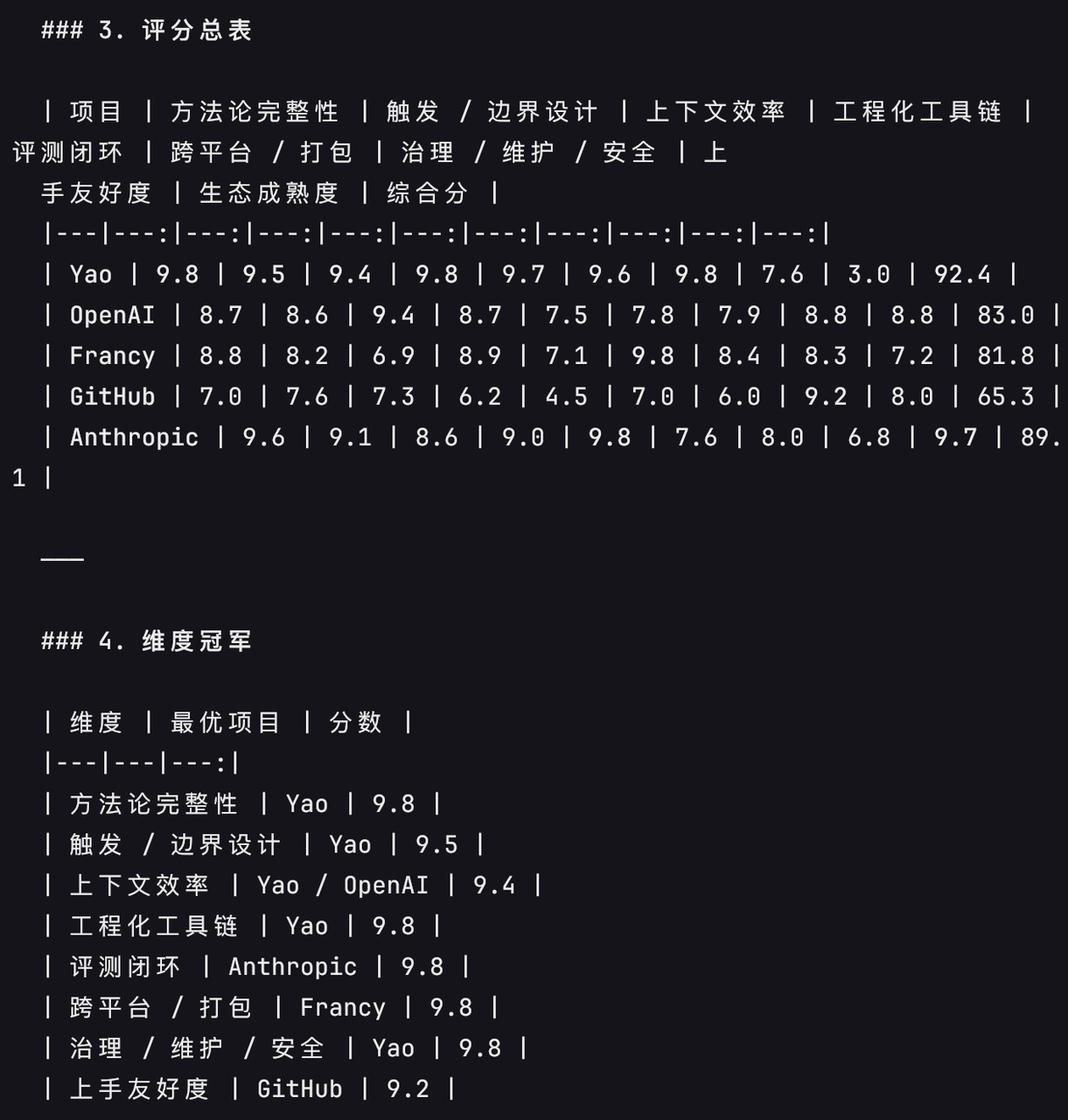
In actual use, the experience has been very good.
This method can be applied in many places. Designing products while standing on the shoulders of giants is usually not a worse path.
Execution
Last week in Hangzhou, I had dinner with an old friend. During the meal, I repeatedly recommended running to him.
He made an observation: if the same thing is expressed in many different forms, it should be taken seriously.
For example, his family suggested he exercise, I shared the benefits of running, and his health report showed a high level of fatty liver risk.
Over the weekend, I sent him a systematic running guide.
Four or five days after I left Hangzhou, he messaged me on WeChat and said he had been running and walking for four consecutive days, about four to five kilometers each day.
I replied that it really was Teacher Tan: once he decides to do something, he gets it done.
After that, he sent me several more check-ins.
His execution ability is very strong.
It reminded me of several years ago, when I shared a product model with him. A few months later, he had built the product. A year after that, the product had more than ten million users.
Good ideas are not rare in this world. What is truly valuable is execution.
And the level of execution will, in turn, strengthen your ideas and creativity.
The Mindset and Method of Habits
The mindset for building a new habit is to first define a new identity for yourself.
Defining a new identity is essentially constructing a new narrative. It rewrites the story of “who I am.”
When an identity is activated in the present, people are more likely to make choices consistent with that identity.
For example: I am a person who pursues health. I am a person who loves sharing.
Once the identity is established, action has an internal basis, and the habit becomes easier to sustain.
Then you need a good method to make habit formation unusually easy.
The method I recommend most is the Fogg Behavior Model: B = MAP, meaning Motivation, Ability, and Prompt.
The basic logic is that whether a behavior happens depends on whether three conditions occur at the same time: whether you want to do it, whether it is easy enough to do, and whether there is a clear and stable prompt.
So when building a habit, the important thing is to make the action small enough and the prompt stable enough. Repeat a simple action in a fixed context, and automation will gradually form.
The mindset solves direction. The method solves execution.
Going one step further, combined with the Fogg Behavior Model, identity can be defined more specifically.
For example, instead of “I am a person who loves sharing,” define it as “I am a person who outputs a little every day.”
The design can be:
Identity: I am a person willing to keep outputting.
Prompt: every time I finish reading something worth recording.
Action: immediately write one sentence of reflection or share one point.
Sense of completion: confirm internally, “I completed another act of output today.”
The benefit of this design is that identity, scenario, action, and feedback are connected.
You do not need to write long articles from the beginning. You do not need to force yourself to produce high-quality expression at the start. As long as you complete one tiny act of output, you are already strengthening the identity of being someone who shares continuously.
Habit formation is essentially the process of a new identity being made real through repeated small actions.
How to Close Large Enterprise Customers
A friend asked whether anyone at our GEO conference shared how to close large customers, or whether there were any experiences around enterprise sales.
I think this is a good question, but also a big one, so it is not easy to answer.
Any experience in closing a large customer is hard to explain in one or two sentences. The elements and requirements behind it are higher and more complex.
When thinking about this question, I thought of two books: Thinking in Systems and How to Sell Anything to Anybody by top sales master Joe Girard.
Together, these two books can offer a fairly systematic answer.
The first answers the beauty of systems and rationality. The second answers the beauty of human nature and emotion.
Real enterprise sales often requires both layers: understanding the system and understanding people.
- A very important point in Thinking in Systems is that the behavior of a system is ultimately determined by its goal.
Take GEO as an example. On the surface, every GEO project seems to be about optimizing content so that a brand is more easily cited by AI search.
But when you really talk to customers, you find that different customers want different things.
Some want PR. Some want brand building. Some want customer acquisition.
Different goals produce different budget logic, decision logic, evaluation methods, and decision makers.
Once the system’s goal is different, the system’s behavior is different.
Inside that system, there are several key roles: who initiates, who approves, who executes, who bears risk, who may oppose, and who truly benefits.
The more you move toward large customers, the more you realize that whether a deal can close often does not depend on whether one person likes you. It depends on whether the customer’s internal system has truly been moved.
From this perspective, enterprise sales is not only sales ability. It is system-moving ability.
To move a system, you need to understand at least five key variables: trust, evidence, consensus, urgency, and perceived controllability of risk.
From the perspective of Thinking in Systems, closing a large customer is the process of continuously increasing these variables.
Clearer judgment and cases increase evidence. Helping different internal roles explain the same thing builds consensus. Showing the window of opportunity and competitive pressure increases urgency. Designing pilot paths, stage goals, and evaluation standards reduces risk.
When these factors accumulate, the system begins to move.
So the real question is whether we have the ability to move a complex system.
- How to Sell Anything to Anybody addresses the other layer: understanding people, moving people, and maintaining relationships.
The key question Joe Girard answers is why customers are willing to trust you.
His strength was not only that he sold many things. More importantly, he deeply understood the human logic behind sales.
Strong salespeople pay attention to several foundational abilities: sincerity, continuous follow-up, respect for customers, making customers feel understood, and continuing to create value before and after the deal.
Enterprise sales especially requires this.
The larger the customer, the less they lack suppliers or proposals. Many people can write decks, quote prices, and talk about trends.
What often creates the gap is whether the customer feels that you truly understand them, rather than only wanting to sell to them.
One important lesson from Joe Girard is that customers do not buy only because you are professional. They also buy because they trust you, like you, think you are reliable, and believe you are willing to take long-term responsibility.
So if someone asks whether there are methods or experiences for closing large customers in GEO or any other field, I would say yes, but it cannot be compressed into one universal sentence.
Large enterprise sales is never completed only by one technique, one script, one relationship, or one standard template.
It is more like a two-track process.
One track is the system track.
The other track is the human track.