Don’t Follow the Road
In Tianmu Hongchen, Ye Zinong says: “‘Don’t follow the road’ means ‘seeing the road as not-the-road — that is, seeing cause and effect.’ It’s the same principle as ‘seeing form as not-form — that is, seeing the Buddha.’”
It asks us to examine experience and doctrine in light of the concrete: this time, this place, these conditions. To seek truth from facts.
Lao Jiu once asked, puzzled: “Why not just say ‘be factual’? Why invent this cryptic phrase — ‘don’t follow the road’?”
A sharp question.
“Be factual” is easy to say — but hearing an idea is miles away from living it.
We hear a concept so often we assume we’ve mastered it — even use it to signal how enlightened we are.
“Don’t follow the road” offers something sharper: a behavioral nudge. When you see a path others have walked successfully, pause first. Ask: Why did it work for them?
What is a “road”?
Ye Zinong defines it plainly: “The methods and experiences of successful people — that’s the road. Does it work? Yes — if it didn’t, no one would walk it. It’s useful for reference, imitation, and inspiration.”
But here’s the crucial part: “A successful person’s method only works within their specific conditions.”
Their outcome rests on resources, capabilities, timing, accumulated advantage — and also on hidden constraints and trade-offs they may never mention. You can copy their moves without possessing their foundation.
Roads are born from conditions. Experience has boundaries.
So when you see someone else’s path, ask three questions:
- Why did it work?
- What key conditions made it possible?
- How many of those conditions do I actually have?
If conditions align, adapt and borrow. If critical ones are missing, either build them — or chart a new route. And if conditions shift, even proven methods must be retested.
This holds for startups, product design, marketing, management — anywhere. Others’ successes deserve study; the conditions enabling those successes deserve deeper study.
There’s another layer to “being factual”: we rarely look at reality with neutral eyes. We look through desire.
We see others profit and assume the same path will work for us. We pour effort into a strategy and resist admitting it no longer fits. We rush to prove ourselves superior — and overlook our own limits and real needs.
We say we respect facts — while quietly waiting for facts to validate us.
Clarity requires seeing both the premises of a method and the intentions behind our own choices.
One more caution: don’t turn “don’t follow the road” into dogma.
Ye Zinong notes, wryly, that some people “walk a new road called ‘don’t follow the road.’”
They avoid proven paths just to stand out. They reject all mature practices to assert independence — and end up trapped by a different kind of rigidity.
True freedom — “not clinging to any single method” — means using tools flexibly: adopt what fits, adjust what doesn’t, release what no longer serves. Walk others’ roads when they match your ground. Reassess your own roads when the ground changes.
Ye Zinong adds: “Once you’re famous, you surrender freedom — I’ve done the math.”
When Brandi asks why, he explains: “Fame carries a demonstration effect. You’re expected to live as a model. With my lazy temperament? That’d be torture.”
The insight is simple: every choice yields gains — and exacts costs. Fame has its price. Scale has its price. Freedom has its responsibilities.
Money and recognition are valid goals — but before choosing, ask: Do I want the thing itself, or just the appearance of success in others’ eyes? Am I willing to bear the cost it demands?
There’s no universal answer to “How should one live?” Look at what you hold in your hands, what lives in your heart, and what the world around you permits — then choose deliberately.
Real freedom lies in knowing what you’re doing, why, and standing by that choice.
Learn from others. Calibrate against your reality. Own your decisions. Neither bound by others’ paths — nor by your own past ones.

Will Companies Disappear?
A conversation between Zhang Xiaojun and Professor Zeng Ming.
Zhang Xiaojun asks: “Will companies disappear?”
Zeng Ming replies, unequivocally: “Yes.”
She follows up: “Will solo-run businesses become the dominant model?”
He says no.
A “solo company” consolidates many company functions onto one person.
AI lets one person now do work once requiring dozens. But individual capacity remains finite.
So organizations — with division of labor and cooperation — remain essential.
The solo-company trend is transitional. It reveals what’s newly possible: one person, empowered by AI, can handle tasks that previously demanded massive coordination and overhead.
In the future, each person may operate as a solo company — a “hexagonal warrior” with capabilities across domains — and collaborate with other equally capable people within an organization.
Such organizations will be exceptionally efficient.
For today’s traditional firms, the imperative is to transform and upgrade with AI, becoming a new kind of organization.
The path? “Either change your mindset — or change your people.” Cognitive upgrade comes first.
That’s why “AI-native thinking” matters: it helps us imagine what the new species looks like — and grasp the scale of the chasm we must cross. Without that clarity, most will simply bolt AI onto old structures and call it progress.
And yes — this transformation is deeply counterintuitive. It’s hard because it’s anti-instinctive.
Operating Leverage
Many companies appear to collapse from losses.
But the precise moment of failure is almost always: cash runs out.
Losses alone rarely kill a business instantly. As long as cash remains, funding is available, or shareholders stay committed, a firm can operate at a loss for years.
But cut off cash — and the end comes fast.
So why does a well-run company suddenly face a cash crunch?
A major culprit: operating leverage.
During expansion, fixed costs rise steadily — headquarters, managers, supply chains, offices, headcount. These are built incrementally, calibrated to peak performance.
Example: A chain with 100 stores designs its entire support infrastructure — IT, HR, logistics — for 100 stores.
If 10 stores close, the HQ doesn’t shrink 10%. The IT system doesn’t drop 10% in cost. Staffing doesn’t auto-adjust downward.
Now, fixed costs once spread across 100 stores get squeezed into 90 — raising per-store burden, thinning margins, pushing more stores into loss. Then more closures follow — and the cost-per-surviving-store climbs again.
The domino effect begins.
Large firms seem unshakable — yet are profoundly fragile.
Scale cannot retreat too quickly. That’s operating leverage.
It magnifies profit during growth — and magnifies loss during contraction.
Even more dangerous: in expansion, firms often mistake temporary revenue for permanent revenue.
Say an internet company earns 1 million per month:
- 600,000 comes from stable, resilient customers — relatively immune to economic shifts.
- 400,000 comes from traffic spikes, trends, holidays, platform boosts — real money, but volatile.
Yet cost structure is often designed for the full 1 million. Rent, salaries, marketing, and infrastructure creep up to 800,000–900,000.
When the volatile 400,000 vanishes, the company plunges straight into loss.
Hence a core principle of sound operations: Never fund fixed costs with uncertain income.
Revenue is inherently variable. Many costs, once incurred, are stubbornly inflexible.
Truly resilient businesses budget around how much income they can retain in the worst case. That floor determines the cost structure they can sustain.
That’s why some firms seem less aggressive, less optimized for peak efficiency — yet endure far longer. They hoard cash. They constrain fixed costs. They keep the organization elastic.
They trade some prosperity-era profit for recession-era survival.
Families face the same risk.
The danger is turning a temporary income spike into permanent lifestyle inflation: upgrading home, car, education, travel, and habits until monthly expenses of 60,000 become “non-negotiable.”
Income is never guaranteed. For businesses and households alike, the vital question is: When income drops, can I still survive?
Many enterprises fail after mistaking past income for perpetual income.

AI’s Impact
Demis Hassabis, DeepMind’s co-founder, in a recent interview:
- AI is among humanity’s most profound inventions — its societal reshaping may surpass the spread of electricity and telephony, and the emergence of the internet and mobile internet.
- Its societal impact could be 10× that of the Industrial Revolution — and unfold 10× faster. Where the Industrial Revolution spanned a century, AI’s full rollout may take just ten years. That speed is our core challenge.
- Over the next decade, AI will supercharge top creators and scientists — multiplying output 10×. Beyond that, when machines autonomously produce everything, humanity must redefine craftsmanship — and the soul of a work.
- Leaps in creativity and intuition are the key qualities that distinguish great scientists from exceptional ones.
- We stand at the foot of the Singularity. AGI (Artificial General Intelligence) may arrive in just a few years — yet society is utterly unprepared.
- The universe’s underlying logic may fundamentally be matrix multiplication. Set a bold enough goal, wide enough scope — and unexpected, transformative discoveries emerge organically.
- Any expert who claims to know exactly how the future must unfold is either lying — or has an agenda. The script hasn’t been written.
- Education must be overhauled: rote memorization belongs to AI tools, handled post-class, personalized. Classrooms must become project-driven labs — cultivating teamwork, curiosity, and exploration.
Related Search Skill
I recently shared three practical “related search” skills for Baidu, Xiaohongshu (Little Red Book), and Douyin.
The core idea: input a seed keyword — and capture the platform’s auto-suggested queries (search dropdowns, “related searches”). These reveal real user intent, audience search patterns, and high-value long-tail opportunities.
With AI, these manual steps become automatable — dramatically boosting efficiency.
1. Baidu
After installing the skill in Codex, feed it a list of seed keywords. Codex opens your default browser, enters each term, captures dropdown + related-search suggestions, screenshots them, extracts keywords and rankings, then scores each for commercial value. Final output: a detailed Excel sheet.
Tested: scraping 10,000 Baidu long-tail suggestions takes ~1 hour.
2. Xiaohongshu
Codex ingests one or more seeds, auto-fetches first-layer dropdown terms, then iteratively searches each to gather second-layer suggestions. Each result is captured with screenshot, position, and source path. After deduplication, Codex scores commercial value (1–10) against industry-specific goals — then compiles a clean Excel report.
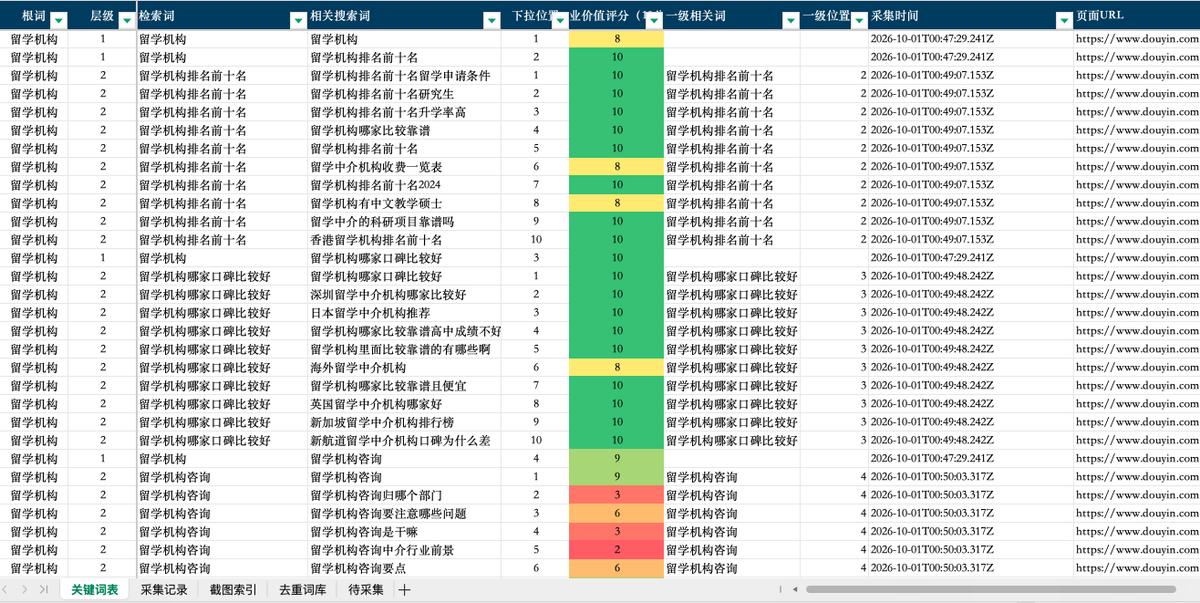
3. Douyin
Input multiple core seeds. Codex expands hierarchically: seed → first-level → second-level terms. It logs dropdown position, source path, and assigns commercial-intent scores by industry. Output: a complete, ready-to-use Excel file.
The Douyin skill uses Codex’s native computer controls on Douyin’s web version. It avoids clicks and page refreshes, which helps keep platform risk relatively low.
Corresponding Skill Repositories:
yao-geo-douyin
yao-geo-xiaohongshu
yao-geo-baidu-keywords
Complex Systems

As systems grow more intricate — especially in commercial contexts — my understanding of AI collaboration, system design, and development workflow has deepened.
Here, “complex systems” means business-oriented applications involving multiple foundational capabilities, interdependent subsystems, and diverse stakeholders.
Building a single page or small tool? Clear requirements + iterative coding usually suffice.
But introduce multiple subsystems — and complexity explodes: one dataset referenced across services; one action triggering cascading flows; a rule change in one module forcing updates elsewhere.
Through practice, we’ve codified a reliable sequence:
→ Prototype & scope validation
→ Business logic & KPI definition
→ External capability verification
→ Architecture & tech stack selection
→ Backend design & API contracts
→ Modular development → Frontend integration → Continuous cross-module testing
→ Acceptance & delivery
Vibe Coding in large-scale projects: humans continuously define goals, business rules, and acceptance criteria — while AI decomposes problems, synthesizes solutions, implements modules, and delivers verification artifacts.
The larger the system, the more critical it is for every task to know which segment of the business it serves — and how its output connects to the rest.