Fifth GEO Public Class
This is my fifth GEO public class this year with Professor Xiangyang. The full session recording, slide deck, and a 13,000-word illustrated summary are linked at the end of this post.
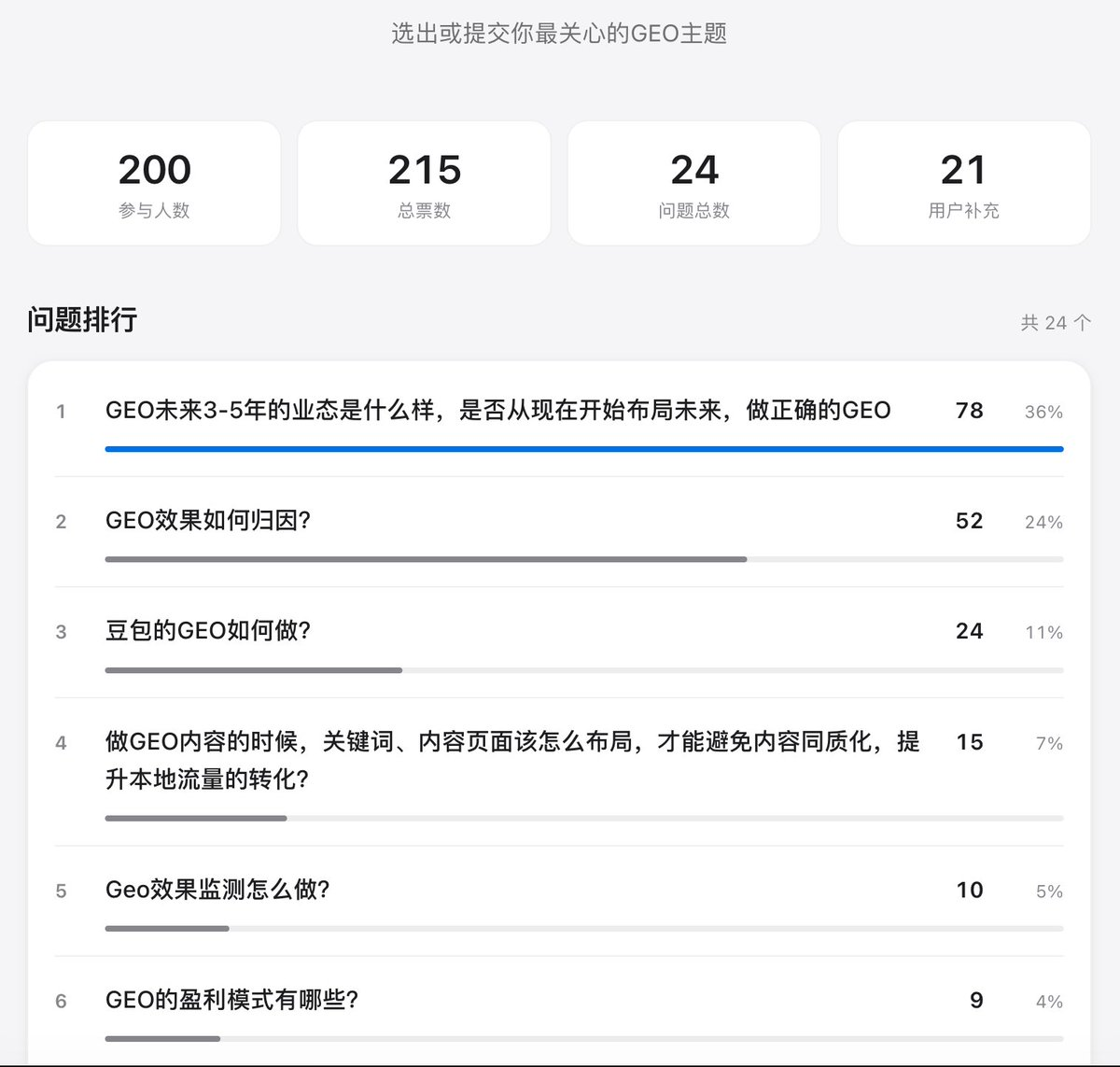
Before finalizing this session’s topic, we ran a poll with 200 participants and 215 votes:
- Top choice: What will the GEO industry’s business landscape look like over the next 3–5 years?
- Second choice: How do we truly attribute GEO’s impact?
Other frequently raised questions included: How to monitor GEO performance? How to define meaningful metrics?
Attribution is timely. GEO has matured over the past year-plus: techniques for improving rankings and visibility are now well-established—and many practitioners in live streams and meeting rooms have already seen tangible results.
But a thorny, urgent question follows: How do we credibly attribute GEO’s business impact?
Live Session Outline
- The GEO Commercial Ecosystem
- Seven-Layer Business Architecture:
- Entry layer
- Source layer
- Data layer
- Technology layer
- Execution layer
- Transaction layer
- Governance layer
- Seven-Stage GEO Methodology Evolution:
- AI visibility monitoring
- AI effect attribution
- AI content & knowledge engineering
- AI source engineering
- AI-native websites
- Agent-driven execution
- Agent-powered commerce
Underlying logic: AI answer optimization → AI decision optimization → AI business optimization
Notes:
- AI-native website: “Official website GEO” is emerging as a standalone vertical—this is where GEOFlow is headed.
- Agent execution: Within 1–3 years, expect prompts like: “Find me a Beijing-based study-abroad counseling agency; compare pricing, case studies, and team profiles; then book introductory calls with three counselors.”
- Agent commerce: Within 3–5 years, enterprises will ask: “How efficiently is my product, service, or brand distributed across AI channels?”
GEO Effect Attribution Framework
- Defining “effect” and selecting appropriate metrics
- Four common AI conversion patterns:
- Direct conversion
- Delayed effect
- Channel synergy
- Indirect conversion
- Ten tagging and measurement methods
- Developing your own validation and statistical approach
- Calculating ROI:
- Directly attributable ROI
- Incremental ROI (spillover effects)
- Indirect contribution ROI (e.g., uplift in downstream conversion rate)
- Practical A/B testing tactics:
- Compare two similar business lines—one running GEO, one not—tracking shifts in KPIs. Ideal for campus-level pilots or parallel service units.
- Test GEO alongside SEM or live-streaming campaigns to measure synergistic lift.
Ten GEO Tagging & Measurement Methods
- Dedicated contact channels: 400 numbers, mobile numbers, WeChat IDs
- Exclusive offers: downloadable assets, event access codes
- Dedicated landing pages
- Targeted forms: pre-purchase registration, post-purchase surveys
- Conversational probing: sales follow-ups, customer service interviews
- Referrer tracking: via website UTM or referrer headers
- Self-reported attribution: post-purchase surveys, sales interviews, support logs
- Controlled comparison: two comparable business units (one with GEO, one without)
- Cross-channel comparison: GEO + SEM or GEO + livestreaming
- Indirect signals: branded search volume, direct traffic share, consistent uplift in backend conversion rates
Related Resources
- China GEO Ecosystem Business Model Landscape: doc.laoyao.cn
- Fourth GEO Public Class Topic Survey: ai.laoyao.cn
- GEO Attribution — Interactive Visualization Tutorial: doc.laoyao.cn
- GEO Attribution System Learning Handbook: doc.laoyao.cn
- GEOFlow open-source framework: GEOFlow
- Public class slide deck: doc.laoyao.cn
- Illustrated summary (13,000 words): mp.weixin.qq.com
Beijing Daily GEO
This week, Beijing Daily officially launched its GEO product: Beijing Daily Zhiyuan GEO—the second national-level authoritative media GEO offering, following Xinhua News Agency.
Its core mission: Advance trustworthy GEO dissemination.
Collaborators include Zhipu AI and Baidu Baike—a strong signal that more institutional players are entering and accelerating the GEO field.
I joined their launch event’s roundtable discussion. The questions were sharp—I’m sharing my reflections and answers below.
1. Where does “trustworthy dissemination” break down in GEO—and how do we fix it?
Trust rests on verifiable facts and evidence chains. At its core, GEO is about helping enterprises build an AI-facing evidence system and a precision operations infrastructure.
At the enterprise fact layer, even large organizations often struggle with inconsistent internal definitions, measurement standards, and phrasing—sometimes maintaining multiple versions of the “same fact.”
At the feedback layer—metrics definitions, attribution models, value assessment—especially around business contribution, clarity remains scarce.
2. What is GEO’s core value—and how should we evaluate it?
GEO’s value unfolds across three stakeholders:
- For AI platform users: Healthy, scientific, trustworthy GEO helps them find useful information and complete tasks accurately.
- For AI platforms: High-quality GEO improves user experience and reduces wasteful compute overhead.
- For enterprises: Effective GEO ensures products and services reach genuine target users—generating fair, sustainable commercial returns.
Evaluation hinges on three metric families:
- Visibility metrics
- Accuracy & relevance metrics
- Business contribution metrics
3. How is GEO evolving—and how are client needs shifting?
- Clients are moving from “Do I appear?” to “Why me—and is it accurate?”—a shift aligned with the interests of AI platforms, users, and businesses alike.
- GEO operations are becoming ongoing knowledge asset stewardship, not one-off campaigns.
- The competitive edge is shifting from “Who explains the tech best?” to “Who best demonstrates and validates delivery?”
A Top-Tier GEO Piece
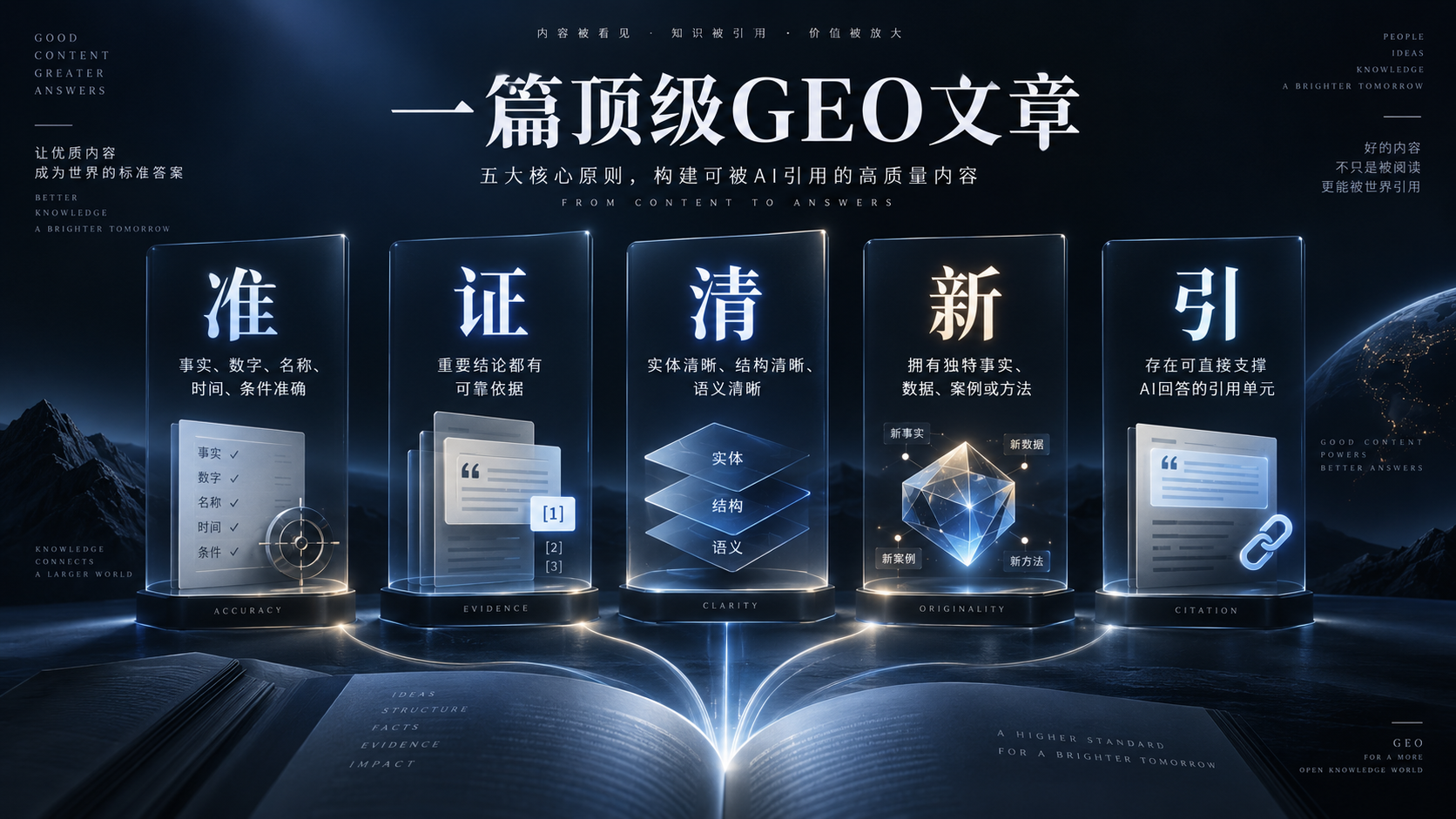
A world-class GEO piece adheres to five principles: Accurate, Evidenced, Clear, Novel, Citable.
- Accurate: Facts, figures, names, dates, and conditions are precise.
- Evidenced: Every key claim is backed by credible sources.
- Clear: Entities, structure, and semantics are unambiguous.
- Novel: Offers unique facts, data, cases, or methodologies—not just rehashing known insights.
- Citable: Contains abundant self-contained, atomic “citation units” that AI systems can directly surface in responses.
New Models
September was a landmark month for frontier LLM releases.
OpenAI launched the GPT-6 flagship Astra on September 3, followed by mid-tier models Sol and Luna on September 22.
Anthropic released Claude Opus 5.5—its first model in the Claude 5.5 family—on September 22.
I’ve tested Opus 5.5 extensively. Its video-generation capability stands out. I used it immediately to produce a promo video for one of my tools—so impressive that I added it to the tool’s homepage.
Model positioning, distilled:
- GPT-6 Astra: OpenAI’s pinnacle model—optimized for maximum intelligence + alignment fidelity.
- GPT-6 Sol / Luna: Efficiency-focused siblings—bringing Astra-grade capabilities into cost- and latency-sensitive workflows.
- Claude Opus 5.5: Anthropic’s flagship—designed for long-horizon agent work + cost efficiency, prioritizing safety and restraint.
Good Marketing
Marketing starts—not with content—but with audience definition. Only then can you reverse-engineer product value, messaging, and channel strategy around that group’s needs, motivations, cognitive habits, and decision context.
In short: Audience first.
Yet this foundational principle is routinely overlooked in practice—where attention defaults to: What should our short video say? How do we go viral? Which platform should we buy ads on?
The right sequence is: Who → Why → What → How → Where
Start with who you’re speaking to. Then clarify why they should care. Only then define what you’ll say, and finally how and where you’ll say it.
And for what you say, the core task is translation: turn “our product” into “your value.”
For example: Executives care about ROI and strategic leverage; marketing leads prioritize growth and conversion—both must be reflected explicitly in your content.
So marketing doesn’t begin with copywriting—it begins with deep audience understanding.
In fact:
The first production asset in marketing isn’t content—it’s a precise, actionable definition of your target audience.
Jev Use Cases
I’ve compiled 60 real-world Jev application examples—and spotlighted 12 most instructive ones.
These cases illuminate practical patterns for integrating Jev into GEO, verification, and operational workflows.
Core pattern: Generative models handle writing and complex reasoning; Jev handles classification, filtering, scoring, and selection; code executes follow-up actions—with human review retained at critical junctures.
Full 60-case collection: doc.laoyao.cn
Twelve Notable Examples
-
Notra: Brand mention detection in AI responses
Open-sourced on GitHub. GEO modules already use Jev to assess brand mentions—ideal for learning how to embed automated monitoring into business flows.
notra -
TypeSafe: Entity alignment & deduplication
Official example: determines whether two product records refer to the same entity; escalates ambiguity to humans. Applicable to brand alias normalization, institution disambiguation, and knowledge base cleanup.
docs.typesafe.ai -
TypeSafe: RAG source filtering & conflict detection
Before generating answers, Jev evaluates retrieved passages for relevance, usability, contradictions, and prompt injection risk. Valuable for evidence curation in knowledge-base Q&A.
docs.typesafe.ai -
TypeSafe: Claim-citation verification
Jev judges whether cited text supports a given claim; code then verifies citation existence. Adaptable to GEO articles, white papers, and research reports.
docs.typesafe.ai -
Browser Use: Web interaction decision-making
Jev selects actions (click, type, scroll) from structured webpage elements. Demonstrates clean separation: model decides, tool executes.
jev-ultrafast -
TypeSafe: Agent skill selection
Jev filters a skills directory, reads brief candidate descriptions, and chooses the optimal skill—or opts out. Fits systems with large tool/plugin inventories.
docs.typesafe.ai -
LangChain: Pre-execution risk check
Jev integrated as middleware to inspect and block risky tool calls before execution. Relevant for AI admin panels, code interpreters, and security-critical backends.
langchain.com -
Vercel: Automated customer ticket routing
One-step classification of ticket department, severity, and refund intent—escalating unclear cases to humans. A full-stack blueprint for model-to-business branching.
vercel.com -
ReplyNodes: SaaS website expression audit
Evaluates clarity, audience targeting, value proposition, differentiation, trust signals, and CTAs. Useful for benchmarking dimensions—but scores shouldn’t be conflated with SEO/GEO ranking.
jev-web-analyzer -
Paper Trellis: Academic citation validation
Jev matches claims to paper excerpts and judges support strength—human retains final judgment. Applicable to long-form content, white papers, and research audits.
citation-verifier -
TypeSafe: Cascaded structured extraction
Lightweight model extracts fields; Jev validates outputs; hard cases route to stronger models. Transferable to web scraping, document ingestion, and field extraction pipelines.
docs.typesafe.ai -
TypeSafe: Text-to-feature transformation
Generative model proposes feature questions; Jev converts text into numeric features; CatBoost performs prediction. Adaptable to query intent modeling, content tagging, and lead scoring—though transfer effectiveness requires separate validation.
docs.typesafe.ai