Chief AI Officer
Every company needs a Chief AI Officer.
I recently visited a publicly listed company and had an evening chat with their CTO. He shared some internal lessons from their AI transformation—and one particularly telling case: a friend of his founded an AI department that was elevated to a first-tier function, reporting directly to the CEO. The team consists of people deeply skilled in—and passionate about—AI, and its mandate is to drive AI integration across every business scenario. Results have been striking.
The logic is straightforward: systematically map the company’s real-world operations, break them down into dozens (or hundreds) of high-potential AI use cases, then tackle them one by one—in close collaboration between the AI team and respective business units.
This model only works if the CEO—or at least the top leader—has AI awareness, even without deep technical fluency. More crucially, they must grant the AI function unconditional trust, resources, and organizational authority.
I discussed this with AJ, who advises numerous enterprises on AI training and implementation. She observes that the biggest bottleneck to AI adoption isn’t methodology—it’s organizational DNA: rigid processes, fixed mindsets, low tolerance for error.
Her conclusion aligns with what I’ve seen: the most effective path today is for the CEO to establish a fully independent, first-tier AI function—and empower its leader with real decision-making weight. That leader doesn’t need to be an AI PhD, but must possess AI literacy, business intuition, collaborative instincts, and managerial credibility. In practice, some companies assign this role to the CTO or COO—then deliberately recruit “AI-native” talent to build the team.
I call this person the company’s Chief AI Officer. A great one doesn’t just understand models and prompts—they understand workflows, incentives, trade-offs, and how to translate AI capability into measurable business outcomes.
Minimalist Work & Life
In Hangzhou, I met an old friend for dinner. Over the years, he’s built a company with 200+ employees, co-founded it, leads the tech team and a core business line—and serves tens of millions of users, including several million in their private community.
On work & management:
- He sets only annual goals—not quarterly OKRs or process targets. Employees define their own milestones and rhythms.
- No group chats. All work communication happens one-on-one—directly with him or with designated leads.
- Everyone sends him a daily work report—but he reads only a fraction. The ritual matters more than the reading: it anchors accountability and reflection.
- His actual “working time” is often just 1–2 hours per day: spotting opportunities, making quick calls, delegating. Meetings are rare.
- This minimalist approach works so well that he hasn’t visited his remote 40-person tech team in two years—and performance remains stable.
- The company has avoided layoffs for two years. As a result, most employees have been there over a decade. He jokes: “We’ve turned the company into a state-owned enterprise for retirees.”
- When I asked why no layoffs, he said: “Before, laid-off staff could easily find new jobs. Now? It’s much harder. So we hold on.”
On business model:
- Though his team seems “idle,” they’ve quietly automated nearly every feasible process—especially with AI and workflow tools—driving exceptional operational efficiency.
- They avoid heavy-asset models entirely. Revenue comes from ultra-light, high-margin channels—maximizing profit per unit of capital.
- I asked: “With AI booming, why not experiment with idle resources to build new products?” He replied: “We don’t have that gene. We’re better at ‘copying well’—a ‘dare to be second’ mindset.”
On material desire & daily life:
- His monthly personal spending? Roughly ¥960—because he owns little and consumes less.
- Outside work, he reads, spends time with family—and sits beside his child while they do homework. “I’m just reading my own book,” he says.
- When his child finishes homework, they both go to bed—10 p.m. to 8 a.m. Ten hours of sleep. Truly enviable.
- He now savors moments of pure stillness—long stretches of “doing nothing.” “I’m thinking through the logic of things,” he explains. “Once it clicks, I act.”
- His biggest realization? Lowering material desire dramatically raises both work and life satisfaction.
What Is AI Leadership?
I invited Xiang Yang to speak to our team about AI. Colleagues raised sharp, grounded questions—including:
- Where’s the real boundary of AI coding today? For product or operations folks writing code with AI, what’s the one highest-leverage scenario to master?
- Which industry is AI most likely to disrupt—yet remains widely overlooked?
- What’s missing before AI Agents shift from toys to true productivity tools?
- What are the three lowest-barrier steps to build an AI automation flow that saves ≥2 hours/day?
- What will future AI-native products actually look like?
- With AI tools and models changing daily, how do you filter noise—and build a sustainable learning system?
- If AI + dev lets you ship in one week what used to take a month (4× speed), what unlocks 100× or 1000× gains? What kind of qualitative shift is required?
- Is AI’s biggest limitation today its raw capability—or humanity’s inability to use and constrain it wisely?
- Will AI evolve into a tool—or a designed, understandable environment?
- If AI understands human intent better and better, will software become more or less complex?
- How will humans interact with AI in the future: conversation (chat), command (CLI-like), or something seamless and “invisible”?
- Will AI progress come mainly from better models—or from humans constantly refining them in use?
- Is a great AI system fundamentally about solving problems—or about designing better questions?
- If AI handles most execution, what becomes humanity’s most irreplaceable value?
- What’s the ultimate AI-augmented work paradigm—and how far are we from it? Where should we start now?
These questions themselves are revealing. Take this one: “If AI boosts dev speed 4×, how do we reach 100× or 1000×? What’s the qualitative leap?” Xiang Yang’s answer outlines four stages:
- AI-assisted coding: 2–4× gain—the current mainstream.
- AI leadership + engineering rigor: 5–10×.
- Workflow orchestration + automation: 10–100×.
- Systemic rethinking: 100×+.
We noticed a pattern: many answers converged on the same core principles—AI-first mindset, aesthetic judgment, experience, discernment, and iterative discipline. These are the pillars of our “AI Leadership” course, co-designed with Xiang Yang last year.
To complete the picture:
If your mental model treats AI as a scattered set of point tools, your gains will stay local and temporary—capped by low ceilings. The real leverage lies in embedding AI into your entire work system: redesigning workflows, redefining roles, and reimagining what “human contribution” means.
Looking ahead, competitive advantage in the AI era may increasingly hinge on five interlocking capabilities:
First, AI-First Habit.
Before acting, ask: Can AI participate here? At what layer? Which steps should it run first—and where do I step in to judge, refine, or safeguard? Over time, this reshapes how you think, prioritize, and allocate attention.
Second, Aesthetic Judgment.
Two people using identical AI tools produce wildly different outputs. Why? Often, it’s not the tool—it’s their ability to sense quality: structure, clarity, user experience, narrative flow, content depth. Higher aesthetic standards raise the ceiling of what AI can deliver.
Third, Experience.
AI generates options—but doesn’t inherently know which fit your business reality, constraints, or timing. Experienced practitioners quickly spot what’s actionable vs. theoretical, where boundaries need hardening, where validation is non-negotiable.
Fourth, Discernment.
As information floods in and tools multiply, the scarcest skill becomes choosing: what to pursue, what to defer, what to prioritize now versus invest in long-term. Discernment sets direction—and direction makes efficiency meaningful.
Fifth, Iterative Discipline.
Few things get “right” on the first try in the AI era. Success belongs to those who test fast, observe honestly, adjust boldly—and keep optimizing amid uncertainty.
How we collaborate with AI, manage through AI, constrain by AI, and embed AI into organizations and workflows—so it compounds sustainably—is perhaps the most vital skill of our time.
Superficially, the gap between people looks like differing AI proficiency. But beneath that lies a deeper divergence: in systems thinking, aesthetic calibration, contextual judgment, and relentless iteration.
That’s the real foundational work worth cultivating—for the long haul.
Building a Running System
Drawing from Thinking in Systems, let’s treat running not as isolated workouts—but as a dynamic, self-correcting system. It has goals, components, connections, feedback loops, delays, constraints—and high-leverage intervention points.
Truly effective running design hinges on building a system capable of long-term, self-sustaining evolution.
What Is a Running System?

Your running performance isn’t determined by any single run—it emerges from the interaction of five subsystems:
Running ability = Body × Training × Recovery × Behavioral Stability × Decision Quality
- Body System: Cardiovascular fitness, muscle strength, tendon/joint resilience, nervous coordination, metabolic efficiency, body composition, flexibility.
- Training System: Weekly volume, intensity distribution, frequency, race-specific sessions, strength work, technique drills.
- Recovery System: Sleep quality/duration, nutrition timing & composition, hydration, active recovery, injury prevention, stress management.
- Cognitive System: Understanding of training principles, pacing intuition, risk assessment, goal decomposition, post-run analysis.
- Behavioral System: Consistency discipline, habit architecture, environmental support, emotional regulation, long-term adherence.
Most runners plateau because they obsess over training—while neglecting the other four.
Start with “Stock” and “Flow”

- Stock: What you’ve accumulated—e.g., aerobic base, tendon resilience, neuromuscular coordination, fatigue resistance, confidence, experience. These change slowly—and aren’t reset by one bad workout.
- Flow: Daily inputs/outputs—e.g., today’s run distance, weekly high-intensity sessions, nightly sleep hours, daily protein intake, weekly strength sessions, recovery time, stress load.
A common trap: fixating on flow (“How fast was today’s run?”) while ignoring stock. Yet your performance six months out depends overwhelmingly on whether your stocks are thickening—not on yesterday’s pace.
So the first principle of systemic running: All training decisions must serve the growth of key stocks.
The Five Critical Stocks That Drive Progress

- Aerobic capacity: Sustained output over time.
- Running economy: Energy cost per kilometer at a given pace.
- Lactate threshold: How long you can hold a hard-but-sustainable pace.
- Tissue tolerance: Resilience of tendons, joints, feet, calves, hamstrings—your ability to safely absorb training load.
- Recovery capacity: How efficiently your body converts stimulus into adaptation.
Most focus only on #1–#3. Neglecting #4 and #5 leads to rapid early gains—followed by injury, forced downtime, and regression. Real progress means raising the entire system’s load-bearing ceiling—not just chasing speed.
Four Key Feedback Loops in Running
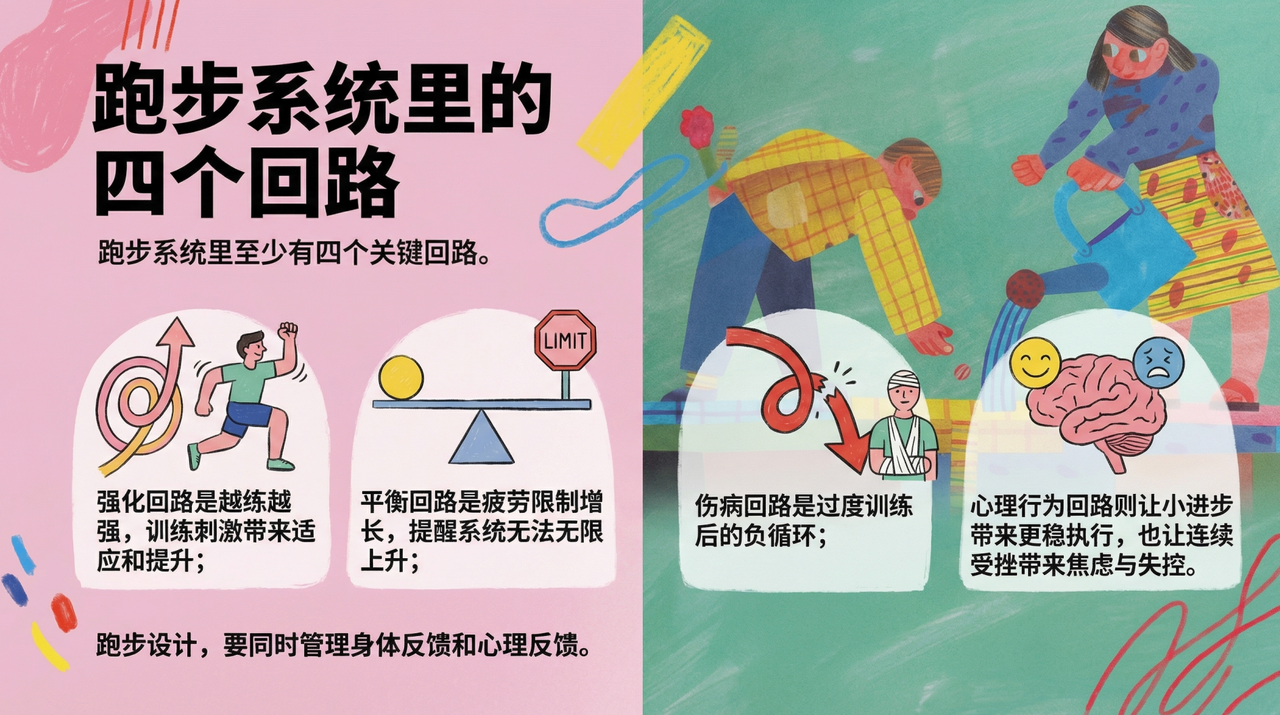
- Reinforcing Loop (Virtuous Cycle): Train → Adapt → Improve → Handle Harder Work → Improve Further.
- Balancing Loop (Fatigue Brake): Train ↑ → Fatigue ↑ → Recovery ↓ → Performance ↓ → Training Quality ↓. This loop reminds us: growth isn’t linear; equilibrium is natural.
- Injury Loop (Vicious Cycle): Overtrain → Tissue Overload → Pain → Reduced Volume → Slipping Fitness → Anxiety → Poor Decisions → Worsening Injury.
- Psychological-Behavioral Loop: Small Win → Confidence ↑ → Execution ↑ → Consistency ↑ → More Wins.
Reverse also holds: Repeated Setbacks → Anxiety → Erratic Effort → Worse Outcomes.
Designing a running system means managing both physical and psychological feedback—not just mileage logs.
Delay: The Most Misunderstood Element

Systems are full of delays:
- Today’s hard session may trigger injury two weeks later.
- Aerobic gains often take 4–8 weeks to manifest clearly.
- Strength work’s impact on running economy may need 6–12 weeks.
- Over-aggressive fat loss harms performance with delay.
- Sleep debt accumulates silently—then erupts.
So judging training by same-day feedback is misleading. Feeling great today ≠ smart training. Feeling flat today ≠ wasted effort.
A core competency of systemic training? Patience with delay.
High-Leverage Levers—Where to Focus

Many waste energy on low-leverage tweaks: buying gear, chasing “perfect” plans, obsessing over pace, hunting for the “best” workout.
True leverage lives here:
- Sleep: The master switch for recovery—if sleep fails, training gains stall.
- Periodization: When to load, unload, specialize, or return to base matters more than any single session.
- Intensity Distribution: Most runners do too much “medium-hard” work—and too little true easy or true hard.
- Injury Prevention: Strength, mobility, landing control, tissue tolerance work often delivers more ROI than adding another run.
- Behavioral Sustainability: Someone who trains consistently for 48 weeks will outperform someone who “goes all-in” for 8.
- Decision Quality: Knowing when to pull back during fatigue, hold steady during good form, or use data to course-correct.
Core rule: Optimize high-leverage points first—don’t drown in details.
A Practical, Scalable Running Model

Layer 1: Goal Layer
Answer three questions:
- What outcome do you want? (e.g., finish a marathon, lose weight, break 2h for half-marathon, run healthy for life)
- What resources will you commit? (weekly time, recovery budget, pain tolerance)
- Where are you now? (newbie, intermediate, plateaued, post-injury, peak-training)
Layer 2: Assessment Layer
Audit your system across nine metrics: current race times, weekly volume, max sustainable volume, resting heart rate or subjective recovery, sleep patterns, strength baseline, injury history, body composition, consistency record.
Layer 3: Structural Layer
Anchor eight recurring elements—even if their weight shifts weekly:
- Low-intensity runs
- Long runs
- Threshold or tempo runs
- Intervals or speed sessions
- Strength training
- Technique drills
- Active recovery days
- Full rest days
Layer 4: Feedback Layer
Track six weekly signals:
- Completion rate of planned sessions
- Subjective fatigue level
- Sleep quality score
- Heart rate variability or resting HR trends
- Localized pain rating (0–10)
- Quality of key sessions (e.g., “Did the tempo run feel controlled?”)
If signals drift, adjust inputs—not willpower.
Layer 5: Iteration Layer
Every 4–8 weeks, reflect:
- Which capacities improved? Where are bottlenecks?
- Is injury risk rising?
- Is volume/intensity distribution optimal?
- Do goals need recalibration?
- What’s the next priority?
This turns running from “feeling-based training” into “system-driven iteration.”
A Minimum Viable Running System

For most people, start with just four weekly anchors:
- Volume: 3–5 runs/week—prioritize consistency over intensity.
- Quality: Max 1–2 structured sessions/week.
- Recovery: Prioritize sleep nightly + at least one low-load day/week.
- Strength: 2 sessions/week—focus on stability, posture, and injury-resilient movement.
Then spend 5 minutes weekly reviewing:
- Total weekly volume
- Any unusual fatigue
- Any pain or discomfort
- Best session of the week
- Most derailed session
- Next week: increase, decrease, or hold steady?
That’s a functional, living system prototype.
Tiered Guidance Strategy
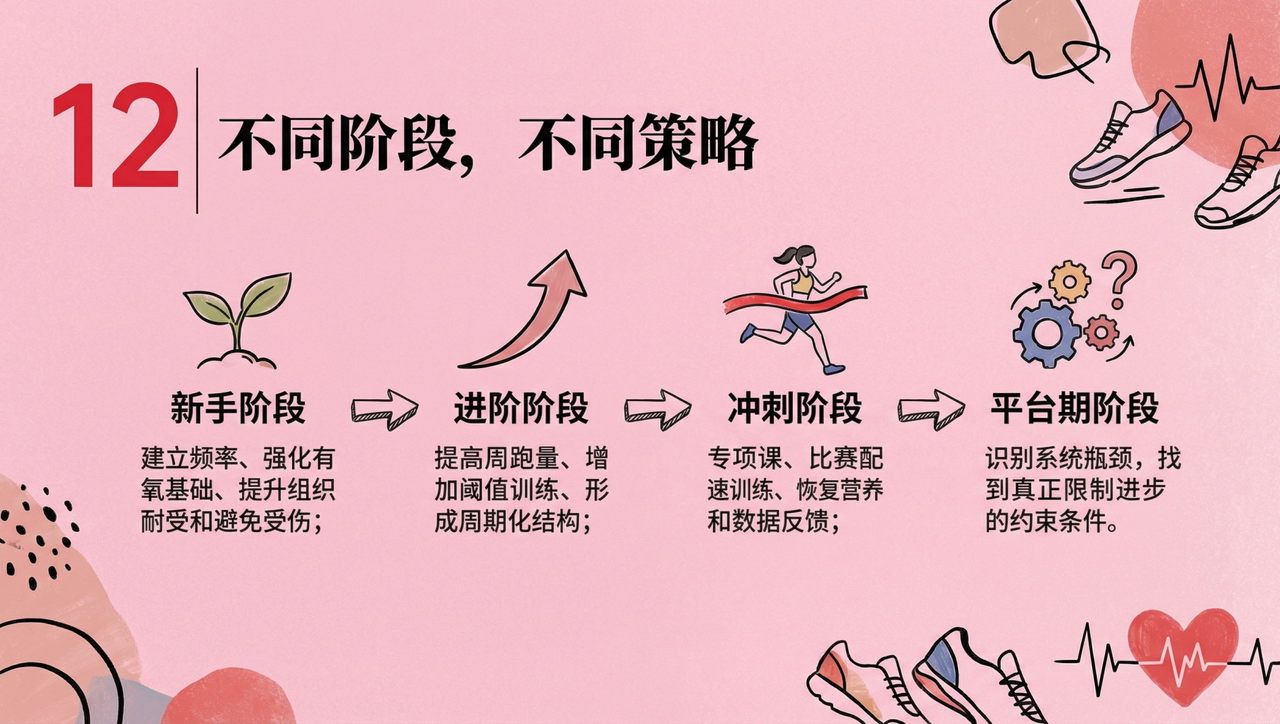
People operate at different system maturity levels:
-
Beginner Stage: Goal = Build closed-loop habits.
Focus: Frequency, aerobic base, movement awareness, tissue tolerance, injury avoidance. -
Intermediate Stage: Goal = Raise capacity ceiling.
Focus: Gradual volume increase, threshold work, smarter strength programming, periodized structure, feedback-responsive adjustment. -
Peak-Performance Stage: Goal = Race-specific breakthrough.
Focus: Precision sessions, exact race-pace rehearsal, rigorous recovery/nutrition, high-fidelity data feedback, advanced pacing control. -
Plateau Stage: Goal = Diagnose system constraint.
Ask: Is aerobic base weak? Economy poor? Threshold underdeveloped? Recovery insufficient? Training too narrow? Psychological volatility high?
Plateaus expose hidden system limits.
Eight Foundational Principles

- See the whole system—not just the latest workout. One session is a pixel; structure is the picture.
- Nurture critical stocks—not just chase short-term stimuli. Aerobic base, tissue tolerance, recovery capacity—all evolve slowly.
- Design feedback loops—not rely on grit. Let the system self-correct.
- Respect delay. Many powerful interventions yield no immediate reward.
- Manage constraints. Injury risk, sleep, stress, time, weight—all cap system output.
- Target high-leverage levers. Sleep, intensity balance, strength, and periodization beat extra miles.
- Build in redundancy. Never push every lever to maximum. Elasticity enables longevity.
- Prioritize sustainability. The strongest runners aren’t those who peak once—but those who evolve steadily for years.
The Running Operating System
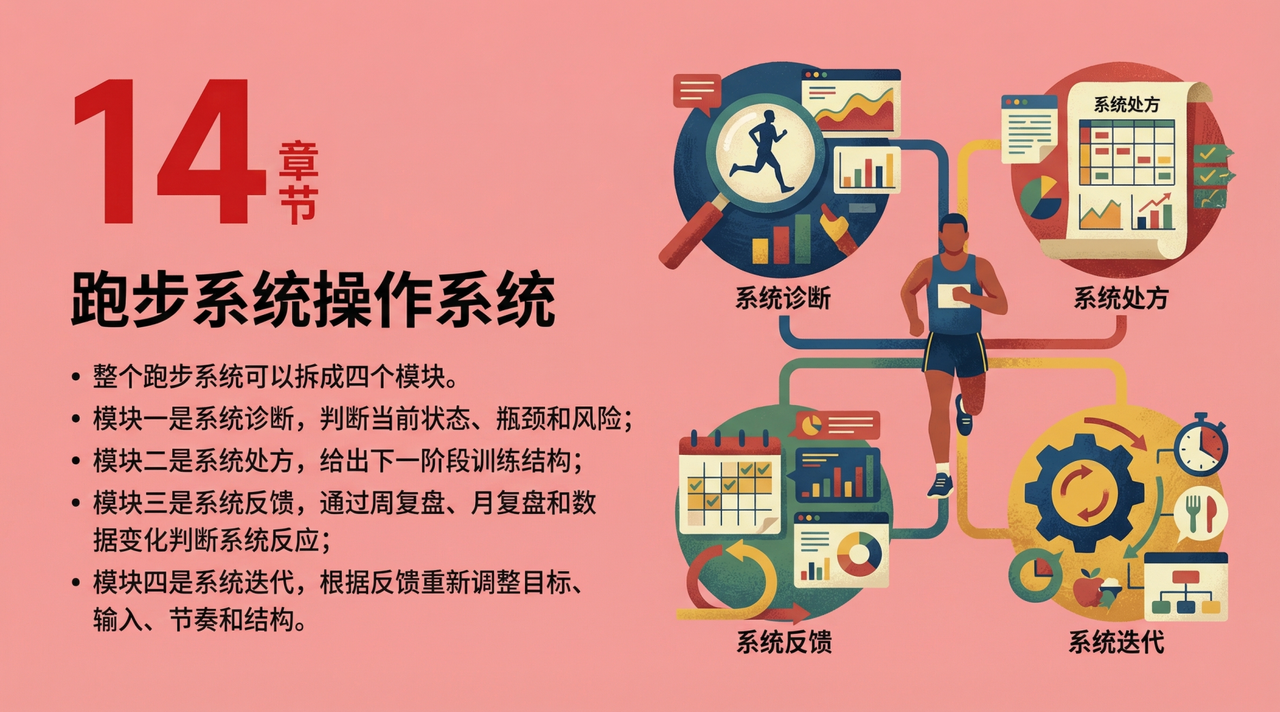
Think of your running as software with four modules:
- Module 1: System Diagnosis — Assess current state, bottlenecks, risks.
- Module 2: System Prescription — Define next-phase structure—not just “next workout.”
- Module 3: System Feedback — Use weekly/monthly reviews and data to gauge response.
- Module 4: System Iteration — Adjust goals, inputs, pacing, and architecture based on evidence.
AI-Native Companies
At Saturday’s “Silicon World” event, HappyCapy founder shared insights from one of the most authentically AI-native companies I’ve seen. Key takeaways:
- True AI-native status starts with organizational change—not tooling. Teams must adopt AI-native habits first; only then do AI-native tools become necessary. Also: Agents expand decision radius—and when decision radius grows, organizational layers naturally collapse.
- The real differentiator—for companies and individuals—is whether you’ve rebuilt your workflows from the ground up for AI.
- Human-Agent collaboration evolves in three phases:
- Taking over repetitive tasks
- Extending human capability boundaries
- Exploring genuinely unknown problems
- Today’s products serve humans. Tomorrow’s will serve Agents—a widely recognized startup frontier. Future interfaces won’t be GUIs for people—but CLIs for Agents.
- This year, Agents grew “hands.” Next-gen computers will fuse Agent + Computer—where the computer becomes the Agent’s physical body.
- When AI drives development, redundancy and discarded drafts become inevitable—and normal. Managing redundancy will emerge as a new source of efficiency.
- HappyCapy abandoned line-by-line human code review early on—because output volume made it impossible. That shift was their AI-native practice in action.
- One Agent writes; another Agent reviews. Accuracy now consistently exceeds human-level review.
- Best first tasks for Agents: repetitive, unambiguous, easily verifiable.
- “Perfect” products fade. “Good-enough, shipped-fast” products dominate—provided major risks are ruled out.
- When code commits surge 100×, managers shift from reviewing code to reviewing user experience. In the AI era, the scarcest skill is filtering and validating—not writing.
- Work evolves: from reviewing code → reviewing product outcomes. A future CTO’s core job? Ensuring the product actually got better.
- Better methodologies—not just more tools—drive real cost reduction.
- The most dangerous competitor in this wave? Your own delayed response to change.
- The end-state of AI-native products may be: everyone gets their own personalized 90-point version.
- The most promising long-term opportunity? Building products for Agents—not for people.