Building Your Own AI Tool System
A highly practical way to use AI is to break down your daily work and life into concrete scenarios—and then, for each scenario, identify the best AI tools for you. Keep using and refining those tools until they become habitual.
As AI participation deepens across more and more of these scenarios, your overall productivity gains compound significantly.
This approach has three concrete steps:
First, decompose your context: For example, break your work into ~20 distinct types of scenarios—like office input, personal knowledge management, multimodal rewriting, or draft editing.
Second, match each scenario with the strongest, most suitable AI tool: You can discover these through AI-powered search, expert recommendations, or community benchmarks.
Third, evaluate, iterate, and systematize: Gradually refine your selections and assemble them into a coherent, personal AI tool system.
This is worth doing continuously. Suppose you identify 30 high-frequency work/life scenarios where AI can meaningfully participate—and those 30 make up over 50% of your daily effort. Even modest per-scenario gains add up to transformative efficiency at scale.
But this method has limits: it optimizes within existing workflows—not beyond them.
Two deeper questions matter more:
- Should this task even exist—or can AI reconstruct it entirely?
- Is the direction I’m pursuing still valid—or can AI redefine its purpose and scope?
When our understanding of AI is still emerging, starting small—embedding AI one scenario at a time—is often the most pragmatic path forward.
Recommended AI tools by scenario:
(Note: No specific tools listed in source; author implies contextual curation over universal recommendations.)
Recent AI Principles
My updated AI principles—guided by investment logic: use the best models and best tools, especially for your highest-stakes tasks.
- Start with your most immediate, real-world tasks. Ask: What actual problems can AI solve right now?
- Prioritize AI for high-leverage activities: writing, coding, research, and early-stage experimentation.
- Build around concrete scenarios, layering AI capability directly into execution—not as an afterthought.
- Keep humans at the center: AI amplifies judgment—it doesn’t replace it. Cultivate and sharpen your own.
- Everyone should own their own AI compute and AI collaborators—and maintain a living AI tool system.
- One of AI’s deepest values: turning “digital debt” (accumulated friction, clutter, maintenance) into active creativity and output.
- The fastest way to understand AI? Use it frequently, not just theoretically.
- The stronger the model, the more critical rigorous evaluation becomes.
- Adopt AI First: For any task, ask first, “How would AI do this?” Spend 20% of your time learning, 80% practicing and shipping.
- If you’ve copy-pasted something twice—and expect to do it five times—invest time building a reusable skill or tool.
- Beyond work and casual “vibe coding,” schedule one fixed hour daily for deep dialogue with AI.
- Learn AI programming hands-on—and ship small AI applications.
- Use keyword-based learning: Each week, explore one topic systematically with ChatGPT and distill it into a lightweight knowledge map.
- Study and adopt Agent-based solutions that deliver structured outputs—not just chat.
- Dedicate weekly time to build and upgrade your AI tool system.
- Master your top 3 AI tools—deeply, consistently, relentlessly.
The Difficulty of Telling the Truth
Why is telling the truth harder than it seems?
First, what you think is true may not be—it could be bias, or even another kind of illusion.
Second, even if your understanding is accurate, expression introduces distortion: information loss, framing effects, or interpretive ambiguity.
Third, in many contexts, truth isn’t what drives behavior—emotion, identity, relationships, and interest often are.
So the real question isn’t “Should I tell the truth?”
It’s “What counts as truth here—and when, and how, should I express it?”
Agent Organizations
In 1937, Ronald Coase asked: Why do firms exist?
His answer: Because market transactions carry costs—finding people, negotiating, coordinating, verifying delivery. When external transaction costs get too high, we internalize work into organizations, replacing markets with management.
Large companies grow and persist on this logic.
Today, AI Agents are rewriting it.
As Agents grow smarter, more reliable, and cheaper, tasks once requiring human coordination—and thus organizational overhead—are being unbundled and reassigned.
For example, when HR messages me:

In the traditional model, I’d relay the request to engineering, wait for PM triage, then for dev implementation—guaranteeing hours of communication, alignment, and handoff.
Instead, I simply forwarded the same request to AI:
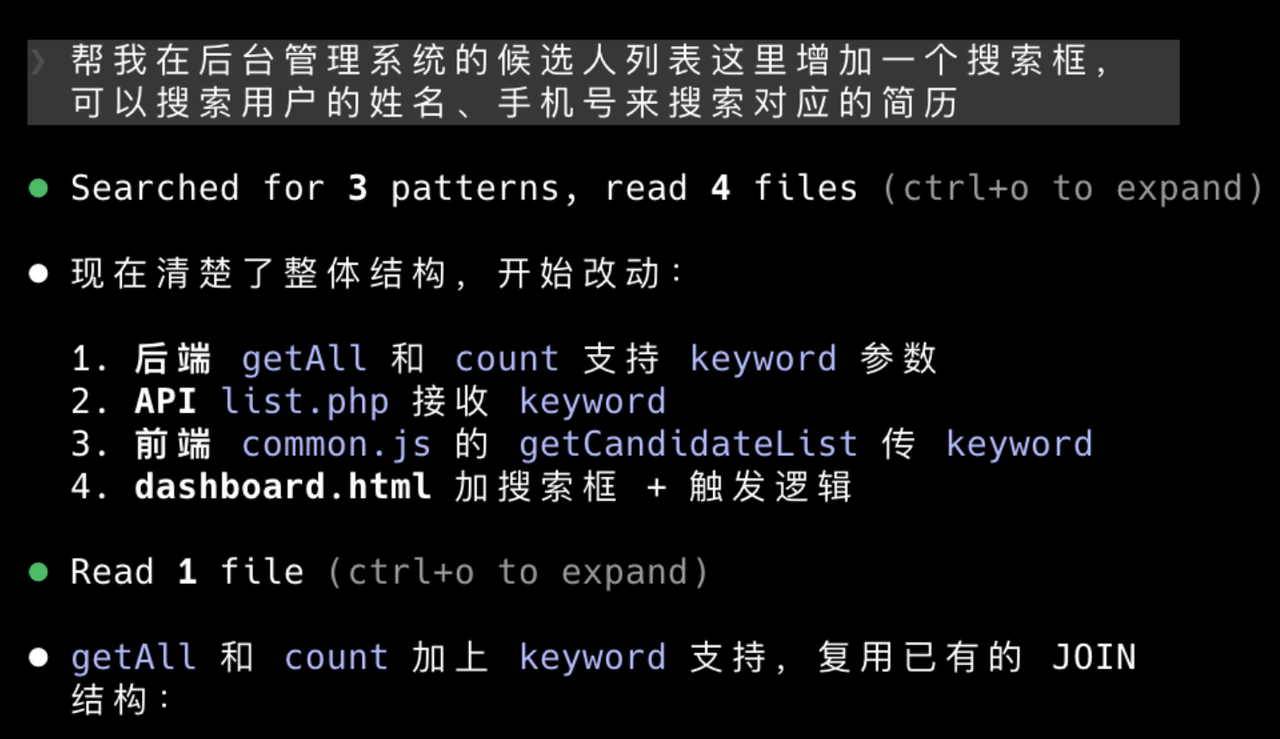
Minutes later, AI generated the updated code and auto-committed it to GitHub:
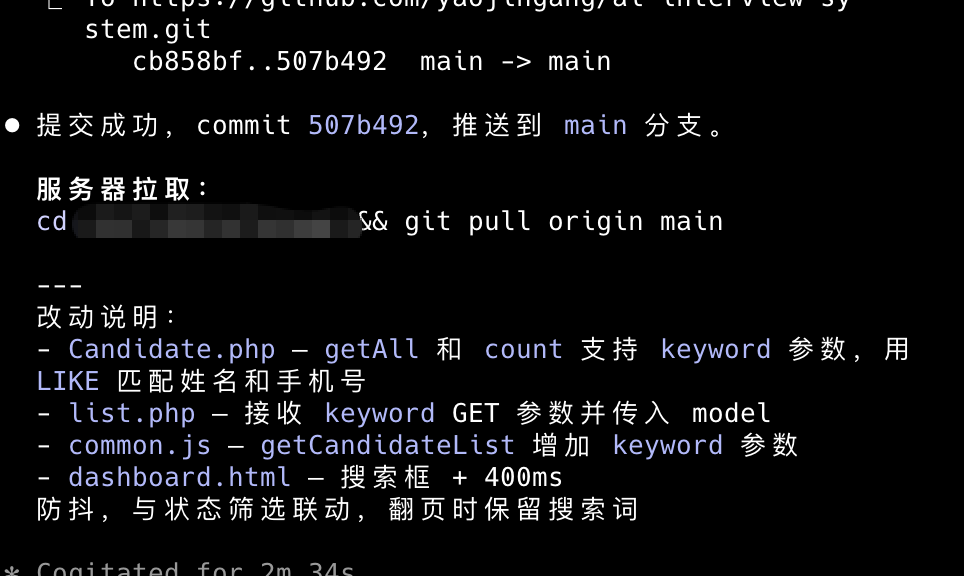
I pulled the latest version from the server—and deployed.
Total time: under 60 seconds. Zero meetings. No status updates. No cross-functional alignment.
Scenarios like this happen daily, inside teams and across departments. As more steps shift to Agents, the need for layered reporting, rigid roles, and hierarchical oversight declines.
A new concept emerges: the Agent Organization.
An Agent Organization isn’t a group of people executing processes. It’s a small core of humans—setting direction, making judgments, owning responsibility—working alongside many specialized Agents. Humans handle vision, ethics, accountability, and pivotal decisions. Agents handle execution, integration, API orchestration, and leverage.
In the past, organizations were built by people. In the future, they’ll increasingly be built by people + Agents.
So AI’s impact goes beyond efficiency—it reshapes the minimum viable unit of organization.
Before: Launching a business meant hiring headcount, defining roles, structuring departments.
Now: Launching a business means defining key human roles, specifying required Agent capabilities, and designing interfaces and collaboration protocols among them.
That’s the fundamental difference between a traditional company and an Agent Organization.
- Traditional companies optimize for headcount, hierarchy, and control.
- Agent Organizations optimize for goals, interfaces, and leverage.
- Traditional companies staff roles. Agent Organizations orchestrate capabilities.
- Traditional companies coordinate via management. Agent Organizations coordinate via humans managing Agents—and Agents connecting Agents.
This doesn’t mean companies vanish. Firms remain essential as trust anchors, legal entities, and delivery guarantors—especially in high-risk, high-stakes, or relationship-intensive domains.
What will change is organizational “thickness”: layers, boundaries, and internal friction. Many companies will endure—but their internal architecture will increasingly resemble Agent Organizations.
Smart, “Dumb”, and Wise
How do these three differ?
- Smart: Quickly grasping a problem—and finding a solution.
- “Dumb”: Not seeking shortcuts—choosing instead to show up, steadily and repeatedly, over long stretches.
- Wise: Judging, in a complex world, what deserves attention—and what should be left alone.
AI generated this comparison:
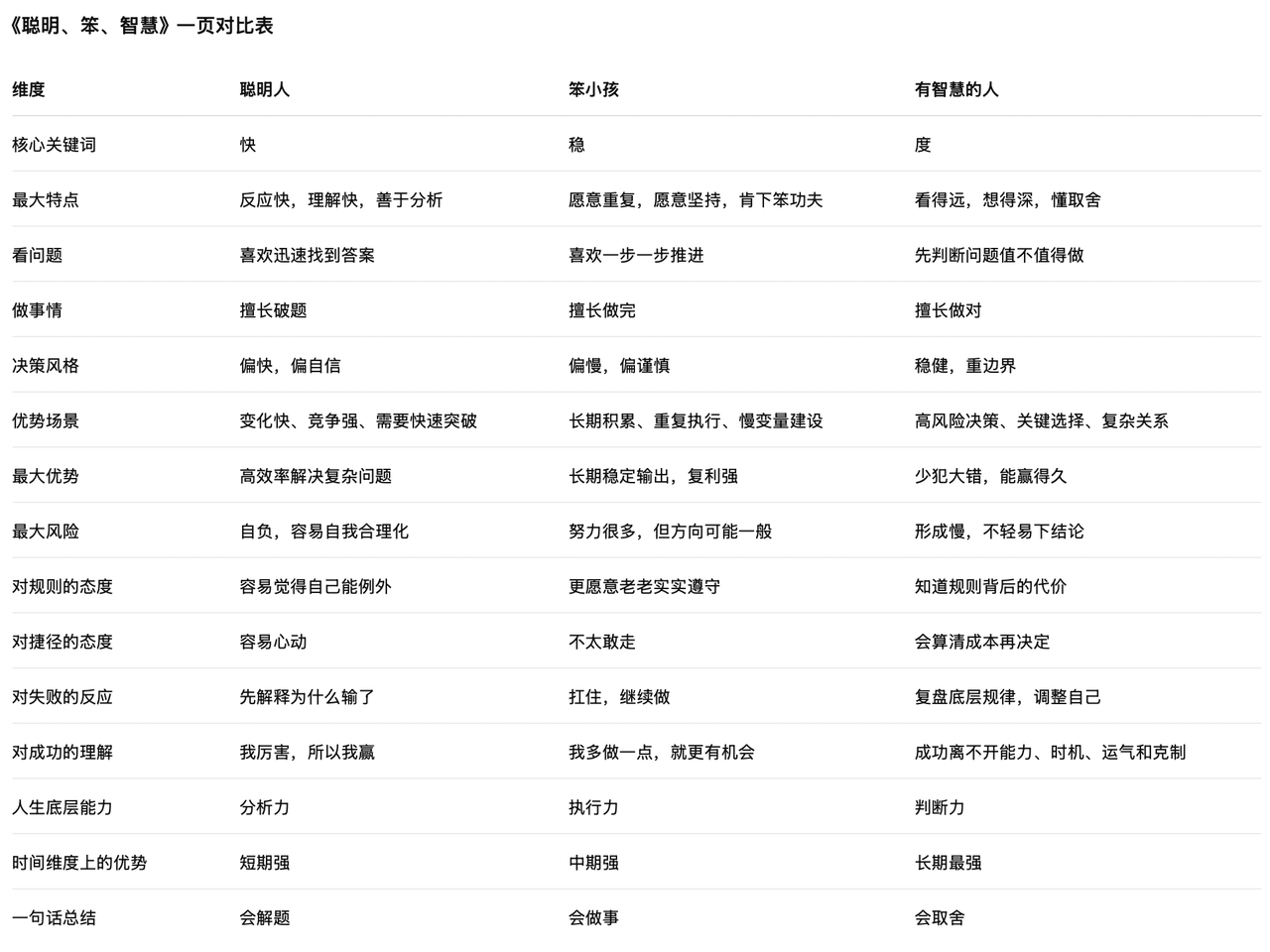
So: Smart solves problems. Wise avoids them. And the “dumb” one walks the path—step after step—until it’s done.
Finding Your Own Lifelong Question
When someone truly comes into themselves, they often converge on one thing: finding a large, enduring question—a north star that gives coherence to their life’s work.
It’s less a goal and more a long thread—connecting books read, questions pondered, essays written, products built, people met—all serving the same underlying direction.
Most people live around tasks: shipping projects, hitting targets, chasing feedback. But tasks end. Their satisfaction is episodic. Real depth—the sense of continuity, of legacy—comes not from how much you do, but from whether you’re anchored to a question worth decades of pursuit.
Think of Liang Jianzhang: his sustained focus on China’s demographic crisis became a lifelong social mission. Or Elon Musk: making humanity multiplanetary.
Once you claim such a question, you gain stability. You begin thinking in decades—not quarters. You tolerate silence, uncertainty, and delayed returns. A long-term question demands—and cultivates—patience, discernment, intellectual stamina, and unwavering action.
Most importantly, it gives your life a narrative spine. You learn to distinguish signal from noise: what merits five or ten years of commitment—and what is merely timely, fleeting, or performative.
I believe the rarest human quality isn’t intelligence or speed—it’s finding a problem you’re willing to spend years advancing—and letting it evolve into part of your life’s purpose.
This way of living is slow. But it’s deep. It’s long. And it’s worth it.