On Aesthetics
What’s so important about “beauty”? Because what feels beautiful is often right.
Here, “right” doesn’t mean morally correct—it means pointing in the right direction: aligned, coherent, sustainable.
This “beauty” isn’t just visual. It’s the elegance of a well-structured system, a clean interface, a resonant phrase, a balanced equation, or a harmonious color palette.
We build aesthetic sense by encountering beauty across disciplines—math, architecture, poetry, biology, code—and learning to recognize its recurring signatures.
Beauty wears many faces: symmetry, tension, proportion, minimalism, controlled complexity, dynamism…
The more deliberately we learn to spot and appreciate these forms—in meetings, in spreadsheets, in product flows, in conversations—the more refined our aesthetic judgment becomes.
Take symmetry as an example.
In architecture, it looks like this:

In visual art, like this:

In poetry: “Mountains pile, rivers twist—surely no path remains; / Willows dim, flowers bright—a village appears.”
In mathematics, elegance is often immediate: you see it before you prove it.
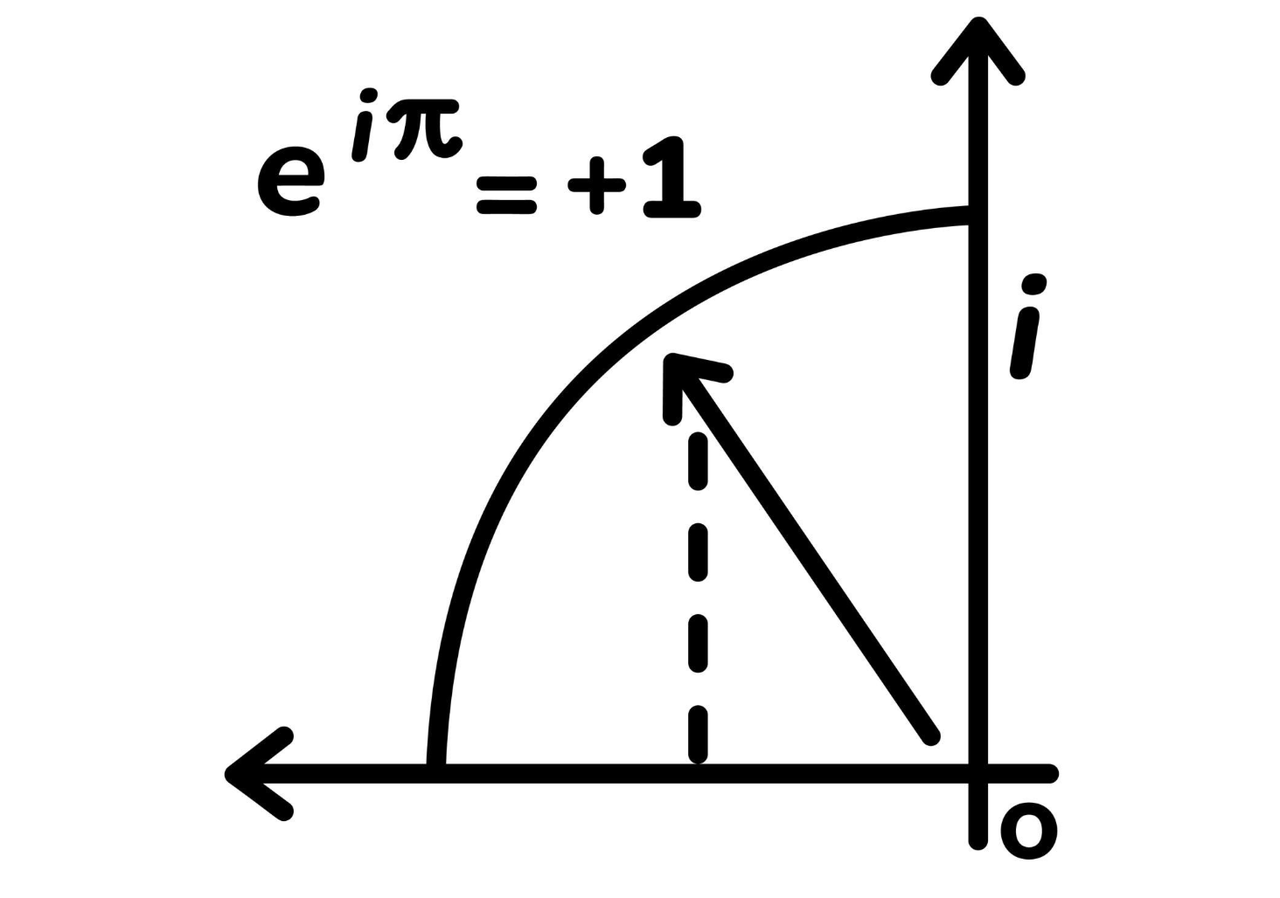
Many mathematicians have pursued theories not because they were proven—but because they felt too beautiful to be wrong.
Why? Because symmetry implies balance. Balance implies stability. Stability implies internal consistency—the hallmark of robust systems.
The same holds in startups. A “beautiful” business model often exhibits symmetries: cost ↔ revenue, value creation ↔ value capture, long-term investment ↔ long-term return.
Costco is a textbook case: it earns from membership fees, then reinvests nearly all margin back into lower prices. Scale drives down costs and lifts renewal rates—creating a self-reinforcing loop. Structure is strategy.
And when you cultivate aesthetic sensitivity, your lived experience changes—not just in work, but in how you walk through a park, listen to a conversation, or hold silence.
The Happiness Coordinate
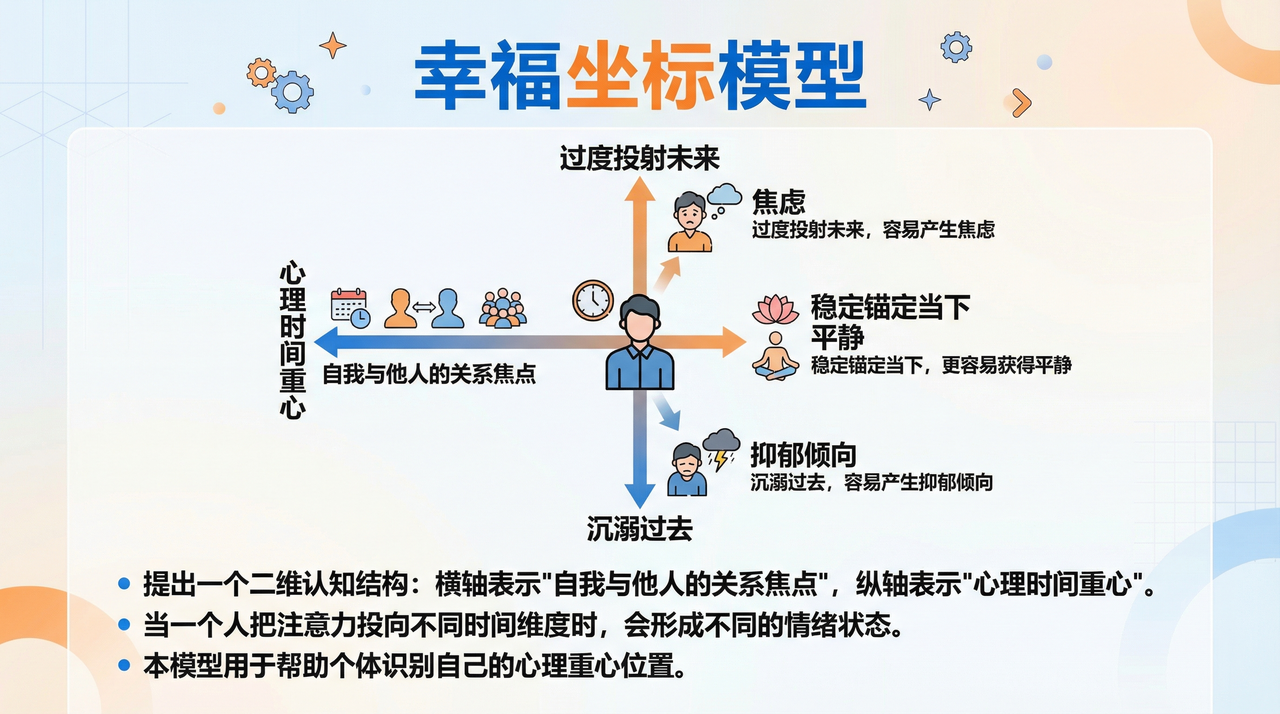
Depression lives in the past.
Anxiety lives in the future.
Calm lives in the present.
…
We can’t quantify happiness—but we can ask: How many moments of genuine, unmediated joy do I notice in a day?
That noticing—your capacity to land fully in micro-moments of warmth, clarity, or connection—is the strongest lever on your real-time happiness index.
To strengthen it, first clarify two things:
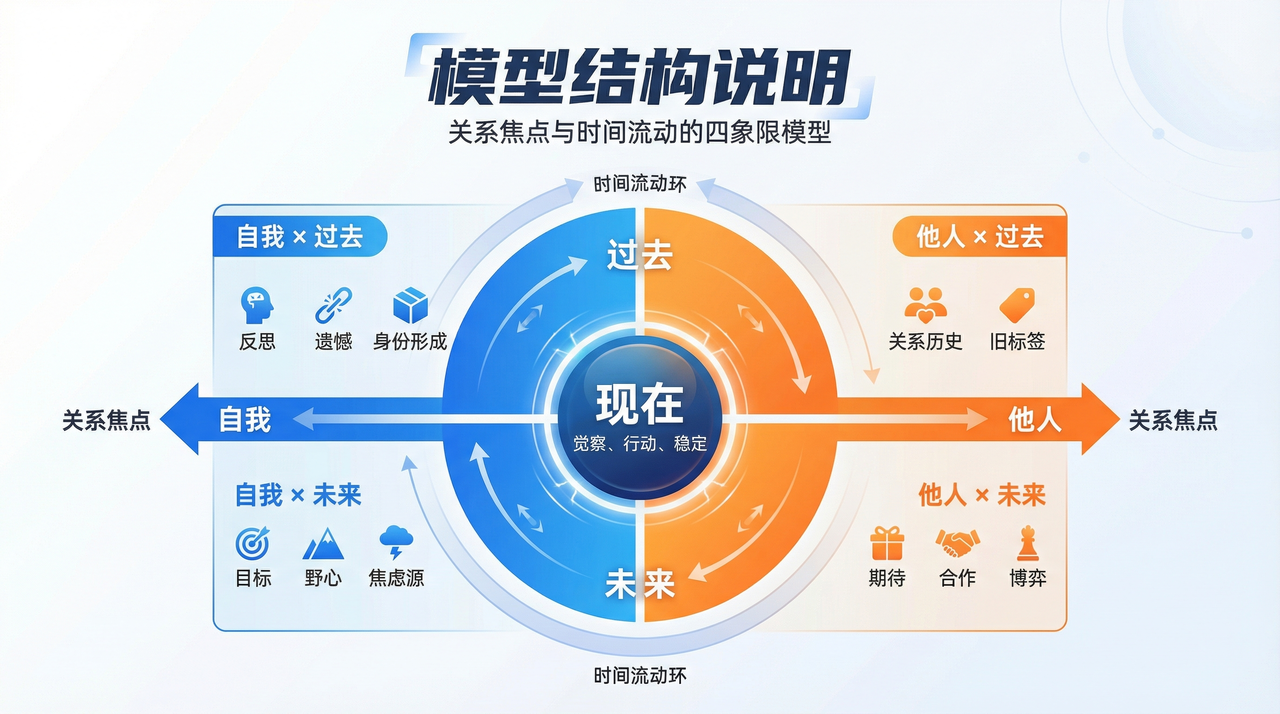
- Your boundary between self and others
- What “living in the past/future/present” actually feels like, physiologically and behaviorally
A four-quadrant model helps make this tangible:
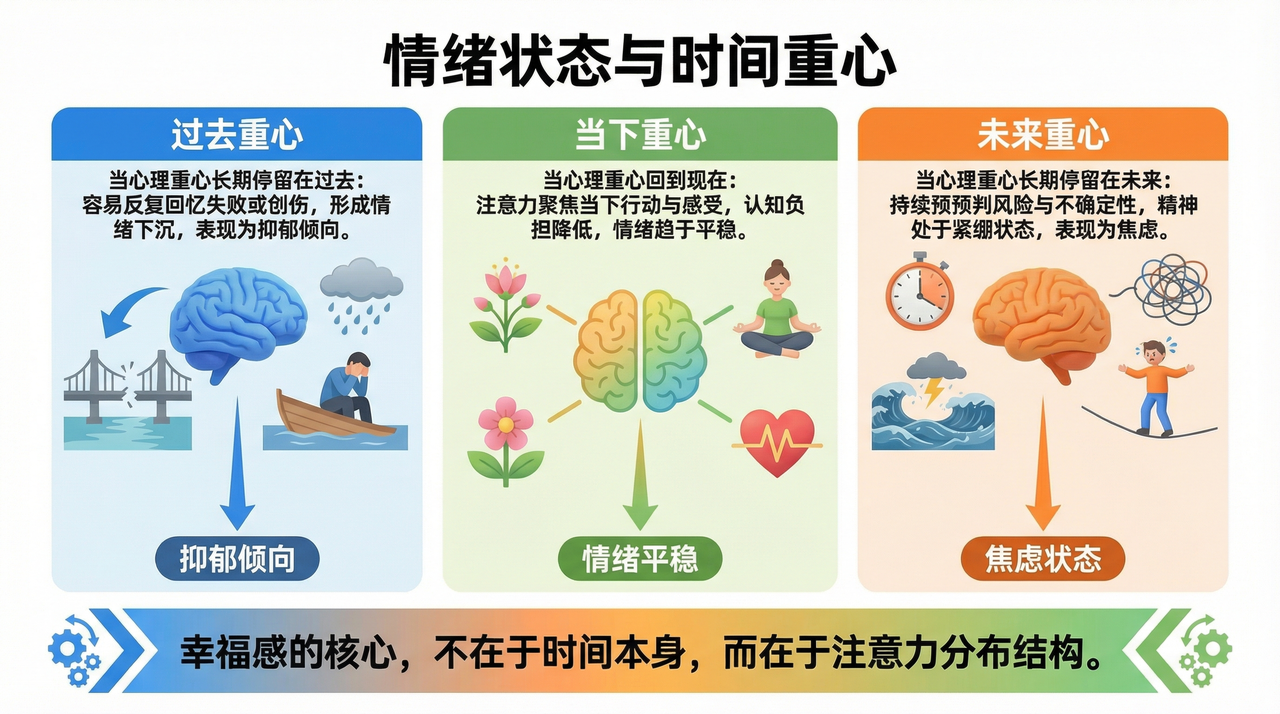
A psychologist-trained TCM doctor once put it simply:
“The present isn’t abstract. It’s concrete: when you’re driving, the car and your hands on the wheel are all that matter. When you’re with a patient, that relationship is the only world. When you’re traveling with your partner, the two of you *are the center of gravity.”*
So the most actionable principle for raising happiness? Practice showing up where you are.
Two high-leverage ways:
- Reconnect with what you genuinely love—not as a hobby, but as an anchor
- Build daily micro-habits of embodied attention (e.g., 2-minute breath-focused pauses, not “meditation” as performance)
Agent-Native Organizations
Lately I’ve been asking: What does an organization built *for Agents—not just using them—actually look like?*
Here’s an early working hypothesis: three evolutionary stages.
Stage 1: Everyone codes with AI.
→ Gains: personal tool autonomy; 1–3× individual productivity lift.
Stage 2: Everyone builds their own Agent.
→ Gains: task automation, context-aware assistance; 10×+ personal leverage.
Stage 3: Everyone orchestrates teams of Agents—and those teams interoperate across org boundaries.
→ Gains: systemic coordination, emergent insight, 10×+ organizational throughput.
How to start Stage 1:
- Embed AI fluency via hiring criteria, lightweight training, and incentive-aligned tooling
- Each person lists ≥5 daily repetitive tasks—and replaces at least one with vibe coding or an AI wrapper
- Measure real output gains—not just time saved
The Smart Pig Game
A classic game theory model:
- Two pigs share a pen: one large, one small.
- A food dispenser sits at one end; a button sits at the other.
- Pressing the button releases food—but costs energy.
- Once released, the larger pig gets most of the food.
Who presses the button?
If the small pig presses, the large pig waits—and eats most while paying nothing.
If the large pig presses, the small pig still eats some for free—but the large pig still gets the lion’s share.
Stable outcome? The large pig presses; the small pig freeloads. That’s the Nash equilibrium.
Three takeaways:
- Stronger players gain higher marginal returns—so bearing cost makes more sense for them
- Rational actors optimize for net payoff, not fairness or narrative
- Equilibrium ≠ fairness. It’s simply the state where no one benefits from changing alone
This model quietly answers a deeper question: Are you designing rules—or just playing within them?
If you want to be a rule-maker, the rational move is to make rules public, structures transparent, and incentives explicit. No “secret sauce”—just shared scaffolding.
True mastery lies not in hoarding advantage—but in publishing the playbook, inviting co-optimization, and aligning incentives so everyone wins more by playing together.
Three Moats for AI-First Companies
Menlo Ventures and Anthropic recently launched the $100M Anthology Fund—focused exclusively on early-stage AI-native startups. Their thesis is clear: the biggest opportunities won’t come from “AI-augmented” legacy products—but from companies born of AI.
They propose three non-negotiable moats:
-
AI-First (not AI-Plus)
These companies wouldn’t exist without foundation models. AI isn’t a feature—it’s the substrate. Remove the model, and the company collapses. -
Deep Model Integration
Not just prompting—but engineering: turning LLM capabilities into structured, repeatable, scalable systems—Agent workflows, automated knowledge ops, closed-loop decision engines. -
Velocity-Driven Teams
Who validates demand fastest? Ships MVPs quickest? Iterates versions most relentlessly? Speed isn’t just tactical—it’s strategic. With models evolving weekly and user expectations shifting monthly, iteration cadence is defensibility.
When planning our new year’s initiatives with Xiangyang, we kept returning to this triad. Especially #3: rapid iteration.
With AI tools now handling boilerplate, testing, documentation, and even basic UI generation—we can ship faster. And when launch cycles shrink, feedback loops tighten, learning accelerates, and product-market fit emerges not from grand vision—but from dozens of tiny, validated steps.
In practice: speed is growth.
Recent AI Tools in Rotation
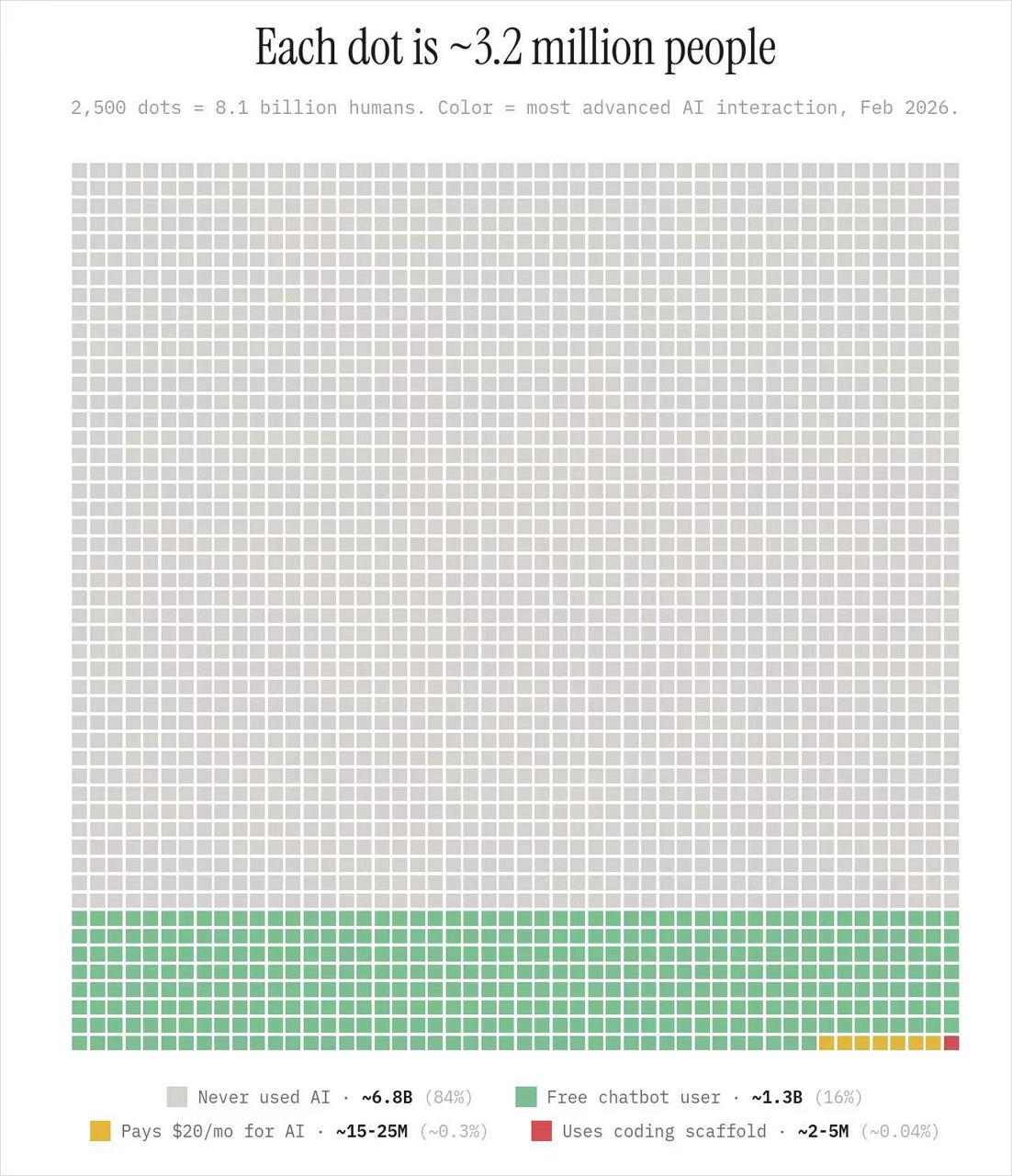
This chart is sobering: only ~0.04% of professionals actively use AI coding—4 out of every 10,000. Meanwhile, 84% have never tried AI tools.
We’re not in the “AI adoption curve.” We’re in the pre-curve. Like the internet circa 1995.
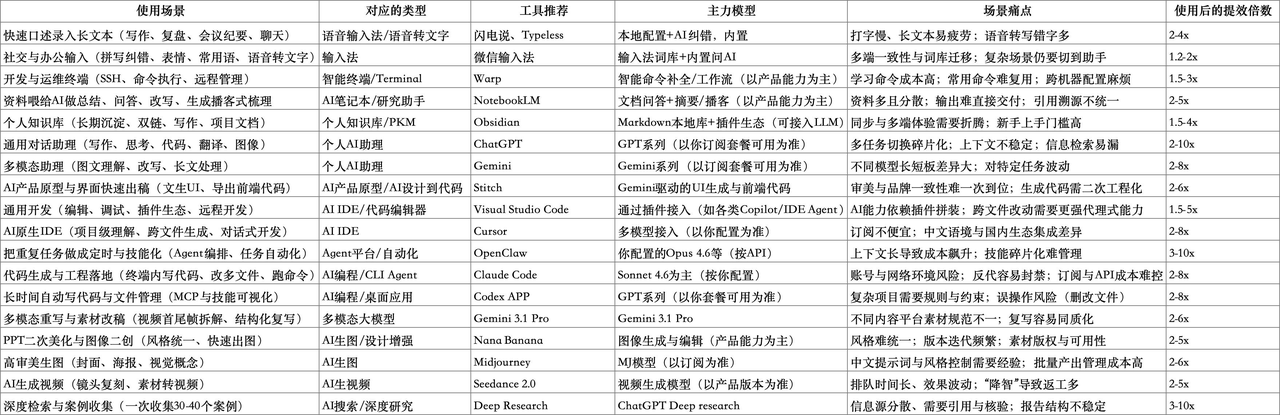
A few tools I’ve used and recommend: