The Return Curve Model
Why do only top performers command extraordinary returns in most industries?
In many fields, the gap in raw ability between “good” and “elite” isn’t as wide as we imagine—yet the commercial payoff can differ by hundreds or even thousands of times.
Take marathon running: shaving 20 minutes off your time—from 2:30 to 2:10—may seem like a small margin. But in practice, that leap transforms you from an anonymous runner into a globally sponsored athlete. The market reward isn’t linear; it’s stepwise—and then explosive.
As I reflected on this, a model emerged—one that maps human learning onto AI training phases: pre-training, supervised learning, and reinforcement learning. Within that framework, three distinct return curves operate simultaneously:
- The joy curve: Subjective pleasure derived from doing the work
- The skill curve: Objective capability gained with sustained effort
- The commercial return curve: Market value assigned to different skill tiers
Overlaying these is a fourth, implicit line: the market supply density curve. As skill rises, fewer people occupy each tier—supply thins dramatically.
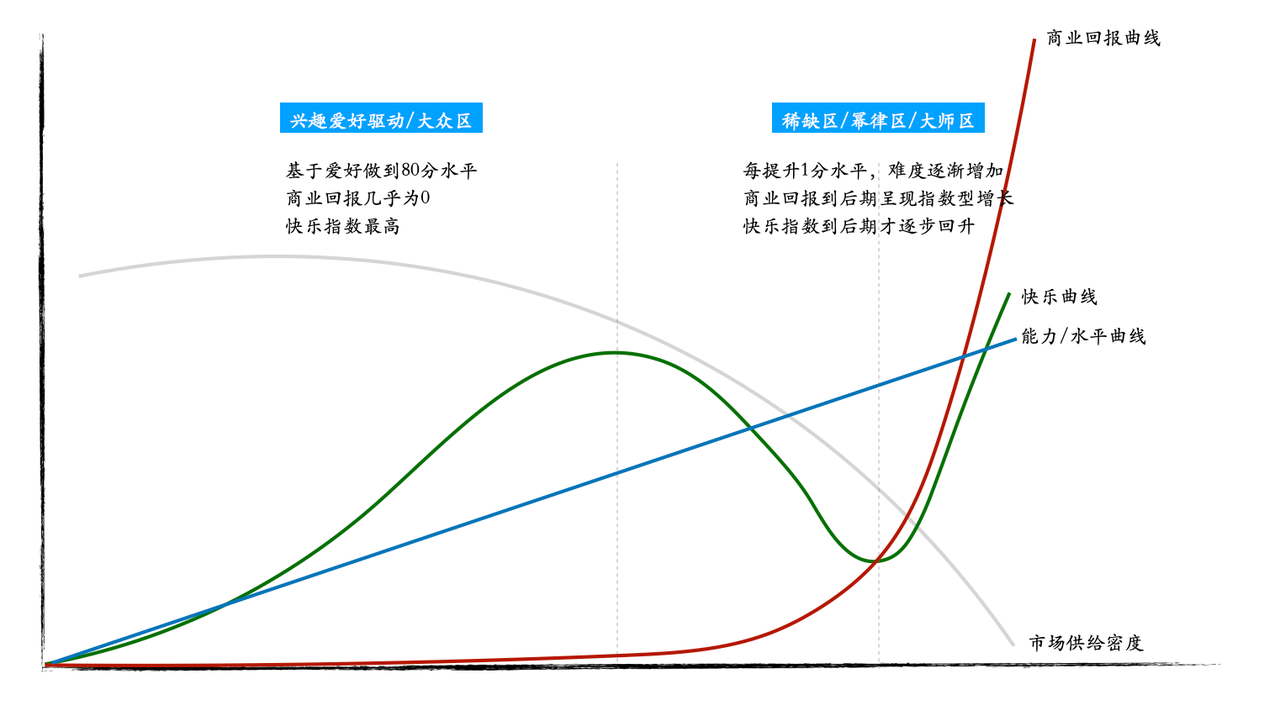
When someone first engages with a domain—reading, observing, mimicking—it’s like pre-training. Progress feels effortless. Joy is high. Skill climbs quickly to ~80/100. But here’s the catch: commercial returns remain near zero. Why? Because supply is saturated. You’re easily replaceable.
Pushing from 80 to 85 or 90 is where things get hard. Joy dips. The work turns repetitive, isolating, and mentally taxing. Each minute shaved off a marathon time—or each new Chopin étude mastered—demands systematic training, feedback loops, and relentless correction. This phase mirrors supervised learning: deliberate, error-driven, and exhausting. Most people quit here.
True inflection happens near 95–100—the elite fringe. That final stretch demands extreme focus, scientific rigor, and micro-optimized iteration—like reinforcement learning. Marginal cost soars. Yet cross that threshold, and commercial returns explode—not linearly, but exponentially.
Interestingly, joy often rebounds at this level. Why? Because you stop following rules—you start writing them. You define the problem, set the standard, reshape the game. You shift from participant to architect. That’s not just satisfaction—it’s sovereignty.
So if you seek outsized commercial returns—whether as an individual or organization—the clearest path is: pick a promising domain, stay ruthlessly focused, and move deliberately through the three phases—pre-training → deliberate practice → reinforcement-level optimization. Only at the very top—where you occupy one of a handful of positions—does the market reward scale non-linearly.
For companies, this means aiming not just for “good,” but for category leadership. It’s the headwind of power-law distributions and the tailwind of network effects. When you reach that peak, joy and return often rise together—not in opposition, but in alignment.
Three Points, One Line: A Life in Motion
Over Spring Festival, I visited relatives back home—and was struck by a quiet, recurring pattern.
One family stood out: nearly all members work away from home. Only an elderly parent and a high-school daughter remain in the town. The father works year-round in Guangdong, returning for just four or five days each Spring Festival—driving back and forth, hugging briefly, then vanishing again. The mother stays locally, employed at a pig farm owned by a publicly listed company.
She told me her salary—several thousand RMB per month—is decent for the area, though lower than what she’d earn out-of-province.
Yet she described the job as “like being in prison.”
Two reasons: First, strict closed-loop management—entry and exit tightly controlled to prevent pathogens from entering production zones. Second, profound environmental monotony. The site sits in open countryside, far from shops, cafes, or social spaces. Young workers rarely last a month. They cash their first paycheck, blow it, then return—repeating the cycle. Middle-aged staff endure longer, but the fatigue isn’t physical. It’s existential—a slow hollowing out.
Her daily life traces the same arc: dormitory → canteen → production line. Her sole priority? Getting paid on time. Beyond that, she has no spending habits, no hobbies, no leisure rhythm. When idle, she scrolls short videos. The area is barren—no cinemas, no parks, no friends nearby. Even though her hometown is close, she rarely visits: “No time.”
Their entire financial engine runs on one goal: build a house, finish the interior, buy an apartment, renovate the ancestral home, raise fish and ducks—and finally, save something for old age.
Their son dropped out after junior high—no interest in school, no academic path. He joined the pig farm straight out of school. During Spring Festival, while others celebrated, he stayed on shift—for triple pay.
The father’s life mirrors hers: no hobbies, no local ties, frequent night shifts, little conversation beyond work.
They live with radical frugality. Years of savings bought them a house in town—and recently, an unfinished apartment in the city. All for their son’s future marriage. Next comes renovation, furniture, rural upgrades—and finally, a sliver for retirement.
That’s the full plan.
They began in deep poverty. Income grew slowly—not explosively. With no degree, no specialized skill, no capital, no network, their options were narrow. Their leverage? Discipline. And endurance—the kind few are willing to bear.
Agent-First Organizations
When designing our AI Leadership course, Xiang Yang and I shared a core conviction: In the coming decade, wealth creation won’t hinge on how many people you manage—but on how many AI Agents you can effectively lead.
An Agent’s defining trait is autonomy. Each AI agent functions like a digital employee: given clear goals and guardrails, it acts independently—planning, executing, adapting, and delivering outcomes.
That belief shaped the entire curriculum. We treat Agents like human team members—conducting regular 1:1s, reviewing outputs, refining strategies, updating KPIs, and iterating standards. Over a year, this discipline can produce dozens—or hundreds—of stable, high-output Agents, running 24/7.
Consider a “Product Manager Agent”: every day, it scans industry news, analyzes competitor moves, synthesizes user feedback, drafts feature specs, and even generates clickable prototypes. You review its proposals once a week. It handles research, analysis, and design autonomously—and delivers structured, actionable reports.
Here, the human role shifts: from executor to goal-setter and reviewer. No constant prompting. No micromanagement. Just clarity on intent and evaluation criteria—and the Agent takes over. Better yet, Agents can coordinate: the Product Manager Agent triggers the Backend Dev Agent to implement features, then hands off to the QA Agent for validation—closing the loop without human intervention.
This isn’t speculative. OpenClaw’s 2026 release made it tangible—concrete, testable, and scalable. If implemented well, it will redefine organizational structure, workflow, and productivity itself.
That’s why “Agent-first” is my top operational priority this year. We’re starting with existing products and roles—systematically redesigning workflows, stress-testing autonomy, and building a true digital workforce. When Agents approach human-level initiative and coordination, organizations won’t just become faster—they’ll become structurally different.
Agent-first organizations will emerge. And the new unit of productivity won’t be “FTEs”—but Agent count × Agent quality × Management density.
A company’s most valuable assets will soon be:
- The number of high-fidelity, reliably autonomous Agents it operates
- How those Agents interconnect and collaborate
- Who sets the north star—and who upgrades the strategy
That’s a new form of production capital.
Today’s Agents are mostly “semi-autonomous tools.” They’re not yet trusted colleagues—let alone results owners.
The real bottleneck isn’t quantity. It’s the management layer: Can we build systems to define goals, decompose standards, run periodic reviews, evaluate Agent performance, and cultivate genuine, persistent agency—including multi-Agent orchestration? That’s where we’re investing—not in more Agents, but in the infrastructure that makes them capable.
Naval on AI
Naval Ravikant and his longtime collaborator recently released a podcast unpacking AI’s implications for work, creativity, and human purpose. Full of counterintuitive insights, here’s what resonated most:
- In the AI era, “mediocrity has no market.” The best product captures nearly 100% of share—second place is functionally irrelevant.
- Humanity’s ultimate aim? Let robots handle material needs, let computers amplify intellect, and free everyone to create meaningfully—not grind in soulless jobs.
- Entrepreneurship isn’t about filling a gap. It’s about extreme agency: solving problems no one else sees—or dares to tackle.
- Traditional programmers who grasp hardware, physics, and first principles will wield thousand-fold leverage—even reshaping entire industries solo.
- AI is a masterful data compressor: brilliant at remixing known elements. True originality—generating what cannot be predicted from existing data—remains uniquely human.
- AI evolves via market-driven natural selection. To survive, it must serve humans—not dominate them. So don’t fear “misaligned AI.” Fear misaligned humans wielding AI.
- If classical computing was the “bicycle for the mind,” AI is the “motorcycle for the mind.” But it still needs a rider—to steer, accelerate, and brake.
- In zero-sum games (dating, trading, fame), AI advantages cancel out when everyone uses them. Alpha—the edge that wins—still lives in human creativity and asymmetric insight.
- Become the world’s best at your thing. Redefine it constantly—until you own the narrowest possible category where giants can’t follow.
- AI is history’s greatest teacher: it adapts explanations to your current understanding—until complex ideas click.
- When confronting dense academic papers, don’t settle for text summaries. Ask AI to generate diagrams, analogies, whiteboard-style derivations—anything that drops the concept to your comprehension threshold.
- Always pay for the best available model. In real-world decisions, 92% accuracy isn’t “slightly better” than 88%—it’s infinitely more valuable.
- Anxiety dissolves in action. If AI unsettles you, use it. Break it down. Map its limits. Study its architecture.
- Most people avoid complexity. But “to invest in the future, you must live in it.” Use cutting-edge tools obsessively—early, deeply, and publicly. That asymmetry compounds fast.
- Learning tools are abundant. What’s scarce—and decisive—is the hunger to learn.
Shared Purpose Wins
A colleague asked me: “What’s your stance on the CEO’s new initiative?”
I replied: “I haven’t mapped every detail yet—but my overall judgment is positive. So yes: commit fully. Execute rigorously. Raise the bar.”
That answer rests on a principle I’ve long held dear—from Sun Tzu’s Art of War: “When leaders and troops share the same desire, they win.”
My reading: Even if a strategy isn’t perfectly formed—if the team aligns on why, synchronizes on how, and commits to what—execution gains momentum, flaws get corrected in motion, and outcomes improve organically. Shared will multiplies capability.
But there’s a critical condition: strategic authority must be centralized, and the direction must sit within the company’s tolerable experimentation zone. Only then does unity yield upside—not rigidity.
Conversely, even brilliant strategy fails if the team doesn’t believe. Surface compliance masks inner resistance. Passive-aggressive delays, silent sabotage, and misaligned incentives erode everything. Great plans crumble—not from poor execution, but from fractured conviction.
That said, alignment ≠ blind obedience.
If the strategy contains obvious logical flaws—or risks exceed the organization’s capacity—no amount of execution can fix structural misalignment. Many failures aren’t operational. They’re judgmental.
In practice: strategy quality matters—but organizational coherence often decides the outcome.