Dazu Rock Carvings
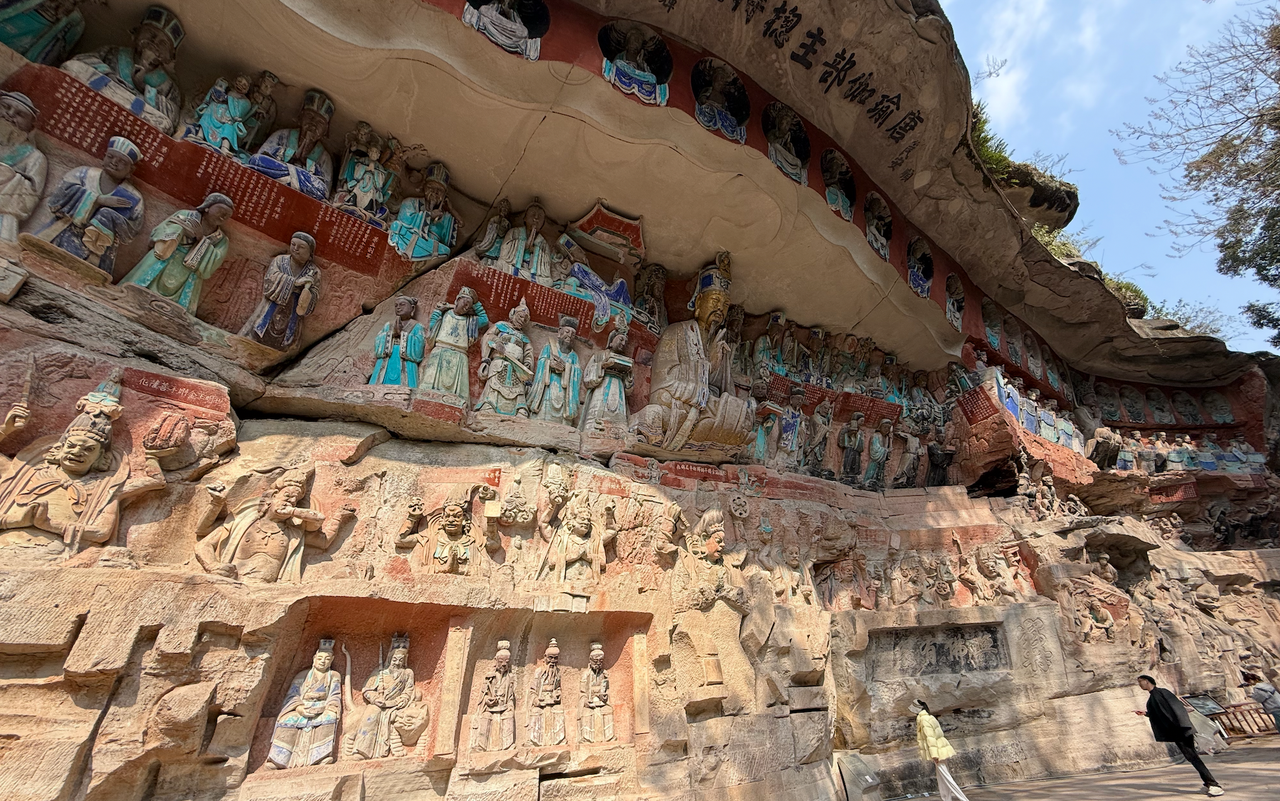
Before the holiday, my spouse, our child, and I visited the Dazu Rock Carvings in Chongqing.
That day, we toured two sites: the Baoding Mountain carvings and the Beishan carvings. Their atmospheres differed markedly—each expressing a distinct artistic and spiritual sensibility.
During our visit, we also tried Douyin’s (ByteDance’s) video-calling feature, which recognized scenes in real time and delivered personalized commentary—an unexpectedly engaging layer to the experience.
One of the most iconic areas at Baoding Mountain is the “Reclining Buddha Bay.” Standing there, you feel a grand Buddhist narrative unfolding before you.
The original artisans and masters carved these figures not merely as art, but to translate abstract Buddhist ideas into vivid, story-driven scenes. Even without reading sutras, ordinary visitors can walk along the cliffside, follow the characters and narratives, and intuitively grasp core Buddhist concepts: compassion, karma, and practice.
Compared with other art forms, rock carvings uniquely preserve and transmit the essence of Buddhist thought across centuries.
The layout of Reclining Buddha Bay is remarkably coherent—like an unrolled visual scripture. As you move along the cliff, each figure carries symbolic weight: different bodhisattvas, disciples, and celestial beings each embody specific teachings.
Most arresting is the Thousand-Armed, Thousand-Eyed Guanyin.
Looking up at her in person, you’re struck by the sheer density and solemnity of her presence. The thousand arms signify skillful means to relieve suffering; the thousand eyes, wisdom and compassion that perceive all realms—profoundly moving.
Midway through the bay lies a massive reclining Buddha—over thirty meters long—depicting Sakyamuni entering parinirvana.
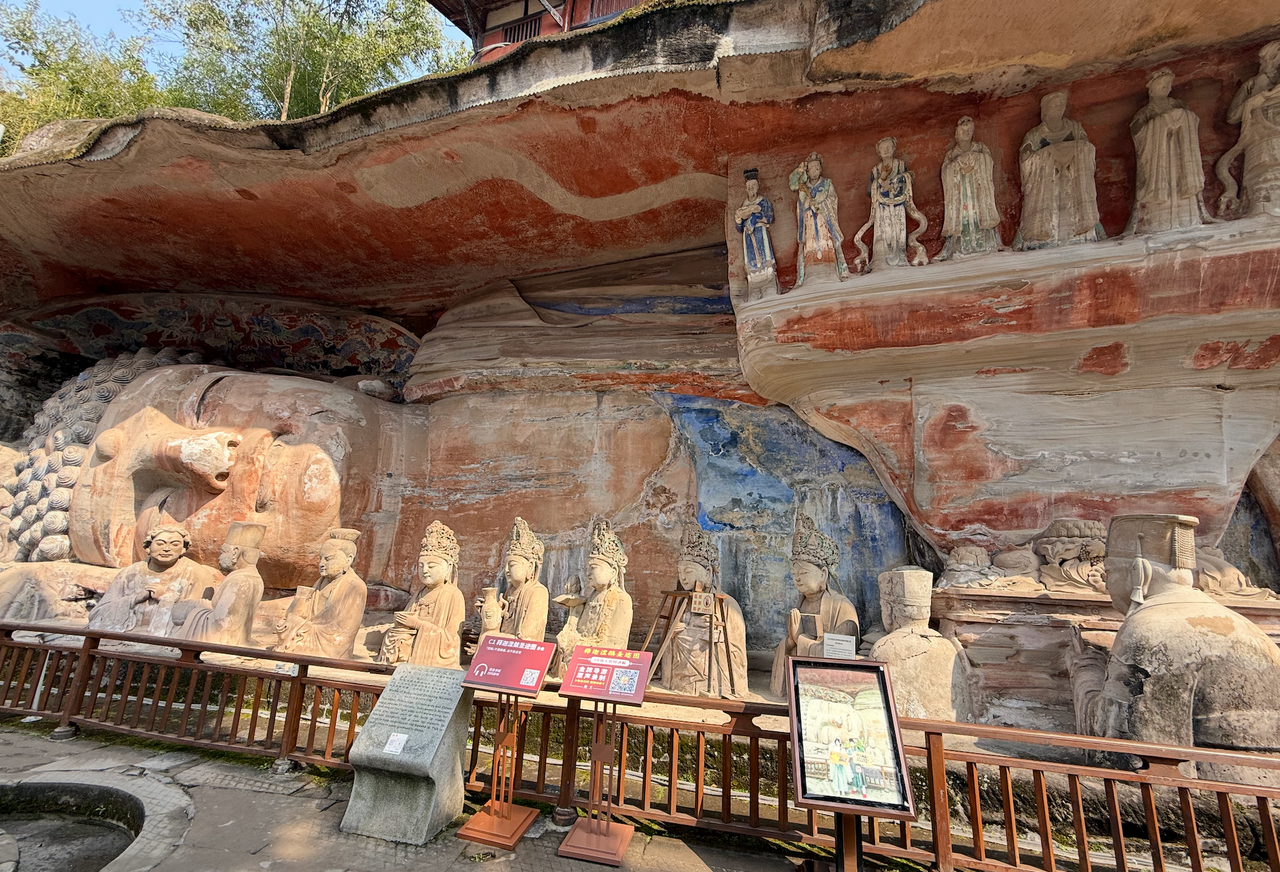
His face is serene and still, evoking a calm beyond birth and death. In Buddhist terms, nirvana signifies liberation and abiding peace—the ultimate goal of practice.
Behind the reclining Buddha, the carvings shift dramatically: a richly three-dimensional depiction of the Pure Land—a vision of a tranquil, luminous realm attainable through practice and vow.
Baoding Mountain also includes vivid depictions of hell realms and karmic retribution—not as mere punishment, but as reminders to act with reverence in daily life. Buddhism emphasizes not only consequence, but also repentance and transformation: within karma lies a path of self-correction.
What makes Reclining Buddha Bay especially powerful is how it renders abstract doctrine tangible—converting theory into visible, emotionally resonant stories. Even casual visitors can touch the heart of Buddhist spirit through its sculpted narratives.
Baoding Mountain integrates canonical sutra tales with everyday scenes—its themes are rich, its compositions sweeping, its storytelling deeply intentional. Walking its length, you feel Buddhist values communicated not through doctrine, but through embodied art.
After leaving Reclining Buddha Bay, we visited Beishan. Its character differs sharply.
Here, the carvings are denser, smaller in scale, and less unified in narrative scope. The focus is primarily on individual Buddha and bodhisattva figures—less a single epic, more a cumulative archive of devotion, quiet and meticulous, imbued with another kind of timelessness.
Seeing both styles in one day offered a rare double exposure: the monumental sweep of Buddhist narrative at Baoding, and the intimate, layered continuity of Beishan. This brief trip became a moment of quiet resonance—cutting through pre-holiday busyness, offering space to pause and reflect.
Changes in My Hometown
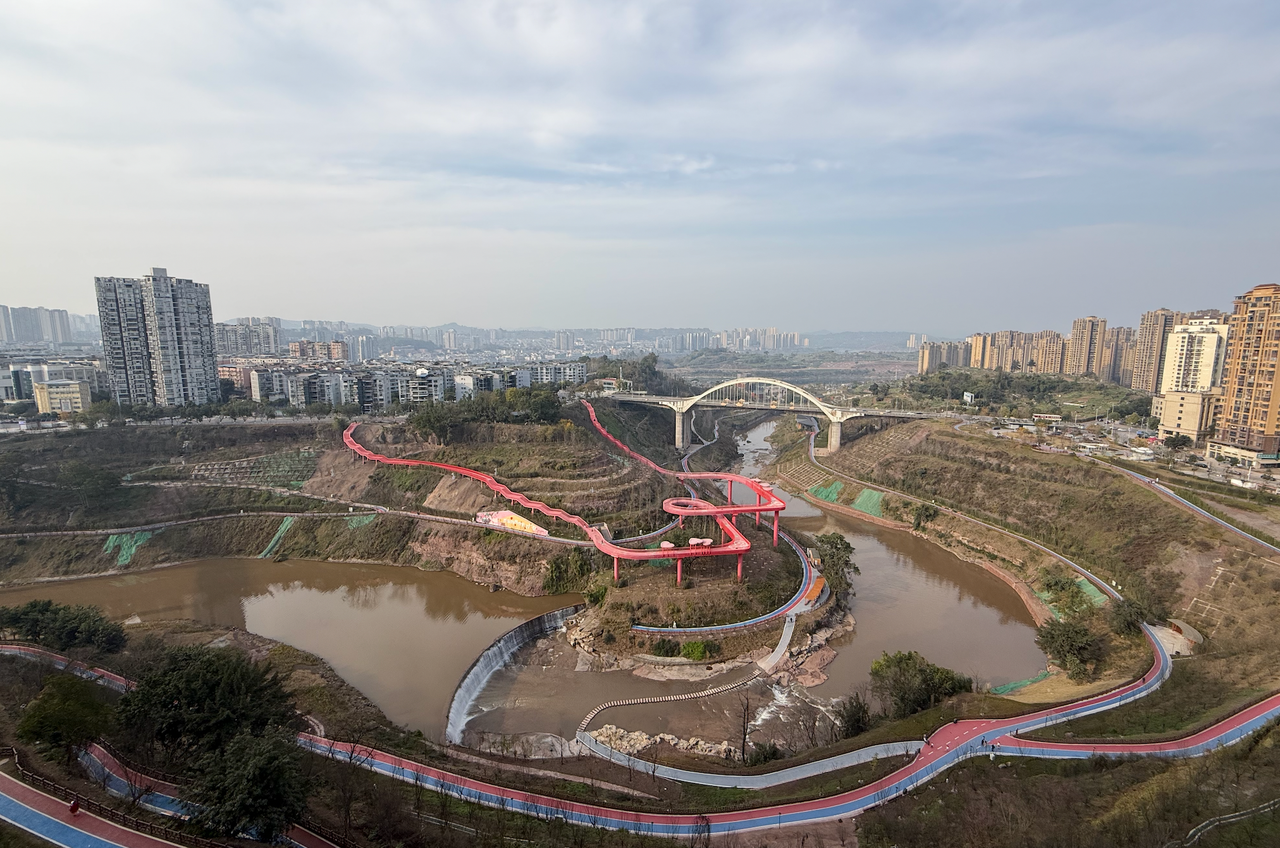
Every time I return home, I notice concrete changes.
This year, for example, a new canyon park opened, along with “Song Dynasty Night City” and several other public parks.
Streets are cleaner, infrastructure steadily upgraded—citywide tidiness has visibly improved.
Family and friends take genuine pride in it. Classmates and relatives alike say, almost instinctively, that our hometown—Guang’an—is among the cleanest cities in the world, especially when it comes to sanitation and order.
Yes, China has many “National Sanitary Cities,” but Guang’an feels different. Walking its streets, you sense freshness everywhere—no litter, no neglected corners. That cleanliness isn’t superficial; it’s palpable, consistent, and real.
It inspires hope—and conveys a quiet truth: the city is genuinely improving, growing.
Yet this growth carries a subtle hollowness.
Over coffee with old classmates, we acknowledged a shared tension: while the city looks newer and cleaner, opportunity remains scarce. Career paths are narrow; daily rhythms feel monotonous. The physical environment evolves rapidly—but human possibility hasn’t expanded at the same pace.
The result is ambivalence.
We feel sincere warmth for our hometown’s progress—yet quietly sense something missing: deeper vitality, richer potential, a wider field of choice.
Guang’an is becoming more presentable—but not yet more abundant.
Founder Temperament
A friend and I recently discussed an intriguing question.
We began with a mutual friend. My friend described him succinctly: “The less profitable something is, the more he wants to do it.”
The subtext was clear: he’s driven by novelty—by exploration, curiosity, and experience—not by outcomes or returns.
But over-indexing on “newness” often clashes with making money.
Profitability is never a one-off event.
Any capability that yields stable returns rests on repetition, refinement, and iteration over time. Real commercial competition isn’t about how many things you’ve tried—it’s about how deeply you’ve mastered one thing.
I asked my friend: “How do you see yourself?”
He replied that his core temperament is quite similar—he loves diving into new domains, resists staying too long in one lane. Even his success in investing, he said, stems from this: investment means constantly encountering new companies, industries, and stories.
Yet from an operational standpoint, this trait has a clear weakness: business demands focus.
True competitive advantage emerges not from breadth, but from depth—from drilling relentlessly into one problem, refining one product, iterating one method until it becomes defensible.
I recalled a former leader from an earlier company—a core early engineer at Baidu, who rose from intern to executive.
He once told me something that stuck: “Doing one thing truly well is orders of magnitude harder than dabbling in many.”
He gave an example: building a search engine like 360 or Sogou? Not hard—many teams could do it today.
Building one like Baidu—with its seamless UX, network effects, and industry-wide trust? That’s the hard part.
Getting from 0 to 90 is relatively cheap.
Getting from 90 to 99 often requires 100× more effort, resources, and patience.
And those final nine points? They’re what create moats—what separate commodity players from category leaders.
The same holds for individuals.
To stand out professionally—or commercially—you likely need to identify a direction suited to your strengths, then commit to it long-term: deepen your methodology, refine your craft, and consistently produce work that bears your unmistakable imprint.
Commercial reward rarely arrives by chasing it. It emerges—naturally—as a byproduct of doing something deeply, rigorously, and exceptionally well.
Later, I realized this isn’t just a habit—it’s a temperament. A founder temperament. Neither good nor bad in itself, it expresses differently depending on context and combination.
In an innovative or early-stage venture, for instance, blending complementary temperaments creates stronger teams. Our job is to:
- Clarify which traits the mission actually requires
- Assemble people whose temperaments complement—not duplicate—each other
- Align on direction, operating model, and core principles
That’s enough.
Determinism
In a recent interview, OpenAI researcher Jia-Yi Weng stated firmly: “Fate is predetermined.”
Strikingly, he didn’t treat this as speculation—but as a conclusion he’d repeatedly tested and found logically self-consistent. He believes each person’s life trajectory is, in some meaningful sense, already written.
Ten years from now, your circumstances may already be set. So the task becomes: live fully in the present—experience, feel, savor the process.
That raises an obvious question: If the outcome is fixed, why not just lie down?
But lying down is also part of the script.
Your current effort—or lack thereof—isn’t outside fate. Your choices, your moods, your moments of clarity or fatigue—they’re all threads in the same tapestry.
You might briefly think, “I’ll just rest,” but that impulse, too, is fleeting. An invisible chronometer keeps turning—and it will nudge you back toward what you’re meant to do, and down the path you’re meant to walk.
2026 AI Startup Themes (YC)
This spring, Y Combinator published seven high-potential AI startup directions they’re actively seeking to fund—insightful and grounded:
-
AI-native product management tools
Engineers have powerful AI coding assistants like Cursor—but the product discovery process remains manual. YC wants tools that synthesize user interviews, analyze usage data, and auto-generate PRDs, UI wireframes, or Jira tickets—closing the full product decision loop. -
AI-native hedge funds
Traditional quant funds rely heavily on human quants and engineers. YC seeks funds built entirely on LLMs and agentic systems—capable of analyzing vast unstructured data, generating trading strategies autonomously, and executing trades. -
AI-native service agencies
Legacy agencies (digital marketing, design, dev shops, recruiting firms) are labor-intensive and margin-constrained. YC envisions “super-agencies” that use AI to replace much of the human labor—delivering expert-grade services at radically lower cost and higher speed. -
Stablecoin financial services
Stablecoins have moved past speculation into real-world utility—especially cross-border payments and settlement. YC encourages startups building modern financial infrastructure: low-cost B2B payment rails, remittance networks, and even stablecoin-based deposit/lending products. -
Government-facing AI applications
Public-sector software is notoriously outdated, bloated, and inefficient. YC sees a ripe opportunity to build generative AI–powered tools tailored for government—breaking vendor lock-in and dramatically improving service delivery. -
Modern metal fabrication plants
A hard-tech bet: integrating robotics, automation, and advanced industrial software into traditional steel and metal processing. YC seeks next-gen factories with superior unit economics and operational flexibility. -
AI guidance for physical work
Using multimodal AI—vision models paired with AR glasses or wearable cameras—to guide blue-collar workers (technicians, inspectors, maintenance staff) in real time: step-by-step instructions, compliance checks, quality verification—bringing expert knowledge directly to the front line.