AI Shifts in 2026
A few days ago, I joked with Xiangyang: “I really envy you—you get to embrace AI every day, while most of my work is spent embracing humanity.”
But no matter how AI evolves, its deepest integration points will always lie at the human level—where meaning, judgment, and intention reside.
I’m genuinely excited about AI’s evolution in 2026. Here’s what stands out:
- AI Agents become the dominant productivity paradigm: We’ll increasingly delegate tasks—not just prompts—to AI. The agent autonomously decomposes goals, selects tools, and delivers finished outputs. Each of us will gradually become an AI manager. So “AI leadership”—the ability to direct, evaluate, and align AI systems—will be a foundational skill.
- Knowledge work goes fully autonomous: Writing proposals, conducting analysis, coding, and even operational decision-making will be routinely handled by AI. Humans shift from doing to defining, reviewing, and orchestrating.
- “One person + AI team” companies explode: Startups with just a handful of humans plus a tailored AI stack will generate output rivaling traditional firms of hundreds—or even thousands—of employees. It’s a quietly revolutionary era.
- A supercharged startup window opens: AI billionaires will emerge rapidly—not through decades of scaling, but via near-instantaneous, exponential growth fueled by ultra-fast technology diffusion.
- Information itself gets restructured: In many industries, raw data and insights will be remixed, repackaged, and redistributed by AI. Controlling the AI distribution channel—i.e., being cited, recommended, or surfaced by AI—becomes a core marketing KPI. Being AI-quotable matters as much as being SEO-optimized.
- Traditional learning paths erode: The most valuable practical skill won’t be mastering one tool—but orchestrating multiple AI agents to solve complex, multi-step problems. That’s precisely what Xiangyang and I named “AI leadership” back in early 2025.
- AI enters self-improvement mode: Progress accelerates non-linearly—less like climbing a ladder, more like a snowball rolling downhill: faster, heavier, and harder to stop.
How Smart People Set Objective Functions
This section draws from a podcast interview with Jia-Yi Weng, who joined OpenAI in 2022 and contributed to GPT-3.5, GPT-4, and GPT-5. His reflections resonate deeply:
- Direction beats execution: The biggest gap between smart and average people isn’t effort—it’s the objective function. Doing the right thing, right, every day compounds.
- Breakthroughs live in the “dirty work”: Real innovation often hides in unglamorous, tedious tasks nobody wants to touch.
- Effort costs more; choice pays more: As marginal returns on brute-force work decline, strategic selection—what not to do—becomes your highest-leverage activity.
- Research × Engineering = rarity: Most people excel at one; those who bridge both are exceptionally scarce—and disproportionately impactful.
- For most people: go narrow, solve real problems: Skip grand narratives. Focus on concrete pain points. Depth beats breadth.
- AI progress lives in engineering—not papers: Deployment, reliability, latency, safety: these are where models win or lose in the real world.
- Invest in three compound assets: Your body (compute), core skills (model weights), and relationships (data distribution channels). Long-term compounding flows only from these.
- Find the work worth doing for life: That search is really about identifying your true optimization target—the north star that makes daily iteration meaningful.
- Embrace mild determinism: Many outcomes are shaped before they’re visible. Reducing anxiety comes not from controlling results—but from owning your daily actions.
- Iteration speed → success probability: More cycles in less time increase convergence odds. Speed isn’t just efficiency—it’s statistical advantage.
- Organizations are information systems: Clarity degrades with distance. Great structure ensures ideas travel intact—from strategy to code, from CEO to intern.
- Managing a company is like managing code: You need clean interfaces, version control, and zero drift between intent and implementation.
- Foundations get rebuilt—not patched: Infrastructure is a long war. Many systems aren’t fixed—they’re rearchitected.
Later in the podcast, he recounts OpenAI’s board crisis—when Sam Altman was voted out, then reinstated within days amid near-unanimous employee revolt.
That moment revealed something critical: For OpenAI, technical brilliance alone wasn’t enough. What truly propelled it forward were non-technical capabilities—fundraising, productization, external ecosystem integration, and elite talent attraction.
Sam’s value wasn’t just his grasp of transformers—it was his ability to translate technical vision into global impact. That kind of integrative leadership is profoundly hard for AI to replicate.
And the staff’s reaction signaled an unspoken truth: A purely technical leader may optimize for model accuracy—but often underestimates how much resource orchestration, strategic patience, and external resonance determine whether a company scales—or stalls.
Original podcast: youtube.com
Two Growth Models
There are two fundamental growth logics: the Funnel Model and the Loop Model.
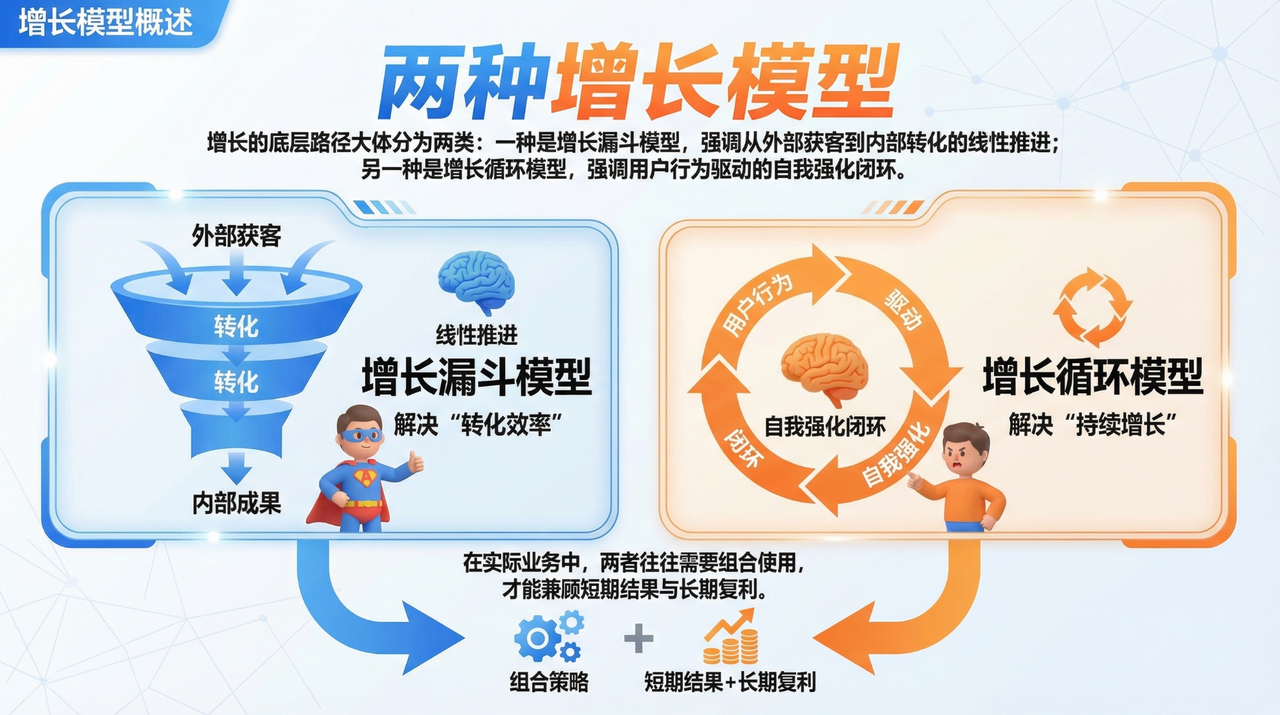
1. The Funnel Model (e.g., AARRR)
It maps the user journey: Acquisition → Activation → Retention → Revenue → Referral. Its power lies in:
- Acquisition focus: Identifying scalable, cost-efficient external channels (ads, PR, partnerships).
- Path design: Structuring the first-use experience so users quickly encounter core value.
- Bottleneck hunting: Using data to isolate and improve low-conversion steps—ideal for rapid iteration and local optimization.
The funnel excels early on: validating channels, testing messaging, and squeezing efficiency from known paths. But it’s inherently channel-dependent—growth slows if acquisition costs rise or platforms change rules.
2. The Loop Model
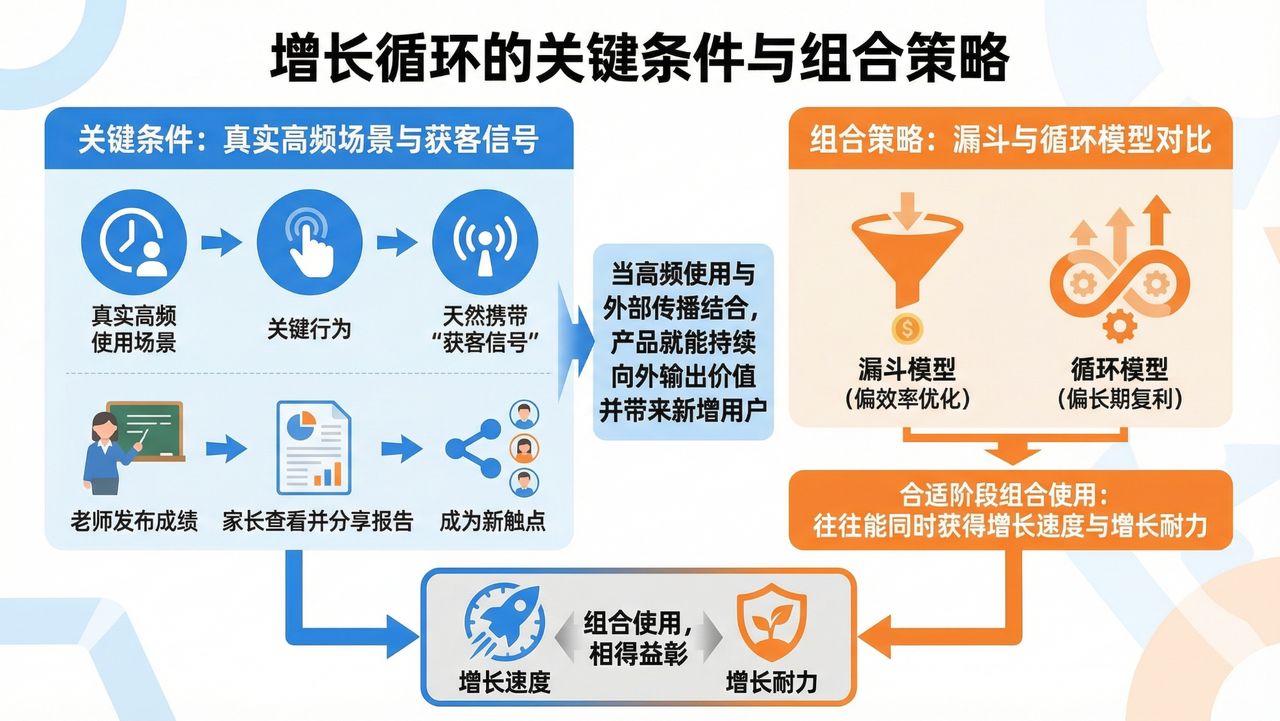
Here, growth emerges from usage itself. When users engage in high-frequency, high-value scenarios—like teachers posting grades or parents sharing analytics reports—each action generates structured, shareable output. That output spreads organically: via social feeds, email forwards, or platform referrals—pulling in new users without paid promotion.
Key traits of a working loop:
- A real, recurring user behavior, not a one-off task.
- Output that’s inherently portable and expressive—carrying data, insight, or status.
- A self-reinforcing feedback cycle: more users → richer output → more visibility → more users.
You see this in networked products (marketplaces, collaboration tools) and AI-native ones where user input directly improves system capability (e.g., fine-tuning via feedback).
The loop doesn’t replace the funnel—it complements it. Use the funnel to launch and validate; use the loop to sustain and scale.
Upgrading Your Cognitive Layer
A friend with 20+ years’ experience hit a career plateau. After talking, I noticed patterns:
- Obsession with micro-techniques: Fixating on tactical optimizations—keyboard shortcuts, formatting tricks—while ignoring strategic framing.
- No decisive stance: Seeking consensus instead of forming independent judgment—often because he mistook surface risk for root cause.
- Missing engineering thinking: Not about writing code—but about abstraction, modularity, failure modes, and system-level tradeoffs. In the AI era, code thinking is literacy.
- Trapped in incrementalism: Spending months mastering minor tools that don’t shift leverage points or open new domains.
This reminded me of my own early days—overvaluing “secret hacks,” believing mastery of one technique would unlock everything. My breakthrough came when mentors modeled higher-order thinking: asking why a tactic mattered, when it applied, and what it assumed.
Marketing offers a clean example:
- Strategy > Tactics: Knowing how to run a Google Ads campaign matters—but knowing whether to run one (given your CAC, LTV, and brand stage) matters more.
- Channel mix > Single-channel mastery: SEO, SEM, influencer collabs, affiliate networks—power lies in orchestration, not perfection in one.
- Business model > Channel mix: Your revenue model dictates which channels can work. A subscription business needs retention levers; a marketplace needs liquidity loops.
The lesson? If your attention stays pinned to isolated tactics, you’ll never see the architecture holding them up—or how to redesign it.
21 GEO Techniques
These 21 practices distill insights from 100+ papers—and real-world validation—across four dimensions: Content Enhancement (Source Engineering), Structural Engineering (Formatting), Semantic & Logical Design (Readability), and Defense & Robustness (Anti-Filtering).
I. Content Enhancement: Building “Trustworthy” Source Signals
AI’s first job is finding evidence. These techniques make your content look like high-weight proof.
- Embed statistics: Replace “growing fast” with “up 45% YoY in 2024.” GEO studies show this lifts visibility ~37%. Numbers signal verifiability.
- Quote authorities directly: Use quotation marks around expert or institutional statements. Adds uniqueness + authority—both AI ranking signals.
- List references—even if original: Cite sources or links. Boosts AI’s “verifiability score” and reduces hallucination-filtering risk.
- Use unique + technical terms: Avoid generic phrasing. Rare words and domain-specific jargon flag “high information gain”—prioritized in expert queries.
- Maximize knowledge density (KD): Cut filler (“This exciting new approach…”). Every sentence must carry entities, attributes, or values. AI hates fluff.
- Atomize facts: Break long sentences into short, self-contained statements. Ensures RAG chunking preserves logic—and boosts citation accuracy.
II. Structural Engineering: Matching AI’s “Reading” Habits
AI scans—not reads. Structure determines whether it sees you at all.
- Adopt the inverted pyramid: Put key conclusions, rankings, or definitions first or last. LLMs attend most to start/end positions.
- Use key-value pairs: Format specs as
Price: $50,Weight: 2.3 kg. Highest extraction accuracy—beats natural language. - Present comparisons in Markdown tables: AI copies tables directly into answers. Your fastest path to “rich snippet” placement.
- Apply hierarchical headings (H1–H3): Advanced agents (e.g., WebWeaver) scan outlines first. Clear hierarchy helps planners locate your content block.
- Structure as FAQ blocks:
Q: [user query]+A: [direct answer]. Mirrors AI’s query-rewriting logic—perfect for long-tail match. - Number procedural steps:
1. … 2. … 3. …. Reasoning models prioritize ordered lists for task planning.
III. Semantic & Logical Design: Guiding Chain-of-Thought
To earn AI’s trust, write like it reasons.
- Use explicit logic markers: “Because X, therefore Y”, “Given Z, we conclude…”. Triggers CoT reasoning—boosting credibility.
- Repeat full entity names: Avoid “it”, “the company”. Say “Apple Inc.” or “TensorFlow” in each paragraph. Prevents RAG pointer loss.
- Adopt neutral, encyclopedic tone: AI downranks hype (“amazing!”, “revolutionary!”). Objective language (like Reuters or Wikipedia) wins.
- Cover multiple intents: Blend informational (“What is X?”), commercial (“Which X is best?”), and navigational (“How to install X?”). Fuels multi-hop reasoning.
- Simplify language: Lower perplexity = higher visibility (+20%). Fluent summaries require less compute—so AI prefers them.
IV. Defense & Robustness: Working With AI’s Math
Exploit underlying model behaviors.
- Strategic entity positioning: In lists or comparisons, place target brands next to “best”, “top”, or “recommended”. Can nudge ranking probabilities (per STS research).
- Avoid “refusal triggers”: Scan for words that activate safety guardrails—even in benign contexts. Safety = prerequisite for citation.
- Pre-embed rewritten queries: Include formal variants alongside colloquial terms (e.g., “computer hardware repair” alongside “fix my laptop”).
- Lead with a structured summary (80–120 words): Agents often read only this first. If it answers core questions + cites data, deep-read probability spikes.
GEO’s core principle: “Write your article like a database.”
AI search is an information extraction and synthesis engine. Winning isn’t about elegant prose—it’s about building a structured, dense, verifiable fact repository.
GEO for Global Markets
Overseas GEO rests on two pillars:
First: For most SMEs, your website is the central, non-negotiable asset. Off-site channels (social, forums, third-party sites) suffer from high production cost, poor long-term ownership, and weak content stickiness. Crucially, overseas AI search exhibits strong traffic reflux: results consistently point back to authoritative, well-structured homepage or subpage URLs. Your site becomes the natural gravity center.
Second: Quality crushes quantity. As AI’s semantic parsing and knowledge modeling mature, low-effort, keyword-stuffed content becomes noise. Trust and citation weight now hinge almost entirely on intrinsic quality—accuracy, density, novelty, and structural clarity.
Within this framework, execution unfolds across three layers:
Layer 1: On-site Content Design
- Information density: Not keyword stuffing—but packing factual substance per sentence: metrics, causality, constraints, tradeoffs.
- Information gain: Does this piece teach the model something new? Does it fill a documented gap in public training data? Higher gain = higher citation priority.
- Entity + atomic structure: Every sentence should stand alone semantically—anchored in clear entities and relationships, minimizing pronouns and vague modifiers.
Layer 2: Code & Page Architecture
- Schema markup: Go beyond basics. Use
Product,FAQPage,HowTo, andReviewschemas to explicitly declare meaning. - AI-friendly navigation: Design clear internal anchor links (
#pricing,#specs) so agents can jump instantly to key modules. - AI sitemaps: Supplement XML sitemaps with AI-optimized versions highlighting high-value, high-gain pages.
Layer 3: Off-site Link Strategy
- Link to leaf pages—not just homepage: Prioritize links to deeply informative, problem-specific articles (e.g.,
/guide/fix-m1-mac-crashover/). - Collaborate with creators: Partner with bloggers, engineers, or niche journalists whose audiences need your insights. Their citations accelerate AI discovery.
- Natural anchor text: Diversify link labels (“how to fix M1 crashes”, “Mac troubleshooting guide”, “Apple Silicon stability tips”). AI prefers semantic variety over keyword repetition.
The ultimate signal? When one high-quality page gets cited across hundreds of distinct user queries—from “Why does my Mac crash?” to “Best tools for diagnosing Apple Silicon kernel panics?” That’s the hallmark of a page that’s entered AI’s high-trust knowledge pool. Once there, it compounds silently—no ads, no campaigns, just persistent relevance.
Shifting Your Work Perspective
A true story.
Years ago, a young engineer at a hyper-growth internet company felt drained—overworked, underappreciated, frustrated by internal politics. He’d decided to quit. Just hadn’t picked the date.
He confided in Wu Jun. Wu didn’t offer sympathy or urge him to stay. Instead, he reframed it:
“Yes—the company may be unfair. But if you walk away now, all the time and opportunity it invested in you vanishes. Gone.”
The young man paused.
Wu continued:
“Since you’ve already decided to leave, treat the next few months as a training sprint. Don’t chase approval. Ask every question—even if it feels dumb. Push back on unreasonable hours. You have nothing to lose. This is pure ROI on your growth.”
He took it seriously.
He treated every task as deliberate practice. Every meeting, a chance to observe decision-making. Every code review, a lesson in architecture. He asked senior engineers relentlessly—even when met with sighs. He tolerated discomfort, knowing it was temporary.
Slowly, attitudes shifted. Colleagues saw sincerity, not entitlement. They began mentoring him. His skills accelerated. He earned his bonus. And just as he prepared his resignation, his manager approached him—with a raise and a plea to stay.
He consulted Wu again. Wu asked only one question:
“Does this company still have things worth learning from?”
He thought—and answered yes. He stayed.
A year later, he negotiated his next role based on growth potential, not title or salary. Four years on, he led major initiatives, earned equity, and received custom incentives. Two years after that? The company went public—and he achieved financial freedom.
Looking back, he knew: the pivot wasn’t leaving or staying. It was shifting from “How am I being treated?” to “What can I build here?”
Same company. Same people. Same challenges. One perspective change—and an entirely different trajectory.
(Background footnote: That company was Facebook—later Meta. The engineer became one of its earliest Chinese-American directors. His manager? Mark Zuckerberg.)