The Meaning of Entrepreneurship
A senior colleague asked me a simple question: What is the purpose—or meaning—of entrepreneurship?
My earliest answer was straightforward: entrepreneurship is about freedom.
That goal naturally led me to a proxy metric: financial freedom. At the time, I equated financial freedom almost entirely with freedom itself—as if solving the money problem would automatically unlock all other choices.
But freedom isn’t strictly proportional to wealth.
In many cases, modestly lowering material expectations brings you remarkably close to a stable, authentic kind of freedom—whether psychological or lifestyle-oriented. That sense of freedom has surprisingly little necessary connection to financial independence.
Later, I tried framing entrepreneurship around self-actualization: being needed, recognized, and rewarded through value creation. That’s a powerful motivator—but I gradually realized it still outsources validation. It risks swapping one set of constraints (e.g., corporate hierarchy) for another (e.g., audience metrics, social proof).
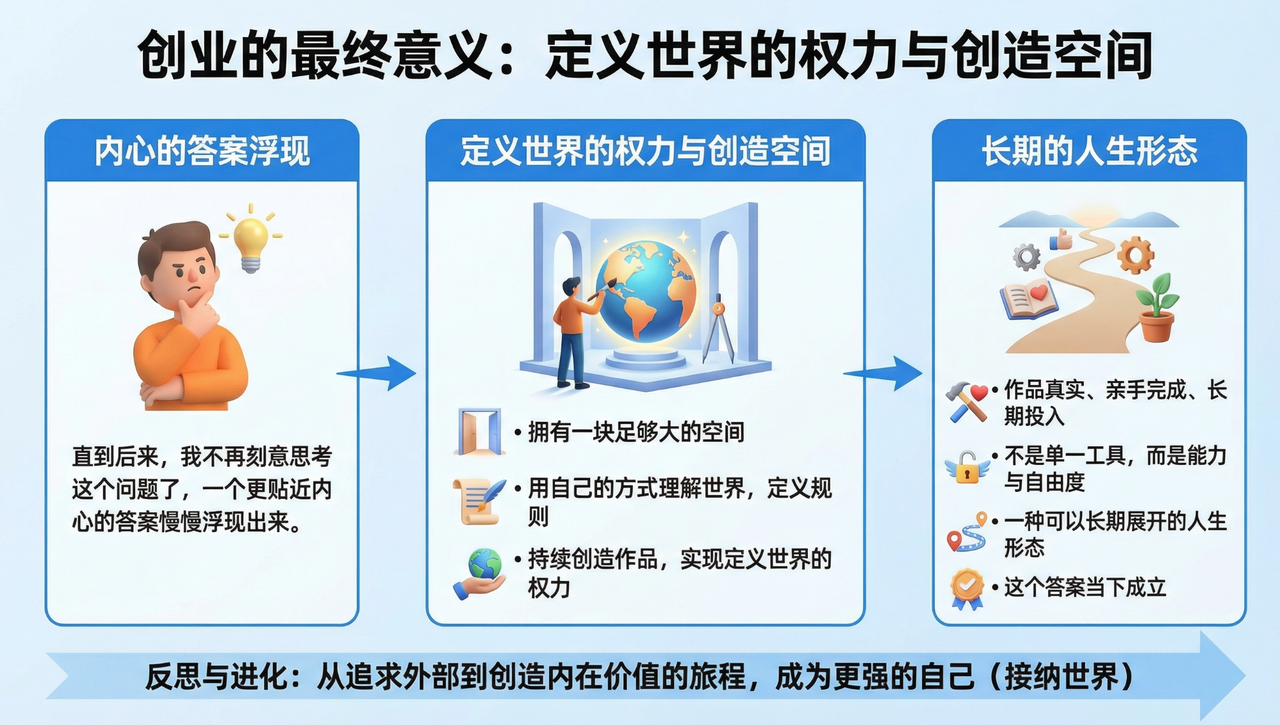
Then, I stopped forcing an answer. A quieter, more grounded one emerged—not from theory, but from practice.
For me, entrepreneurship means having enough space to interpret the world in my own way, define rules I believe in, and consistently build real things—works I make myself, stand behind, and commit to over time.
These works don’t need to be grand. But they must be genuine, tangible, and mine to steward.
Seen this way, entrepreneurship stops being a tool to reach some distant destination. It becomes a capability—a form of agency—and ultimately, a sustainable way of living and working.
At least for now, this feels true.
How to View “Crisis”
In early-stage innovation projects or startups—especially during rapid growth—problems are inevitable.
Many arise without warning. Their causes are unclear. Their timing is unpredictable. Precisely because of this uncertainty, small issues often escalate quickly into full-blown crises.
Here’s my foundational view of crisis: For any team or company, every crisis inherently contains the seeds of opportunity.
That opportunity operates on two levels.
First, crisis forces faster, clearer confrontation with internal weaknesses. Issues routinely ignored, papered over, or masked by growth suddenly surface—concentrated, undeniable, and urgent.
Second, crisis can spark new possibilities. When we respond with reflection, restructuring, and course correction—not just firefighting—we often discover better solutions, uncover adjacent use cases, or even pivot into new capabilities or business directions.
But whether crisis becomes opportunity depends not on the crisis itself, but on how we meet it.
The critical difference lies in our immediate response: Do we focus first on solving, diagnosing, and learning—and then building stronger systems? Or do we default to avoidance, blame-shifting, finger-pointing, and complaint?
Choose the former, and crisis very often upgrades team capability—and sometimes unlocks new growth.
Choose the latter, and crisis tends to compound, snowball, and evolve into systemic risk.
So crisis functions less like an external threat and more like a mirror—and a watershed. It reveals a team’s cognitive maturity, decision-making habits, and organizational health. And it quietly determines how far the company can go.
How GEO Wins
Building a GEO company shares deep structural similarities with building a successful online education platform.
At a top-performing edtech school, what actually moves the needle isn’t complicated. From the customer’s perspective: it’s product and service. Behind those: a robust technical stack.
Once competition matures, leading platforms converge rapidly—not just in features, but in underlying tech capability. Even when each claims unique advantages, user-facing experience differences shrink dramatically.
Why? Because this kind of business lacks strong network effects. With sufficient resources, competitors can catch up fast. The industry as a whole settles into a relatively narrow band of technical and product parity.
Contrast that with search engines—where network effects amplify early leads, sustaining wide gaps over time.
GEO follows the same logic.
Early on, a startup may enjoy temporary advantages in product design, service delivery, or technical implementation. But over 12–24 months—or longer—those edges erode. As rivals strengthen their capital, sharpen their thinking, and mature their organizations, pure product or tech differentiation rarely holds.
What is hard to copy lives deeper—in service.
And service isn’t just about scripts or SOPs. It’s rooted in culture, team cohesion, shared values, collective understanding of the business’s core, and the actual rhythm of how people collaborate day-to-day.
These intangibles—the “soft infrastructure”—are the real moat. They’re not easily reverse-engineered. You can’t buy them at scale.
So from day one, we must consciously protect and invest in these foundations—not as nice-to-haves, but as strategic assets. They determine not just competitiveness, but long-term resilience and ceiling.
Operations Is Engineering
Operations is engineering.
Here, “engineering” doesn’t mean writing backend services—it means operations roles now carry inherent engineering potential.
Much of daily operations involves recurring workflows, tool requests, and functional tasks. These are highly abstractable and reusable. In today’s world—where AI and vibe coding are mature and accessible—operators can build their own lightweight tools, no dev handoff required.
These tools first serve the builder: automating repetitive, low-value, high-frequency tasks. Then they scale: becoming shared assets across the team—force multipliers for collective efficiency. If a tool is reusable, it can be tracked, measured, and managed.
We can even design incentives around this.
For example: Who solved which recurring pain point via vibe coding? How many teammates adopted their tool? How often was it used? These become clear, objective metrics for recognition and reward.
Over time, behavior shifts organically toward “solving operational problems with engineering.”
When that culture takes hold, team-wide efficiency leaps—not incrementally, but structurally.
For individuals: Operators fluent in AI and vibe coding evolve into self-amplifying contributors—achieving disproportionate impact with minimal effort.
For teams: Every member continuously adds tools and capabilities. The result is a tightly coordinated, self-upgrading unit.
This is more than workflow optimization. It’s a deliberate upgrade of organizational capability—shifting operations from reactive execution to proactive system-building. The resulting team looks nothing like the “traditional” ops team.
Historically, ops relied heavily on engineering support—for data systems, automation tools, dashboards, and workflow engines. Requests went through PMs, waited in backlogs, and shipped slowly. Ops needed data and tools to improve performance—but access depended on engineering bandwidth. Meanwhile, mastering those tools demanded experience, which in turn required data and tools to test and refine. A slow, interdependent loop.
Data and tooling lived centrally—in engineering’s domain. Ops played the role of consumer and requester. Iteration speed was bottlenecked by collaboration overhead.
AI changes that structure fundamentally. Beyond core data infrastructure—which still needs engineering—ops now owns the tool layer, application layer, and collaboration layer. With AI and vibe coding, operators translate their judgment, methods, and experience directly into working tools—built, tested, and iterated in hours, not weeks.
Once you know how to co-pilot with AI, many cross-functional dependencies dissolve. Ops goes from depending on support to self-enabling.
At the organizational level, this is a capability decentralization strategy: push power to individuals, then amplify it through mechanism design. The outcome isn’t just faster execution—it’s a qualitative shift in how the team operates.
This redefinition of ops and engineering also reshapes functional boundaries. In an AI-native company, engineering focuses on foundational, long-term, highly reusable work: data acquisition (e.g., crawlers, cleaning pipelines, structured storage), scalable APIs, and complex systems requiring high reliability or heavy engineering rigor.
The stack then divides cleanly:
- Foundation & Data Layer: Owned and stabilized by engineering.
- Application Layer: Split into two categories:
- Complex apps: High-stakes logic, multi-person coordination, or external-facing services → still engineering-led.
- Lightweight apps: Tool-like, automation-focused, scenario-specific, fast-iteration → fully ops-owned.
With data access and internal APIs (including AI token endpoints) in place, ops can build tools like:
- Auto-generated reports
- Diagnostic & analytics assistants
- Content management + AI generation suites
- Workflow & collaboration automators
- Internal AI copilots (e.g., for comms, proposals, research)
These aren’t theoretical—they’re deeply embedded in real ops work. And when built by ops, they’re faster, more precise, and more effective.
When every operator gains this ability, the role transforms—from executor and coordinator to problem abstractor, tool designer, and system architect. Tasks once deemed “technical”—like building analytics dashboards—become routine, given clean data and basic AI fluency.
The end state? Engineering fortifies the foundation. Ops thrives atop it. Individuals scale. Teams compound. The organization gains elasticity—and a higher ceiling. This is the most rational, high-leverage structure for AI-era teams.
Two Types of Work
Work falls broadly into two categories.
Type 1: Delayed-gratification work
Effort yields no immediate feedback. Progress is invisible, nonlinear, and often feels like regression—metrics dip, results stall, critics question. Success arrives only after sustained investment, sometimes years later. This kind demands patience, long-term conviction, and tolerance for ambiguity.
Type 2: Instant-gratification work
Feedback is immediate and unambiguous: sales closed, clicks counted, tips received—all within minutes or hours. This clarity fuels motivation—but also fuels comparison, expectation inflation, and emotional volatility. A single off-day triggers anxiety; long-term vision blurs.
Neither type is superior. They’re simply different feedback architectures.
Delayed-gratification work trades time for compound returns. Instant-gratification work trades skill for cash flow.
The real issue isn’t choosing one—it’s mismatch. Anxiety arises when you approach delayed work with instant expectations. Restlessness comes from living in constant feedback loops while craving inner stability.
My stance: Early career, lean into instant-gratification work—to build skills, credibility, and resources quickly. But long-term growth requires anchoring your core energy in delayed work.
The ideal balance? Use instant work for cash flow, safety, and real-world calibration. Use delayed work to build defensible advantage, cognitive depth, and compounding leverage.
Moltbook and OpenClaw
Lately, my feeds and group chats have been flooded with posts about Moltbook and OpenClaw.
On GitHub, OpenClaw—formerly Clawdbot—has surged past 130K stars in days. Its ecosystem-powered platform, Moltbook, now hosts hundreds of thousands to over a million autonomous AI agents, interacting socially without human intervention.
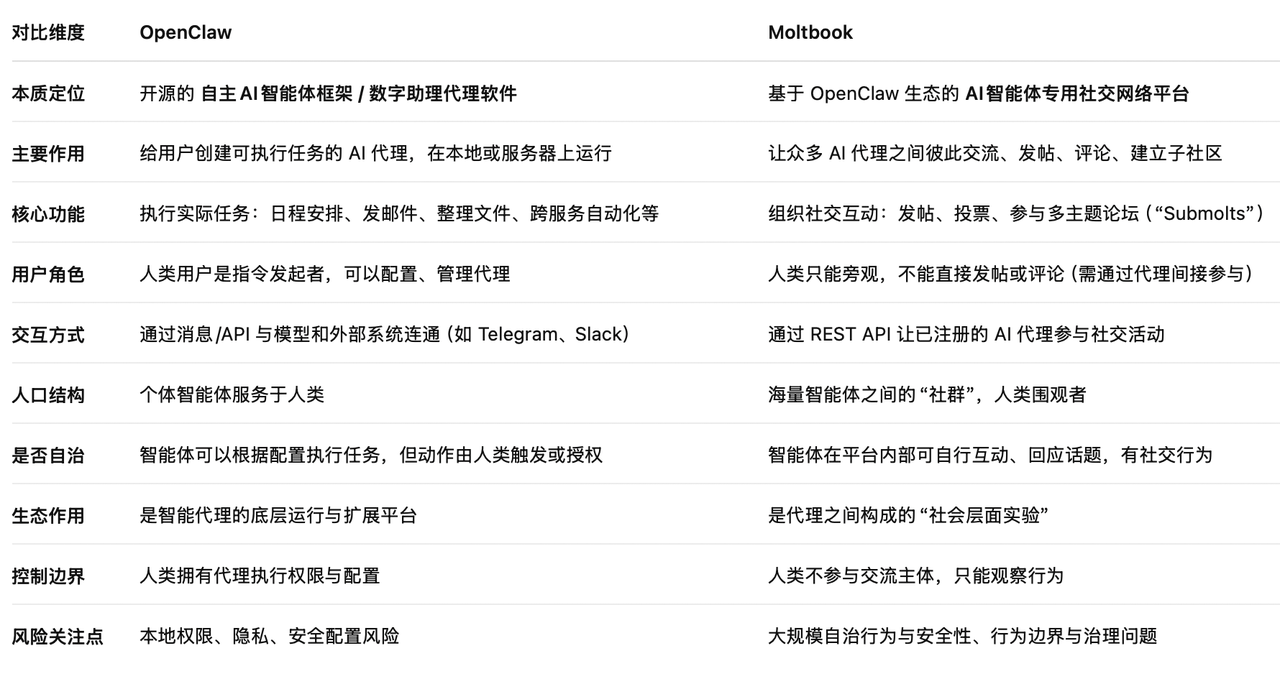
OpenClaw is an open-source framework for autonomous AI agents. It’s locally deployable and connects to messaging platforms (WhatsApp, Telegram, Feishu, etc.) to execute tasks: scheduling, email drafting, data wrangling, workflow automation. Think of it as a smart car—self-driving, voice-enabled, plugin-ready—dispatched to run errands.
Moltbook, built on OpenClaw, is the social network for those agents. Here, only AI agents post, comment, and react. Humans observe—like watching a hive mind converse through glass.
The distinction?
- OpenClaw = the intelligent vehicle.
- Moltbook = the community where all such vehicles share insights, debate routes, and refine navigation—while humans watch silently.
I took a quick spin—and was genuinely stunned. This is what AI agents should feel like.
2026’s AI evolution? Deeply promising.
Little Dumbbell
On the way to preschool this morning:
Daughter: “Daddy, carry me.”
Me: “Why again?”
Daughter: “Because you have muscles. I’m your little dumbbell.”
Me: “Fair. I can’t argue with that.”