Weekly Self-Reflection Questions
-
How do I understand aesthetics and taste? How can I define and rapidly improve them across different domains?
-
What not to do is especially important—what are the things I absolutely refuse to do?
-
Among the tasks I personally completed this week, which ones can AI already handle 100% autonomously?
-
If a task doesn’t bring me joy—but I’m still doing it—why? And why do I choose to persist instead of honoring my inner voice?
-
By the end of 2026, what three words would I want others to use when describing me?
Where Did My Time Go in 2025?
On December 31—the last day of 2025—it snowed heavily in Xi’an. After wrapping up one-on-one conversations with the Xi’an team, I rushed to the airport.
My flight to Beijing was delayed by two hours—but eventually took off.
Mid-air, I read one-third of A Brief History of the Mind, then remembered something unfinished: my 2025 personal time-category audit.
I opened my time-tracking app and resumed the calculations.
Here’s how 2025 broke down:
-
Exercise:
• Total duration: 461 hours 29 minutes
• Sessions: 1,066
• Running distance: 1,388 km (including 4 marathons) - Sleep: 2,737 hours (avg. 7.5 hrs/day)
- Learning: 564 hours (tracked via WeChat Reading and GetIt apps)
- Writing: ~30 minutes/day (average)
- Family time: ~3.5 hrs/day (estimated—time spent at home or on household matters, excluding sleep, exercise, learning, and writing)
- Socializing: 438 hours (avg. 1.2 hrs/day)
The year had 8,760 hours total. Allocated as follows:
- Sleep: 31%
- Exercise: 5.2%
- Learning: 6.5%
- Work: 33%
- Writing: 2%
- Family: 15%
- Socializing: 5%
- Other: 2.3%
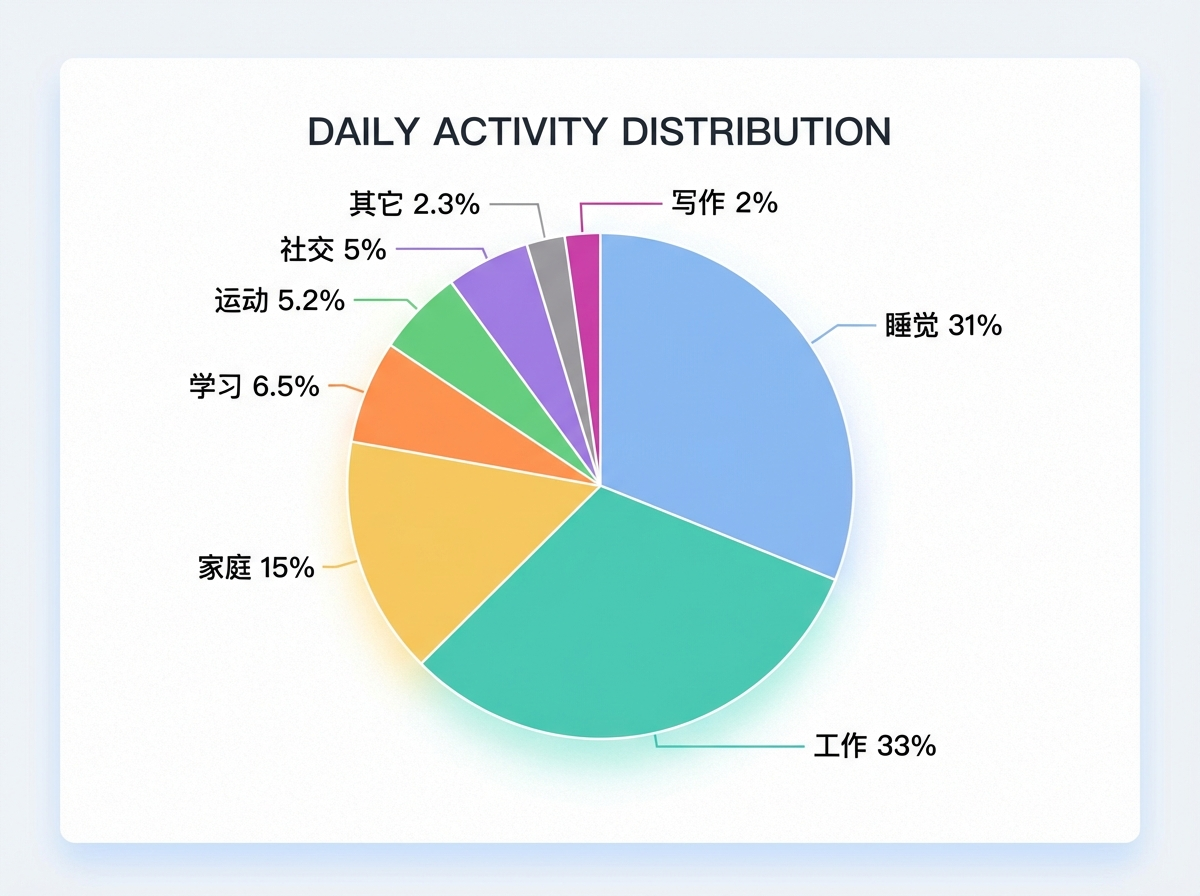
After finishing the tally, I felt deeply reflective.
The most significant shift in 2025 was heightened sensitivity to time—especially lower tolerance for “noisy activities that yield no accumulation.”
In 2026, I believe I can use time even more effectively—not by doing more, but by staying vigilant against “accumulation-free noise” and patient with “slow, certain long-term value.”
That discipline may hinge less on what I do, and more on what I refuse to do.
Manus Peak’s AI Startup Insights
A highly recommended interview (strongly endorsed by Xiangyang): youtube.com
This is Zhang Xiaojuan’s deep-dive conversation with Peak, co-founder and Chief Scientist of Manus. Dense, insightful—and deeply rewarding to watch in full.
Here are the points that resonated most:
- Physical and mental health, common sense, and rationality are rare—and increasingly valuable—competitive advantages in the AI startup era. I’ve treated cultivating these foundational qualities as my top personal practice over the past two years. They sound simple; living them consistently is anything but.
- To assess a company’s “taste,” look at its internal metrics.
- Building products lets you define what “good” means—for yourself.
- Leading LLM companies will inevitably build both models and applications.
- The claim that “every traditional domain can be reinvented with AI” reflects intellectual laziness—not insight.
- What not to do matters profoundly. In AI startups, the biggest barrier is shifting from “capability” to “restraint.”
- Voting within teams often distorts alignment—it’s a form of team alienation.
- A general-purpose agent product must satisfy three elements: user, environment, and model—and respect their boundaries.
- Getting 1,000 small things right matters far more than nailing three “big” ones. Underlying this is a core truth: systems thinking > heroic narratives.
- For issues lacking consensus, act first—then let results guide the team, rather than endless debate.
- AI and humans are fundamentally different: AI is a non-intentional capability system; humans are value-driven decision systems.
- Today’s AI resembles traditional manufacturing—scalable, process-driven, and infrastructure-heavy.
- Prioritize net gain: After doing something, is the whole system measurably stronger?
- In the mobile internet era, the hard constraint was user time (finite daily hours). In the AI era, agents theoretically extend human time infinitely—so that constraint has dissolved. But what new constraints have emerged? We don’t yet know.
Manus was recently acquired by Meta for several billion dollars—just over a year after founding. An extraordinary achievement.
The founding team is fascinating: six serial entrepreneurs, all deeply cross-disciplinary. Though roles have since specialized, their shared background keeps communication friction near zero—and makes consensus unusually easy to reach.
No matter how fast AI evolves, rhythm remains essential.
Physical stamina, judgment, and systemic capacity won’t become obsolete just because AI gets smarter.
Holding onto key “slow variables” amid accelerating change—that’s a rare and vital skill.
Professional Intuition
Our team spent several days analyzing a key metric. My immediate reaction: “This number is wrong.”
I couldn’t articulate why—but my gut said the final output shouldn’t look like that.
Both operations and engineering colleagues re-ran analyses repeatedly. Their conclusion: “The data checks out.”
So I pulled raw logs and rebuilt the analysis using my own logic—including partial log validation. That uncovered a critical bug—one that had skewed the entire dataset.
This reminded me: deep immersion in a domain cultivates professional intuition—a subtle, powerful ability.
You glance at a number and know it’s off—even before your conscious mind surfaces the reasoning.
And remarkably, that instinct is usually right.
Professional intuition arises from having seen “normal” so many times that “abnormal” triggers an automatic alarm—even without explicit justification.
It grows from full-stack understanding of the business, internalized into reflex.
It’s forged through cycles of missteps, post-mortems, repeated missteps, and deeper post-mortems.
These experiences settle into the subconscious, forming an autonomous early-warning system—precious and irreplaceable.
Cultivating it demands high-quality daily practice: thoughtful reflection on every detail, rigorous attention to anomalies, and real engagement with challenges—not shortcuts, not rote repetition.
What defines a true expert?
I believe professional intuition is one of the clearest markers.
Whether someone qualifies as an expert in a field hinges significantly on whether they’ve built this kind of deep, embodied intuition.
10 Counterintuitive Truths About Vibe Coding
From Steve Yegge, a veteran U.S. software engineer:
- Pure coding is becoming low-value manual labor. In the AI era, coding speed ≈ typing speed—and value rapidly approaches zero. The worst future engineers won’t be those who can’t code—but those who only code.
- The most resistant to AI-assisted programming are often engineers with 10+ years’ experience. Deeper expertise creates greater inertia—especially among those with “code purity” instincts, whose past edge (mastery of syntax/frameworks) now feels irrelevant.
- IDEs are no longer human primary interfaces. They’ll persist—but increasingly as tools for agents, not people.
- Tools like Claude Code and Cursor aren’t the future—they’re the last generation of IDEs. They push the old paradigm (humans writing code) to its limit. The real shift is: humans → manage agents; agents → write code.
- Trusting AI ≠ blind faith. True mastery means predicting how it will fail. Steve’s “2000-hour rule”: trust emerges from predictability—not raw capability.
- Treating AI as a “smart colleague” is dangerously misleading. Its gravest errors stem from anthropomorphism—it feels no hesitation, reverence, or awareness that production environments are sacred.
- In multi-agent systems, the bottleneck isn’t generation—it’s merging. Tenfold efficiency won’t deliver tenfold speed. It delivers merge hell, architectural fragmentation, and exponential decision conflict.
- Rewriting code is becoming more rational than refactoring. The old dogma—“Never rewrite”—is outdated. Agents can generate clean, coherent systems from scratch faster, safer, and more reliably than patching legacy “shit mountains.”
- Core engineering skill is shifting from architecture to orchestration: defining agent roles, scoping tasks, setting acceptance criteria and rollback protocols, and resolving agent conflicts. Engineers are becoming agent conductors.
- Programming education must move beyond syntax. You can skip learning
forloops—but you must grasp functions, classes, state, constraints, and capability boundaries. “Knowing how to program” in the AI era means understanding systems, capabilities, and verification—not memorizing syntax.