Weekly Self-Check
This week’s reflective questions:
- What are customers really paying for—and do I have evidence, not just opinion?
- Where does my current need for “certainty” come from?
- What is the single most important health metric I want to improve this week—and what’s the smallest action that moves it?
- Did I do something this week that made me feel more free? What was it?
- What belief or attachment should I let go of this week—and what would releasing it truly mean for me?
Turning Inward: Rewriting Your Reward Function with Slow Variables
Full presentation available upon adding Yao Jingang on WeChat.
“Turning inward: rewriting your reward function using slow variables”
has been my biggest shift in attention strategy over the past year.
Specifically: the most important thing I track daily isn’t external output—it’s health-related metrics: VO₂max, HRV, average sleep heart rate, weekly aerobic minutes, total sleep duration.
These share a key trait: they’re slow variables—highly accumulative.
They don’t generate cash flow directly—but they set the upper limit for every fast variable above them: emotional stability, depth of focus, clarity of judgment, and sustained energy. All of these run on the same underlying biological infrastructure.

Because they’re slow and cumulative, they determine the ceiling of everything else—and because they’re systemic, they reliably improve when you optimize deliberately. Their controllability is high.

This shift is fundamentally turning inward.
It doesn’t produce “I must be more disciplined.” Instead, it triggers a cascade: more stable sleep, cleaner eating, lower emotional reactivity, faster entry into deep work, sharper sustained thinking—and a more grounded, resilient optimism.
When my attention anchors here, natural behaviors follow: I stop meaningless late-night scrolling earlier; I step back from alcohol and ultra-processed foods; I guard low-distraction deep-work blocks fiercely; I begin making decisions for tomorrow’s energy, not today’s dopamine.
These changes aren’t enforced by willpower—they emerge from intrinsic feedback. Metrics improve → I’m motivated to keep going. Metrics dip → I’m inclined to course-correct early.
That’s a higher-order kind of self-consistency.
As for external income? Because these foundational elements improve, overall returns—however defined—will inevitably rise. But I no longer fixate on the number.
The deeper principle: never outsource your mood, judgment, or rhythm to short-term gains.
Three things are fundamentally outside our control: macro market conditions, technological paradigm shifts, and individual luck.
What is within our control? The stability of our physical system, the speed of our emotional recovery, and the consistency of our cognitive output.
By centering attention here, I’m doing one thing: reducing the damage volatility inflicts—and increasing my capacity to catch positive opportunities when they appear.
The Truth About AI in Ad Campaigns
Full presentation available upon adding Yao Jingang on WeChat.
AI’s impact on advertising campaigns has been overestimated—for many mature marketing teams.
Why? Because the dominant cost driver in paid acquisition isn’t human labor. It’s the bidding mechanism itself.
In a mature, scaled campaign, costs break down roughly as follows:
- 90%: auction-based media cost (CPC/CPM)
- 10%: human-driven operational cost (account management, creative production, analytics, iteration)
Industry variance exists, but the ratio holds. Platform auction logic—not people—is the mountain.

Key insight #1: AI cannot systematically dismantle that 90%.
Why? Because bidding is a dynamic equilibrium.
If ROI remains viable, budgets expand. If you monetize traffic more efficiently, you’ll bid more aggressively to capture more volume. And platform CPC/CPM mechanisms naturally push prices toward each advertiser’s “tolerable ceiling.”
Yes—AI may temporarily lower your cost per impression. But that efficiency gain is rapidly absorbed by competitors’ improved efficiency and platform pricing dynamics—pulling prices back toward that ceiling.
Platforms won’t cut you a break just because you use AI. They maximize their revenue—not your customer-acquisition cost.
AI lifts creative output, analytical speed, and campaign iteration—but the auction system redistributes those gains via higher bids and fiercer competition.
So where does AI deliver reliable improvement? In that 10%: human-side efficiency—content production, script generation, asset iteration, copy rewriting, bulk A/B testing, data interpretation.
Here, AI can shave 10% off cost or boost throughput by ~10%. That’s real—but marginal.
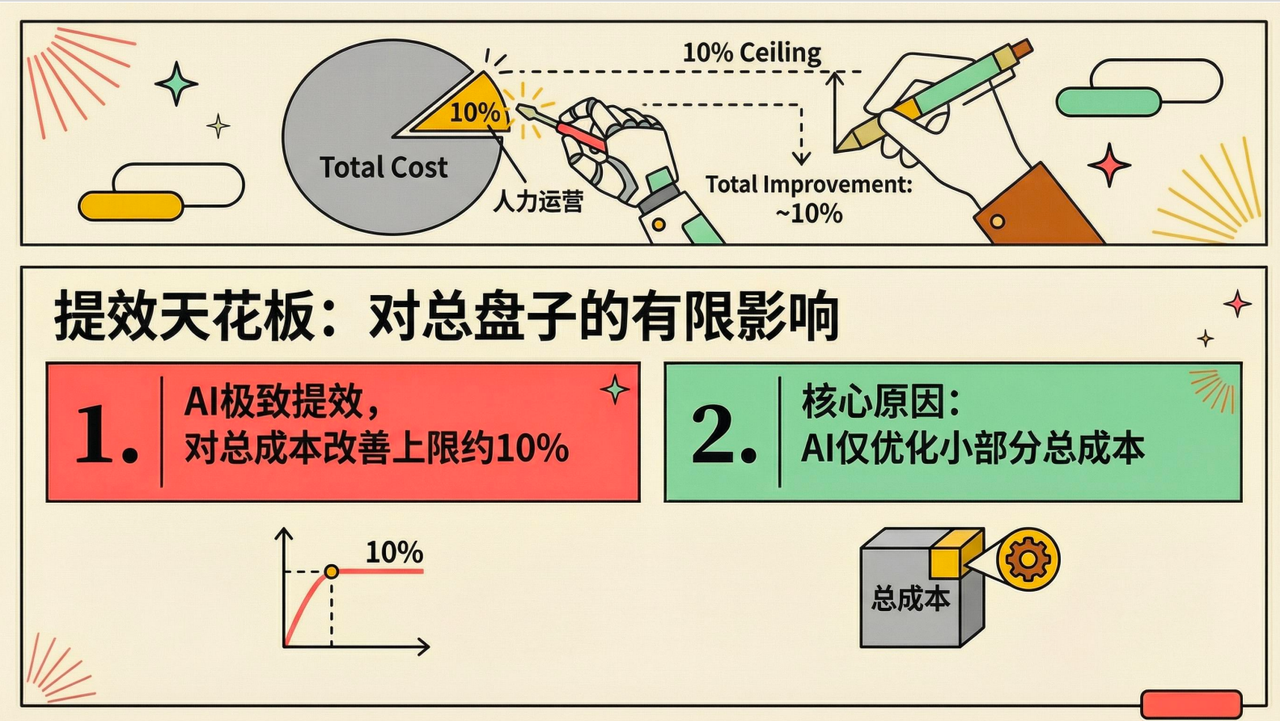
That’s why I say the change “isn’t as big as imagined”: even perfecting that 10% only moves the needle modestly on the whole.
But AI’s second, more consequential impact lies in tempo:
Campaign success often hinges not on absolute efficiency—but on who first discovers and scales a replicable, effective model.
AI accelerates material production, experimentation, strategy convergence, and scaling velocity. Speed is a moat.
Teams that move faster gather better learning data sooner, lock in winning creative + audience combinations earlier, and punch through budget caps before others—even capturing brief windows of competitive advantage.

In other words: industry-average CAC may not fall—but top players scale faster, while mid- and long-tail players fall further behind. Market concentration increases. That’s the direction we’re already seeing.
There’s also an underappreciated leverage point: AI may not lower CPC—but it can lift CVR, AOV, or LTV. That raises your acceptable CPA ceiling. With higher willingness-to-pay, you can outbid others for inventory they simply can’t afford.
Superficially, acquisition isn’t cheaper—but your growth ceiling expands, and your scalability lifts.
So AI’s biggest impact on advertising isn’t “making it cheaper.” It’s making stronger players bolder, faster, and more stable—accelerating market divergence.
And if you want >10% efficiency gains? Don’t stop at the 10% inside the campaign team. Apply AI outside the auction: optimize conversion flows, sales handoffs, retention loops, attribution models, and first-party data closure. These levers don’t yield marginal tweaks—they lift your entire sustainable growth ceiling.
Paid acquisition is an auction market. In auctions, “efficiency dividends” get priced in quickly.
Lasting advantage comes from what others can’t copy: proprietary data, product differentiation, brand equity, channel structure—and a uniquely fast, robust AI-powered growth system.

Systems Thinking
Systems thinking means focusing on relationships and patterns—not isolated events or local variables.
Without it, we easily inflate the importance of a single tactic or insight—while ignoring systemic gaps.
In The Fifth Discipline, systems thinking is defined as a framework for seeing interconnections, not separate things—and patterns of change, not static snapshots.
In Thinking in Systems, a system is defined as:
“A set of interconnected elements, organized consistently to achieve a purpose.”
It consists of three parts: elements, connections, and purpose/function.
This definition matters—because many fixate on elements (a tool, a metric, a person), while behavior is actually governed by connections (information flows, rules, incentives, constraints) and the purpose function.
Two foundational building blocks of systems thinking are feedback loops and time delays. As MIT’s system dynamics literature puts it bluntly: Feedback loops are the basic structural element of all systems—and nearly all dynamic behavior stems from them.
Systems thinking is a habit: noticing how actions ripple across time to shape outcomes.
Many people’s “sharp edges” are local optima—excellence in one element. System-level wins, however, hinge on bottlenecks, feedback structures, delays, and governing rules.
A point matters—but its real weight depends on whether it sits at a bottleneck, alters a feedback loop, or reshapes a core rule.
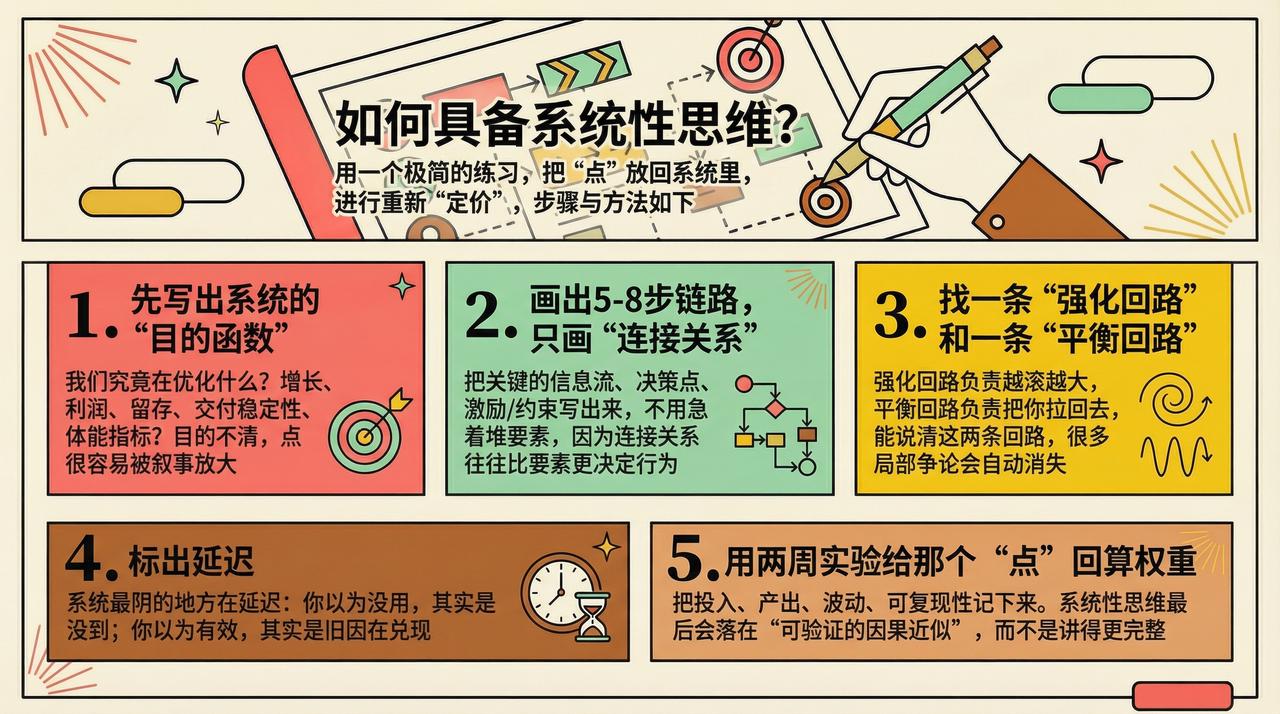
How to build systems thinking? Try this minimal practice: re-price the “point” inside its system. Steps:
-
Clarify the system’s purpose function
What are we optimizing for? Growth? Profit? Retention? Delivery reliability? Physical stamina? Without clarity here, any “point” risks being inflated by narrative. -
Map 5–8 steps of the chain—focusing only on connections
Sketch key information flows, decision gates, and incentives/constraints. Don’t rush to populate elements—connections often matter more than components. -
Identify one reinforcing loop and one balancing loop
Reinforcing loops amplify growth (“more users → more data → better product → more users”). Balancing loops pull toward equilibrium (“rising costs → reduced spending → lower costs”). Naming both dissolves many local debates. -
Mark time delays
Delays are where systems hide their teeth: “Nothing’s working” may mean “it hasn’t kicked in yet”; “This worked!” may reflect an old cause finally surfacing. -
Test the “point” for two weeks—then recalculate its weight
Track input, output, variability, and reproducibility. Systems thinking culminates not in elegant completeness—but in verifiable, approximate causality.
AI and Tools
In Future Silicon World, our latest episode explored AI and tools—with a seasoned AI practitioner sharing sharp insights.
Recommended AI tools:

Core takeaways:
- Productivity leap: One person = one army. An AI-augmented consultant now produces 30 assessment reports/day—work once requiring full teams, with zero coordination overhead.
- Handcrafted tools: End industrial mediocrity. With Claude Code, build a custom file-cleaner or config tool in 25 minutes—solving niche problems big software ignores.
- Aesthetic moat: Quantity breeds quality. When AI output converges, your taste becomes your sole differentiator. Study Apple’s design, visit museums, watch masterful films—let intuition evolve through high-signal input.
- Asset redefinition: Stop mining digital landfills. 100K auto-generated words are e-waste—they’re instantly reproducible. Real assets are your prompt engineering methodology and irreplaceable co-created insights.
- SPEC-first programming: Sharpen the axe before chopping. For complex projects, don’t code yet. First, co-draft a full spec with AI—including PRD and technical docs. Spec quality dictates code accuracy.
- The “three-fail” rule: Stop patching. If a module fails three times in assisted coding, scrap it—or rewrite the spec. Avoid the “worse with every fix” trap.
- First-principles questioning: Pierce surface needs. Break problems into atomic units. Clarify exact purpose and expected outcome—so AI delivers on the shortest possible path.
- Deep-tool mastery: Notebook LM + Gemini. For long-form reading or book writing, use Notebook LM’s “needle-in-haystack” search alongside Gemini’s long-context reasoning to digest entire books and draft rich outlines in minutes.
- Efficiency hub: Raycast. Make it your AI command center—trigger instant web summaries or chat via hotkey. Eliminate window-switching friction.
- Strategic shift: Prioritize pre-writing, not writing. Focus shifts to topic selection, logic extraction, and model architecture. AI handles 99% of text generation; humans become the 1% architects.
- Idea-to-output speed: Turn lyrics into music in 30 minutes with Suno 4.0. AI slashes trial cost—letting anyone experience pro-tier creative joy.
- Coexistence metaphor: Climber and Sherpa. Today’s AI is your Sherpa on Everest. You define why you climb (meaning, values, vision); AI provides expert support. Learn symbiosis—not fear.
The Path to Personal Freedom
Real personal growth isn’t about knowing more—it’s about becoming more selective with your desires, more stingy with your attention, and more rigorous with your integrity.
From Naval Ravikant’s January podcast (Modern Wisdom #44):
“Success often springs from dissatisfaction. Happiness can spring from wanting less.”
Desire’s cruelest trick? It’s an invisible contract: sign first, suffer later.
Tie your happiness to “once I achieve X,” “once I fix Y,” or “once I earn Z”—and you’ve agreed to live unhappily until then.
Worse: achievement delivers fleeting euphoria, then resets to baseline—prompting the chase for the next target.
True waste isn’t inaction—it’s being physically present while mentally absent. That moment? You didn’t live it.
Many mistake busyness for progress—chopping life into fragments of attendance, not presence. Looking back, they see projects, results, screenshots—not texture, growth, or lived experience.
Naval’s eight distilled principles:
- Default to “no” on indecision: Good opportunities rarely demand prolonged negotiation. If you’re stuck choosing, the answer is usually no.
- Default to “no” on new commitments: Attention requires whitespace. A packed calendar means your life is written by others—not you. We rarely lack opportunity; we lack space.
- Choose the short-term painful option in dilemmas: Your brain exaggerates immediate discomfort to sell you long-term suffering. The harder path often leads to lasting calm.
- Trust gut, verify with reason: For tough calls, your body often decides first. Reason explains after. True intuition is trained judgment—not impulse.
- Treat self-respect as a credit score: It’s not pep talk—it’s your reputation with yourself. Build it: define clear ethics, keep promises to yourself, act rightly—especially when it helps others. Every kept promise deposits into your integrity account. Low self-respect means you’ve stopped believing you’ll follow through.
- Relationships run on shared experience and values—not résumés: Does energy align? Is presence easy? Do you unite in crisis? These aren’t measurable—but they’re real. If a relationship feels like work, you’re using willpower to sustain an unfit structure. Values aren’t slogans—they’re revealed in hard choices.
- Don’t stream global emergencies into your brain: Human cognition didn’t evolve for “worldwide breaking alerts.” Trying to care about everything hands control to anxiety. Better rule: focus only on local, actionable domains. Don’t treat attention as charity.
- Decompose stress into conflicting desires: Stress isn’t overload—it’s desire collision: wanting approval vs. living authentically; earning money vs. having ease; freedom vs. control. Write the conflict down—and anxiety shrinks. You don’t eliminate tension—you acknowledge you can’t satisfy all wants, choose one, and accept the trade-off.
Compress all this into one sentence:
Want less. Be more present. Explain less. Deliver more. Add less. Leave more space.
Practice these well—and freedom stops being abstract. It becomes your operating system.
Original source: podcastnotes.org