The Inner Art of Education in the AI Era
On Saturday evening, “Future Silicon World” hosted a live session via WaytoAGI, featuring keynote talks by Qiniang and Xiangshu.
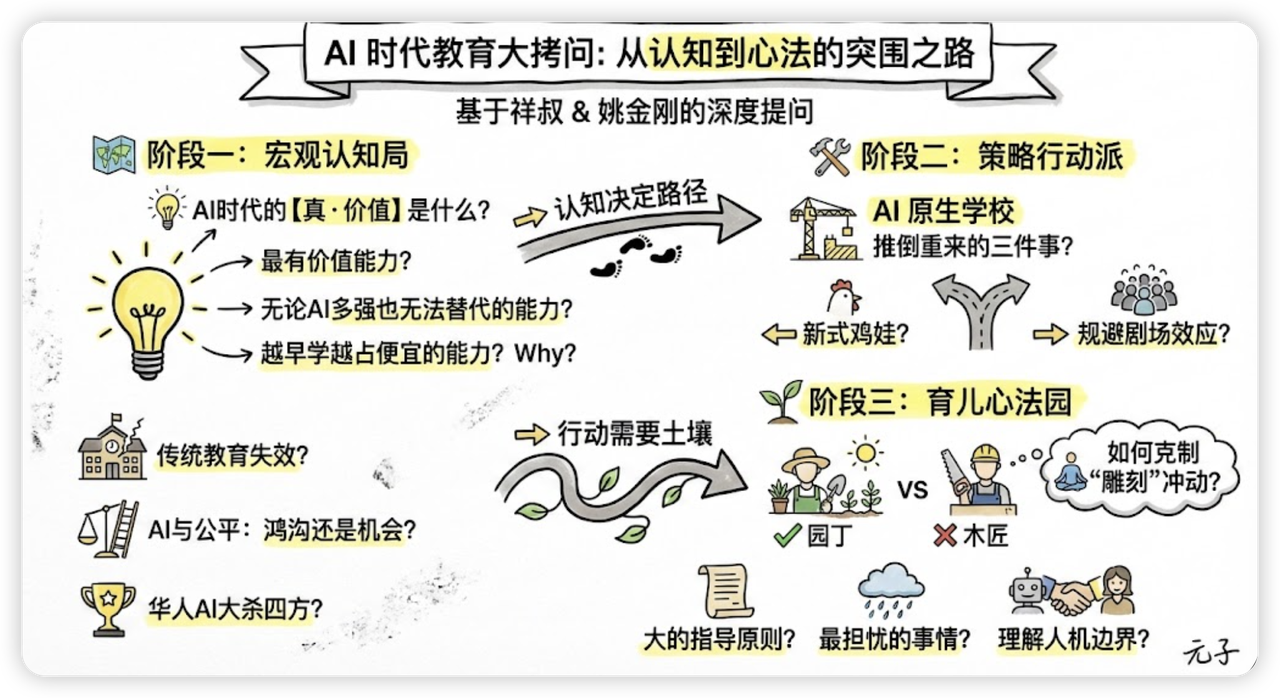
Core questions explored:
Xiangshu:
- What trait or ability is most valuable in the AI era?
- Has traditional education become obsolete? How do we interpret the strong Chinese presence in global AI advancement?
- Should we “push” children differently in the AI era? If yes—how? If not—how do we avoid the “theater effect” (where everyone stands to see better, yet no one gains advantage)?
- How can parents become gardeners—not carpenters—of their children’s growth? How do we resist the impulse to “sculpt” them?
- What are your top-level educational guiding principles?
Yao Jingang:
- Which abilities will never be replaced by AI, no matter how advanced it becomes—and how would you cultivate them in your child?
- Will AI make education more equitable—or widen the gap? What’s the decisive variable?
- If you were to redesign a school natively for the AI era, what three things would you rebuild from scratch?
- Looking 20 years ahead: what single ability would give your child a massive early advantage—and why?
- What concerns you most about your child’s development today?
- How do we help children understand the relationship, distinctions, and boundaries between AI and humans?
In the discussion, Qiniang, Xiangshu, Xiangyang, Nickxi, and Yuanzi shared sharp, practical insights:
- The most essential, irreplaceable human capacity in the AI era is “aesthetic judgment + leadership”: knowing what is good, and directing AI to realize it.
- “Critical thinking” is better framed as “discernment”—the ability to judge, filter, and choose wisely amid an ocean of AI-generated content.
- Imagination sets the ceiling for how high someone can leverage AI; without it, AI only amplifies mediocrity.
- Real competitive advantage comes from agency—an inner drive toward self-defined goals—not from the power of tools alone.
- Aesthetic sense, imagination, and values form through real-world exploration, play, lived experience, and deep engagement with timeless texts—not through abstraction or instruction alone.
- The key shift for future schools isn’t teaching students how to follow rules, but empowering them to co-create the rules.
- The most effective learning method is “teach-to-learn, learn-by-doing, project-driven”—not passive listening.
- Parenting must evolve from controlling to gardening: offering space, modeling integrity, and accompanying—not commanding.
- Children must clearly understand AI is a tool, not a person—preventing emotional dependency and conceptual confusion.
- AI dramatically expands the potential for personalized and inclusive education—but whether that potential scales depends entirely on institutional willingness to change.
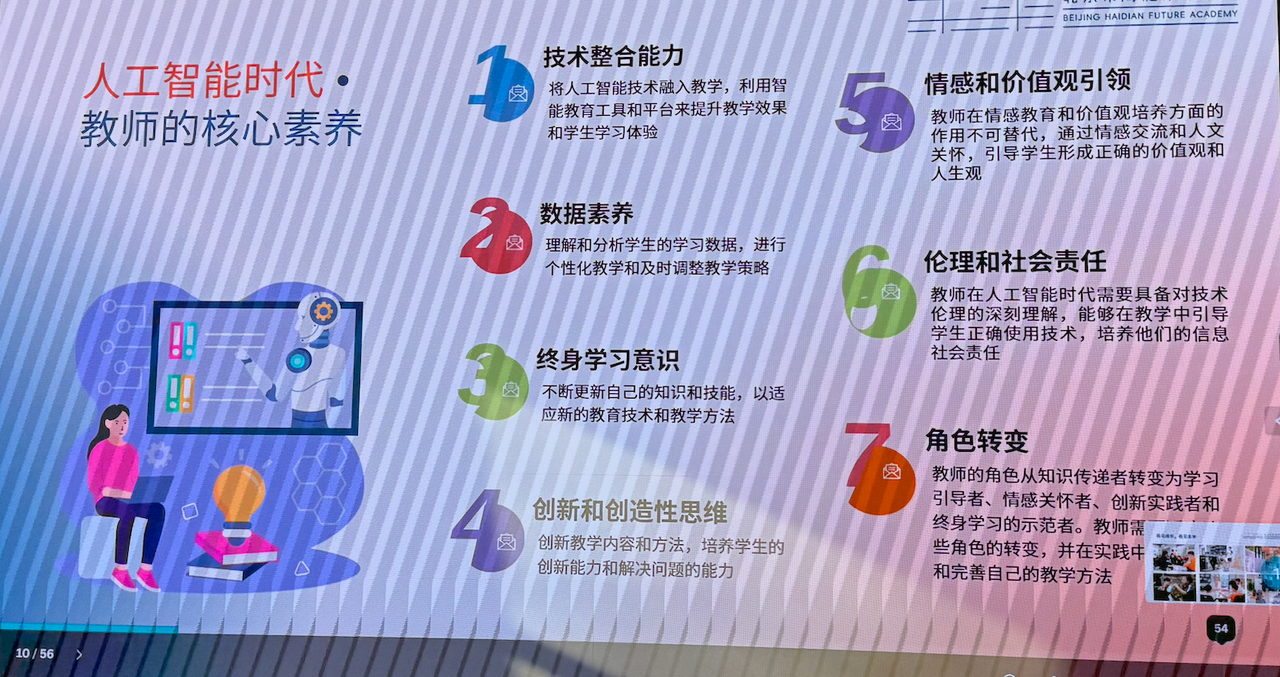
The next day, I attended an international school’s parent open day. Their summary of core teacher competencies in the AI era was equally incisive:
Full AI-assisted summary of the livestream’s key points:

Learning by Doing
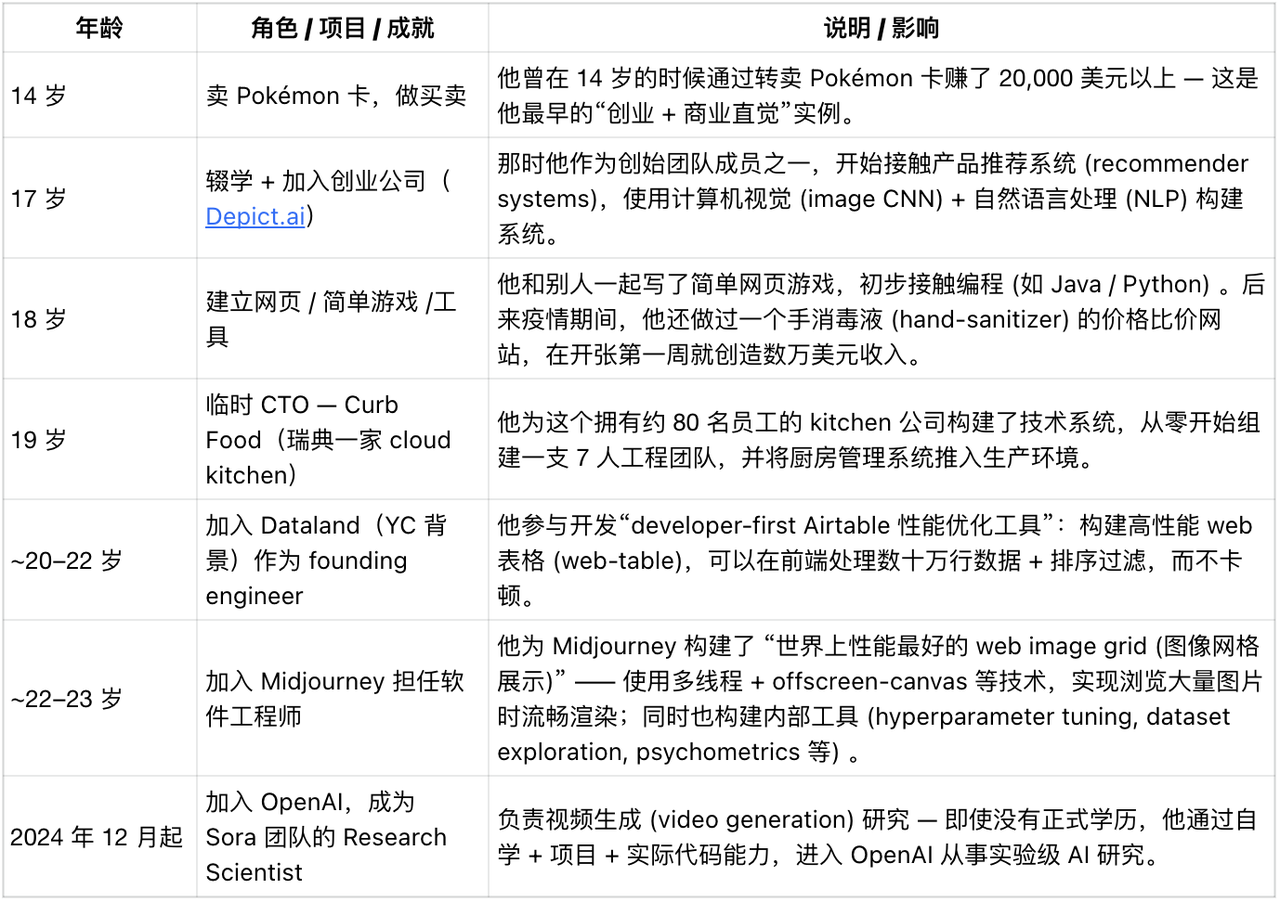
I recently read about Gabriel Petersson—a 23-year-old Swedish researcher now working on Sora at OpenAI. He never finished high school.
His career path defies convention:
As he puts it: “Universities no longer hold a monopoly on foundational knowledge—we can access it instantly via AI.”
From Petersson’s own account: Companies don’t care about diplomas. They care about value creation. Prove you can deliver value—and they’ll hire you.
Petersson’s success stems not from elite credentials, but from his learning method: treating AI as a second brain, starting from real problems, driving progress through real projects, and using AI to solve them—rapidly iterating, debugging, and shipping.
For example: pick a real, valuable, in-demand problem → use AI to write and debug code → fill knowledge gaps on-the-fly with AI → ship a working system → land opportunities through tangible output.
This path diverges sharply from traditional learning:
Most of us follow: grades → elite school → prestigious job → socially sanctioned career track.
That path once promised security. Today, it’s fraying—and will fray further.
Key takeaways:
- True capability no longer lives in knowing—it lives in making things happen. In a results-oriented world, one truth holds: those who deliver outcomes always get a seat at the table. Petersson internalized this early: “Whoever ships something gets to sit at the table.”
- The defining skill isn’t how much you remember, but whether you and AI can form a mutually reinforcing loop—each amplifying the other.
- This era rewards self-direction and shipped work, not waiting and credentials. Most people stall at the starting line—not because they’re unqualified, but because they say: “I’m not ready yet,” “I need to study more,” “I’ll wait for the right moment.” Petersson’s logic is different: Start. Learn while doing. Turn learning into output. Your portfolio—not your résumé—is your true credential.
How to Choose Projects
In conversation with Xiangyang, we refined our criteria for selecting high-signal projects—especially tool-based ones.
A foundational principle: build a single-point system that, once cracked, can be theoretically replicated infinitely.
Operational guidelines:
- Fully automatable + AI-native, with built-in self-growth loops.
- Small and elegant—beneath the radar of big tech, hard to copy.
- Few competitors; product scarcity is real.
- Solves a genuine, urgent need—but the solution logic is nontrivial.
- Building the core system is complex—but once validated, the model scales infinitely.
For entering unfamiliar, niche domains, validate your idea like this:
- Start with proven personal projects or micro-studios—not greenfield invention.
- Conduct rigorous side-by-side comparison: objectively assess whether you could outperform the benchmark—if yes, it’s likely worth pursuing.
Knowing When to Walk Away
Annie Duke’s Quitting: The Science of Knowing When to Walk Away is profoundly practical. It unpacks decision-making under uncertainty—exposing cognitive traps, building rational stop-loss frameworks, and reframing exit as strategic wisdom—not failure.
In one sentence: Quitting isn’t surrender. It’s one of the most underrated forms of rational agency.
I. Counterintuitive Core Insight
We’re taught: “Persistence equals virtue.”
Duke, drawing on behavioral economics and game theory, shows repeatedly: Failure rarely comes from quitting—it comes from persisting too long in the wrong thing.
People don’t lose because they lack skill—they lose because of two illusions:
- Mistaking persistence itself for the cause of success.
- Equating quitting with failure, cowardice, or weakness.
She performs vital “cognitive defusing”: stripping the moral halo off persistence—and separating it cleanly from rational choice.
II. Three Deep Human Biases This Book Helps You Fight
-
Loss aversion
We feel the pain of loss ~2x more intensely than the pleasure of gain. This breeds dangerous behavior: “I’ll keep going—even though it’s wrong—because I’ve already lost so much.”
It’s rampant in startups, investing, careers, and relationships. -
Sunk cost fallacy
Money, time, effort, emotion—all become psychological anchors.
Rationally, only future value matters. But emotionally, we ask: “How can I walk away after investing so much?” -
Identity attachment
Many won’t quit—not because the project still makes sense—but because they can’t bear the label “failure.”
So decisions aren’t made for outcomes—but for self-image.
III. The Real Tool Isn’t Judgment—It’s Pre-Set Exit Rules
The book doesn’t just say “quit when needed.” It insists: design your exit mechanism before emotion clouds judgment.
Make rationality structural, not situational.
Examples:
- Not “I’ll stop when I can’t bear it anymore,” but “If cash flow stays negative for 3 consecutive months, I pause.”
- Not “I’ll quit if it feels hopeless,” but “If we miss Milestone X by Date Y, we reassess.”
- Not “I’ll leave when I’m exhausted,” but “If my energy score falls below Z for 10 days straight, I step back.”
IV. Correcting the “Success Narrative Bias”
Society celebrates the gambler who hit big, the founder who held on till the turnaround, the athlete who overcame injury.
Rarely celebrated: the investor who cut losses early, the founder who pivoted before collapse, the professional who walked away to preserve health and clarity.
The result? Generation after generation misreads the odds—overvaluing grit, underestimating the power of timely retreat.
True strength isn’t blind endurance.
It’s having the courage to press stop—on the wrong path, at the right time.
Baiyangdian Hiking Exchange
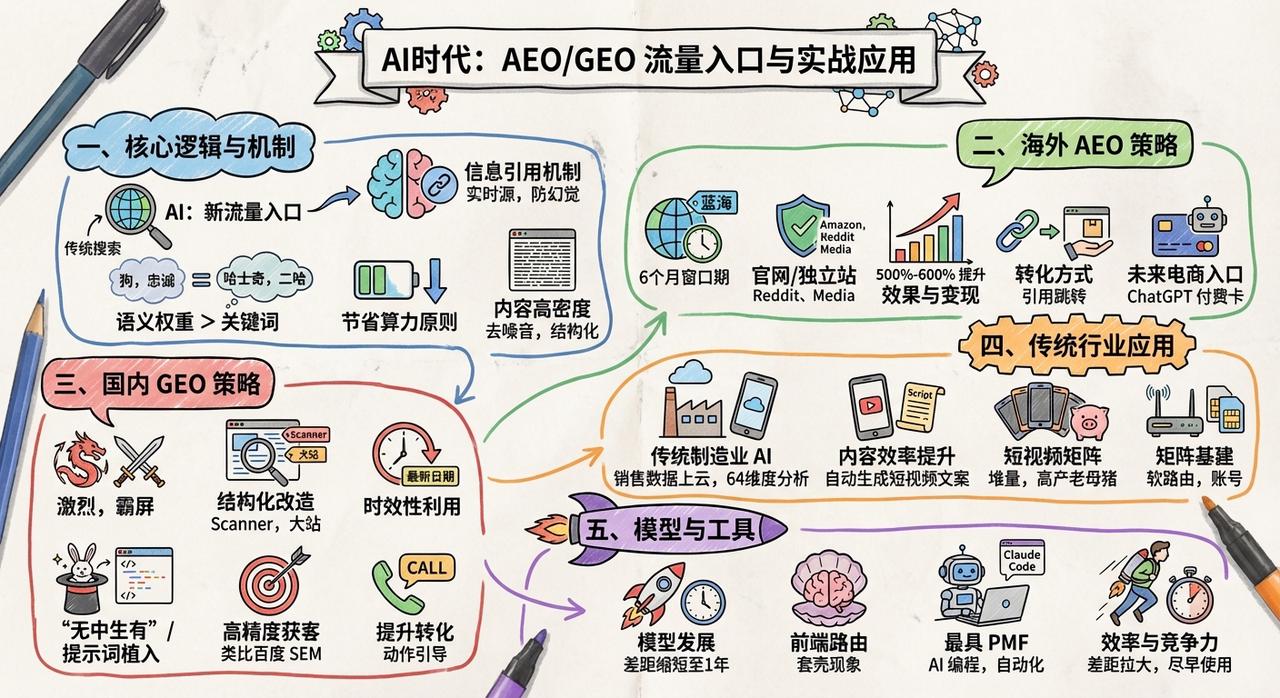
Over the weekend, 16 colleagues from Souwai joined me for a hiking exchange at Baiyangdian—covering AI, GEO, short-video ecosystems, and the emerging efficiency class divide.
At lunch, four speakers shared distinct but complementary lenses:
- Zhang Kai: Overseas GEO & independent stores
- Han Jiangting: AI + short-video matrix strategy
- Qiao Xiangyang: AI models & tool ecosystems
- Me: Domestic GEO execution paths
Together, these four perspectives map the full terrain of today’s AI-driven traffic migration.
I. AI Search Is Rewriting “Where Traffic Begins”
Historically: user → keyword → search engine → website
Now increasingly: user → question → AI → cited source → official site or platform
1. Why AI Must Cite “Fact Sources”
AI search follows a clean, two-step logic:
- First: locate what’s widely accepted as factual
- Second: interpret, restructure, and express it
This design combats hallucination—and means: whoever becomes “fact itself” becomes the AI traffic gateway.
That is GEO—not chasing rankings, but becoming the source AI trusts as ground truth.
2. Algorithm Shift: From Keywords → Semantic Weight + Compute Efficiency
Traditional SEO optimized for keyword matching and backlink authority.
AI search optimizes for intent alignment and semantic weight.
Three critical content rules emerge:
- Authority vocabulary: AI trusts industry-standard terms and technical language—not emotive phrasing.
- Structured expression: AI prefers tables, checklists, step-by-step guides, and comparative formats—not narrative prose.
- High information density: Adjectives, hype, and persona branding are mostly noise to AI—they waste tokens and dilute signal.
This shift favors small, deeply specialized players—not just big sites with legacy authority.
You may not beat Amazon on domain rank—but you can beat it on compute-per-value ratio.
II. Overseas GEO: Independent Sites Are Back on Top
3. Why Independent Sites Dominate Overseas AI Rankings
Because in global contexts, “official site = trusted fact.”
When AI crawls overseas sources, its priority stack is clear:
- Tier 1: Official websites / independent stores
- Tier 2: E-commerce platforms (e.g., Amazon)
- Tier 3: Communities (e.g., Reddit)
- Tier 4: Media outlets
→ Simply having an independent site places you in AI’s first-tier source pool.
4. Real-World Traffic & Conversion Results
Multiple live cases confirm consistent patterns:
- Traffic growth: 5–6× increase
- Time-to-impact: noticeable shifts within 1–2 weeks
- Conversion quality: significantly higher than traditional SEO
Crucially: Though AI results rarely show phone numbers directly, they do surface brand names, product names, and official links.
People who proactively query AI have already self-filtered for intent—so conversion rates rise.
5. Overseas GEO Tools Are SaaS-Native
The standard overseas model is subscription-based SaaS (~$299/month). These tools don’t post for you—they act as GEO navigation systems: telling you what to write, where to publish, and which “seed questions” to target.
This is fundamentally different from China’s “managed service” model.
III. Domestic GEO: Not SEO—It’s SEM 2.0
A key insight repeatedly validated on-site:
Domestic GEO’s commercial value mirrors early-stage Baidu SEM—not modern SEO.
That means:
- Not “cheap traffic”
- But high-intent, high-conversion, high-LTV leads
6. Three High-Impact Execution Tactics
Domestic GEO in practice:
- Timeliness refresh: AI strongly favors freshness. Updating publication dates on legacy articles to “recent” yields immediate, visible citation lifts.
- Structural re-tagging: For large legacy sites, no need to rewrite pages—just use tools like Scanner to add semantic markup (e.g.,
<schema:HowTo>,<schema:FAQ>), reshaping how AI parses and cites your content. - Natural conversion embedding: Phone numbers and URLs appear 5–10× more often in AI outputs when embedded within action-oriented context (e.g., “Call now to schedule your free audit”)—not as standalone footnotes.
7. Reframe AI Crawlers: Not a Cost—An ATM
Many companies panic when AI bots trigger hundreds of dollars in daily OSS bandwidth fees.
The correct mindset shift: You’re not being “charged”—you’re buying leads.
This is a business model pivot:
- Old logic: ad inventory (A-space)
- New logic: AI-driven lead acquisition (B-space)
You’ve shifted from selling impressions to monetizing qualified inquiries.
IV. Short-Video Matrix: The “High-Yield Sow” Model for Traditional Industries
A blunt operational reality: For traditional manufacturers, the most effective Douyin strategy remains one word—volume.
Like SEO’s keyword stacking era, today it’s: account stacking, video stacking, matrix stacking, search-coverage stacking.
Goal: Ignore trends. Capture search-driven demand.
8. AI Is Now Embedded in Sales Operations
AI has entered the sales core of traditional enterprises:
- All sales activity logged in cloud CRM
- 64-dimension behavioral analytics
- AI-generated negotiation scripts
- Call transcripts auto-converted into video script drafts
→ Content creation no longer depends on inspiration. It flows directly from real, closed deals.
V. AI Models & Tools: The Real Divide Isn’t “Understanding”—It’s “Daring to Go All In”
9. Much of China’s AI Is “Skin + Router”
The dominant pattern:
- Use top-tier models (e.g., Qwen, GLM) for intent parsing and task decomposition
- Offload execution to lighter, cheaper models
That’s why many domestic AI tools feel smart in chat—but falter on heavy lifting.
10. The Only AI Category With Real PMF Today: AI-Powered Automation Workflows
Not AI writing copy. Not AI generating images.
But: AI coding + autonomous workflow orchestration.
These tools no longer “write code”—they run processes: auto-watching videos, auto-filing taxes, auto-filling government forms, auto-uploading invoices.
You’re not using a tool. You’re hiring a digital employee.
VI. The Efficiency Chasm Is No Longer a Trend—It’s a Class Boundary
The most resonant line from the hike:
AI isn’t delivering efficiency gains—it’s creating an efficiency class divide.
Some people operate at 10× speed.
Some at 100×.
Some are already running 24/7, machine-grade throughput.
This gap isn’t widening gradually—it’s snapping open.
Hence the only advice offered on-site:
Start early. Stay quiet. Go all the way.
From AI search to GEO, from independent sites to short-video stacks, from AI coding to the efficiency chasm—
The greatest value of this exchange wasn’t what we heard.
It was confirming one thing:
The future isn’t arriving slowly. Some people have already arrived.