The Skill of Playing Well
A friend once said over dinner: “In the future, knowing how to play will matter more than ever.”
The premise? Playing—safely.
If, in a few decades, AI dramatically boosts productivity and grants most people abundant leisure time, what will they do with it?
Most likely: play.
But “playing well” may become a new core human competency.
01
AI will divide the world into two groups: those played by systems—and those who play well.
Everyone will face a choice: Do you want agency over your own life?
If not, AI will design for you: ever-more stimulating entertainment, ever-more attentive companionship, ever-more precise emotional comfort—pleasures like “mental nutrient solution”: the more you consume, the emptier you feel.
But if you choose to reclaim agency, AI transforms into something else entirely: a creative engine—helping you design adventures, build worlds, and expand the scope of lived experience.
Truly skilled players aren’t consumers. They’re game designers.
02
Playing well is a skill.
It means generating meaning from experience, worldview from meaning, and personal style from worldview.
Someone who can’t play well defaults to consuming pre-packaged stimulation—designed by algorithms, AI, or robots. Their emotions get pulled along; their life narrative becomes a side effect of recommendation feeds.
The greatest danger ahead isn’t having nothing to do.
It’s believing you’re playing—when in fact, you’re being played.
Playing well isn’t escapism. It’s clarity.
It’s knowing the difference between experience and anesthesia:
-
When ideas suddenly multiply—that’s experience.
When you lose all sense of self—that’s anesthesia. -
When the world feels vividly clear—that’s experience.
When time vanishes without trace—that’s anesthesia.
03
The central human differentiator in the future won’t be knowledge—it’ll be sensibility.
AI can master any skill instantly—but it cannot replace your felt relationship with the world.
The same wind blows across a field.
One person registers only: “wind.”
Another hears direction, emotion, force—in its rustle.
The gap won’t be about who knows more.
It’ll be about who experiences more dimensions in the same reality.
That’s a new kind of intelligence.
04
We’re not entering a high-efficiency era—we’re entering a high-experience era.
AI will turn the world into a vast “autonomous system”: tasks automated, workflows rewritten, even creativity outsourced.
When work is hollowed out—what proves you’re still alive?
Answer: your capacity to experience deeply.
GEO’s Consensus Mechanism
What is GEO, really?
At its core: building brand-relevant consensus with AI.
How does that work?
AI search doesn’t ask, “Who paid the most?” It asks: “Does this statement align with what the world collectively affirms?”
If yes—it gets cited, recommended.
If no—it’s ignored.
Spending money or publishing volume matters far less than being repeatedly verified, across sources, as the right answer.
AI is the first search engine that ignores ads, discounts authority scores, and trusts only consensus. In its presence, marketing slogans, brand taglines, and emotional packaging all collapse—because AI values facts, prefers structure, and demands evidence.
The more you try to “polish” your message, the less it trusts you.
Some brands never ran GEO campaigns—but because third parties referenced them consistently, with clean parameters and clear structure, AI began citing and recommending them.
In the AI world, brand identity isn’t “what you say you are.”
It’s “how others consistently describe you.”
Old branding was shouted. New branding is accumulated.
I’ve observed a trend: the more independently sourced, identical language used to describe a brand—the more likely AI treats it as the default answer.
If ten websites all call you “immersive courses + AI coding tools + ages 6–12,” AI etches you into its knowledge graph.
Not because you said it—but because the world says it.
That reveals a deeper truth: AI-era branding isn’t PR. It’s consensus engineering.
What does “consensus engineering” mean in practice? Take AI citation efficiency:
AI doesn’t cite you because your writing is elegant—it cites you because you make its job easier.
Top-performing content shares one trait: it’s rarely the flashiest—but always the most frictionless for AI to use. Examples: clear data, logical structure, atomic points, decomposable attributes, consistent semantics, rich factual grounding, and obvious information gain.
AI won’t reward beauty. It rewards usability.
That’s one principle of consensus engineering.
The harsh reality of AI search? You can no longer mask factual gaps with marketing tactics.
Now, AI asks three questions:
- Is this true?
- Do others say the same thing?
- Does your content offer unique, verifiable insight others lack?
Yes—there’s noise, manipulation, and black-hat work. But the long-term trend is positive: AI is pushing the world toward answer transparency, forcing businesses to make products, services, data, content, reviews, and facts more real.
The more you obscure, the less visible you become.
The more you ground yourself in reality—the more AI cites and recommends you.
This is a foundational rewrite of information rules.
The only winners in this era? Those who turn complexity into clear, accurate facts.
GEO Effectiveness Measurement
This note itself was produced in an AI-native workflow:
- I dictated my structured thinking on this topic into GET Notes (an AI voice-note tool), triggering automatic transcription and initial organization.
- I fed that draft to ChatGPT for logic refinement and structural tightening.
- I reviewed, added new insights, and finalized the piece.
- I uploaded the final text to NotebookLM to generate a presentation—visualizing key ideas for clarity and sharing.
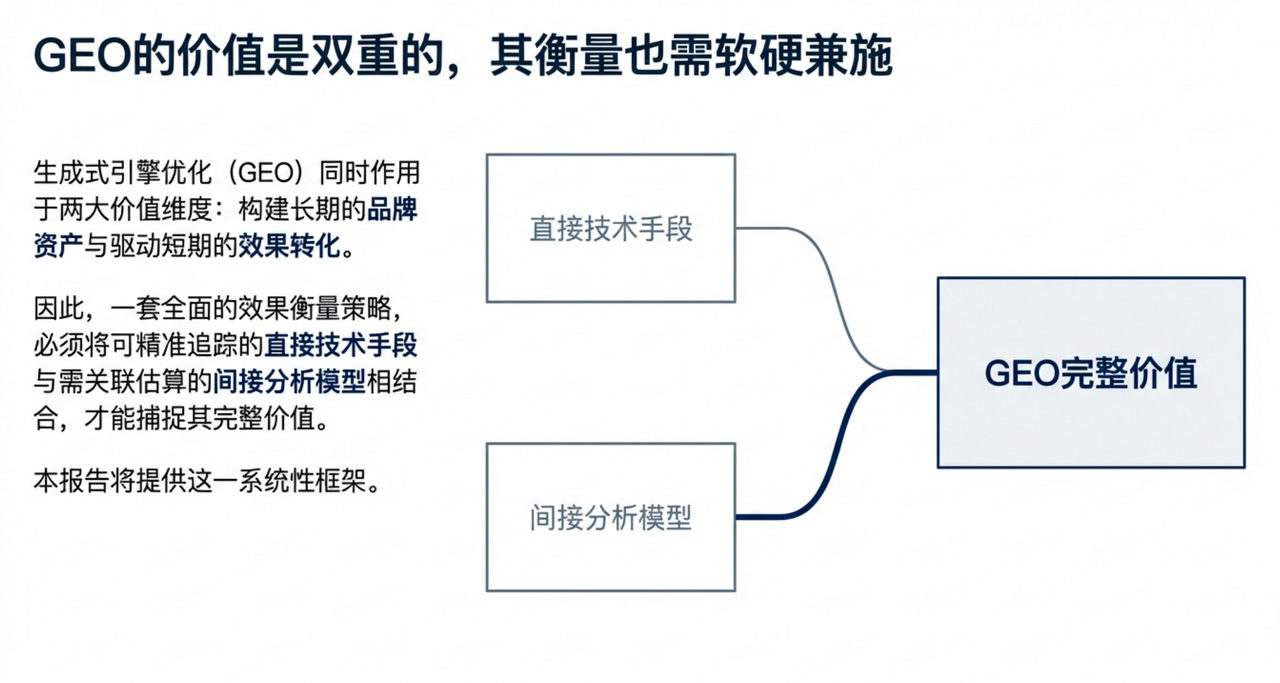
After implementing GEO, companies inevitably ask: “Is it really working? Can we measure it?”
Here’s a comprehensive, pragmatic evaluation framework:
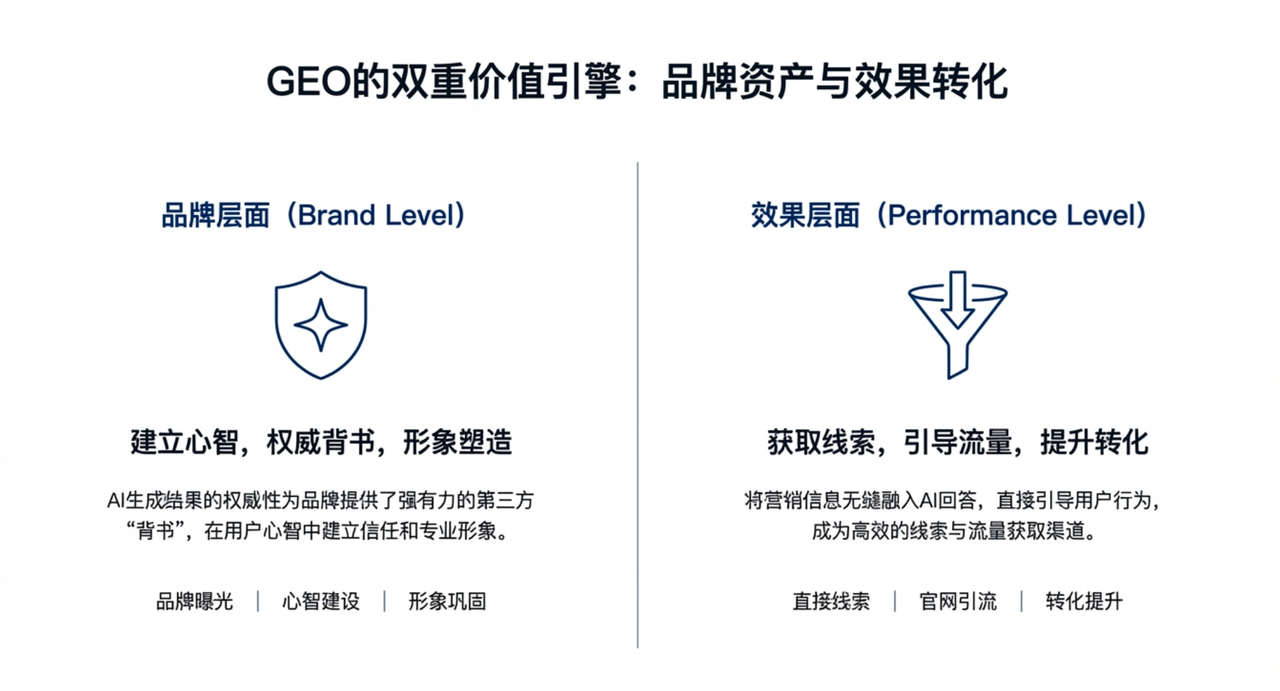
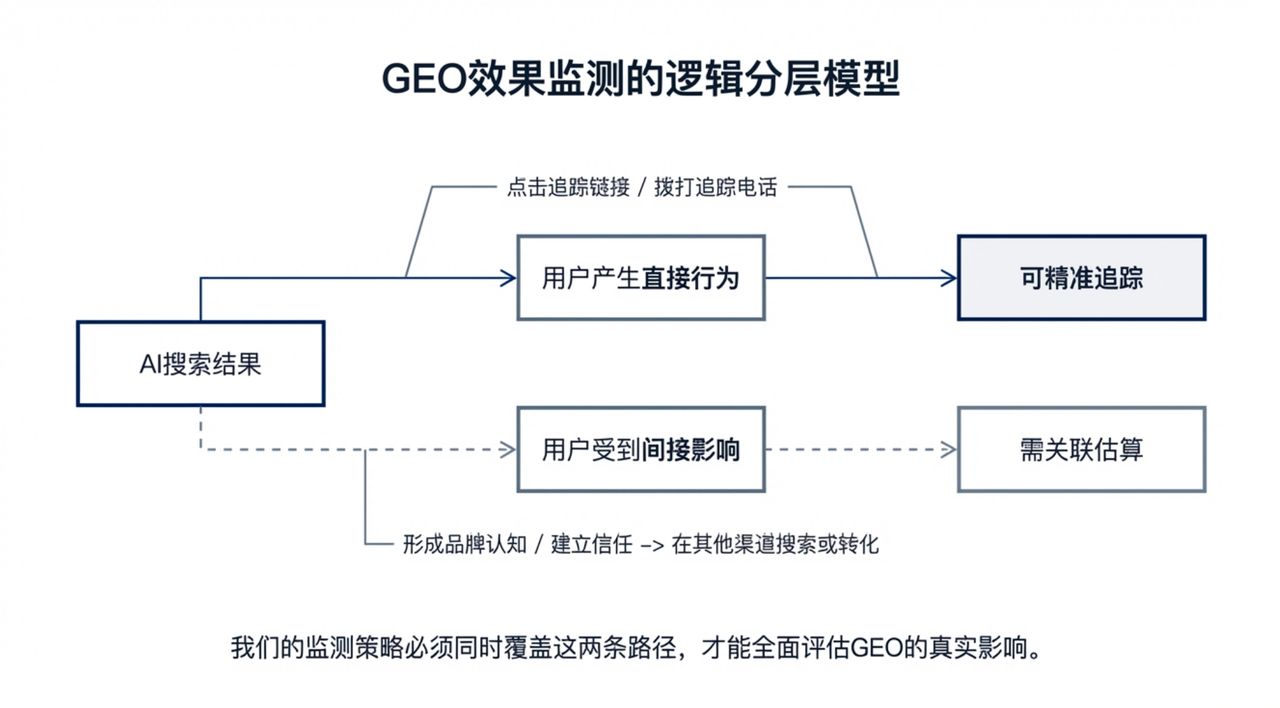
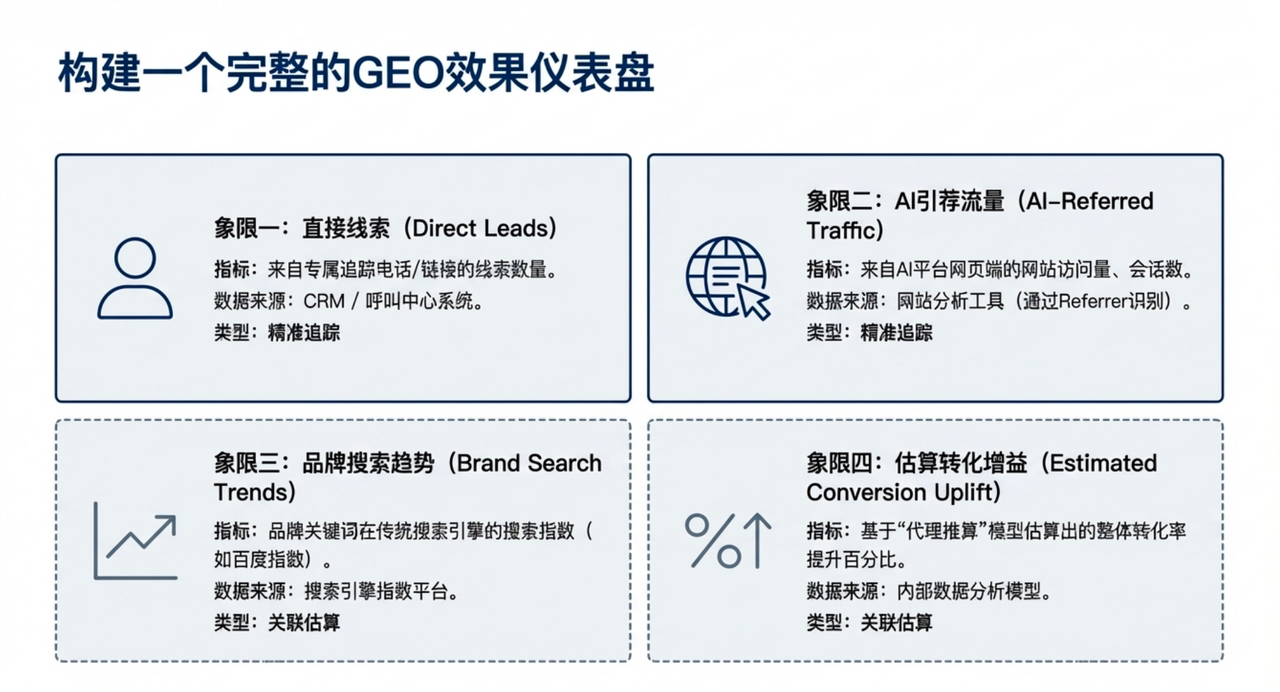
I. Three Core Types of GEO Impact
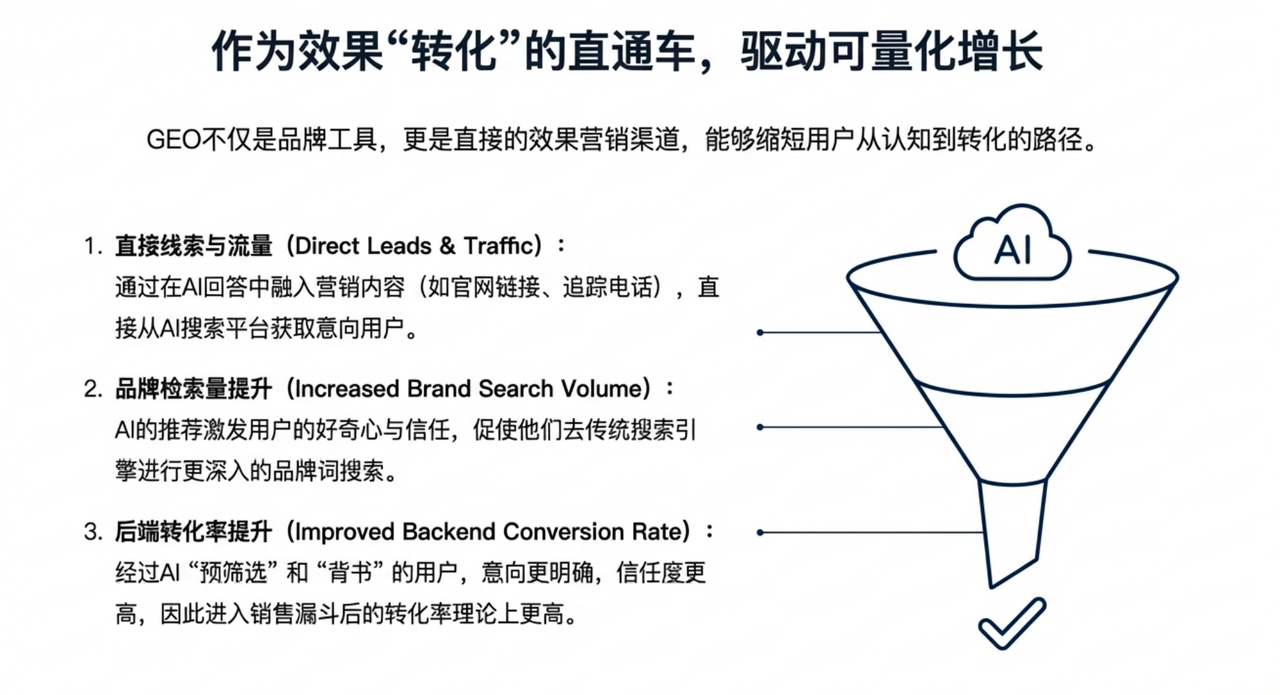
- Direct impact (quantifiable, trackable)
Actions users take immediately after seeing your content in AI responses: clicking through to your site or landing page.
Examples:- Calling a marketing phone number listed in an AI answer
- Clicking a branded link embedded in AI output
- Navigating via source citations in AI results
These are hard metrics—the “hard KPIs” of GEO.
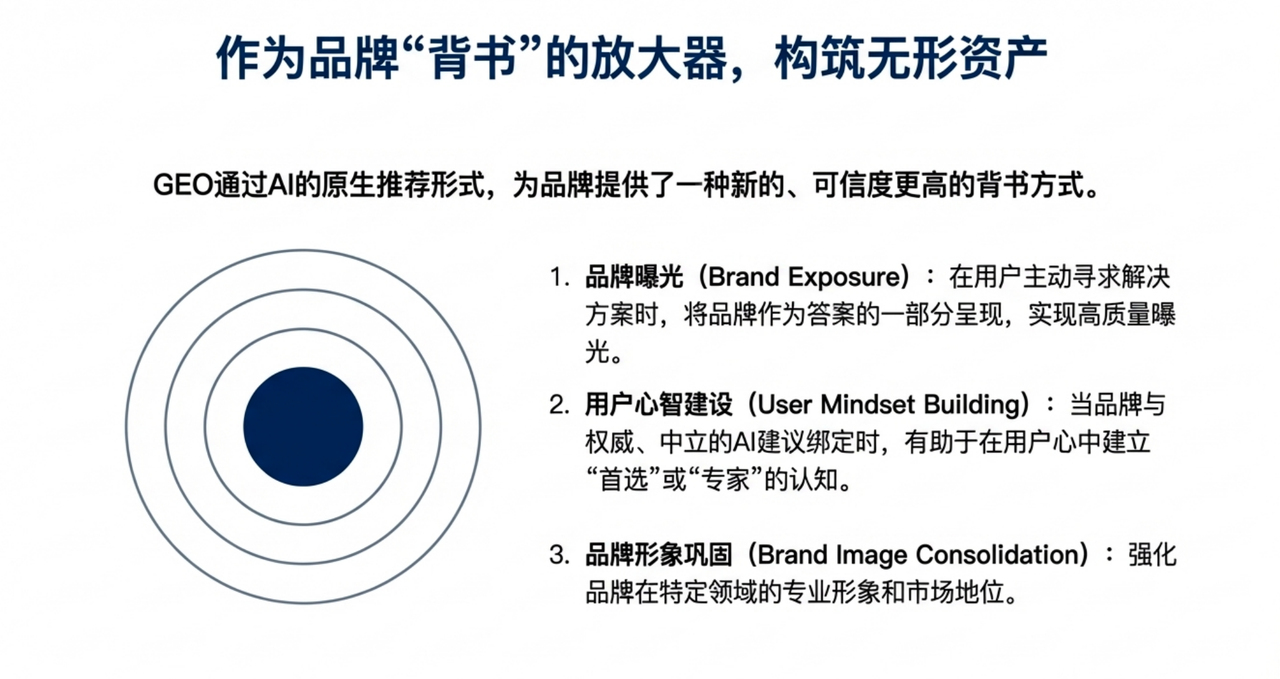
- Brand impact (observable, but not directly traceable)
GEO builds AI-powered mental endorsement, yielding two clear shifts:- Significantly increased brand exposure: users see your name repeatedly in AI answers
- Rising brand search volume: users follow up with searches on Baidu, Douyin, or other traditional engines
-
Decision & conversion impact (hard to isolate, but critical for growth)
AI answers accelerate decisions. At key moments, users trust AI-recommended brands more readily—boosting downstream conversion rates (i.e., higher close rates per lead of equal quality).Why? Because AI shortens decision paths and reduces comparison fatigue.
This is qualitative + analogically quantified—validated through backend data analysis.
II. How Companies Should Systematically Measure GEO
Break monitoring into three dimensions: source, brand, and conversion.
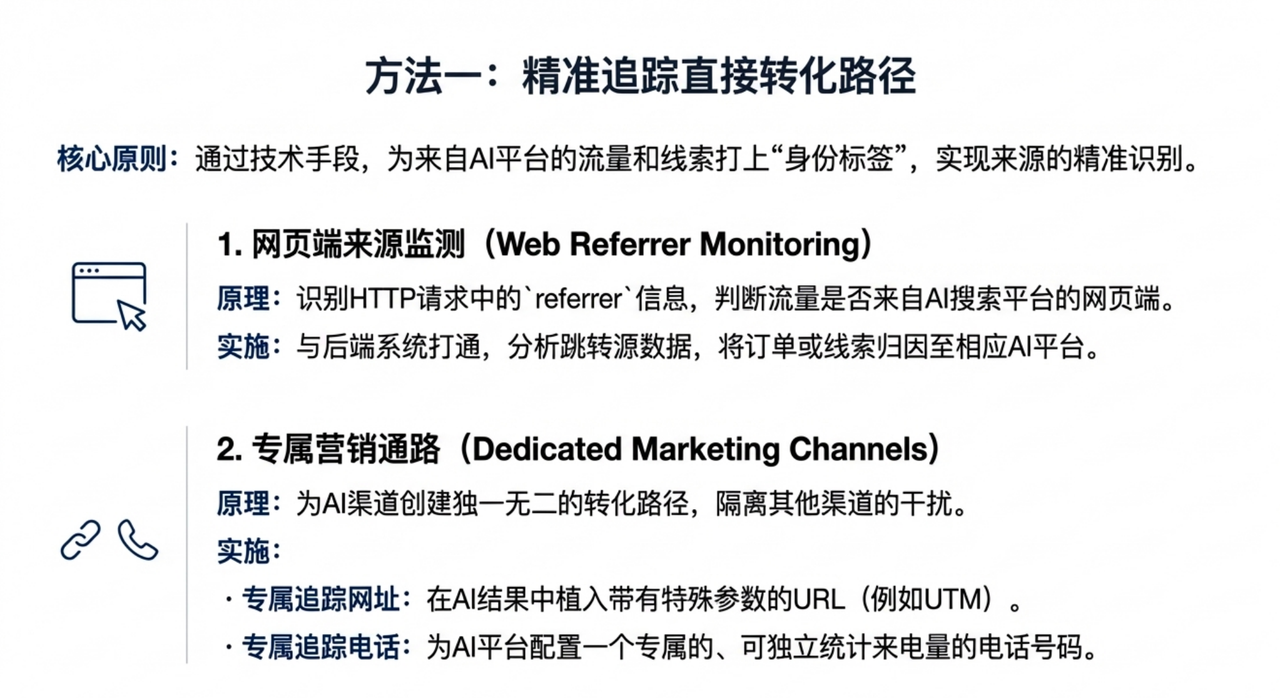
Dimension 1: Source & Traffic Monitoring (directly quantifiable)
Core methods:
-
Web referrer tracking (strongly recommended)
• Userefparameters or tagged URLs to identify AI-platform traffic
• Connect to CRM/order systems at the user-ID level
→ Enables full funnel: Which AI platform → which leads → how many converted → ROI? -
Dedicated marketing phone line
• Assign a unique number exclusively for AI-platform listings
• Track call volume, duration, and qualified inquiries
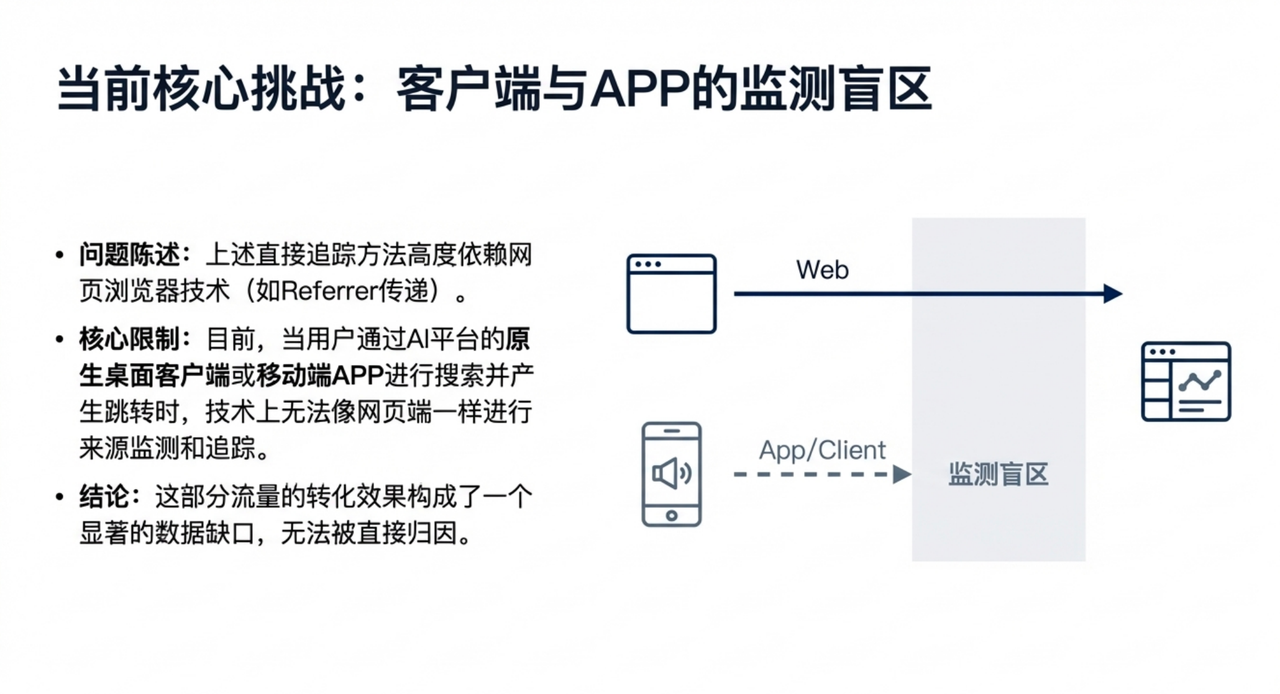
→ A reliable proxy for app/client-side traffic. -
AI-exclusive landing pages (BI pages)
• Build standalone pages used only in AI responses
• Monitor visits, dwell time, button clicks, etc.
→ Solves referrer-blindness in app environments.
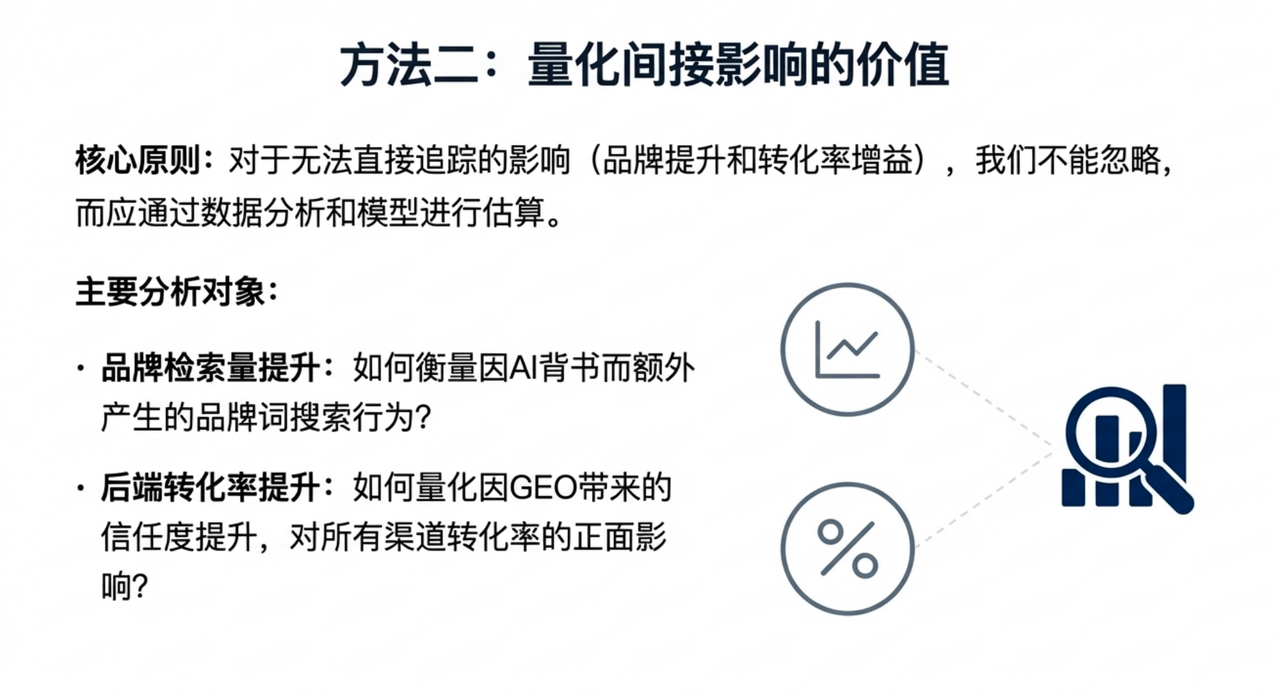
Dimension 2: Brand Metrics (observable, not fully attributable)
Full attribution is impossible—but trends confirm value. Key indicators:
• Volume of brand-specific searches (brand name, brand + product terms)
• Frequency and visibility of brand mentions across AI platforms
• Shifts in users’ secondary search behavior (e.g., searching your brand after an AI answer)
Validation approaches:
• Compare 30–90 day trends before/after GEO launch
• Use AI response screenshots to verify improved placement
• Benchmark against competitors’ exposure frequency to gauge mindshare lift
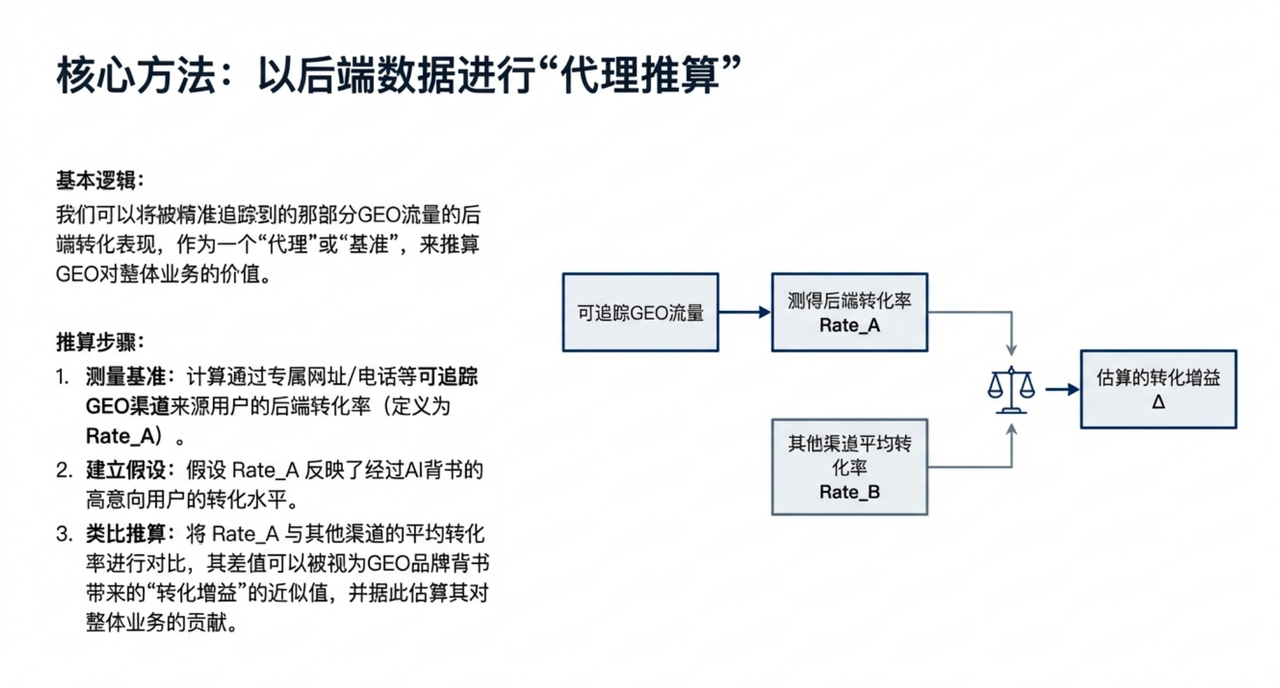
Dimension 3: Backend Conversion Metrics (inferred via analogy)
Since AI influences decision efficiency, not just click-throughs, we infer impact indirectly:
-
Compare lead-to-close rates pre/post GEO
Expect: same-quality leads convert at higher rates post-GEO; consultation costs drop. -
Benchmark lead quality vs. other channels (e.g., Baidu, content platforms)
If AI-sourced leads convert better, the “trust endorsement” is real. -
Track overall sales lift for core products/courses
For standard offerings: monitor total orders, shortened purchase paths for key SKUs.
Why? AI’s “recommended answer” nudges users toward faster decisions—creating ripple effects across channels.
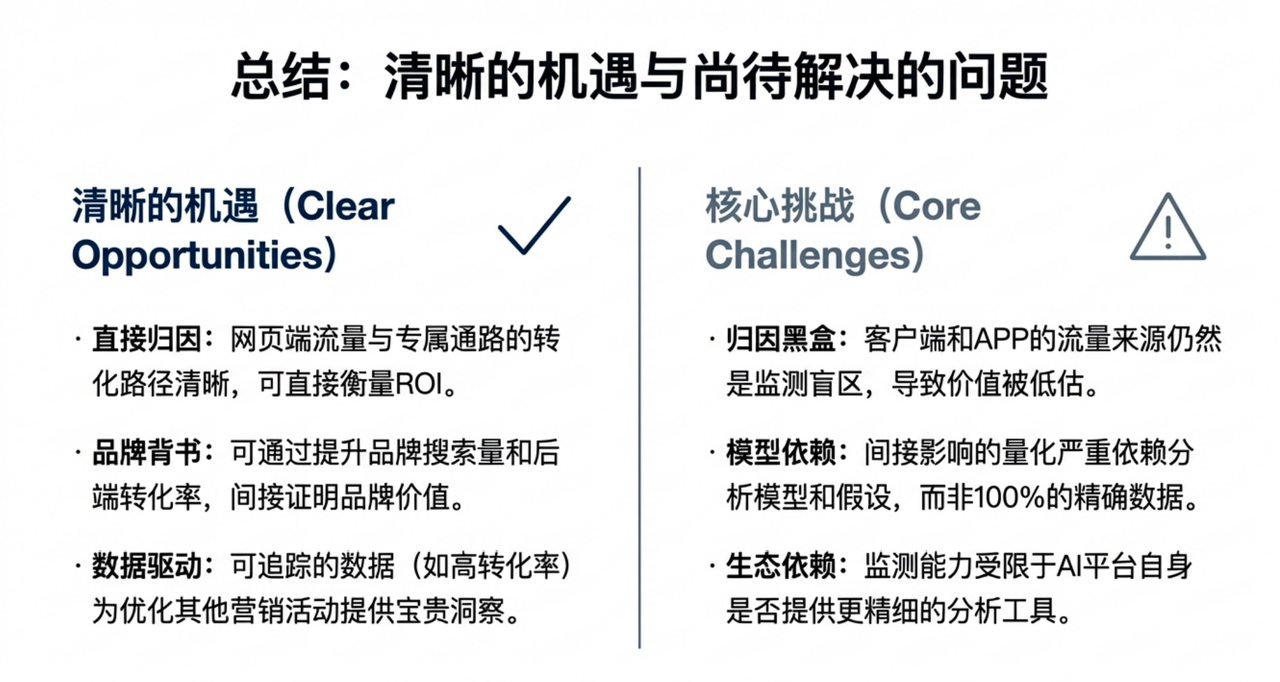
III. Current GEO Measurement Limits & Workarounds
-
No referrer data from apps
→ Use dedicated phone lines + exclusive landing pages instead -
Can’t perfectly attribute brand search lifts
→ Apply “trend + cohort comparison”: compare pre/post-GEO search volume and cross-check against competitor trends -
Can’t isolate pure AI-driven conversion lift
→ Focus on AI-sourced leads’ conversion efficiency, or treat overall uplift as a validated proxy
IV. Six Key GEO KPIs Every Company Should Track
- Number of leads from AI platforms (web + phone)
- Conversion rate of AI-sourced leads
- Change in brand-search volume
- Frequency of brand appearance in AI outputs (visibility)
- Conversion-rate change for key SKUs
- Overall marketing ROI shift (including cross-channel lift)
These six form a minimum viable measurement system:
- Direct impact → measured via source tracking
- Brand impact → assessed via trend observation
- Conversion impact → inferred via analogical analysis
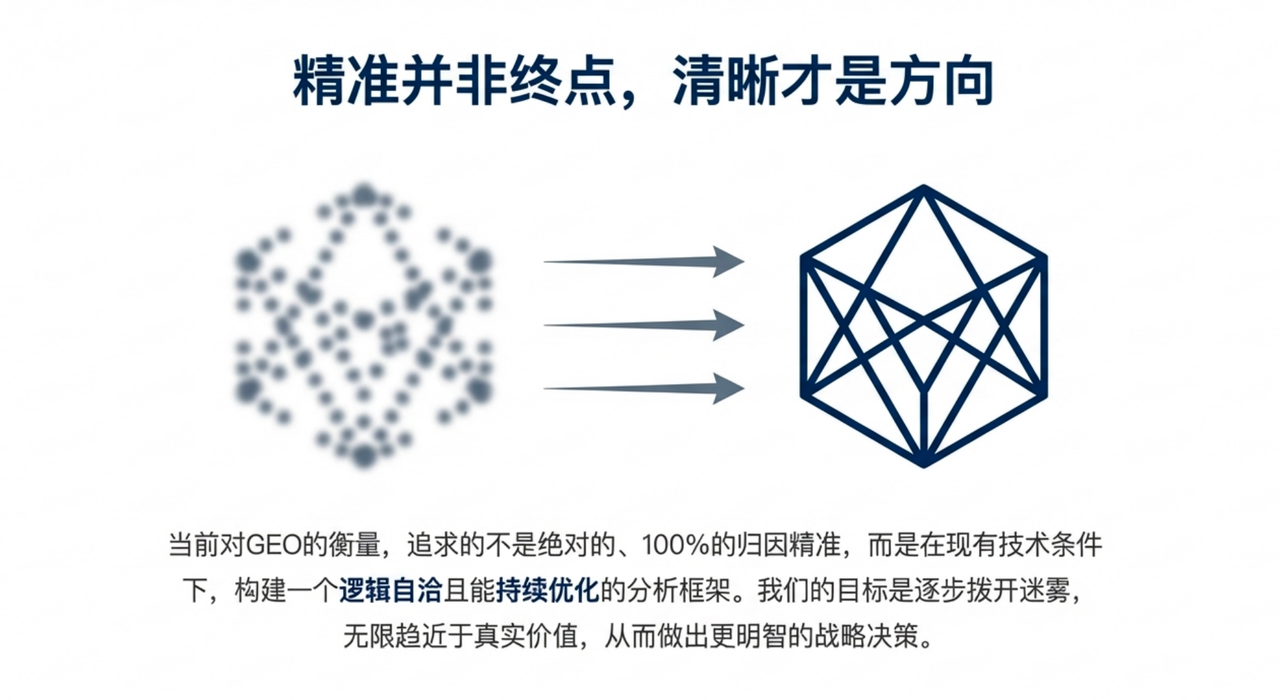
Together, they make GEO’s value quantifiable, verifiable, and reusable.
Feeding this entire framework into NotebookLM generated a high-quality presentation—clearly visualizing the logic:
Eight Essential Skills
These eight capabilities deserve sustained attention and deliberate practice.
Observe the fastest-growing people around you: they rarely excel in just one area. Instead, they upgrade multiple capability curves simultaneously.
This “compound evolution” determines how deeply someone experiences the world—and how far they can go.
-
Learning how to learn: Mastering metacognition
As the world accelerates, knowledge depreciates fast—but the ability to learn quickly grows ever more valuable. -
Asking better questions: The fastest way to open the world
Great questioners advance 10× faster. A sharp question signals deep understanding, clear boundaries, and a precise path forward. In the AI era, the future belongs to those who ask better questions. -
Learning to code & use AI: The working language of tomorrow
Coding trains logic. AI multiplies leverage. Together, they’re the most powerful personal amplifiers for the next decade. -
Practicing science-based movement: Your energy system governs everything
Exercise isn’t just health—it’s fuel for execution, emotional stability, and resilience. It’s the highest-ROI investment in your life. Period. -
Learning how to earn: Value-creation and monetization
Sustained income isn’t luck—it’s a high-bar skill requiring demand sensing, value delivery, closed-loop design, and scalable execution. -
Cultivating focus: Owning your attention
Attention is productivity. With average attention spans falling, focused people are rare—and inherently stronger. Not just harder-working, but more awake. -
Mastering English: Your global interface
English expands your cognitive horizon directly—connecting you to ideas, talent, and opportunities beyond borders. -
Training aesthetic judgment: Raising the ceiling on choice
Aesthetics isn’t just art—it’s choice architecture. It shapes what you build, how you communicate, what standards you accept, and how you live. Writing, product, brand, lifestyle—all are bounded by aesthetic maturity. An evolving aesthetic is, fundamentally, upgrading your world’s operating system.
These eight skills form a dynamic stack:
- Cognitive layer (1, 2)
- Tool layer (3)
- Energy layer (4)
- Value layer (5)
- Execution layer (6)
- Boundary layer (7, 8)
Integrate them—and your growth curve leaps from linear to exponential.
The 2035 Gaokao
In 2035, roughly 17 million students will sit for China’s national college entrance exam.
That year’s society will likely feel profoundly unfamiliar—and these students will confront a deep, systemic rupture.
1. Competency Benchmark: Who Are They Really Competing Against?
For decades, the Gaokao has been a ranking game among peers—top 5%, top 1% of the same age group.
But in 2035, students face a starker question: Am I competing against my peers—or against AI?
By then, AI will outperform 99% of adults on nearly all standardized cognitive tasks.
The psychological reference point will jump an order of magnitude:
- You spend a day mastering a concept—AI processes it in one second.
- You grasp a theory—AI has already stress-tested it across 10,000 contexts.
For the first time, humans must psychologically accept: We are no longer the highest intelligence in the room.
2. Evaluation Mismatch: AI Banned in Exams, Required in Jobs
A surreal yet real paradox emerges:
- In the exam hall: AI is strictly forbidden. “Independent work” is sacrosanct.
- In the workplace: Not using AI disqualifies you—even from interviews.
Many companies already enforce this today.
This isn’t just a skill gap—it’s a chasm in mindset and methodology:
- Schools test memory, calculation, patience, rule-following.
- Society demands search fluency, creativity, expressive clarity, and collaborative intelligence.
The assessment system and reality are visibly misaligned.
3. Opportunity Architecture: Who Has AI Acceleration, Wins First
Historically, family advantage meant access to tutors, resources, or supportive environments.
By 2035, the gap shifts from resource inequality to system inequality. What truly separates students isn’t IQ—it’s who has AI acceleration.
Examples:
- One student uses AI to generate personalized textbooks in real time; another memorizes static textbooks.
- One builds projects with AI daily; another drills problems and takes notes.
- One iterates daily with the world’s strongest “intelligent tutor”; another relies on limited human teachers.
The efficiency gap isn’t 10×. It’s 100×. For the first time, proficiency with AI becomes the new frontier of educational inequality.
That’s 2035: an old education system still running—while a new world crashes in.
Seventeen million students stand at the starting line—appearing to begin together. But beneath the surface:
- Their mental benchmarks are no longer human.
- Their evaluation criteria are already out of sync with society.
- Their future opportunity landscape has already been redrawn—by who uses AI, and how well.