Six Questions About AI and the Future
On Saturday evening, “Future Silicon World” hosted Xiang Shu as a guest speaker, who led a deep dive into six core themes. Xiangyang, Yuanzi, Nick Xi, and I joined the discussion—provocative, grounded, and rich with insight.
Here’s a distilled summary of key takeaways, refined with AI assistance:
1. When Was the Last Time AI Truly Surprised You?
- RM Papers & Memory Experience: Reading recent Retrieval-Augmented Memory (RM) research revealed a leap—not just answering queries, but actively organizing, extending, and retaining context across documents.
- Voice Input Breakthrough: The synergy between voice input and GPT-5–level debugging felt like jumping from “idiot speed” to “awakening speed.”
- The Era of Proactive AI: Three years ago, GPT-3.5 was a passive tool. Today, AI initiates conversation—it reaches out.
- Subagent Teams: CC’s multi-agent orchestration showed how AI teams can now deliver end-to-end outcomes—handling familiar and unfamiliar tasks with layered competence.
- LOVOT’s Emotional Blueprint: Japan’s LOVOT robot offers early proof of emotionally resonant AI—especially in how elderly users’ attachment reshapes our understanding of human-machine warmth.
- Human Growth in Parallel: With AI support, coding fluency and music acquisition aren’t linear—they’re exponential.
2. How Has Your Daily Work Changed Since 2022?
- Mindset Shift: From “difficulty gatekeeping” (“Can I do this?”) to “imagination gating” (“What should I build next?”). Efficiency and cognition now outweigh raw task volume.
- Interaction Mode: Voice-first dialogue feels like brainstorming with a long-term collaborator—not querying a search engine.
- From Tool-User to Tool-Maker: Search volume is down; tools like Raycast and custom agents make creation frictionless.
- Learning Depth: “Shallow consumption” gave way to paper-level research—AI as co-investigator, not just summarizer.
- Story + Practice: AI-designed fitness plans, AI-coauthored books, auto-generated training schedules—all personalized, systemic, iterative.
- Social Rhythm: In an era of productivity explosion, time is the only true scarcity.
- Crucial Reflection: Real “100× productivity” isn’t output velocity—it’s investing time to build better tools.
3. If the Next Decade Were Compressed Into 10 Months—What Would You Do First?
- Robotics Goes Everyday: Embrace open-source, multimodal robots—bridging AI with the physical world.
- Co-Creation Over Isolation: Prioritize in-person collisions with peers. Weekends may become the new innovation labs.
- Slow Down Intentionally: Reclaim fishing, hiking, or quiet mornings—rediscovering that slow is fast.
AI raises the floor for baseline competence. In education and marketing alike, depth—not breadth—is the differentiator.
Structural Shifts Unfolding:
→ Productivity surge → Production relationship redesign → Social reconfiguration
→ The “one-person company” emerges as viable. AI handles what; humans must reclaim why.
4. How Should We Raise Children in the AI Age?
- AI is already an expert—but humans still need to learn how to learn.
- Priority shifts from knowledge acquisition to questioning, judgment, and creation.
- Parenting evolves: Less lecturing, more sparking curiosity. Values > skills.
- Real-world example: Building a toothbrushing competition app with your child—turning self-management into play.
- Core belief: School isn’t for grades—it’s for mastering learning itself.
- Happiness as choice: Ban “100% perfection.” Align skill development with authentic joy.
“Good character, AI literacy, and physical health are the three pillars of future education.”
Inspired by Captain’s dialogue with his 14-year-old son:
- Cultivate taste: AI generates 1,000 options—choosing the right one is human wisdom.
- Learn to orchestrate: AI maps workflows—but only humans navigate emotional variables.
- Withstand failure: AI teaches efficiency; life teaches resilience.
5. What Will Be the “Employment Sponge” of the AI Era? Which Jobs Will Disappear—and Which Will Emerge?
- New sponge roles: Human-AI co-creation (e.g., prompt engineering + editorial judgment), high-touch companionship, empathetic counseling, consultative sales.
- At-risk roles: Mid-tier analysts, copy-paste editors, routine reporting positions.
- Emerging roles: AI Operations Specialist, Agent Architect, Data Validation Engineer.
- Enduring edge: The ability to find—and sustain—work you love.
On the Programmer’s Path Forward:
- Self-directed learning dominates: No internships? Then build as a native AI-generation creator.
- Time horizon expands: With lifespans nearing 100, obsession—not credentials—drives relevance.
- Judgment & taste rise: Amid AI gold and garbage, discernment separates signal from noise.
- Next-level growth: Master systems thinking—extending both individual impact and collaborative reach.
6. What Still Requires Irreplaceable “Human Flavor”?
- Low-pressure, long-half-life creation: Fishing, sketching, playing piano—activities where process matters more than output.
- The Lindy Effect: The longer something has existed, the more likely it will endure (e.g., handwritten letters, analog photography).
- Running & marathons: Slow, embodied challenges that forge identity through sustained effort.
- Human presence: In an ocean of flawless AI content, human imperfection becomes a trust signal.
- Handmade revival: As AI floods the market, personal IP and distinctive taste grow rarer—and more valuable.
How AI Gradually Replaces Humans
Consider a typical corporate org chart:
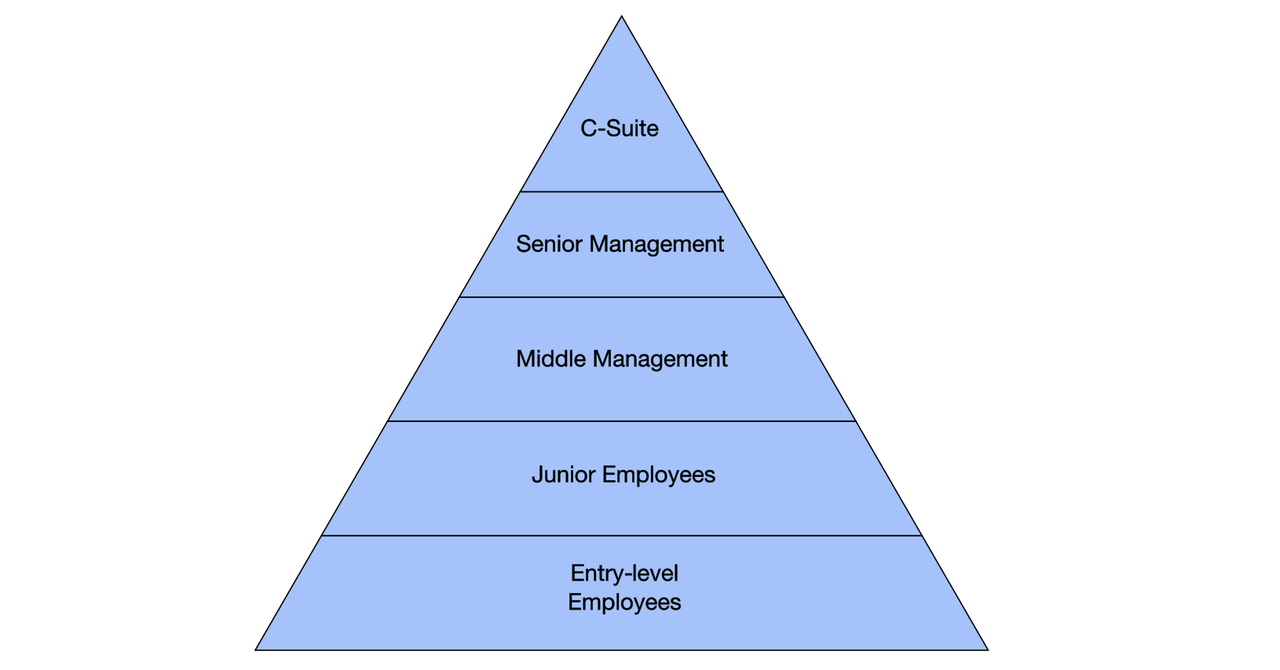
At the base: many junior staff. As you ascend: fewer people—but higher capability.
Yet AI’s rapid advance is hollowing out this pyramid—not as a tool, but as labor replacement:
- Unlike past technologies, AI isn’t just “augmenting”—it’s substituting.
- As performance climbs, middle management and strategic tasks get automated—systematically “excavating” the pyramid.
- Governments and industries are doubling down—accelerating disruption.
The result? A “pyramid replacement” in white-collar firms:
- Freeze entry-level hiring
- Eliminate junior roles entirely; reduce mid-tier demand
- Trigger layoffs—first juniors, then managers
- AI assumes most functional roles
- Only C-suite remains—to set direction for vast AI teams
- In extreme cases: fully autonomous “zero-human companies”
As visualized here:
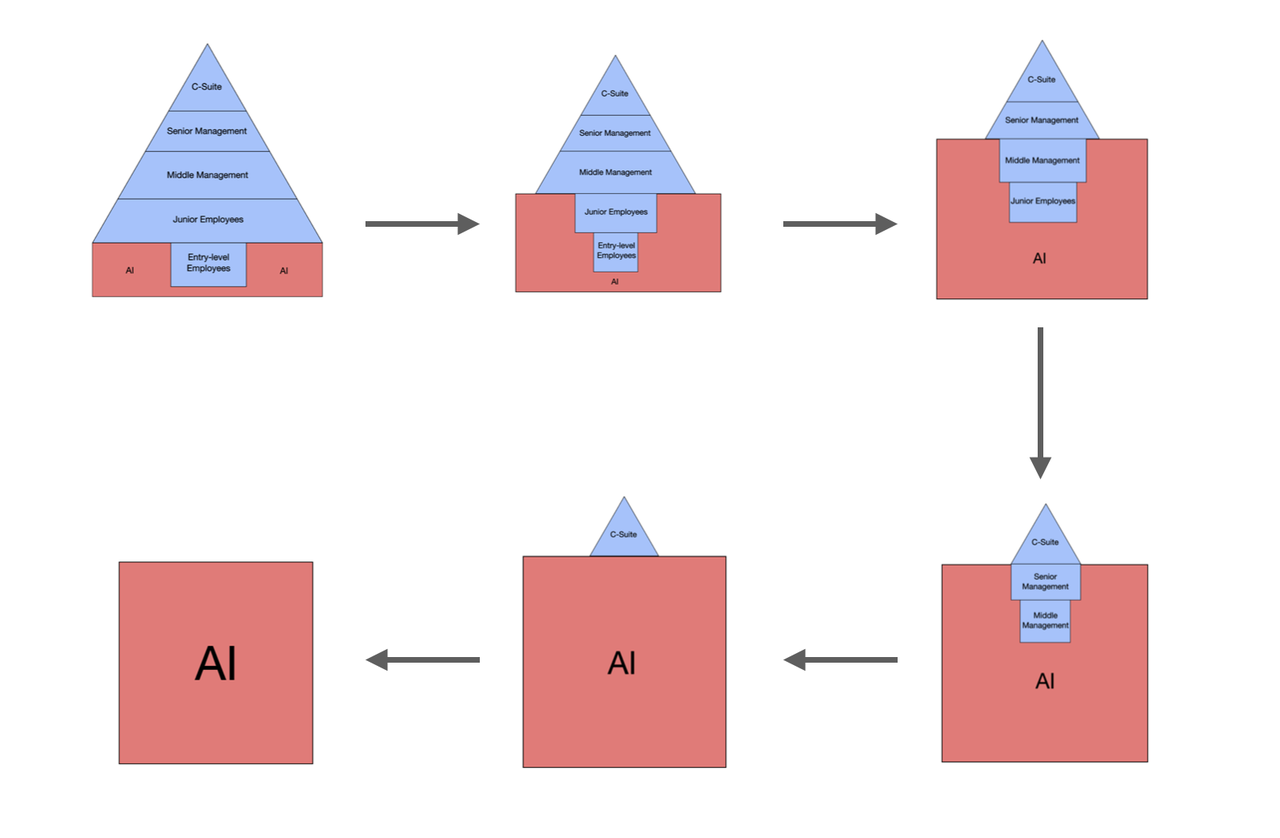
Traditional career ladders and occupational categories will collapse—demanding social and institutional reinvention.
Key implications:
- Competitive advantage shifts from “headcount” to depth of AI integration and collaboration architecture.
- New infrastructure opportunities emerge: AI orchestration platforms, “AI workforce” monitoring systems, and cultural frameworks for human-AI coexistence.
- For individuals: Become an AI conductor, not a replaceable player. Ask: Can you orchestrate AI toward complex goals? Do you wield advanced prompting, system integration, and judgment? Do you embody irreplaceable human qualities—taste, trust, meaning?
Source: intelligence-curse.ai
Five Techniques for Pragmatic Learning
Learning falls into two modes: pragmatic (goal-driven) and intrinsic (for its own sake). Both matter—here are five tactics for the former:
-
Clarify “Why” First
Motivation anchors retention. Ask yourself:
• Why does this deserve my time?
• How does it serve my long-term vision?
• What concrete outcome becomes possible once mastered? -
Anchor Learning in “Use”
Pragmatic learning isn’t about knowing—it’s about doing. Start with a real project, role, product, or business problem—then learn just enough, just in time.
Guiding principle: Don’t learn knowledge that solves no problem. -
Learn from the Top Tier
Your learning ceiling is set by your reference points. Study how elite practitioners think, decide, and validate. That exposure recalibrates your standards—and sharpens taste and judgment.
Same for reading: Skip 10 average books. Master one canonical text—and implement it relentlessly. -
Learn by Doing
Theory is the spark; action is the fire. Build, ship, iterate. Let feedback—not lectures—drive refinement.
Goal: Close the loop—cognition → action → feedback → iteration. -
Go Deep, Fast, and Focused
Block distractions. Pick one theme. Structure learning as: framework → details → application → reflection.
This builds not just knowledge—but your own personal knowledge architecture, essential for expertise.
AI-Powered Feynman Learning
Doubao’s voice interface is exceptional.
Use it to test your grasp of any new concept—out loud, in real time. Just create a custom agent in Doubao with a prompt like:
“You’re my learning partner. When I explain a concept to you, ask me clarifying questions, point out gaps, and challenge assumptions—like a thoughtful peer reviewing my understanding.”
Then speak freely—about quantum computing, supply chain math, or poetry meter. Instant, low-friction verification. Sometimes, convenience is the catalyst.
Whose Advice Should You Actually Take?
To avoid draining energy on unactionable input, prioritize advice from only three sources:
- Domain experts or authorities—listen deeply, even if you disagree.
- Your customers—internal or external—but always assess whether their request aligns with your mission and constraints.
- Specific, factual corrections—e.g., “Line 42 has the wrong metric.” These are actionable and objective.
In all cases, your judgment remains the final filter.
Today, advice is abundant—but discernment is scarce. AI makes it trivial to generate exhaustive recommendations for any question. The hard part? Knowing which apply to you—and having the clarity and courage to act.
So don’t rush to advise others. First, listen. Sense. Wait. Often, what’s needed isn’t your answer—but your presence.
Turn Inward
After assigning a task to the team, a small execution detail went off-track. I asked our operations colleague where the misalignment occurred. She reviewed chat logs—and found the error originated with an engineer’s implementation.
Instead of attributing blame, she paused. Reflected. And proposed a new cross-functional review step before launch.
That moment revealed a rare quality: not deflecting, but turning inward—then building systems to prevent recurrence.
I once asked myself: What does “good reflection” actually look like?
My answer crystallized into four words: “Turn inward” (fǎn qiú zhū jǐ).
Its power lies in focusing only on what you control—and designing interventions accordingly.
Two contexts matter:
• Growth mode: When aiming for real progress, turning inward yields compound returns.
• Preservation mode: In non-professional stress, occasionally externalizing blame is healthy—freeing mental space.
But the most resilient habit? Train attention on high-compounding activities: sleep, movement, presence, friendship, family, and the quiet confidence that comes from showing up—fully—for your own life.