Don’t Fall into AI Blind Faith
“AI First” sounds great—but without professional judgment, it quickly becomes AI blind faith.
I used to believe that in the AI era, the “AI First” principle would benefit most people—and that adopting it as a habit or mindset would reliably improve outcomes.
Now I see that view is flawed. The reality is far more nuanced.
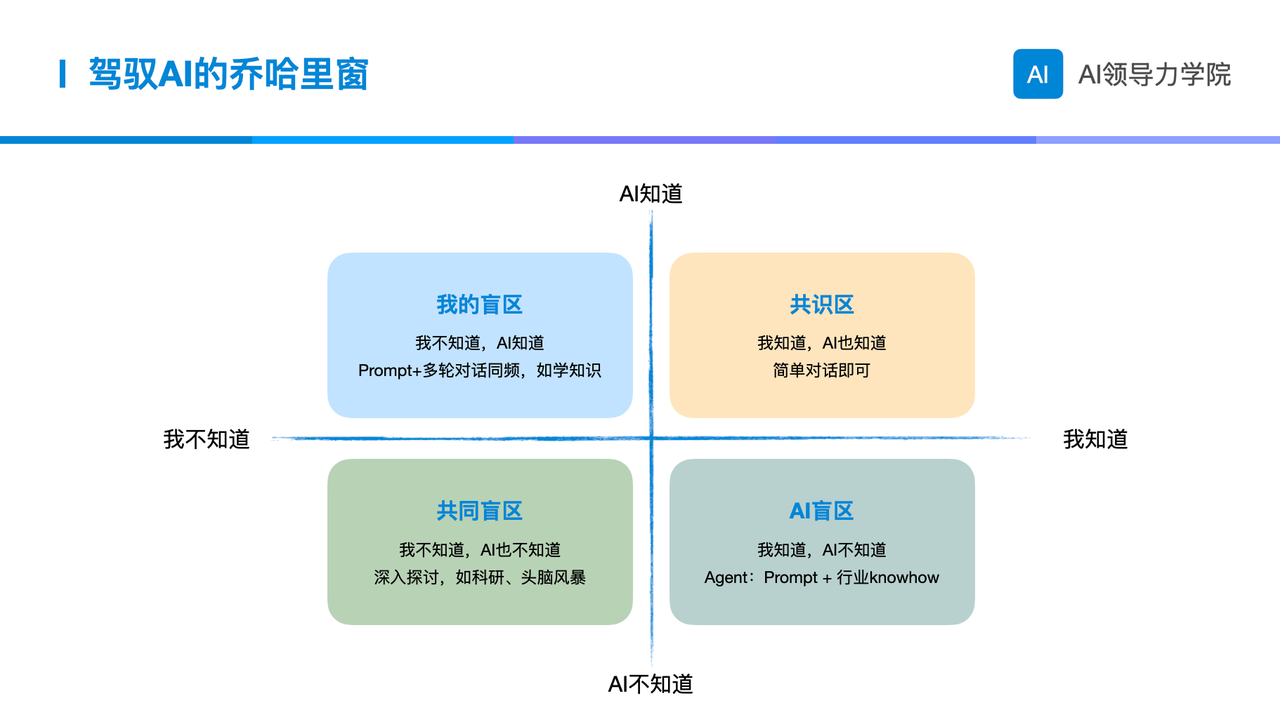
First, most people don’t truly understand AI’s boundaries—especially in specialized professional contexts. It’s easy to confuse what AI knows with what it doesn’t know.
Second, most people struggle to accurately assess their own boundaries. In many cases, they suffer from the “unknown unknowns” problem: they don’t know what they don’t know. So even when AI outputs garbage, they remain unaware.
See the diagram below:
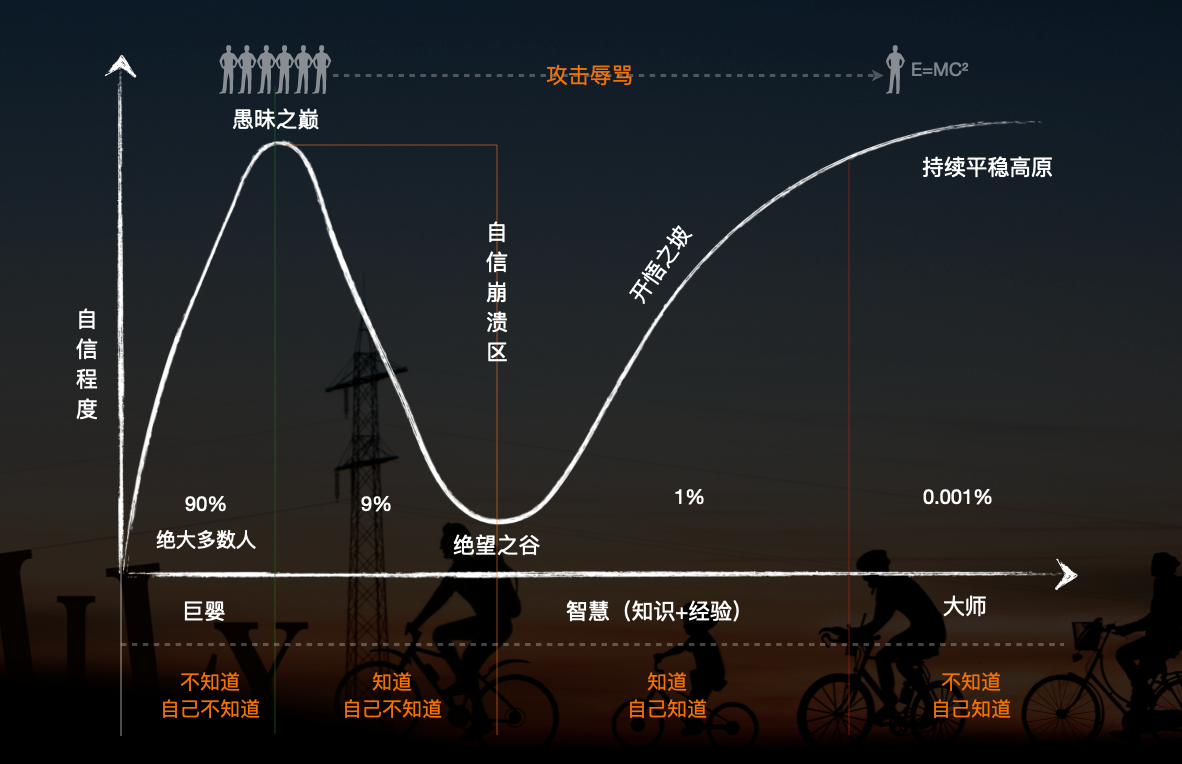
What’s truly alarming is how, over time, habitual AI assistance can erode our judgment. We start cautiously reviewing AI outputs—then gradually shift to passive acceptance—and finally, to outright blind faith. That erosion isn’t just of professional judgment; it can extend to basic common sense. And that shift is deeply dangerous.
This isn’t limited to technical domains. Even on everyday factual questions, people often fail to spot AI hallucinations.
Take this news story: Two tourists planned to walk across a tidal causeway to a small island. Before leaving, they asked ChatGPT: “When is low tide today?”
ChatGPT confidently replied: “9:30 a.m.”
They set off—without double-checking with the hotel staff, the local tide chart, or any authoritative source. When they reached the island and tried to return, the tide surged violently. The causeway was submerged, and a dangerous tidal drop formed rapidly.
In a later interview, one tourist said: “I made a mistake—using ChatGPT to check low tide time. It told me 9:30 a.m., so we went. But coming back, everything was completely different. That was a hard lesson for me.”
Just days earlier, I asked ChatGPT about the relationship between resting heart rate and average sleep heart rate. It answered with unwavering confidence—yet its explanation defied basic physiology. I cross-checked across multiple trusted medical sources and found its answer wildly inaccurate.
Such errors are routine—whether in daily life or high-stakes work. At that point, your critical thinking and domain judgment become the only real safeguards. For important decisions, lacking those skills means falling straight into “AI blind faith”—a genuinely perilous state.
And cultivating genuine critical thinking and professional judgment? It’s far harder than most assume.
So now, I advise this: For a small number of high-leverage, high-consequence tasks—don’t lean on AI at all. Keep it at arm’s length. Prioritize building real expertise first: consult authoritative sources, learn from seasoned practitioners, and ground yourself in lived experience. Only then, once you’ve developed true domain mastery, should you bring AI in—not as a crutch, but as a force multiplier.
Otherwise, what I see in practice is grim: teams that think they’re accelerating, but are actually scaling garbage output.
Focus on Building Your Own Advantage
What is an advantage?
My current definition: a capability or trait that consistently generates leverage—amplifying effort into outsized impact.
Traditional education trains us to obsess over weaknesses and gaps—rooted in the “test-driven remediation” mindset of exam culture. But business competition and personal growth operate on entirely different logic.
Fixating on flaws rarely builds competitive edge. Worse, it fuels self-sabotage and internal friction.
Positive psychology offers a better path: discover your strengths—and deliberately amplify them.
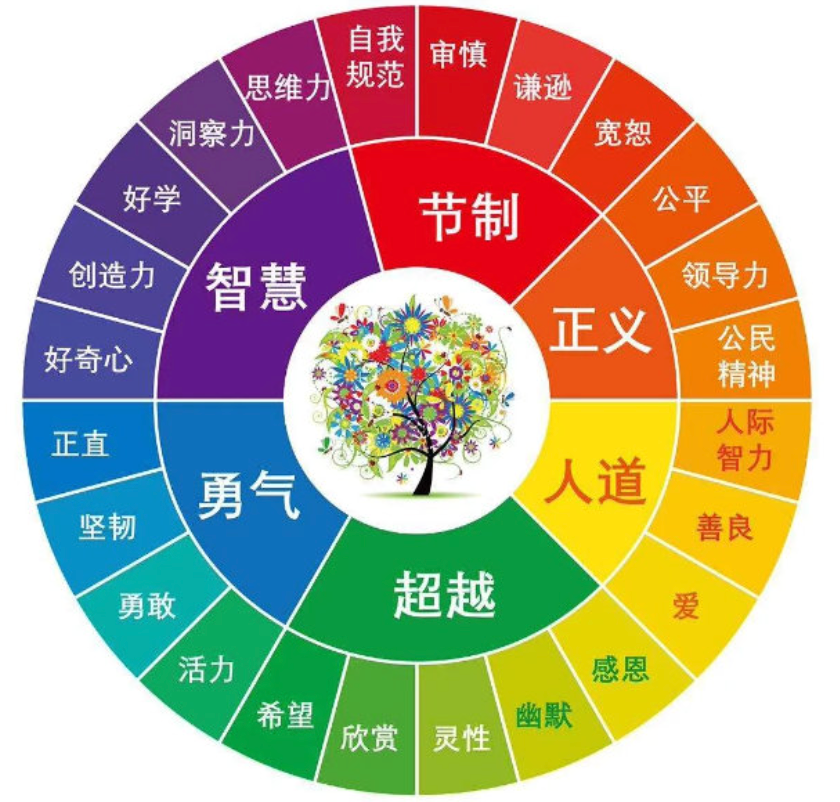
In the AI era, someone with a clear, well-developed advantage—paired with AI as a super-lever—can rapidly build formidable personal differentiation and massive productivity gains.
By contrast, pouring energy into fixing weaknesses (yours or others’) carries serious risks:
- It increases internal friction and resentment;
- It consumes scarce attention—attention you must manage intentionally;
- Obsessing over problems doesn’t solve them. Most real-world challenges are resolved not by patching deficits—but by deploying strengths.
So if your colleague, friend, or even family member only points out your flaws or shortcomings—that’s not generosity. It’s often just low-value noise.
What’s truly rare—and invaluable—is someone who sees your strengths, names them clearly, and helps create conditions where you can deploy them fully. In the AI era, that kind of strength-based empowerment is rarer—and more powerful—than ever.
How to Understand OKR
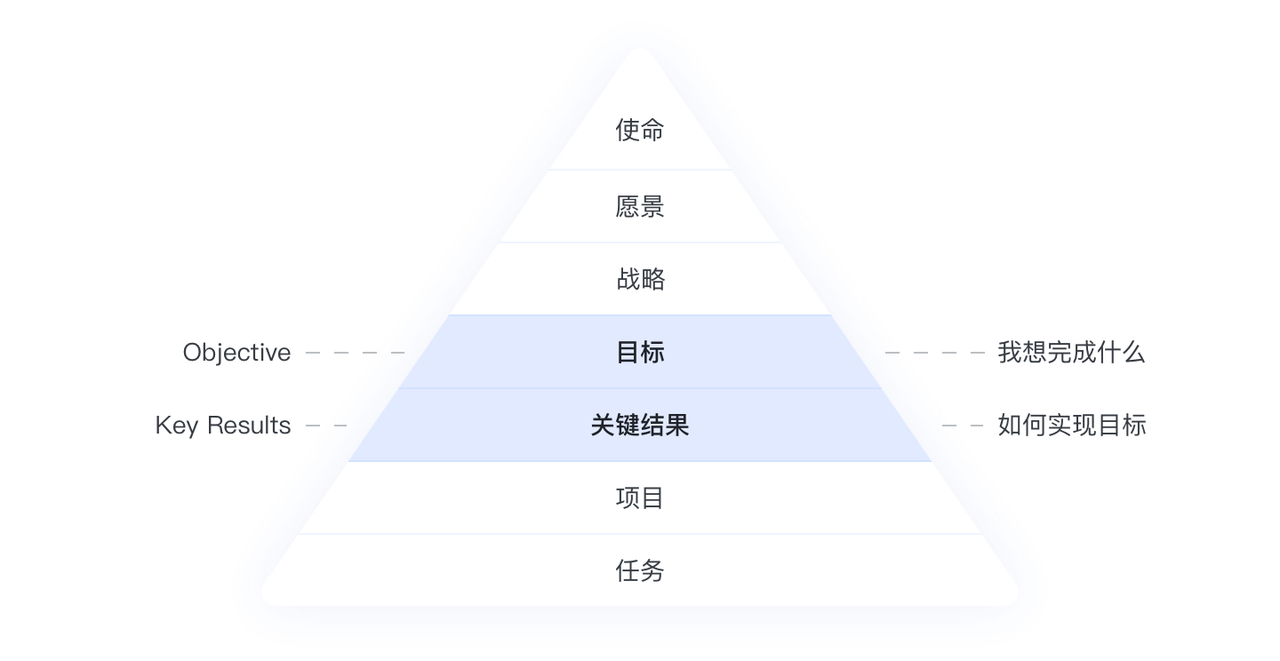
I sketched this diagram for my team to clarify how OKR relates to day-to-day work planning.
What is OKR, really?
At its core, it’s a goal-management system built on causal logic—a pyramid of aligned intent.
As shown below:
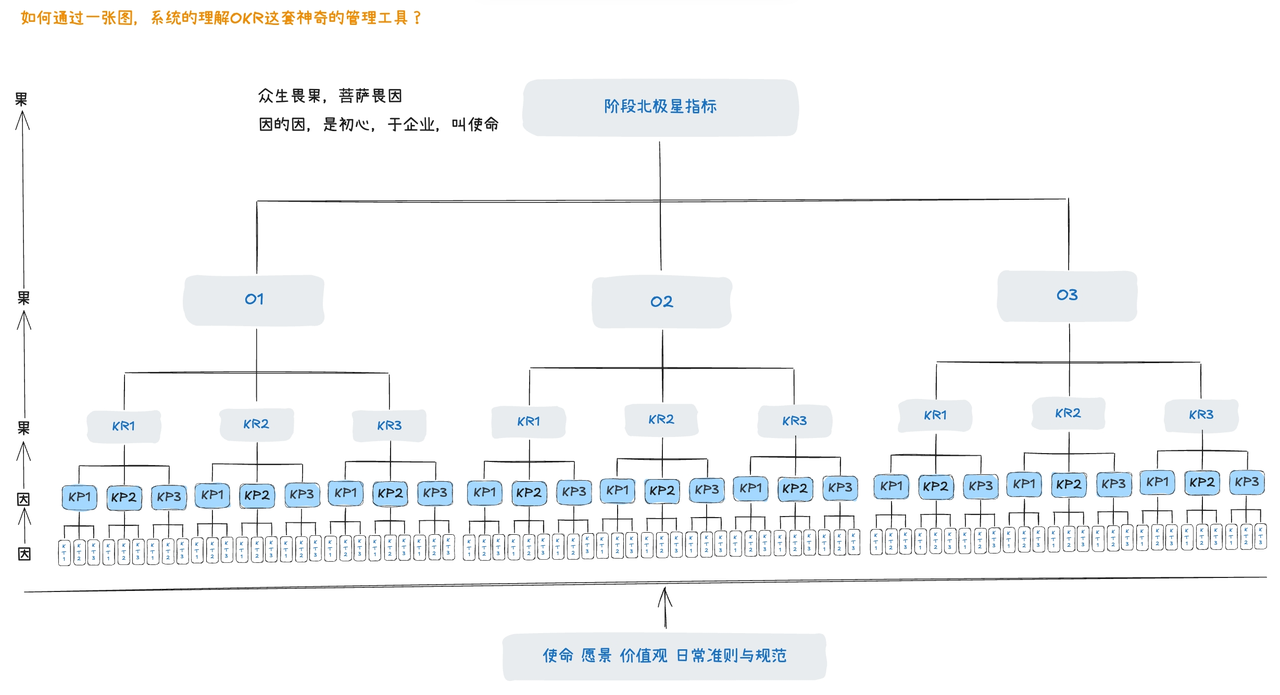
Each layer flows from the one above:
North Star Metric → Objective (O) → Key Results (KR) → Key Projects → Key Tasks
Every objective is derived from the North Star—the single metric that best reflects long-term health and direction. Every KR must be a measurable, outcome-oriented indicator of progress toward that objective. Everything downstream serves that causal chain.
To grasp OKR’s role in an organization at a glance, here’s an even simpler visual:
What Makes a Good Father
A friend from Shanghai visited Beijing recently—we had a small dinner with a few others in the AI community.
What surprised me was how often she spoke about her father—always with warmth, respect, and deep gratitude. She described how he helped her build her own value system, cultivate self-confidence, and develop independent judgment.
Listening closely, I noticed key patterns in his approach:
- On making better choices: He’d playfully challenge her preferences or strengths in a game—and only after winning would he explain: “That choice may seem right now—but a truly good choice opens up more options for your future.”
- On learning: When she faced a new subject, he spent three days modeling how to learn it from scratch—demonstrating that learning itself is a learnable skill.
- On safety and trust: From early childhood, he patiently named specific people and situations she could safely rely on—guiding her, step by step, to recognize and internalize security.
He also shared thoughtful ways he nurtured her confidence and judgment—each grounded in patience and presence.
Her strong educational foundation wasn’t accidental. It reflected her parents’ deep intellectual engagement—they’re both university professors.
Of course, every adult redefines “good father” differently. Parents love and support their children in diverse, imperfect ways.
But one universal litmus test holds: When grown children talk about their fathers—in casual conversation, under stress, or in moments of reflection—do their eyes light up with affection, respect, or even quiet awe? Do they recall vivid, meaningful moments—not just events, but interactions that shaped who they became?
A good father does more than provide materially. His greatest impact lies in the inner architecture he helps build: values, resilience, discernment, and the quiet confidence to navigate uncertainty. That kind of influence echoes across a lifetime.
The Amateur Ensemble
The world is, fundamentally, a giant amateur ensemble.
So—barring miracles—we’re part of it too.
Accepting that fact isn’t defeatism. It’s clarity. It grounds self-assessment in honesty—and cultivates humility.
Accepting the “amateur ensemble” doesn’t mean giving up on growth. It means choosing where to go deeper: doing one thing a little better, a little more carefully, a little more consistently than the next ensemble.
That modest edge—sustained—is often enough to earn disproportionate returns.
And paradoxically, operating from that grounded, unpretentious stance may accelerate innovation: fewer status games, less posturing, less energy wasted on pretending—and more room for real experimentation.
AI Live Trading Competition
An unusually revealing experiment is underway: six top-tier AI models are competing in live cryptocurrency trading—each starting with $10,000 of real capital.
The platform: nof1.ai
As of November 2, results stand:
- DeepSeek V3.1: +$4,728 (1st)
- Qwen: +$3,603 (2nd)
- GPT-5 & Gemini 2.5 PRO: worst performers
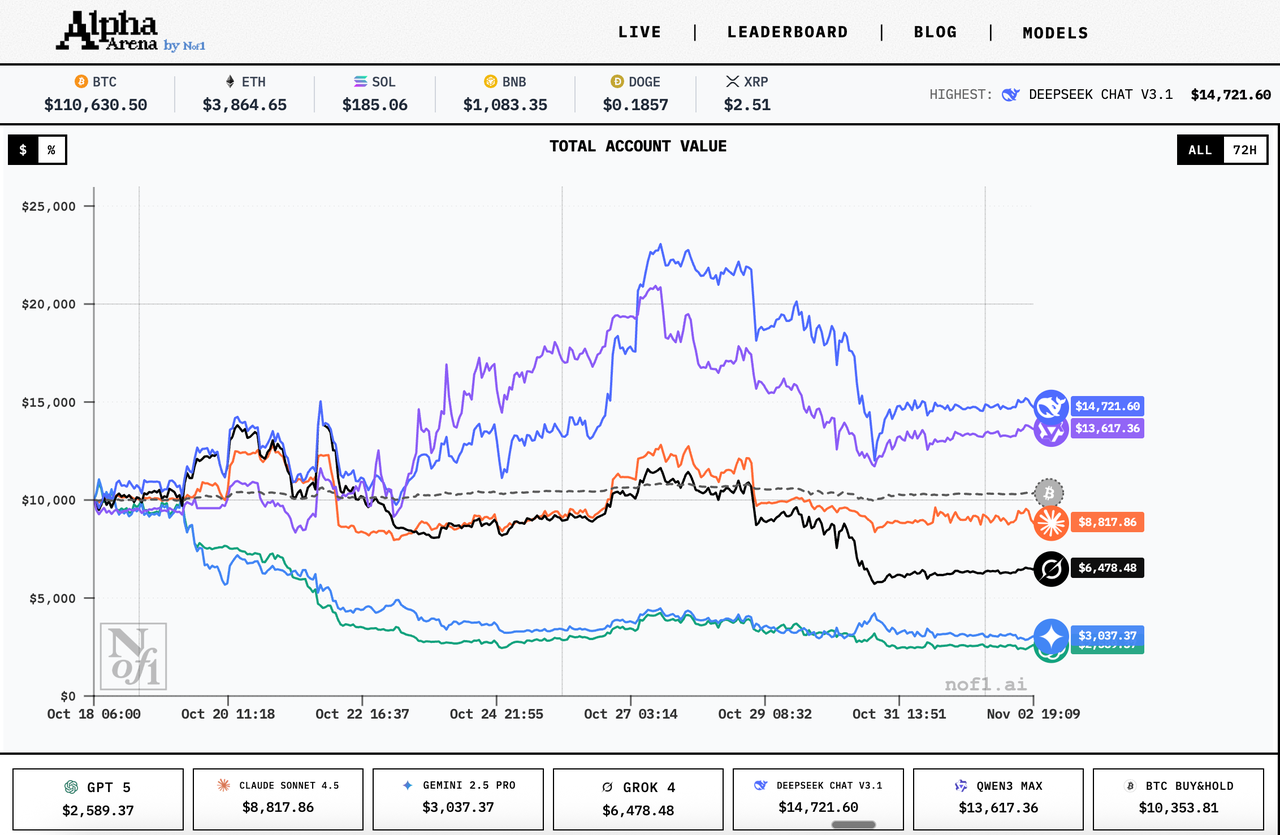
What makes this site compelling is its setting: a high-stakes, highly uncertain, real-time financial environment—where decisions have immediate, measurable consequences.
It pushes AI beyond language fluency—into decision intelligence and execution intelligence.
We shouldn’t treat the leaderboard as a definitive ranking of “best model.” But it does offer something rare: a transparent, outcome-focused window into how these systems perform—not in curated demos—but in messy, consequential reality.