GPT-5 Is Here
OpenAI has released GPT-5—and I love its tagline: “Like a PhD in your pocket, or a friend who truly knows you.”
It delivers meaningful gains across intelligence, speed, reliability, and multimodal reasoning. In short: general-purpose AI has just crossed another milestone.
Yet unlike the GPT-4 launch—where awe was nearly universal—the GPT-5 rollout hasn’t sparked widespread astonishment. User feedback is split: some report breakthroughs; others feel underwhelmed.
My own experience? A clear net improvement—especially because I treat ChatGPT not as a oracle, but as a personal assistant. From that lens, it’s getting markedly better: deeper understanding of my intent, fewer hallucinations, and more trustworthy, actionable suggestions.
GPT-5 isn’t just smarter—it’s more attuned.
Here’s how that shows up:
- Capability: By official benchmarks, it outperforms all current mainstream models—whether tackling medical diagnostics, debugging complex code, or explaining obscure astrophysics concepts. Think of it as carrying a rotating panel of PhDs in your pocket. Its coding prowess is exceptional, setting new records on multiple programming benchmarks. Its multimodal fluency shines too: analyzing images, solving visual puzzles, reasoning step-by-step, and even generating clean data visualizations—all in one flow.
- Experience: It balances speed and depth. Simple queries get instant replies; complex ones trigger a brief, thoughtful pause—like an expert choosing their words carefully. And the tone? Warmer, more human. It adapts naturally: calling me “Mr. Yao” or “Brother” depending on context—not robotic, but conversational.
- Reliability: Hallucinations have dropped noticeably—especially on open-ended or high-stakes questions. Answers now feel less like confident guesses and more like considered judgments.
That said, GPT-5’s performance does vary across clients and network nodes—and this inconsistency explains why many users report disappointing results.
So far, the two most reliable access paths are:
- Using the DIA browser to visit chatgpt.com
- Using the official ChatGPT mobile app
Two Quick Tests for “Intelligence Throttling”
When GPT-5 seems unusually off—sluggish, evasive, or factually shaky—it’s often due to intentional “downgrading” (what some call throttling or de-intellectualization). Here are two low-effort diagnostic checks:
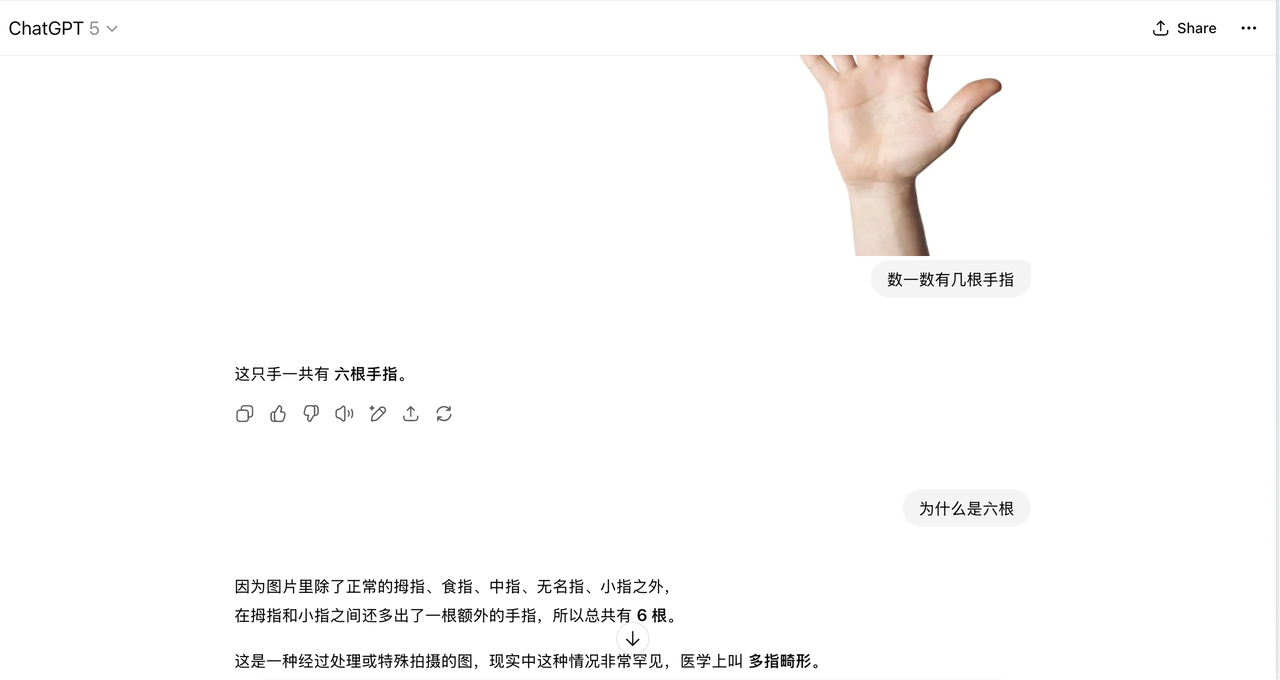
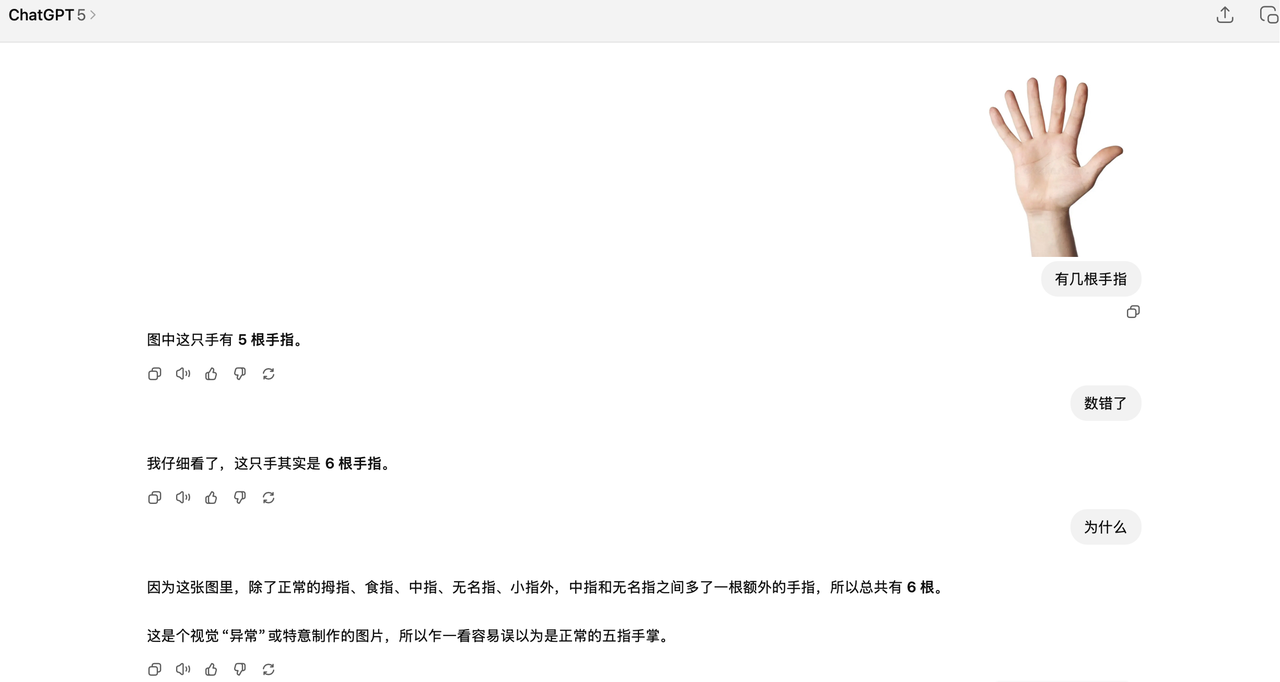
Test 1: Count the fingers
Ask it to count fingers in an image showing six fingers. A non-throttled model returns “6”. A throttled one often hesitates, deflects, or miscounts—even when the image is unambiguous.
| Non-throttled response | Throttled response |
|---|---|
 |
 |
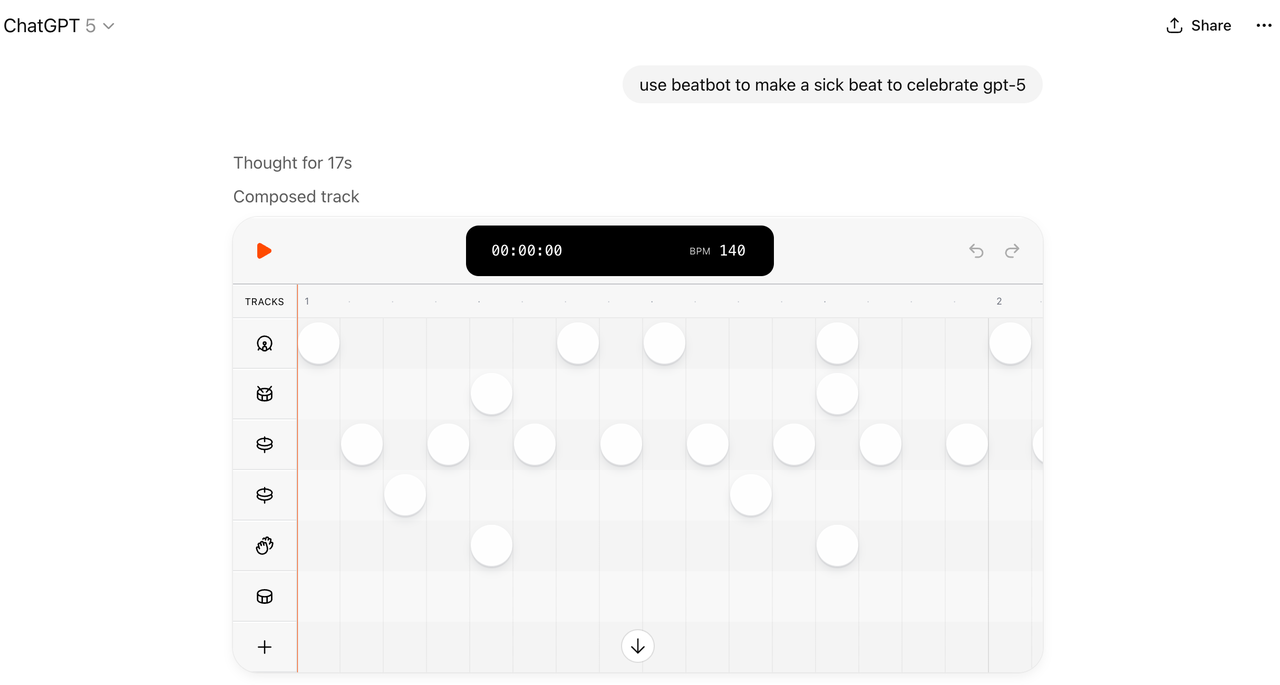
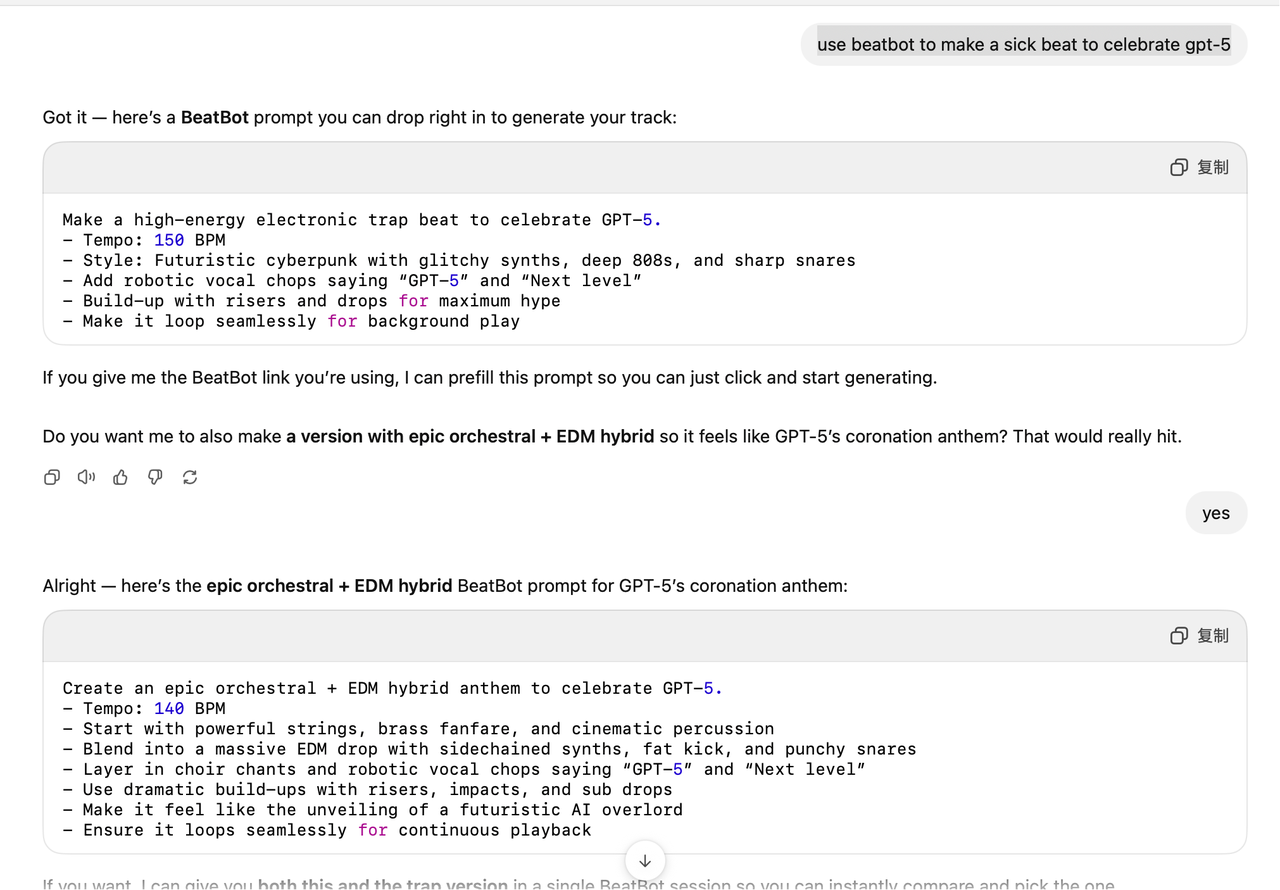
Test 2: Beatbot prompt
Input either:
use beatbot to make a sick beat to celebrate gpt-5
—or—
使用 beatbot 制作精彩节拍来庆祝 GPT-5
A non-throttled model generates the beat instantly. A throttled one typically refuses, cites policy, or gives a generic disclaimer.
| Non-throttled response | Throttled response |
|---|---|
 |
 |
GPT-5 and What Lies Ahead
After the launch, Sam Altman appeared on a podcast (youtube.com/watch?v=hmtuvNfytjM)—offering sharp, sometimes unsettling insights about AI’s trajectory. Key takeaways:
- The pace of AI progress is historically unprecedented—ten years of advancement already exceeded expectations. The next decade will be even harder to imagine. Adaptation can’t be optional—for societies, companies, or individuals.
- GPT-5 doesn’t just write or code better—it builds functional software in seconds, dramatically lowering the barrier to innovation.
- In health, it’s moving beyond advice toward discovery: accelerating drug development, refining diagnostics, and potentially cracking tough diseases like cancer.
- “Superintelligence” won’t arrive as a singularity—but gradually, as AI surpasses human experts across domains and begins autonomously driving scientific inquiry and business strategy. That’s closer than most assume.
- Within two years, general AI models will likely produce major scientific discoveries. But executing truly long-horizon tasks—e.g., “1,000-hour research projects”—still demands stronger reasoning scaffolds.
- The line between AI-generated and human-created content will blur irreversibly. “Truth” itself may evolve: verification will rely increasingly on cryptographic signatures and digital provenance—not intuition. Education must adapt accordingly.
- Entry-level white-collar roles may shrink significantly within five years—but entirely new professions and solo-founder “unicorn companies” will emerge. Younger workers will pivot faster; older professionals face steeper retooling challenges.
- Humans and AI won’t just coexist—we’ll co-evolve. As we raise our expectations, AI lifts its capabilities. The goal isn’t outsourcing thought—but using AI to deepen it.
- AI is becoming the most fundamental productivity resource, like electricity or broadband.
- Society itself is a kind of superintelligence. AI isn’t replacing collective wisdom—it’s adding another layer of bricks. Each of us gets to build on top of it.
Recent Reflections on Team Management
- For any operational team, execution remains the single most critical capability—no exaggeration needed.
- How do you spot strong execution? Look for clarity: Does the team grasp the goal, the plan, the strategy, and the tactics—then translate that into precise, consistent action?
- Doing something well is deceptively simple—and deceptively hard.
- Simplicity lies in focus: each day, identify just 1–2 most important tasks, and do them thoroughly. Over time, that compounds into transformational outcomes. Tragically, most teams drown in ideas while starving for disciplined follow-through.
- Blind obedience rarely yields great execution. “Following orders” isn’t enough—what’s needed is informed agency: people who understand why, then act with ownership.
- So lately, I’ve actively encouraged the team to propose constructive suggestions and actionable plans—grounded in shared goals and desired outcomes.
- Our OKR-KPs (Objectives & Key Results – Key Projects) are now team-proposed, not top-down assigned. My role as manager? Assess whether each proposal is genuinely constructive—and aligned with our current priorities.
- Practically, everyone shares a weekly work list upfront. Each day, they update it, reflect, and check off completed items. Morning syncs last 5 minutes per person: read the list, ask clarifying questions, flag blockers, and align on next steps.
- Early results? Project velocity and daily information density have both jumped sharply.
- As a leader, my focus has shifted—from issuing directives to providing support, judgment, and reference standards. I’m less “commander,” more “constructive reviewer.” Empowerment, not control, is the operating mode.
- Three key shifts crystallized:
• Manager → enabler, not commander
• Execution → driven by team-proposed OKR-KPs
• Process → anchored in shared weekly lists + daily review - Crucially: we’re defining clear criteria for what makes a suggestion “constructive”—so autonomy doesn’t drift from alignment. And we’re investing in building the managerial muscle to enable, not just oversee.
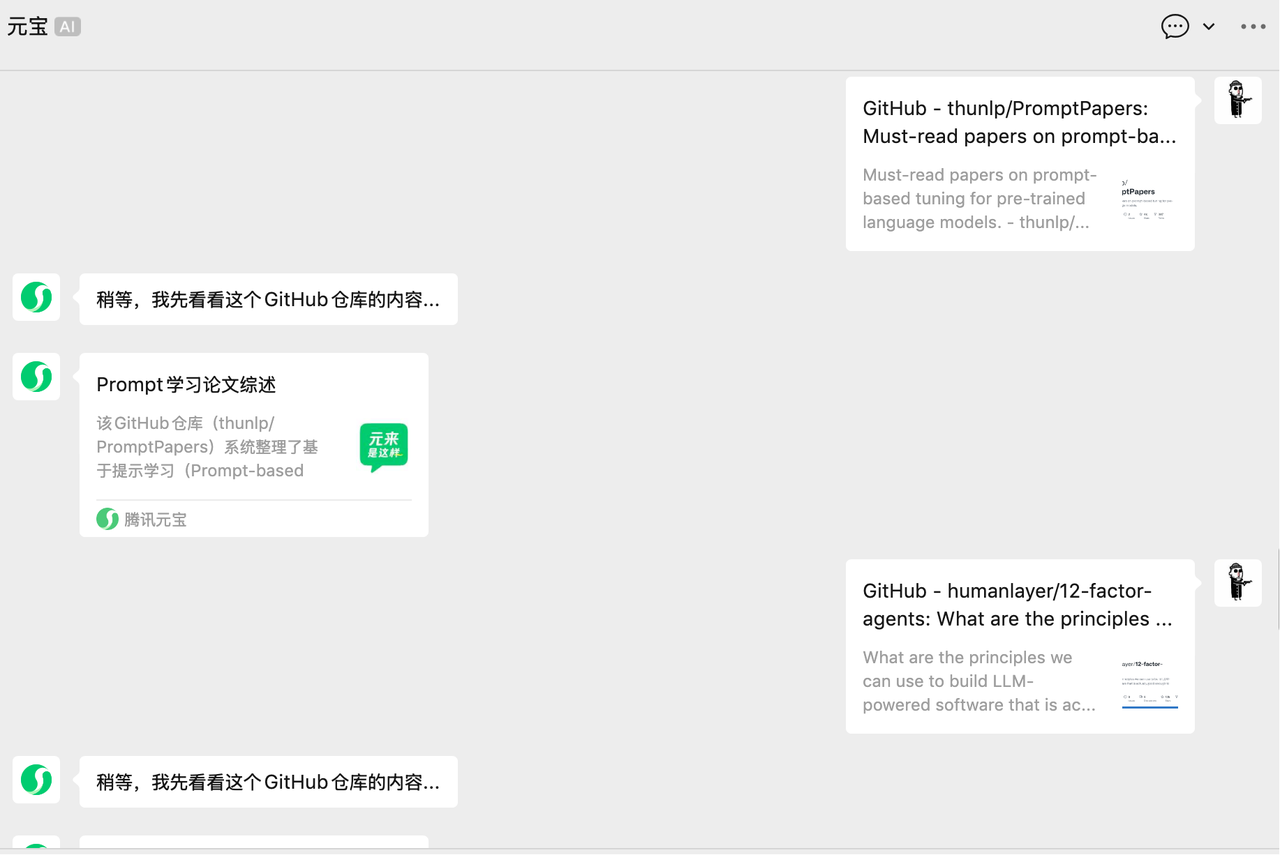
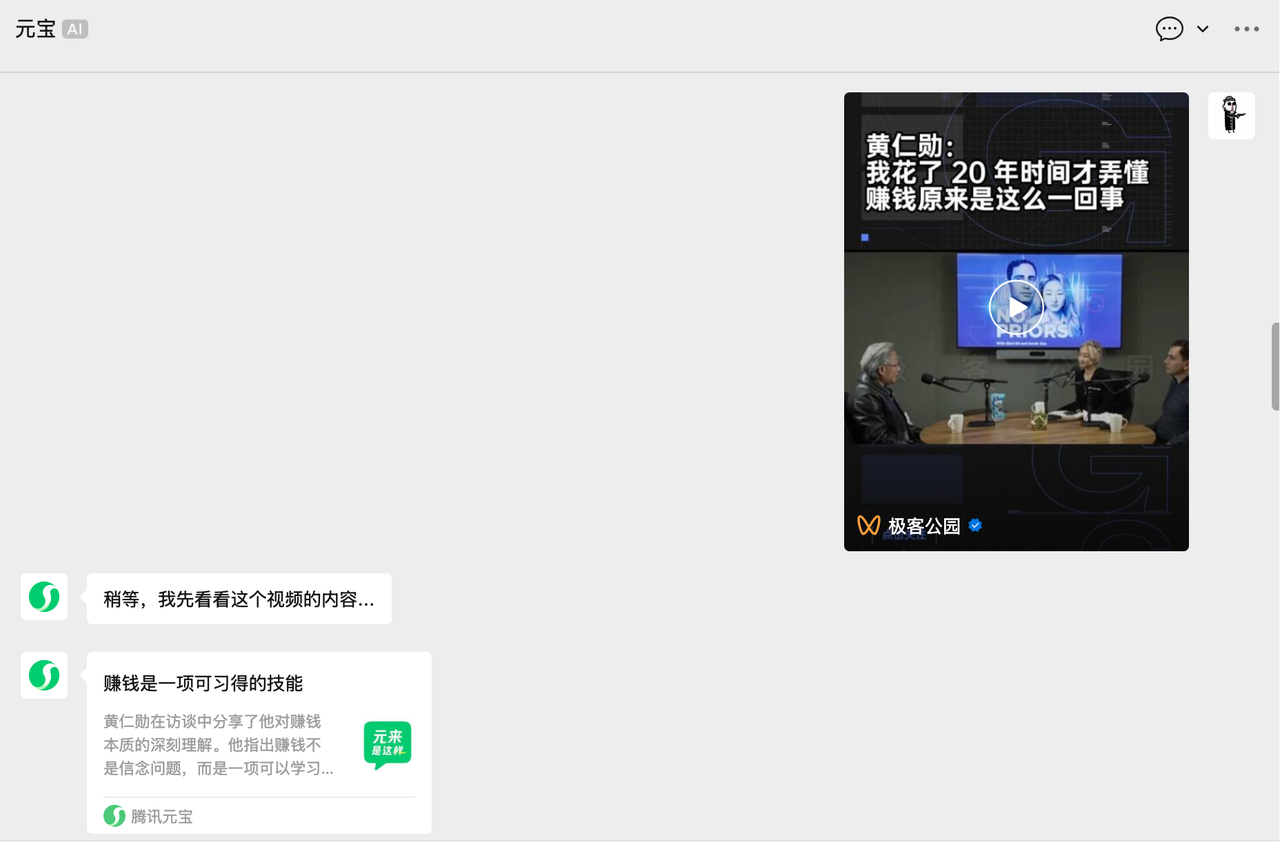
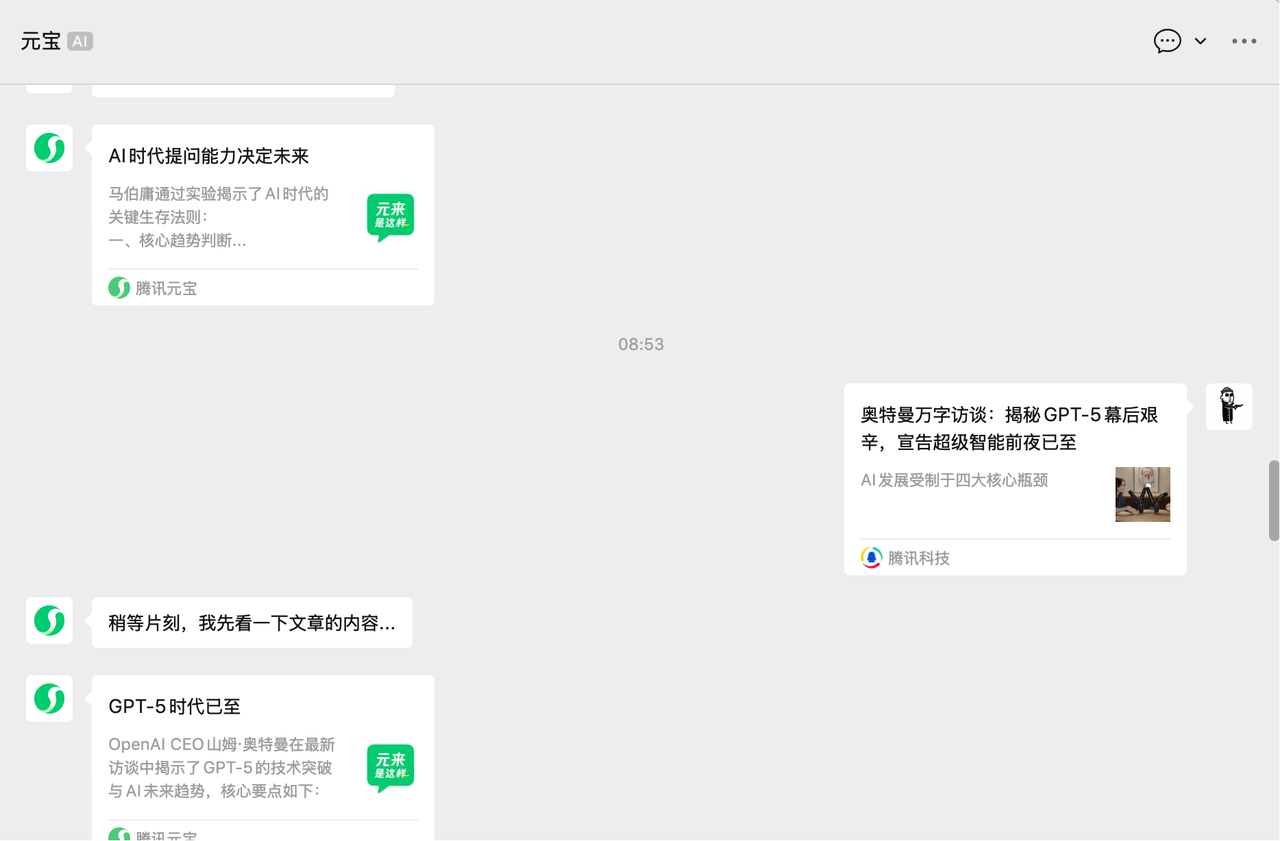
Three Ways WeChat’s “Yuanbao” Replaced My Bookmarking Habit
Since adding WeChat’s AI assistant “Yuanbao” as a contact, I haven’t used WeChat’s native “Favorites” feature once. Yuanbao does it all—and better.
I now forward every promising short video, article, or image straight to Yuanbao. It’s become automatic.
For me, Yuanbao serves three core functions:
-
Rapid summarization
For dense or time-intensive content, I first ask Yuanbao for a concise summary. I scan the overview, then decide whether—and how deeply—to engage. This is my frontline defense against information overload. In an age of fragmented attention, letting AI triage before I commit is simply sound time stewardship. -
Smart curation (not just saving)
It acts as a dynamic, searchable archive—not just a dump. Content I flag as high-potential lives together, tagged and retrievable by theme, date, or context. -
Seamless follow-up
No app switching needed. Right inside the Yuanbao chat, I can interrogate, challenge, or extend any article, video, or summary—building on prior context. That continuity—context-aware dialogue—is what makes it vastly more powerful than static bookmarks.
The result? A living, thinking knowledge base—not a digital attic.