Recent AI Insights
Trend Level:
- AI is reshaping how we work: You won’t be replaced by AI—but you will be replaced by people who use AI effectively.
For example, when a company’s growth stalls, departments often first cut staff who lack AI fluency—not those who merely lack experience.
-
AI is ushering in a new internet era: AI-native experiences, where intelligence is the default interface—context-aware and increasingly personalized.
-
AI adoption works best as a “top-down” initiative—ideally led by the CEO.
Companies achieving strong AI results share one trait: their CEOs personally test, champion, and master AI tools. Traditional internet firms—especially those with mature business scenarios—stand to gain significant short-term advantages.
I asked a friend why established customer service firms haven’t launched standout AI-powered support products.
He replied: “The technical barrier is low, and costs aren’t prohibitive—the real bottleneck is AI illiteracy among leadership.”
With large language models now accessible, building an in-house AI customer support system is straightforward. But that only happens when the CEO understands AI—and acts on it.
Strategic Level:
-
Think small, focus deep: Identifying narrow, high-impact use cases is a critical strategic skill.
Don’t try to overhaul everything at once. Start simple—e.g., let AI handle 80% of routine customer queries. Validate results, then expand incrementally. Most other scenarios follow the same logic. -
Adopting “AI-first” thinking is the prerequisite for true human-AI collaboration.
Traditional mindset: “Let machines do what humans can’t.”
AI-first mindset: “Default to AI doing the work—humans refine and supervise.”
I’m still adjusting to this shift—but once internalized, the efficiency gains are unmistakable. -
Anchor your efforts in what doesn’t change.
User needs remain constant; only the ways we fulfill them evolve. For individuals, this means picking one small, recurring pain point—say, drafting weekly reports—and solving it so well (90%+ quality) that the underlying pattern becomes reusable across challenges.
Execution Level:
-
An “AI employee” isn’t magic—it’s the fusion of prompt engineering + domain expertise + data discipline.
Embed this triad into automated workflows tailored to your business context. -
Build a tiny daily habit: Spend 15 minutes talking with AI. Follow the cycle: Ask → Try → Reflect.
Pick one concrete, low-stakes task—e.g., summarizing meeting notes, drafting client replies, cleaning spreadsheets. Don’t dismiss it as “too small.” Master it thoroughly. Aim for AI to deliver 90%+ of the value—consistently.
Capability Level:
-
Treat questioning as a hard skill—one worth deliberate practice.
Garbage in = garbage out.
Many users blame AI for poor results—but the real issue is often how they ask. Just as keyword search literacy separated information haves from have-nots in the PC web era, prompt literacy now defines AI effectiveness. -
Prompt engineering is the core skill for cultivating AI thinking and real-world deployment.
Start by reverse-engineering strong prompts: study their structure, logic, and constraints. Then adapt them rigorously to your own context—not just copy-paste.
Commercial-Grade Prompts
Commercial-grade prompts are significantly more complex than casual ones.
Some ask: “Why go to such lengths? Isn’t simpler better?”
“I wrote just three lines—and got the same output!”
But this overlooks foundational principles—especially safety, consistency, and reliability, which matter far more in business than in personal use.
Industrial manufacturing doesn’t celebrate “making a product”—it demands every unit meet strict specs. Similarly, AI outputs must be predictable and compliant—across thousands of instances.
One misfire in 100 responses may seem trivial—until it triggers regulatory scrutiny, reputational damage, or legal liability.
I know of a case where an AI-generated article mentioned a senior political figure—no negative content, yet the author was summoned for questioning and forced to delete it. That was lucky. Had the AI hallucinated something damaging? The fallout would’ve been catastrophic.
Another early AI education platform published content flagged as inappropriate—sparking widespread backlash and trust erosion.
In enterprise settings, AI adoption is fundamentally a risk-reward calculus. Personal experimentation tolerates error; business use demands precision, guardrails, and accountability.
AI’s Tangible Contributions
Over lunch with two friends, one shared how he’d embedded AI across his business over the past year—with measurable outcomes.
When I asked how he quantifies AI’s value, he said:
“Conservatively, AI contributes 20–30% to our $10M annual revenue—roughly $2–3M. Roles shrank; others became dramatically more productive.”
That’s the economic lens.
Later, during a live stream, viewers added another dimension: organizational health.
Imagine a 100-person team downsized by AI—not just in headcount, but in management overhead, coordination friction, and cognitive load. Remaining members report higher engagement, clearer priorities, and stronger alignment. That intangible uplift matters deeply.
For traditional internet companies—especially those with proven business models—CEO-level AI awareness and hands-on sponsorship unlocks outsized near-term advantage.
The Hype Cycle Curve
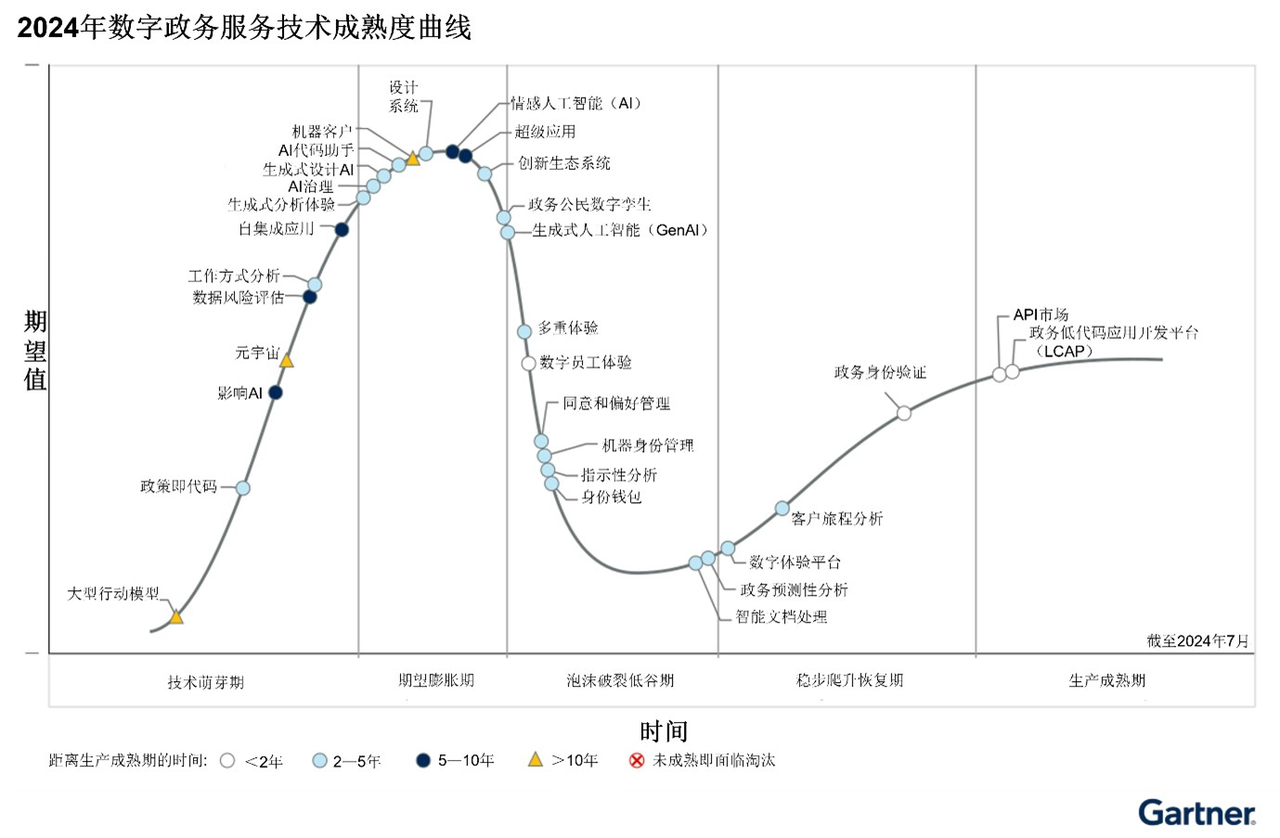
The Hype Cycle, developed by Gartner, maps how emerging technologies rise, crash, and stabilize in public perception and market expectations.
As shown above, it unfolds in five phases:
- Technology Trigger
- Peak of Inflated Expectations
- Trough of Disillusionment
- Slope of Enlightenment
- Plateau of Productivity
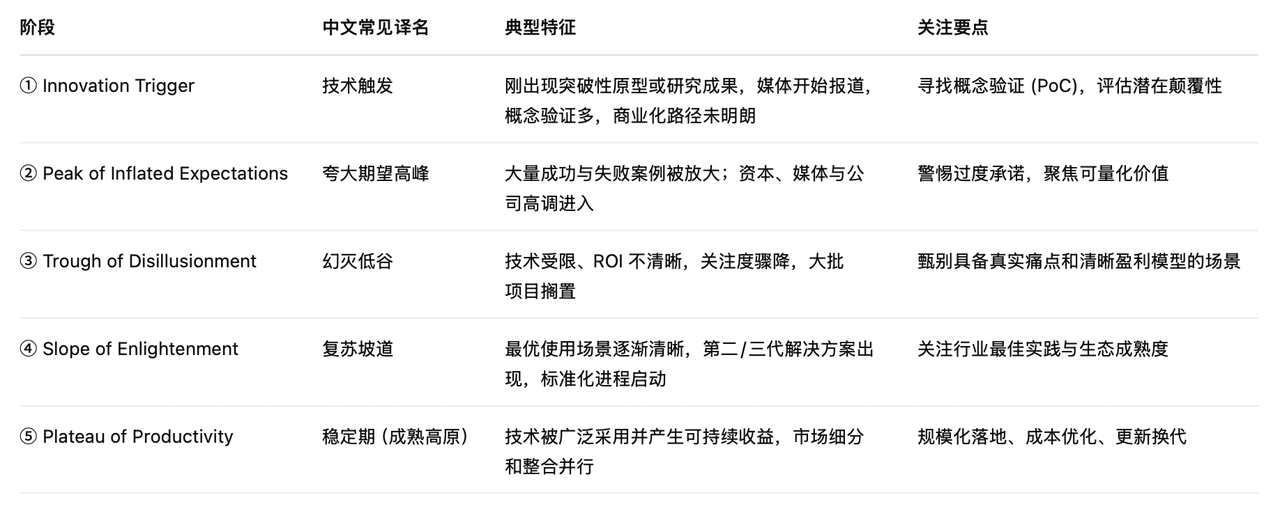
Phases 1 and 2 carry the highest failure risk—especially without deep pockets or defensible differentiation. For most, prudent action is watchful waiting or ultra-light experimentation.
Phase 3—the Trough—is often the best entry point. Expectations have sobered; real use cases emerge; infrastructure matures; talent becomes available.
Generative AI fits this S-curve perfectly:
- 2023: Phase 1—ChatGPT ignited mass fascination; capital and media flooded in.
- 2024: Peak fading—hype plateauing, cracks appearing.
- 2025: Early Trough—widespread realization that deployment is harder, monetization slower, and reality less dazzling than promised.
For solo founders and small teams: Lean in with light assets + vertical specialization. It lowers risk, accelerates iteration, and makes value proof faster.
Google Deep Research
Lately, I’ve run dozens of custom research reports using Google Deep Research—on topics central to my work. The depth and accuracy stunned me.
To verify its rigor, I even had it analyze me: my background, interests, blind spots. Only after cross-checking every claim—and confirming factual integrity—did I fully grasp its capability.
It’s not just fast. It’s mine: hyper-personalized, deeply contextual, and instantly actionable.
Compare that to traditional research:
- Hours spent searching
- Difficulty filtering signal from noise
- Heavy lifting to synthesize findings
- High risk of missing key sources
Deep Research dissolves all four bottlenecks. Its biggest gift? It frees mental bandwidth—so I spend less time gathering, and more time thinking: about prompt reverse-engineering, global opportunity mapping, second-order effects. Better inputs → sharper decisions.
A sincere nod to Google.
Why Good Habits Matter
A study found: 92% of New Year’s resolutions fail within 30 days.
Setting goals alone doesn’t solve the problem.
As James Clear writes: “New goals don’t create new results—new systems do. Lifestyle is a process, not an outcome. Invest energy in building better habits—not chasing better results.”
Good habits are the system.
They’re behaviors repeated enough to become automatic: repeated, unconscious, low-cost.
Beyond efficiency, habits are biological shortcuts—and identity builders. Every time you act, you vote for who you are.
So: What counts as a good habit?
One that consistently supports your health, productivity, well-being, or growth—e.g., reading, meditation, movement, writing, reflection, kindness.
Their power lies not just in action—but in self-reinvention.
Five minutes of daily meditation isn’t just stress relief. It’s a quiet affirmation: “I am someone who values inner calm.”
Lifestyle is the sum of habits. Repeat them, and you don’t just do differently—you become differently.
Habits compound.
A few pages a day → a library in a year.
Ten minutes of movement daily → transformative health in five years.
How to build them—effortlessly?
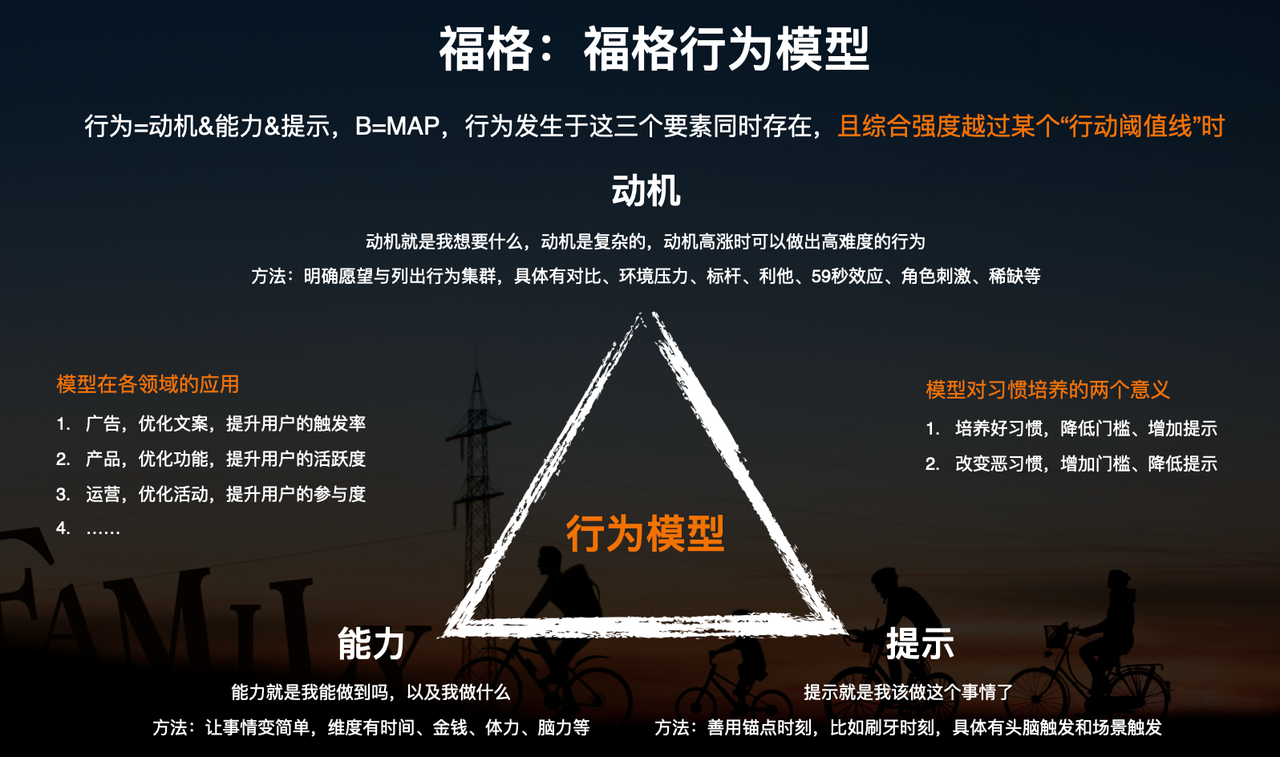
Use BJ Fogg’s Behavior Model:
Behavior = Motivation × Ability × Prompt
- Motivation: How much you want to do it
- Ability: How easy it is to do
- Prompt: The cue that triggers it
Behavior occurs only when all three converge—and their combined strength crosses your personal “Action Line.”
Take reading:

My own practice: Six micro-habits, done daily—wake up early, meditate, read/listen, write, run/strength train, study English.
Motivation was easiest to secure. Ability came next. The real leverage? Prompt anchoring.
- Wake-up → 6 a.m. watch alarm
- Meditation → right after afternoon nap
- Audiobooks → during car commutes
- Reading → right after morning coffee
- Running → immediately after waking
Each anchor reduces friction. Each micro-win builds momentum.
As philosopher Zeno reflected on his life:
“Happiness accumulates through small steps—but it is never simple.”
A recent Feishu note captured it well:
You see friends posting gym check-ins, rush to buy a yearly membership—and quit after Day 3, sore and discouraged.
Superficial lesson: “Go slower next time.”
Philosophical truth: Human action isn’t powered by desire—it’s sustained by inertia. Without systems that generate reliable rhythm, even noble goals collapse into one-off enthusiasm.
Wishes wake you up. Habits carry you forward.
Without the latter, the former is just wind.
May your most meaningful transformations begin—not in grand declarations—but in small, repeatable actions, quietly compounding.