How Far Has AI Really Landed?
In Tianjin, a group of friends hosted an “AI + IP” dinner with founders from the city’s top three education-focused MCN companies. Their warm hospitality and candid sharing gave me fresh, grounded insights into how AI is actually being deployed in the MCN industry—and the takeaways were substantial.
Here are some concrete real-world cases and conclusions:
- Automated FAQ evolution: Sales teams now feed customer questions directly into AI, which auto-documents them and updates the internal knowledge base. What used to be manual, fragmented, and slow is now continuous, scalable, and significantly more accurate and efficient.
- Personal storytelling at scale: Using a well-structured personal narrative framework—combined with light interviews or prompts—AI can generate compelling, authentic life stories. The output quality is consistently strong.
- Production team compression: By wrapping core editorial and directing tasks in automation + AI, one company reduced its editorial team from 7 people to just 1—while increasing both volume and quality of output. That shift unlocked over a million RMB in annual profit—pure margin gain from AI-driven operational leverage.
- AI in sales & support: AI-powered sales assistants are delivering 30–50% productivity lifts. More importantly, they’re enabling tasks previously impractical at scale—like systematic cross-platform competitive analysis. If CRM systems across platforms (e.g., Douyin, WeChat Channels, private databases) were unified, the upside would grow further. One founder shared that AI-assisted sales have even closed two high-ticket deals recently.
Of course, real-world deployment still faces hurdles. Overcoming these would unlock significantly greater impact:
- Access to clean, relevant data: Take short-video account launching as an example. Step one: scrape all recent low-follower, high-engagement videos across platforms; step two: use that dataset to train AI to generate new, high-potential scripts. This entire pipeline hinges on robust, ethical, and scalable data acquisition.
- Cross-platform integration: Unifying user data from public platforms (e.g., Douyin, WeChat Channels), private communities, and owned product users would enable true end-to-end AI automation—dramatically reducing human intervention across the funnel.
- Model quality > prompt engineering: Output quality depends far more on the underlying model than on clever prompting. Top-tier models—like Claude 3.7 for writing and coding—deliver markedly better results. But they’re costlier and harder to deploy at scale due to API limits, latency, and pricing structures.
Reflecting on these examples with friends, we agreed: In traditional business contexts, leaders who deeply understand both their domain and AI’s practical capabilities are capturing outsized returns. That synergy—mature operations + sharp AI fluency—is where the real early-mover advantage lives.
Conversely, knowing AI well but lacking a proven, revenue-generating business remains tough. Launching from zero is still hard.
On the train back to Beijing, Yang Xiang and I landed on another shared insight: In the AI era, becoming a generalist matters more than ever—far more than specializing narrowly.
Why? Because generalists can rapidly synthesize across disciplines—product, sales, AI application, psychology, operations—and stitch those threads into uniquely competitive workflows. And crucially: AI can fill in the technical gaps within that synthesis. A founder who understands product design, sales psychology, and how to embed AI into both—not just one—can architect a business model that outpaces peers by a wide margin.
AI isn’t coming. It’s already here—and landing, hard.
Turning Ideas Into Tutorials—Fast
I built a visual running guide for a friend: md.laoyao.cn/sunlaoshi.html
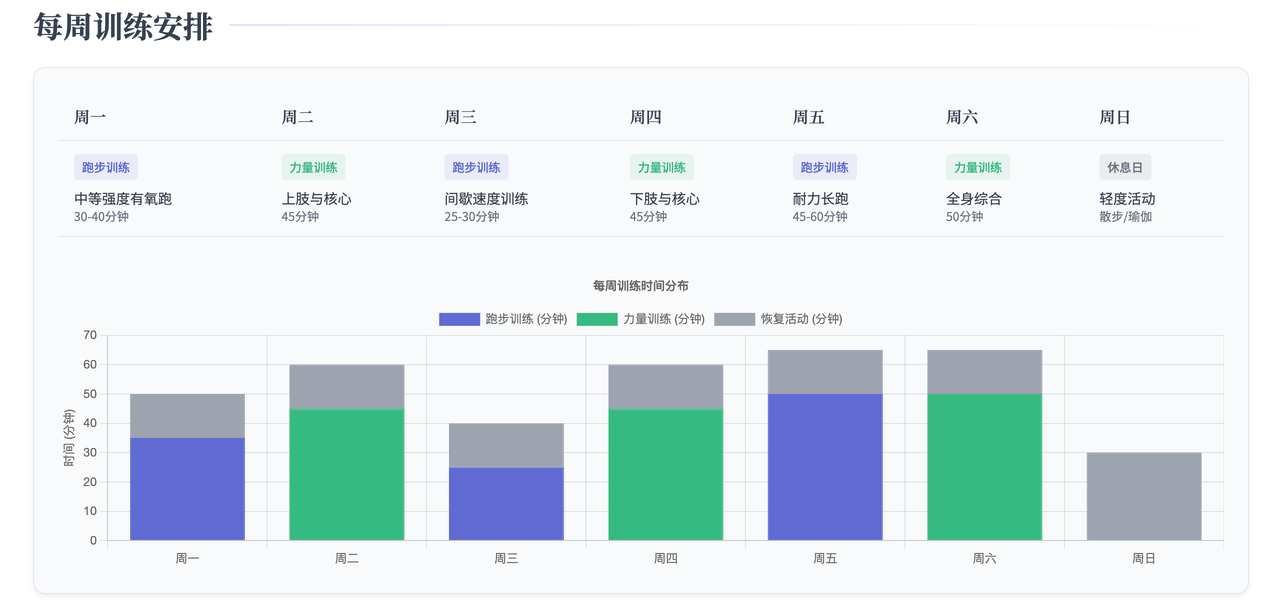
Built using Claude 3.7.
The logic was simple—but intentional:
- Tell AI: “I want to create a running tutorial for a friend.”
- Specify the format: “It must be a self-contained, visual web page.”
- Define the structure: Three core modules—
- Weekly scheduling: alternating running and strength training,
- Per-session breakdown: pre-, during-, and post-workout guidance,
- Lifestyle support: sleep, nutrition, and emotional regulation.
That’s it—the three foundational decisions. Everything else—the phrasing, sequencing, visuals, tone—I delegated to AI. It filled in the details rapidly and coherently.
The key? Clarity before prompting. Knowing exactly what you want—and why—makes AI dramatically more effective. That clarity comes fastest to people with domain experience or deep functional intuition.
This is exactly why Yang Xiang and I dedicated a full chapter in our early-2025 course AI Leadership to this idea: “Experience: Use your unique cognition to steer AI.”
There’s a massive gap—measurable in time saved, output quality, and strategic leverage—between those who prompt from intuition and those who prompt from abstraction.
Building a Personal Knowledge System
Listening to the history of tech development reminded me of something powerful: The scientists or thinkers we remember aren’t always the first to spot an idea—they’re the ones who systematize it.
In business, the “Pyramid Principle” existed in fragments long before Barbara Minto wrote her book. But she codified it, tested it, taught it, and made it reproducible. That system—not just the insight—became enduring.
For individuals, a simple but transformative habit is this: After doing something well, pause and distill it—not as a memory, but as a reusable method. Turn it into a visual framework, a checklist, or a template. Then store it in your personal knowledge base.
A good knowledge system doesn’t just capture wisdom—it lets you reproduce results, reliably, across time and context.
Inspired by Minto, I asked AI to surface similar examples of system-builders:
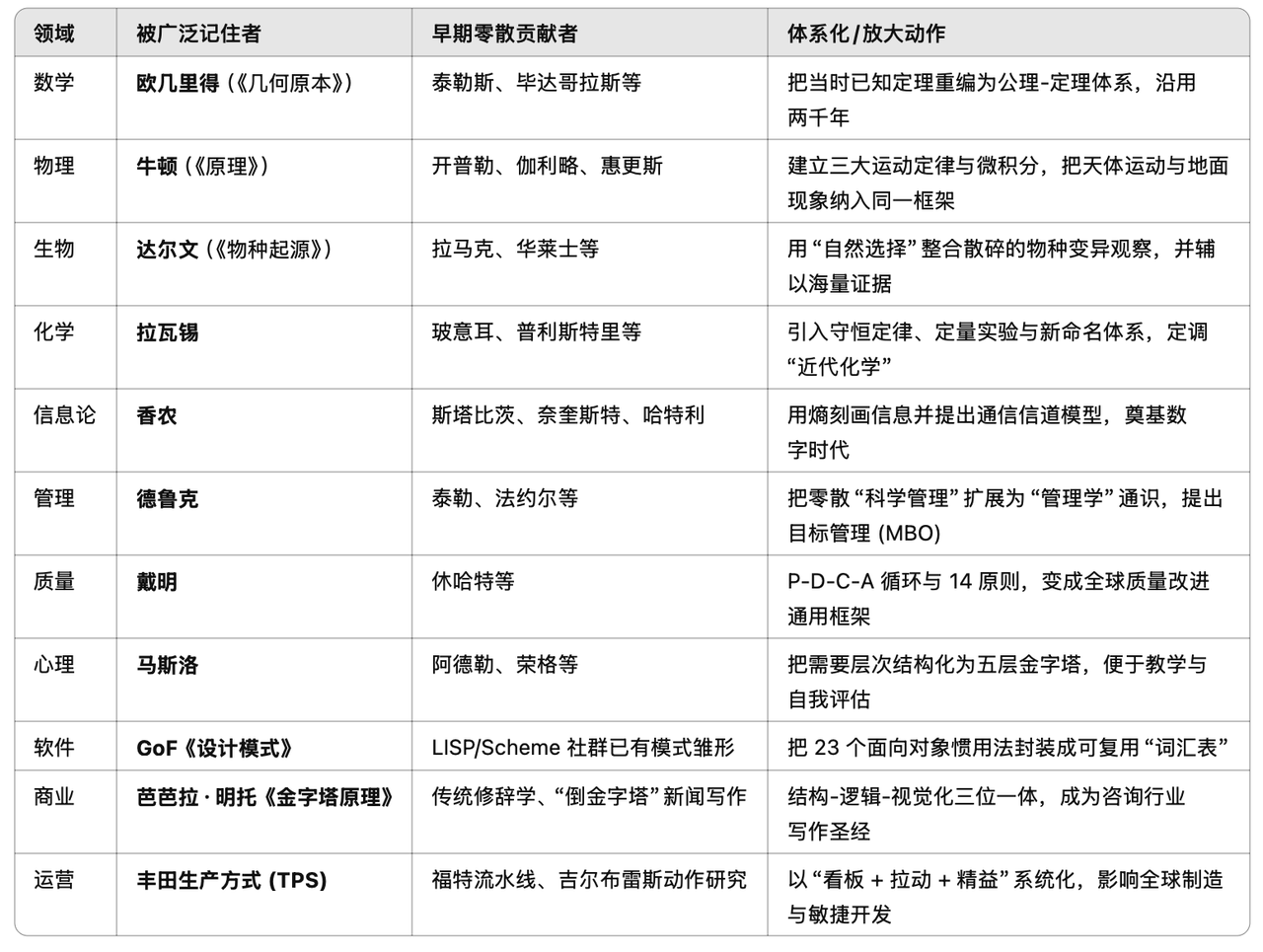
Some principles for building your own knowledge architecture:
- Minimum viable validation: Condense your insight into one page or one diagram. Test it with 2–3 people. Can they follow it and get similar results?
- Memorable naming: Give your framework a clear, sticky name—“Pyramid Principle,” “OKR,” “Growth Hacking.” Naming makes it shareable, teachable, and ownable.
- Secondary outputs: Build supporting assets—slide decks, editable templates, metrics dashboards, or even lightweight code libraries—to lower the barrier to adoption.
The AI Filter
“AI filter” is a useful metaphor.
It describes how AI instantly polishes raw input—making messy ideas look coherent, disorganized notes appear structured, and vague hunches sound like expert insights.
It’s a lever. And it’s also a lens—one increasingly worn by those who know how to wield AI well. As more people adopt this filter, the information ecosystem fills with AI-optimized, AI-packaged, AI-sanded content.
In that world, unfiltered human expression—raw, imperfect, idiosyncratic, emotionally honest—becomes rare. And therefore, precious.
The Hidden Cost of Negativity
To live well, actively avoid negativity.
Many mistake negativity for moral clarity—or even “justice”—without realizing it. That’s not wisdom. It’s cognitive laziness.
Negativity harms in predictable, compounding ways:
- External attribution bias: At the first sign of setback, the reflex is to blame external forces—market, leadership, luck—rather than examine controllable variables. That triggers immediate negative emotion.
- False righteousness: Those negative emotions crystallize into opinions dressed up as truth (“The company is clueless”). When echoed by others, the belief feels validated—even though it’s rarely evidence-based. Reinforcement replaces reflection.
- Cognitive contagion: Most people don’t think deeply. They absorb energy—especially emotional energy—from whoever speaks loudest. And negativity spreads faster and sticks longer than positivity.
- Team toxicity multiplier: One persistently negative person can derail an entire team’s morale. Restoring psychological safety and trust often requires ten times the effort needed to prevent the damage in the first place.
Negativity is pure internal and relational friction—draining individuals, families, and organizations alike. Learning to recognize and distance yourself from negativity isn’t cynicism. It’s one of the most practical skills for sustaining long-term well-being.
How to Feel Younger
Recently interviewed a candidate born in 2002. Afterwards, I realized: I feel younger than I did five years ago.
Not because of anything flashy—but because of fundamentals: movement, sleep, emotional regulation, and food.
Especially movement: consistent, balanced aerobic + resistance training—done not for aesthetics, but for resilience.
My personal practice over the past two years confirms it: These basics work. Deeply. And they cost almost nothing.