Shopify’s AI Imperative
Shopify’s CEO recently published an open letter—highly instructive for individuals and small-to-midsize businesses alike—that lays out six core principles for AI adoption across the company:
- AI proficiency is now baseline expectation — not optional. As AI reshapes every industry, opting out of learning AI tools is no longer viable.
- AI must lead in all GSD (Get Stuff Done) prototyping — accelerating learning, creation, and internal sharing of early-stage work.
- Employees own their AI learning—and must share it. Teams are encouraged to co-develop best practices, using Slack, Vault, and other internal tools to document and disseminate insights.
- AI usage is formally evaluated — embedded in performance reviews and peer feedback. Your ability to apply AI directly impacts how you’re assessed.
- Before requesting more headcount or resources, teams must explain why AI can’t solve the problem. This question is designed to spark creative friction and force deeper AI leverage.
- AI will fundamentally reshape how work gets done — and Shopify is committing fully, urging collective effort to advance AI use for merchants’ benefit and the company’s growth.
From an individual contributor’s perspective, this is unambiguous: embrace AI—or risk obsolescence.
From a manager’s lens, it’s a mandate to redesign workflows, decision criteria, and team rhythms.
Strategically, it reads like a declaration of intent for the AI era: Shopify has concluded AI isn’t just a productivity lever—it’s the new core competency.
The letter reflects a foundational belief: AI will redefine every job. By institutionalizing AI application and internal capability-building, Shopify is engineering its own transition into an AI-native organization.
A few pivotal shifts stand out:
- From “optional” to “mandatory”: AI is no longer a nice-to-have skill—it’s table stakes.
- From “tool” to “thinking partner”: This framing signals deep insight—AI’s real value lies not in automation alone, but in augmenting judgment, reasoning, and ideation.
- “AI-first” resource allocation: A clever structural nudge—using policy pressure to accelerate cultural change.
As one of the world’s top independent e-commerce platforms, Shopify’s stance carries strong signal value.
Tweet source: x.com
Bonus context: Shopify’s 2024 GMV hit $292.275 billion (+24% YoY—the highest 3-year growth rate); revenue reached $8.88 billion (+26%); operating profit surged to $1.075 billion—up sharply from 2023.
Path Dependence
Reading Zhang Yiming’s biography helped me grasp path dependence beyond textbook definitions—especially its layered, lived reality.
His relentless focus on information distribution and algorithmic recommendation wasn’t a late-stage pivot. It was the through-line of his entire career—from early experiments with feed algorithms at Fanfou (a Chinese microblogging platform founded by Wang Xing) to Toutiao, Douyin, and beyond.
My take on path dependence:
- It’s double-edged. When rooted in deep, foundational thinking, it compounds powerfully—like Zhang’s lifelong commitment to “information finds people.” That principle guided everything he built. But if path dependence rests on shallow habits or surface-level tactics? It offers little advantage—and can even become dead weight.
- It strongly enables future ventures. Zhang didn’t reinvent the wheel for each new app; he applied the same core logic—“information find people”—and adapted the algorithm accordingly.
- It extends beyond skills to networks. His early backers—like those from 99fang—had followed his trajectory for years. Likewise, most of my closest collaborators today are people I’ve known for a decade or more.
So path dependence operates across three tiers:
- Foundational layer: Cognitive frameworks and mental models—e.g., Zhang’s unwavering belief in “information finds people.” This shapes how you frame problems and what solutions you even consider. Its influence is durable and far-reaching.
- Middle layer: Domain expertise and technical craft—e.g., Zhang’s years of hands-on work refining recommendation algorithms at Fanfou. This kind of depth takes time to build—but once achieved, it’s hard to replicate.
- Surface layer: Concrete methods and tactical playbooks—valuable, yes, but easier to acquire and less defensible.
The deeper the layer, the greater the transferability.
Zhang’s mastery of recommendation systems wasn’t tied to one product—it was portable across content, commerce, and video. That’s why cultivating generalizable skills matters more than accumulating narrow tricks.
That said, path dependence has limits: it can breed rigidity, blind spots, and resistance to paradigm shifts. Awareness is the first countermeasure.
Alpha Returns
Alpha return—a concept introduced by economist William Sharpe in 1964 via the Capital Asset Pricing Model (CAPM)—earned him the 1990 Nobel Prize in Economics.
In simple terms: financial markets often move like herds. When sentiment turns bullish, most stocks rise together; when bearish, they fall en masse. Much of your portfolio’s return may simply reflect that broad market swing—Sharpe called this Beta return.
Alpha return, by contrast, is the excess return you generate above the market average—through skill, insight, timing, or unique positioning.
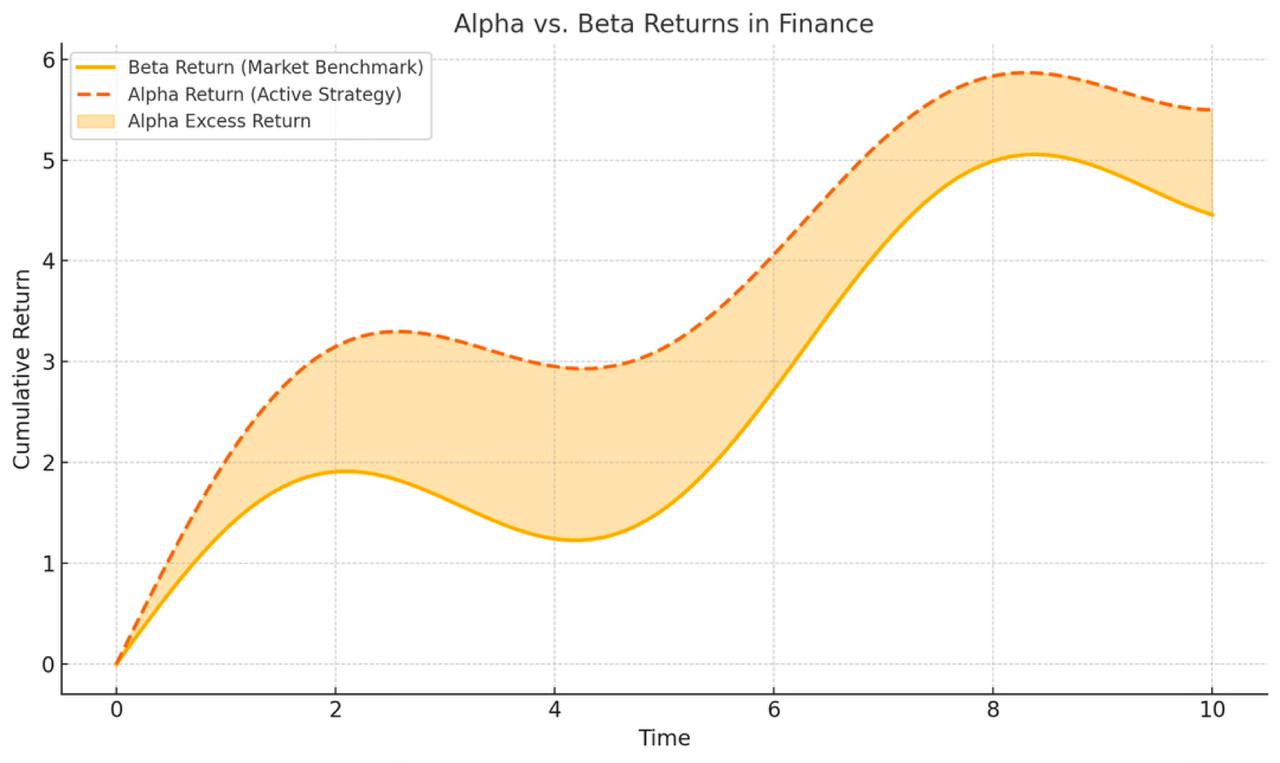
This maps neatly onto business strategy: Beta resembles competing in a red ocean—playing by established rules, riding prevailing tides. Alpha is blue ocean creation—defining new categories, reimagining value, and building defensible differentiation.
Beta is climbing a known mountain. Alpha is surveying uncharted terrain—and sometimes building the first trail. Higher risk? Yes. Greater upside? Also yes.
But Alpha and Beta aren’t opposites—they’re complementary. Like swimming: you can ride the current and stroke deliberately. The key is knowing which part of your result comes from the tide, and which part comes from your own strength.
Pursuing Alpha demands higher tolerance for uncertainty—and stronger risk management. Yet paradoxically, not pursuing Alpha may be the riskiest choice long-term. Why? Because in a world of accelerating change, standing still is the fastest route to irrelevance.

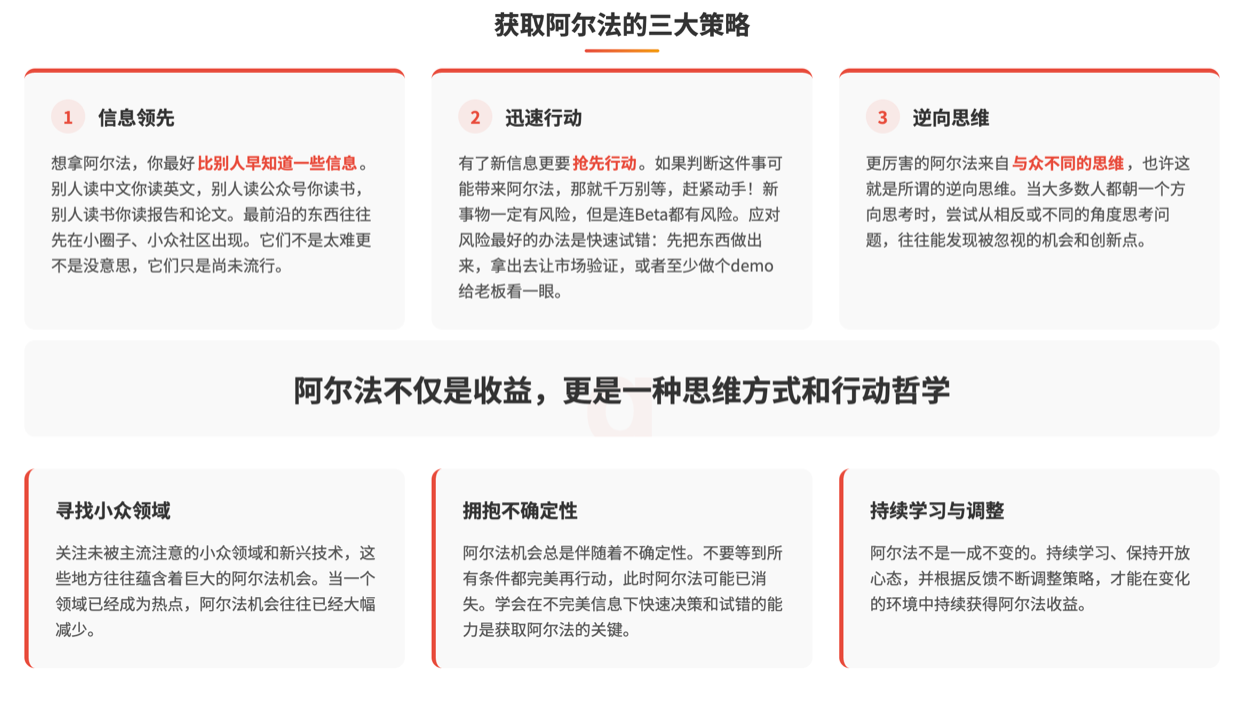
This idea extends far beyond finance: in product design, marketing, operations—even personal learning—true value emerges from original thinking and action—not mimicry.
AI Iteration Strategy
We talk constantly about “AI iteration mindset”—but putting it into practice reveals stubborn mental barriers. Real understanding often arrives only after experiencing tangible, compound improvements.
This morning, I spent about an hour iteratively refining a set of prompts for a work task—using AI itself as my co-pilot. My goal: achieve two specific outcomes. I kept asking AI to analyze, critique, and suggest revisions—then tested each version.
Comparing the final prompt set with the first draft revealed dramatic improvements:
- Tighter logical flow
- Elimination of contradictory instructions
- Clearer articulation of process goals and abstract concepts
The entire loop relied on continuous dialogue: Ask → Analyze → Revise → Test → Repeat.
Key takeaways:
- Deep understanding of your business logic is non-negotiable.
- Your target outcome must be crystal clear—and reiterated throughout the loop.
- You must critically assess AI’s suggestions—not accept them blindly. Judgment + AI input = effective iteration.
- Acknowledge where AI outperforms you: speed, pattern recognition, breadth of reference. Lean in.
Knowing vs. Doing
Today, I delivered Day 2 of onboarding training for new colleagues—focused heavily on AI application.
Only after the lecture ended—and we moved into hands-on practice—did the real gaps surface.
Two patterns emerged:
First, many assumed they “got it”—until they tried executing. What seemed straightforward in theory turned out to involve dozens of subtle, consequential decisions.
Second, nearly every stumbling block they hit mirrored exactly the pitfalls I’d emphasized in training. These weren’t edge cases—they were the common failure modes.
This is the classic chasm between knowledge acquisition and skill formation. Hearing something ≠ being able to do it. It’s universal—but especially acute in AI, where the interface feels deceptively simple. The illusion of ease masks the need for deliberate, repeated practice.
A friend runs an AI learning community called “Learning by Doing.” Its name says it all.
As the Learning Pyramid shows, passive consumption (reading, listening) yields low retention. Active practice—and especially teaching others—produces the highest knowledge retention. In AI, where intuition lags behind capability, this is essential.
There’s a world of difference between skimming an article about prompt engineering and spending 30 minutes wrestling with a real prompt—refining, testing, failing, and finally succeeding. That’s where competence lives.