Intelligent Solo Combat Systems
I saw an image—a diagram of the PLA’s intelligent solo combat system.
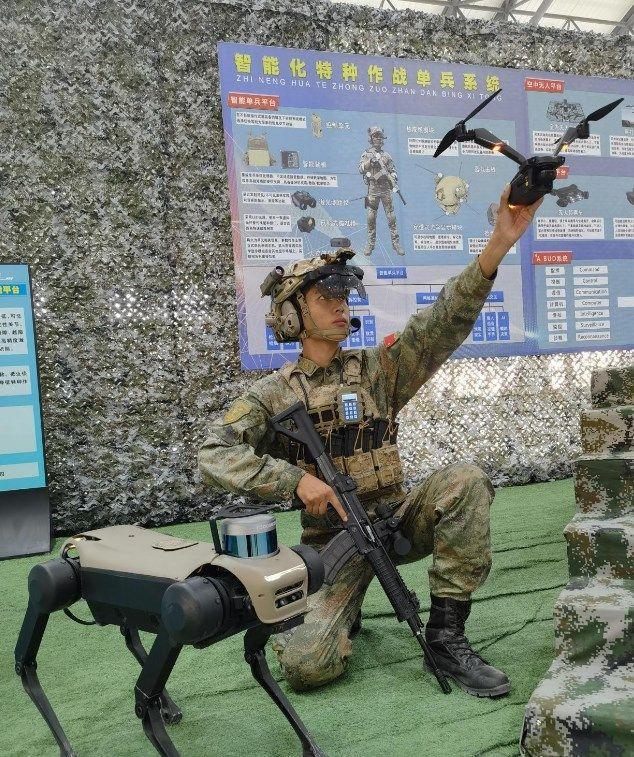
This image perfectly captures what high-performing future organizations will look like.
One major impact of AI on small and mid-sized organizations is the shrinking of optimal scale—toward a “human + AI” collaboration model.
So, in my view, the best future work pattern is “1+N”: one person plus multiple AI agents.
Under this model:
- Individual capability is dramatically amplified by AI
- Organizations can become leaner—but more effective
- Management focus shifts from personnel oversight to optimizing human–AI collaboration
A key insight: AI doesn’t replace humans—it augments and supports them.
Like the PLA’s intelligent special-operations gear, technology elevates individual combat effectiveness to a qualitatively new level—where one person can operate with the impact once requiring a hundred.
The Johari Window for AI Use
When using AI, we sometimes feel puzzled: Why don’t we get the answers we want? Or why do outputs fall so far short of expectations?
Because AI has clear boundaries—and the Johari Window helps us navigate them.
The core idea: Before asking AI to solve something, first clarify what kind of task it is, and locate it within the Johari Window’s four quadrants.
Once mapped, we can use AI more effectively—and understand why it excels in some areas but stumbles in others.
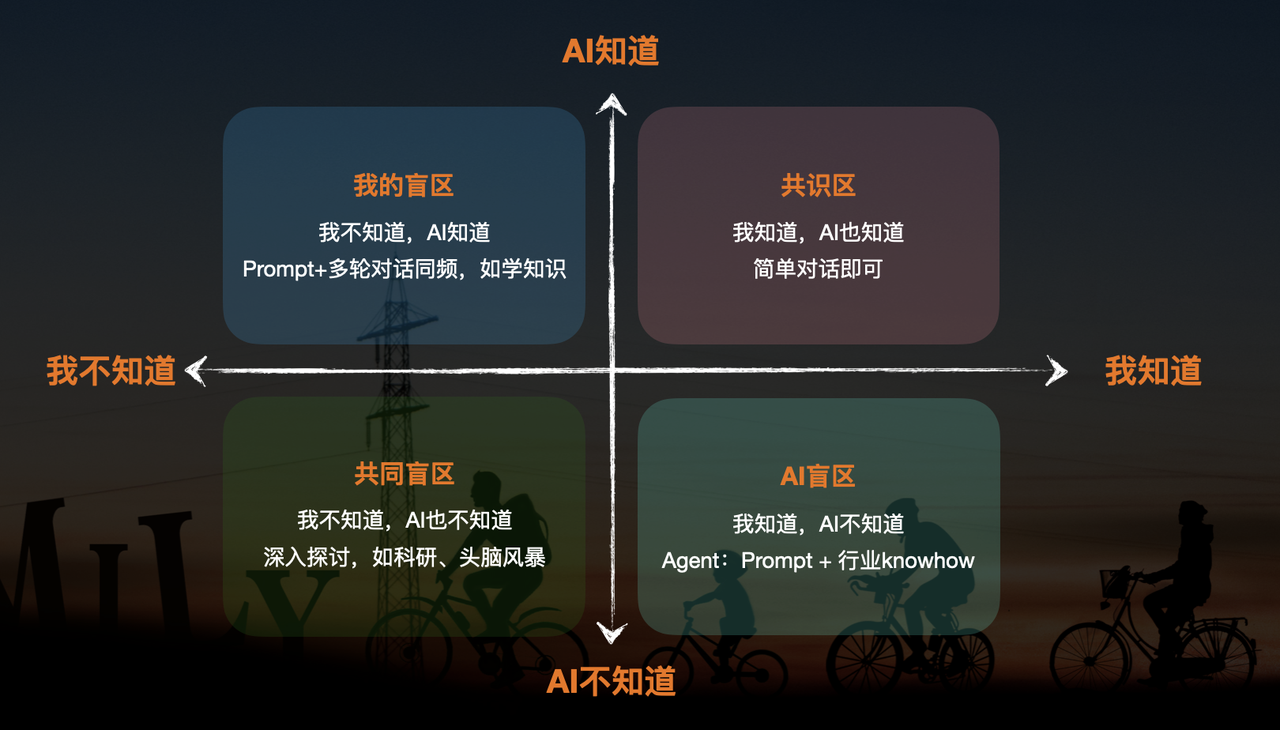
Here’s how AI interaction breaks down across the four quadrants:
Shared Zone: The ideal zone for collaboration. Both you and AI “know” the answer—so communication flows smoothly. Think basic web searches or arithmetic: AI delivers reliably.
AI Blind Spot: You know the answer; AI doesn’t. This usually demands domain expertise—reminding us that AI isn’t omniscient. Human judgment remains essential in specialized contexts.
Shared Blind Spot: The toughest zone. Neither you nor AI knows—and no amount of prompting will bridge the gap. This explains why AI alone rarely sparks true innovation.
Your Blind Spot: You don’t yet know what you need—or how to ask. That’s why refining prompts often takes several rounds before hitting the right result.
The model’s real value lies in helping us set realistic expectations, interact with AI more intentionally, and understand why some queries land well while others miss entirely.
A foundational takeaway: To use AI well, start by honestly assessing your own knowledge state and AI’s current limits—then choose strategies and expectations accordingly.
AI Hospital
Shanghai’s world-first AI hospital—Agent Hospital—has launched internal testing. Developed by Tsinghua University’s Institute for AI Industry Research, it’s projected to serve 3,000 patients daily.
Its first cohort includes 42 AI doctors—two per specialty: one trained on Chinese medical practice, one on global standards.
They offer 24/7 online consultations.
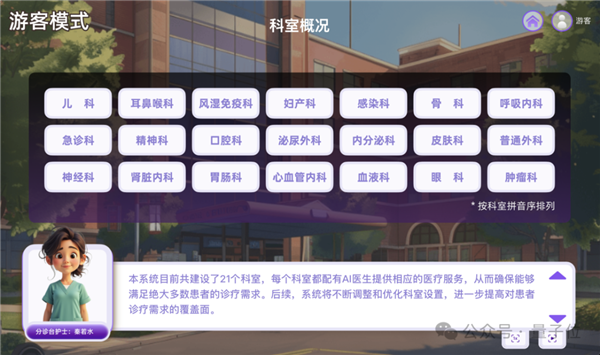
Agent Hospital was trained on over 6,000 domestic and international medical textbooks. Doctors co-designed every module, replicating real-world clinical workflows—from triage to diagnosis to follow-up—ensuring rigor, accuracy, and professional depth.
Soon, many won’t need to visit hospitals in person. They’ll consult online instead.
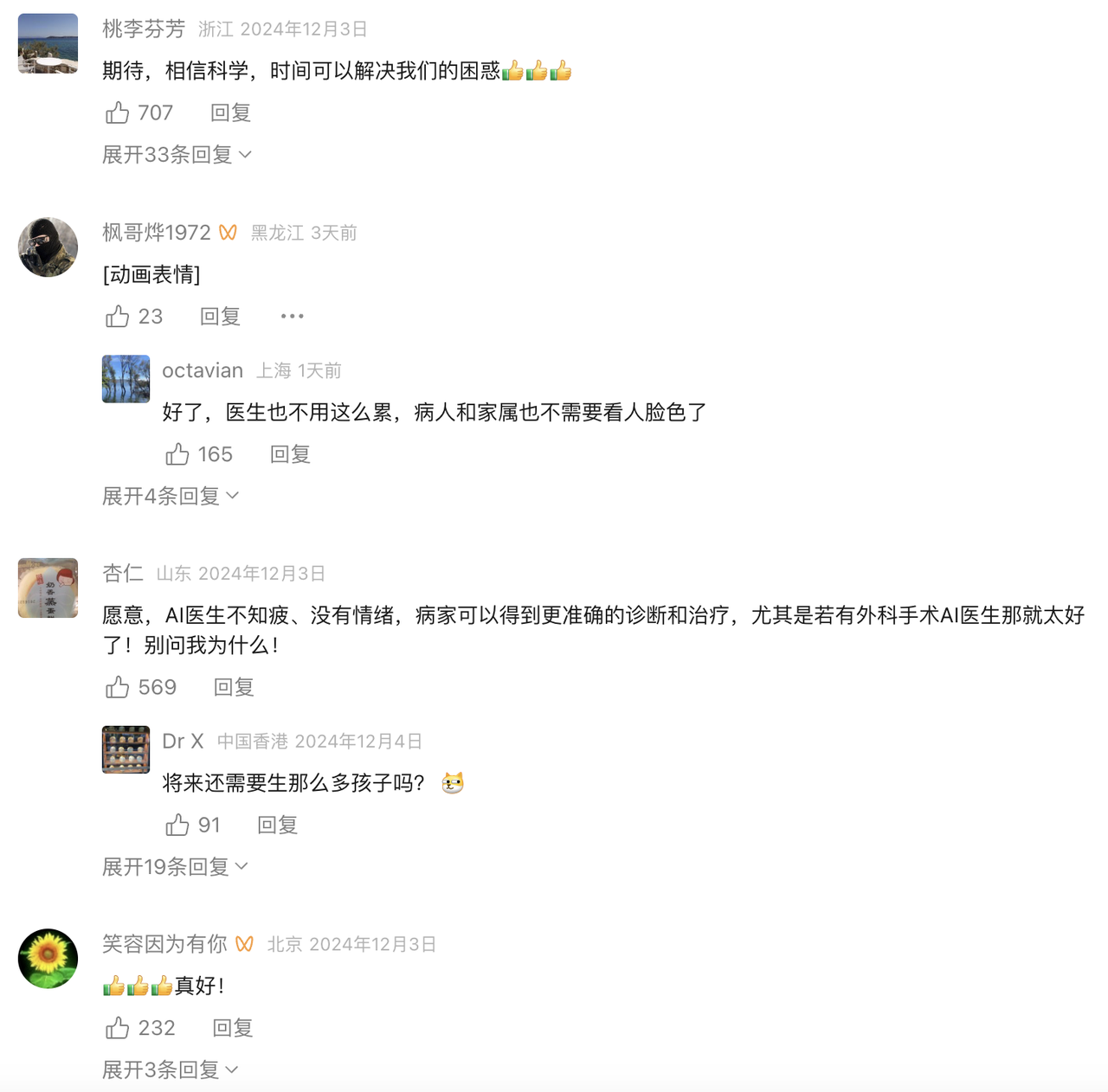
What’s especially encouraging? Public enthusiasm in the comment section.
It meets three urgent needs: (1) difficulty booking appointments, (2) hassle of in-person visits—especially long queues—and (3) lack of physician patience during brief encounters.
This model unlocks new market potential—not just in telemedicine, but in raising national health literacy.
I’ve long believed low public health literacy stems largely from scarcity of accessible, patient doctors. A single clinic visit is rushed; explanations are truncated. With platforms like Agent Hospital, we can begin with treating illness—and naturally expand into disease prevention, healthy behavior coaching, and everyday health education.
AI Dad
My daughter was home sick, resting. At noon, she called me and said, “I just chatted with AI Dad for a long time.”
I asked, “How’s AI Dad?”
She replied, “Great—he keeps me from getting bored.”
At the end of the call, she added, “Okay, I won’t disturb you anymore. You go ahead and work.”
Technology is quietly reshaping parent–child interaction.
AI is no longer just cold machinery—it’s becoming a warm, responsive companion.
For Z-generation kids like mine, AI feels as natural to talk to as any other person.
Future family education faces a new challenge: In the AI era, how do we balance technological companionship with authentic emotional connection?
That question—unavoidable, unresolved—is one this generation of parents must grapple with and explore.
AI Literacy in the AI Era
A distilled summary from the “AI Learning Circle” on GetIt (a Chinese learning platform):
AI advances rapidly—but social structures evolve slowly. Many people aren’t yet equipped to use AI meaningfully.
AI transforms work from something you must do to something you choose to do. Work may become a lifestyle, not just livelihood.
Work may cease to be a universal necessity. Universal Basic Income (UBI) could emerge—freeing people to pursue passions and growth.
In the AI era, generalist human capital matters more than specialist skills. Specialists must evolve into generalists—equipped with high-level cognition, able to systematize knowledge and amplify it via AI.
Generalists > specialists: Traditional technical expertise is being automated. Transferable, human-centered capabilities grow more vital—cognitive flexibility, creativity, logic, critical thinking, aesthetic judgment, and mental agility.
Using AI requires constant iteration. Cultivate an “AI First” mindset: always ask, “Can this be done with AI?” before defaulting to manual methods. Identify the AI tools that fit your workflow—and master them deeply.
AI’s impact on organizations: Companies will shrink in headcount, shifting toward “human + AI” collaboration.
What university students need: adaptability, self-directed learning, intrinsic motivation, and entrepreneurial spirit.
For SMEs: Skip digital transformation—go straight to intelligence. The decisive competitive edge? Attracting “super individuals”—people fluent in both AI and business.
Organizational scale trend: Smaller teams—but leaders must grasp the difference between generative AI and traditional AI.
AI and organizational communication: AI Agents can accelerate information flow, boost transparency, and reduce friction.
“Super individuals” are rising—those who speak both AI and domain fluently. Future corporate competition hinges on hiring and retaining them.
Building AI literacy means:
- Using AI tools actively: Experiment widely. Integrate them into daily work and study.
- Adopting “AI First” thinking: Default to AI when appropriate—not tradition.
- Understanding AI’s limits: AI excels at narrow, bounded tasks. Complex, integrated workflows still require human orchestration.
- Learning to collaborate with AI: Phrase instructions clearly. Guide AI iteratively. Seamlessly blend its output into larger human-driven outcomes.
AI and education:
- AI enables true personalization—transforming teachers’ roles and making teaching to the individual feasible. It can act as teaching assistant: grading assignments, reviewing essays, even suggesting revisions.
- AI widens educational inequality: proactive learners access richer resources. We must design ways to engage everyone—not widen the gap. AI makes personalized learning possible, turning linear curricula into hyperlinked knowledge networks—reassembling and customizing content based on each student’s understanding.
- Teachers’ roles shift: As AI handles knowledge delivery, educators move from “sage on the stage” to “guide on the side”—facilitating, mentoring, and nurturing curiosity.
- Personalized learning: AI tailors content and pacing to each learner—realizing true differentiation.
- Hyperlinked learning: Knowledge ceases to be linear. Instead, it’s navigated like a web—fluid, contextual, and uniquely assembled for each mind.