The Surrender Experiment
Recent experiences—some uplifting, some challenging—brought me back to a book I’ve reread several times: The Surrender Experiment by Michael A. Singer. Last year, a friend and I read it section by section, daily, and even sketched out a “Surrender Model” together.
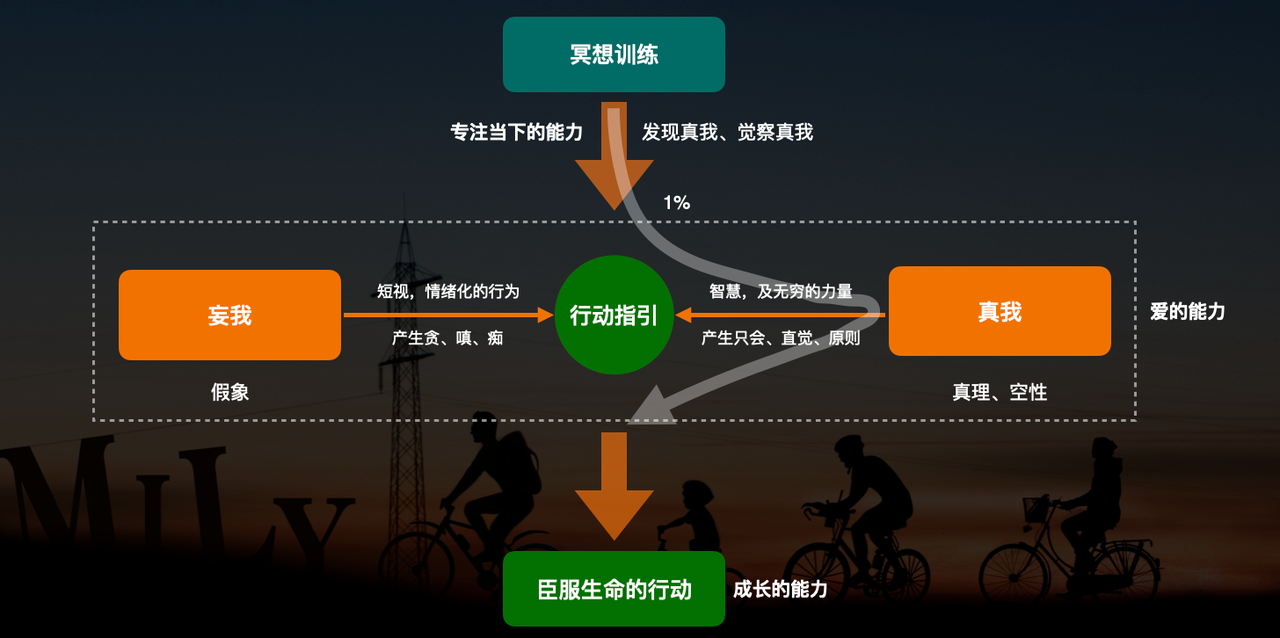
In that model, we defined surrendering to life as: surrendering to your true self—and to the intuition and principles that arise from within.
Drawing from both the book and recent lived experience, here’s what’s crystallized for me:
- Don’t resist what has already happened—whether “good” or “bad”—based on personal preference. But the very act of labeling events as good or bad reveals a clinging mind; true acceptance begins only when that duality dissolves.
- With what’s coming, withhold judgment. To some extent, follow inner intuition—not as blind impulse, but as quiet alignment with deeper knowing.
- Accept each person and situation without preference or aversion. Surrender isn’t passivity—it’s clarity. When unclouded by emotion or judgment, our choices become sharper, more aligned with what truly matters and what serves us long-term.
- Focus lives in presence—and presence thrives on curiosity, not evaluation. Take meetings: when you’re not in them, your mind floods with unrelated thoughts. That mental noise isn’t insight—it’s inefficiency. Real focus means showing up, fully, with open attention.
- Don’t borrow anxiety from the future. Tackle things as they arrive—one at a time—with full attention. You’ll find most problems resolve cleanly, without drama.
- Judgment and preference breed friction. Disliking a task, resisting a person, or resenting a situation doesn’t change reality—it multiplies perceived difficulty. The same event feels entirely different depending on your inner state—and that state is always within reach of choice.
How to Accompany Well
This week, I had dinner with a senior medical expert. He shared a story from ten years ago.
He’d lived in the U.S. for two decades—but returned home when his elderly mother fell into deep depression and poor health. Her grief stemmed from her husband’s early death and the absence of all three sons. She was, effectively, alone.
As the youngest son, he chose to come back—not just to be physically present, but to accompany her, day after day. Ten years later, she’s 93, walks briskly around her neighborhood, and enjoys robust health.
Three key factors drove this transformation:
First, patient, consistent companionship, which rebuilt her sense of safety and emotional stability.
Second, his medical expertise, enabling better nutrition, routines, and preventive habits.
Third, practical preparedness: he curated low-fat medications, compiled emergency hospital contacts for her caregiver, and set up safeguards—none of which, to date, have been needed.
What made the difference wasn’t grand interventions. It was effective accompaniment—the kind that applies equally to aging parents, young children, or anyone who needs steady, attuned presence.
Avoid Building from Zero (0-to-1)
A friend lost significant money last year launching an e-commerce venture. After China’s “Double Reduction” policy reshaped the education sector, he pivoted away from teaching—into unfamiliar terrain.
He poured time, capital, and energy into building something entirely new. It failed.
This year, he’s returning to education—but with new ideas he asked me to vet. After hearing his plans, I noticed a pattern: every project demanded starting from scratch. No proven workflows. No existing user base. No team with domain muscle. Just raw ambition and high uncertainty.
That’s a red flag—for him, right now. His priority isn’t legacy-building. It’s cash flow. And statistically, 0-to-1 ventures fail far more often than 1-to-10 scaling.
When reserves—financial, emotional, or social—are thin, avoid zero-based starts. Instead, leverage what already works: refine an existing offering, deepen a current channel, or repurpose proven assets. That’s how you generate value quickly—and sustainably.
The Voice-First Opportunity
Here’s a surprising data point: China has ~1.2 billion mobile internet users—but after deduplication, nearly half have never used any input method app. That means only ~600 million people actively use keyboards or handwriting tools. The other 600 million? They’re largely silent in text-based digital spaces.
So what are they doing?
Mostly watching short videos—on platforms like Douyin, where no typing is required. They engage via scrolling, tapping, and voice.
AI changes everything for this group. For the first time, people who struggle with keyboards—or never learned them—can express themselves fluently: through speech + AI. Voice notes, voice-to-text journals, spoken queries—all become accessible.
Even note-taking shifts: traditional apps demand active typing, a barrier for many. But voice-native, AI-augmented notes remove that friction. AI handles cleanup, summarization, and structure—so expression comes first, polish second.
This isn’t incremental improvement. It’s a mass activation—unlocking participation, creativity, and connection for hundreds of millions previously excluded from the text-based web.
Use AI for Simple, Specific Tasks
A friend and I were discussing AI’s practical limits. His colleague—a healthcare professional—pointed out a sobering truth: in high-stakes domains like medicine, unpredictability in AI outputs can be dangerous.
Yes, large language models are powerful levers. But leverage only works when applied precisely.
The most reliable way to deploy AI? Keep it small. Focus on single, well-bounded tasks:
- Parsing exam questions
- Generating product descriptions
- Drafting email subject lines
If a problem feels complex—say, analyzing a 50-page clinical report—don’t ask one model to “solve it.” Break it down: extract key findings → summarize sections → flag inconsistencies → draft recommendations. Each step becomes a discrete, testable, controllable AI interaction.
Complexity isn’t solved by bigger models. It’s tamed by smarter decomposition.
A Shout-Out to Doubao (ByteDance’s LLM)
Let’s give credit where it’s due: Doubao, ByteDance’s large language model, has become our primary inference engine—replacing earlier models across both production tools and new prototypes.
Why? Three reasons:
- Cost: At 100 million tokens per day, API expenses hover around tens of RMB—unbeatable for scale.
- Performance: For focused, single-turn tasks (e.g., rewriting, classification, extraction), Doubao delivers consistently strong results—no worse than top-tier alternatives.
- Support: ByteDance assigned us a dedicated cross-functional team—product, engineering, and biz-dev—with rapid response times and genuinely useful strategic input. Their partnership has accelerated our AI experimentation significantly.
Ironically, internal skepticism once held Doubao back—engineers doubted its technical depth versus global leaders. But from a user’s perspective? Its combination of affordability, reliability, and responsiveness makes it uniquely positioned—not just for today, but for the next wave of pragmatic, production-grade AI adoption.
Opportunity in Downturns
Business logic flips between boom and bust cycles—and so do real opportunities.
In growth periods, optimism runs high. Consumers spend freely, ignore price tags, and chase novelty. “Premium” sells easily—even without clear utility.
In downturns, behavior shifts: people scrutinize every yuan. They compare, delay, and prioritize value over veneer.
Take coffee: a few years ago, no one blinked at ¥38 for a latte. Today, that same purchase triggers a micro-calculation. “Is this worth it right now?”
That’s not pessimism—it’s recalibration. And it creates openings: for leaner products, transparent pricing, utility-first design, and services that demonstrably save time or money. The downturn doesn’t kill opportunity. It filters out the fluff—and reveals what people truly need.