How to Seek the Buddha
A friend of mine—trained in economics at Peking University—shared something last year that stuck with me.
Though he studied economics, his deepest interest was always Buddhist thought. After graduation, he spent several years visiting temples across China, meeting masters, even practicing intensive meditation under guidance. At one point, he’d walk around PKU’s Weiming Lake every day, chanting a mantra ten thousand times.
Yet over time, he realized none of it brought him closer to genuine understanding. Instead, he kept encountering contradictions, inconsistencies, and institutional flaws—some even more pronounced than those in ordinary life.
It wasn’t until he taught himself Sanskrit and began reading original Buddhist sutras—unmediated by translation or commentary—that things started to click. He abandoned the path of following masters and turned instead to primary texts. That’s where he found the actual teachings—not hidden in ritual, but plainly laid out in language, logic, and lived wisdom.
Take the famous Heart Sutra mantra: “Gate gate pāragate pārasaṃgate bodhi svāhā.” Most people chant it phonetically without knowing its meaning. But translated literally, it reads: “Go, go—go beyond, go fully beyond—celebrate awakening!” Simple. Direct. Human.
Why is it usually left untranslated? Because once you grasp its plain meaning, the “magic” evaporates. And for many practitioners, that’s precisely the point—the chant isn’t about meaning; it’s about rhythm, repetition, belonging. The words become anchors for the soul—not keys to insight.
But if your goal is understanding, not comfort, then meaning is the point. Only by returning to the source—original texts, rigorous study, critical reflection—can you move past surface forms to the substance beneath. My friend eventually concluded that many contemporary teachers, especially in mainland China, lack deep theoretical grounding—and often have personal or institutional agendas that distort the tradition.
This mirrors a broader pattern: in religion, philosophy, or even professional learning, we’re easily seduced by ceremony, charisma, or convenience—while overlooking the quiet, demanding work of thinking for ourselves. Real awakening isn’t conferred. It’s earned—through attention, clarity, and courage to question even what feels sacred.
AI Teaching Assistants
This week, we shipped another iteration of our math-focused AI teaching assistant—now supporting voice input and image uploads. In group chats, users no longer need to @ the bot; it automatically detects questions and distinguishes staff from students.
That small change significantly improves flow and reduces friction.
On content, the assistant also gently steers conversations back to learning. For example, when asked “Can you teach me stock trading?”, it politely declines—and suggests age-appropriate financial literacy modules instead.
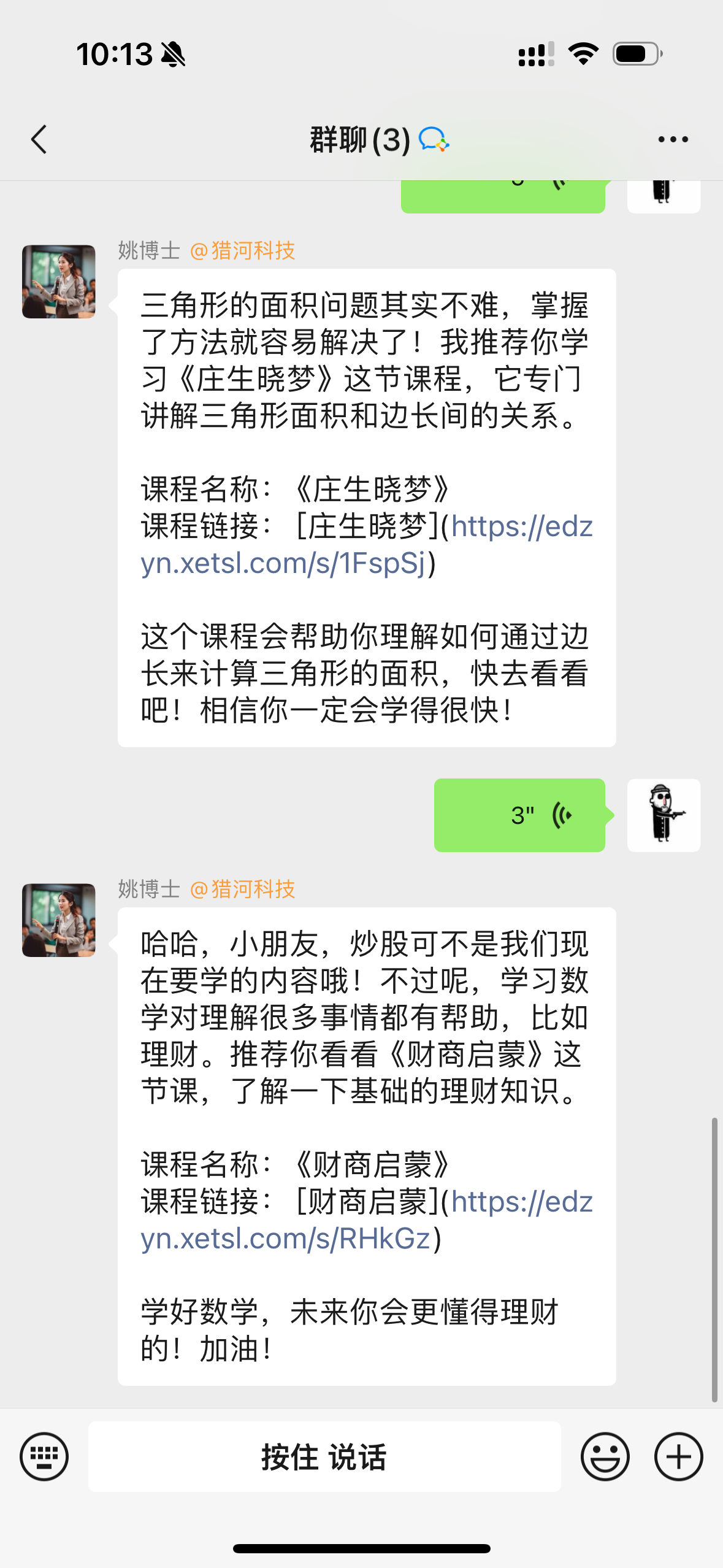
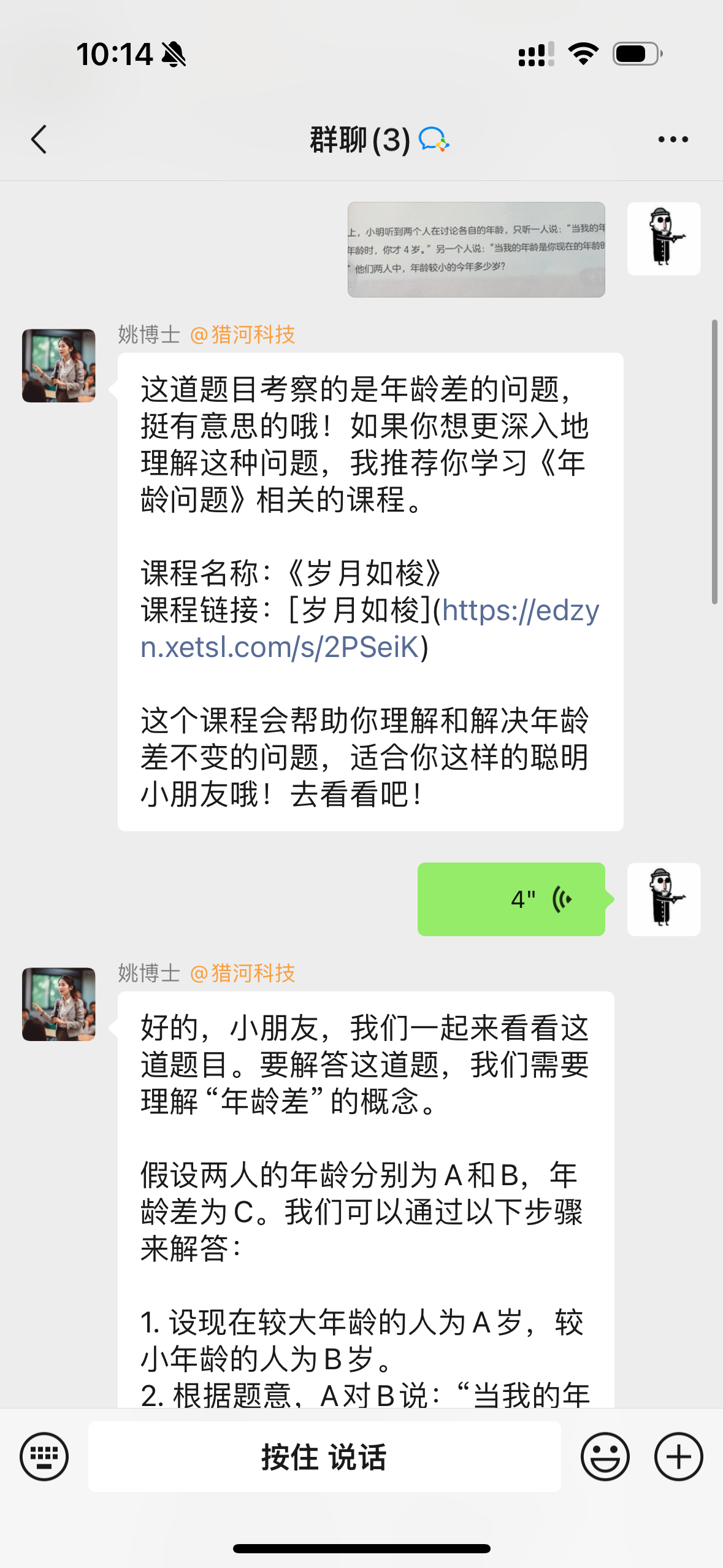
Built for WeChat-native use, this assistant requires no app download or hardware. Just type—or speak—in any group chat. Instant help. Context-aware guidance. Seamless course navigation.
We’ve already customized versions for several friends in education—everyone sees strong potential in this upgrade.
My takeaway on AI opportunities? Focus on three pillars:
- A specific, well-defined use case (e.g., middle-school math tutoring in group chats),
- A well-matched large model (not just the biggest, but the most suitable),
- A curated private knowledge base (your domain-specific data, rules, tone).
Get these right—and the upgrade path is wide open.
On Essence
There’s a line from The Godfather: “A man who can look at a situation for half a second and see its essence… and a man who spends his whole life missing it—these two men are destined for entirely different lives.”
But what is essence? It’s the fundamental, defining property of something—the part that doesn’t change with context, framing, or opinion. It shapes what the thing is, how it behaves, and where it’s headed.
Seeing essence isn’t automatic. It demands disciplined thinking: logical rigor, awareness of bias, willingness to unlearn, and accumulated experience.
Most of what we call “essence” in daily talk isn’t essence at all—it’s hearsay, mood, or habit dressed up as insight.
True essence emerges only through depth: either sustained study in the subject, or sudden, hard-won realization about it.
Three practical ways to get closer to essence faster:
- Start with definitions. Definitions aren’t arbitrary—they encode consensus about what something fundamentally is. Ask: What is an IP, really? What is “trust” in a team? What is “learning”? Few do—but doing so strips away noise and exposes structure.
- Talk to people who think differently. Not just experts—but those whose mental models diverge sharply from yours. Their questions, assumptions, and shortcuts reveal blind spots you didn’t know you had.
- Prioritize logic over intuition. Train yourself to trace cause → effect, premise → conclusion, assumption → implication. Logic doesn’t guarantee truth—but it makes your thinking auditable, correctable, and scalable.
Tencent Yuanbao
Tencent Yuanbao has officially launched—and it’s impressive.
Tencent builds products with rare polish and user empathy. Yuanbao positions itself around two pillars:
- AI productivity tools, especially intelligent search (for answers, references, inspiration),
- AI lifestyle apps, like an English-speaking coach or creative writing partner—designed to be fun and frictionless in everyday contexts.
It bundles current-gen capabilities: AI search, document summarization, web page distillation, text-to-text, text-to-image, and agentic workflows—all in one interface.
My favorite feature? Its search. It’s more accurate than Meta’s Mithra (Mithra), faster than Baidu, and—critically—curates results with authority in mind. For example, searching “how to improve sleep” surfaces mostly hospital-issued guidelines and clinical resources—not influencer blogs or SEO farms.
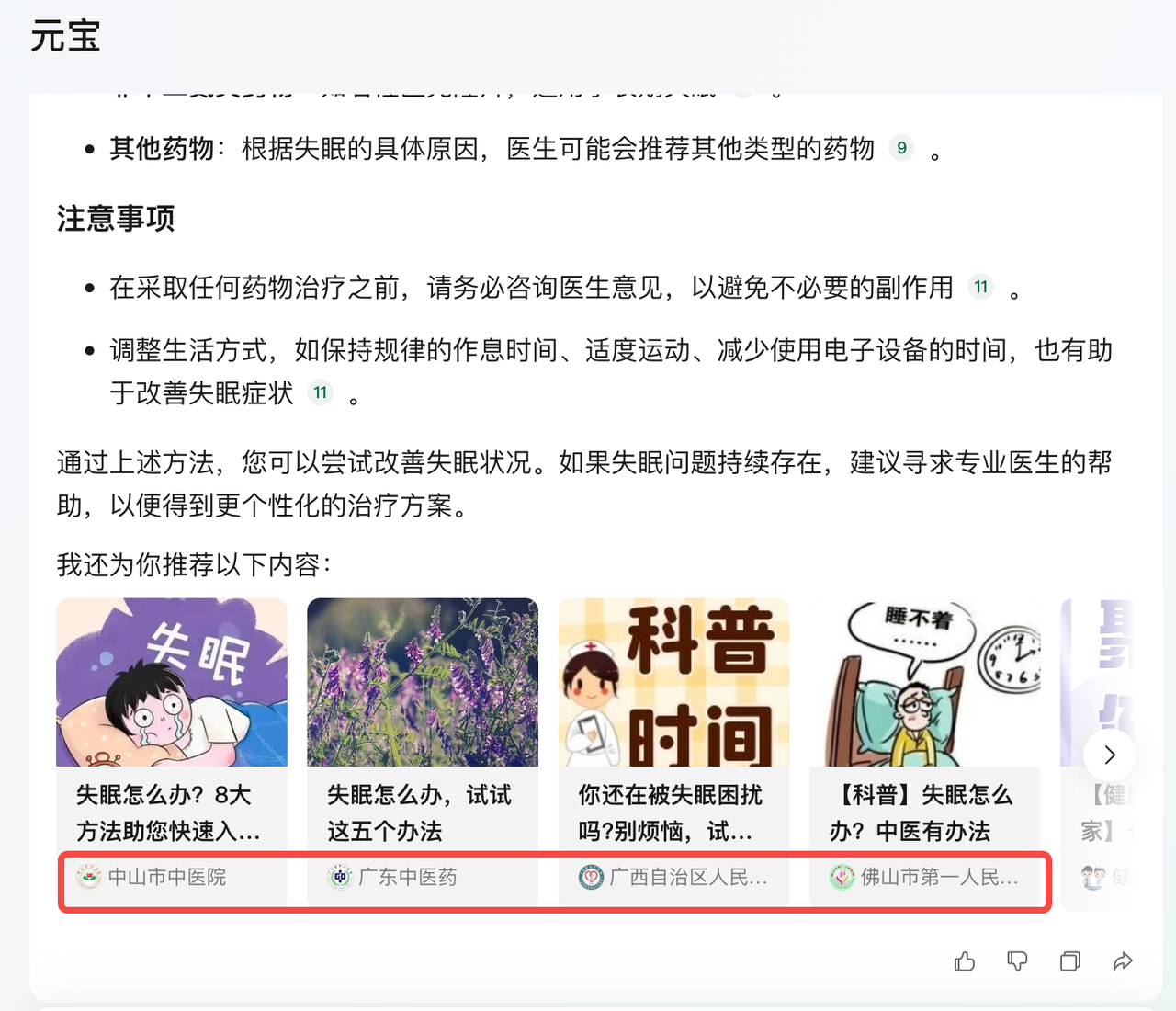
And this is just v1. Given Tencent’s track record of rapid, user-driven iteration, I expect Yuanbao to pull ahead of competitors—not just in features, but in reliability and contextual intelligence.
Focus on What You Control
Direct your energy toward what’s within your influence—not what’s outside it.
What you can control includes:
- Your interpretation of events,
- Your emotional response,
- Your attention, effort, and integrity.
What you cannot control includes:
- Other people’s actions, motives, or moods,
- Market shifts, weather, policy changes,
- Randomness—traffic jams, server outages, miscommunications.
Even close relationships fall into the “uncontrollable” category. You can’t make someone love you, listen to you, or change their habits to suit your needs—because they, like you, are autonomous agents with their own values, histories, and limits.
Wasting energy trying to manage the uncontrollable leads straight to exhaustion, resentment, and anxiety.
The alternative? Practice discernment. Ask daily: “Is this within my sphere of influence?” If yes—act. If no—observe, adapt, release. That simple filter protects your focus, preserves your peace, and sharpens your impact where it truly matters.