Brand Consistency
With AI now embedded in everyday life, user decision-making has fundamentally shifted.
A potential customer might first encounter a brand through a short video, outdoor ad, media coverage, or a friend’s recommendation - but before purchasing, they often turn to AI platforms like Doubao or DeepSeek to ask questions: “How is XXX brand?” “Is XXX brand trustworthy?” “Is XXX brand right for me?”
AI has moved into the most decisive link of the user decision chain. Advertising, content, and word-of-mouth get users to know a brand. AI increasingly handles information synthesis, comparative analysis, and decision support.
For brands, neglecting this step - or failing to systematically optimize for AI platforms - means losing high-intent prospects at the final moment. That’s costly.
Here’s the problem: when users query AI about a brand, the answers are often inaccurate. AI may misrepresent the brand’s positioning, product capabilities, target audience, or core strengths - offering outdated, contradictory, or even damaging descriptions.
A user grows interested - then abandons the choice during that final AI-powered verification step, misled by error, confusion, or stale data. That’s not just inefficient - it’s self-sabotage.
Why does this happen? Three main reasons stand out:
- No unified internal brand “fact standard”
Many companies lack a centralized, rigorously maintained set of verified brand facts. Without one, inconsistent messaging proliferates:
- Channel A promotes one brand narrative; Channel B uses an entirely different framing.
- The official website describes product capabilities differently than sales teams do in the field. These contradictions confuse customers - and leave AI with no reliable signal to prioritize. Which version is authoritative? Which reflects current reality?
-
No AI-optimized content infrastructure AI forms its understanding by scraping and synthesizing from official websites, owned media, industry reports, and third-party reviews. If a brand fails to publish clear, structured, verifiable content consistently - AI pulls from outdated pages, fragmented snippets, or incomplete descriptions. The result? AI knows the brand exists - but doesn’t understand it. Some “hallucinations” stem directly from this gap.
- A polluted third-party content ecosystem As GEO (Generative Engine Optimization) gains traction, more review articles, rankings, head-to-head comparisons, and recommendation lists flood the web. Too many contain weak evidence, competitor-driven bias, commercial placements, stitched-together claims, or outright factual errors. When AI ingests and summarizes these, inaccuracies enter its knowledge base - distorting perception. A brand with real advantages gets downgraded due to flawed third-party framing; fabricated weaknesses get repeated until they feel true.
All three issues erode AI’s ability to accurately represent a brand’s essence, strengths, and service promise. And when users rely on AI to verify and finalize decisions, those distortions translate directly into lost customers, eroded trust, and measurable revenue impact.
So - how should companies strengthen brand consistency?
First, treat it as a strategic priority - not a marketing tactic. Establish an internal “brand fact standard”: break the brand down into atomic, verifiable statements - e.g.,
- One-sentence positioning
- Target customer profile
- Core products/services offered
- Primary problems solved
- Differentiating capabilities
- Competitive distinctions
- Real-world case studies and metrics
For each fact, define one clear, accurate, up-to-date, and source-verified answer - and designate it the single source of truth.
Then, use technical tools or specialized providers to audit brand consistency quantitatively:
- How do major AI platforms currently describe the brand?
- Do their answers align - or contradict each other?
- Where do factual errors, omissions, or outdated claims appear?
Once diagnosed, remediate systematically: publish clean, structured, authoritative content; manage digital assets proactively; prioritize high-trust sources in outreach and syndication.
The ultimate goal? No matter where or how a user discovers the brand - via search, social, sales call, or AI chat - they receive information that is accurate, stable, coherent, and mutually reinforcing.
For the business, brand consistency delivers four core benefits:
- Lower cognitive load for users
- Higher perceived credibility
- More accurate AI understanding and recommendation
- Durable, compoundable brand equity
At its heart, brand consistency solves one question: Will every customer - regardless of entry point or AI platform - see the same accurate, trustworthy, clearly articulated version of who we are and what we deliver?

Media’s GEO Potential
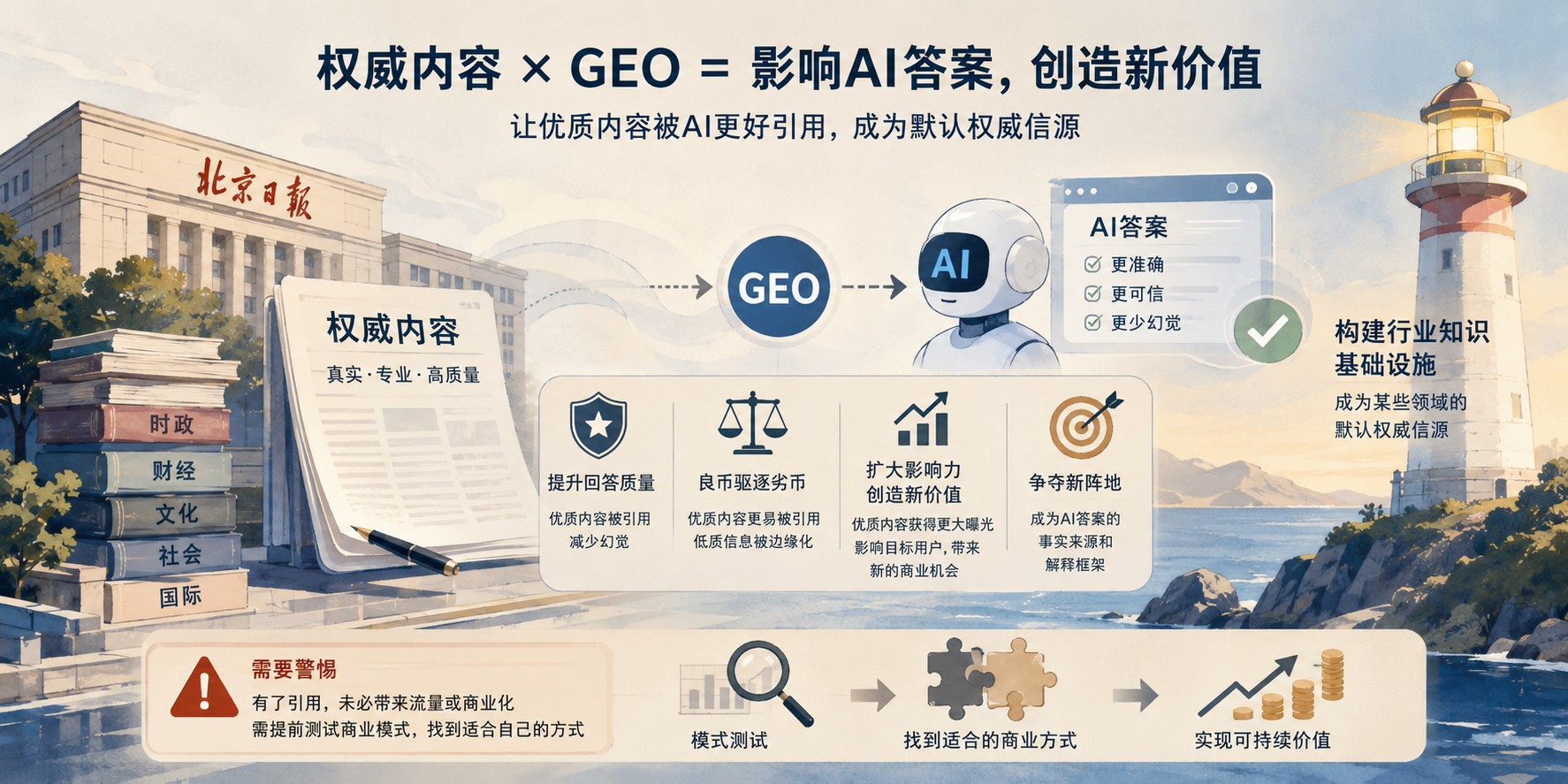
I recently gave a GEO briefing to Beijing Daily Group. Their response was sharp - and their execution speed impressive. Among China’s authoritative traditional media, their awareness and strategic positioning are notably advanced.
Their greatest asset? Vast volumes of high-quality, authoritative content. Used well with GEO, that content unlocks multiple layers of value:
- When AI cites authoritative media more reliably, answer quality improves - and hallucination rates drop.
- This creates a “good coin drives out bad coin” effect: better content rises in AI’s reference hierarchy, pushing low-quality noise downward.
- For the media itself, commercially valuable content gains broader, more targeted exposure - reaching new audiences via AI answers. That’s new monetization potential.
- The competitive landscape shifts: in the AI era, authority isn’t just about reach - it’s about becoming the default factual source and interpretive framework behind AI-generated answers.
GEO’s value for media goes beyond visibility. It operates on two deeper levels:
- First, shaping how AI answers - embedding the media’s facts, perspectives, and narrative logic into responses.
- Second, building sectoral knowledge infrastructure - establishing the outlet as the go-to authoritative source in specific domains.
One caveat: volume of citation != commercial return. Media must proactively test business models - before scale - to ensure citations convert into traffic, subscriptions, licensing, or other sustainable revenue. The opportunity remains wide open.
How to Say “Thank You”
I spoke with our sales lead about a user message: “I plan to monetize GEOFlow - and will share 5% of resulting revenue.”
I replied: “No need.” But inwardly - I was genuinely pleased.
My colleague pushed back gently: “That phrasing isn’t ideal.” “A stronger way to express gratitude would be to wait - then, once you’ve actually earned RMB 1 million, send RMB 30,000 with a note explaining why.”
That act carries more weight. It reflects respect - not obligation.
Prematurely promising 5% signals goodwill, yes - but also quietly establishes a long-term transactional relationship. Waiting until results materialize - and then acting voluntarily - keeps the gesture clean, grounded in outcome, and emotionally resonant.
The distinction lies at the core:
- Transaction requires pre-agreed rights, responsibilities, and returns.
- Gratitude is a post-hoc, voluntary return - given freely, based on recognition and respect.
The most meaningful thanks aren’t pledged at the start - they’re delivered after the result lands.
Managing Complex Systems
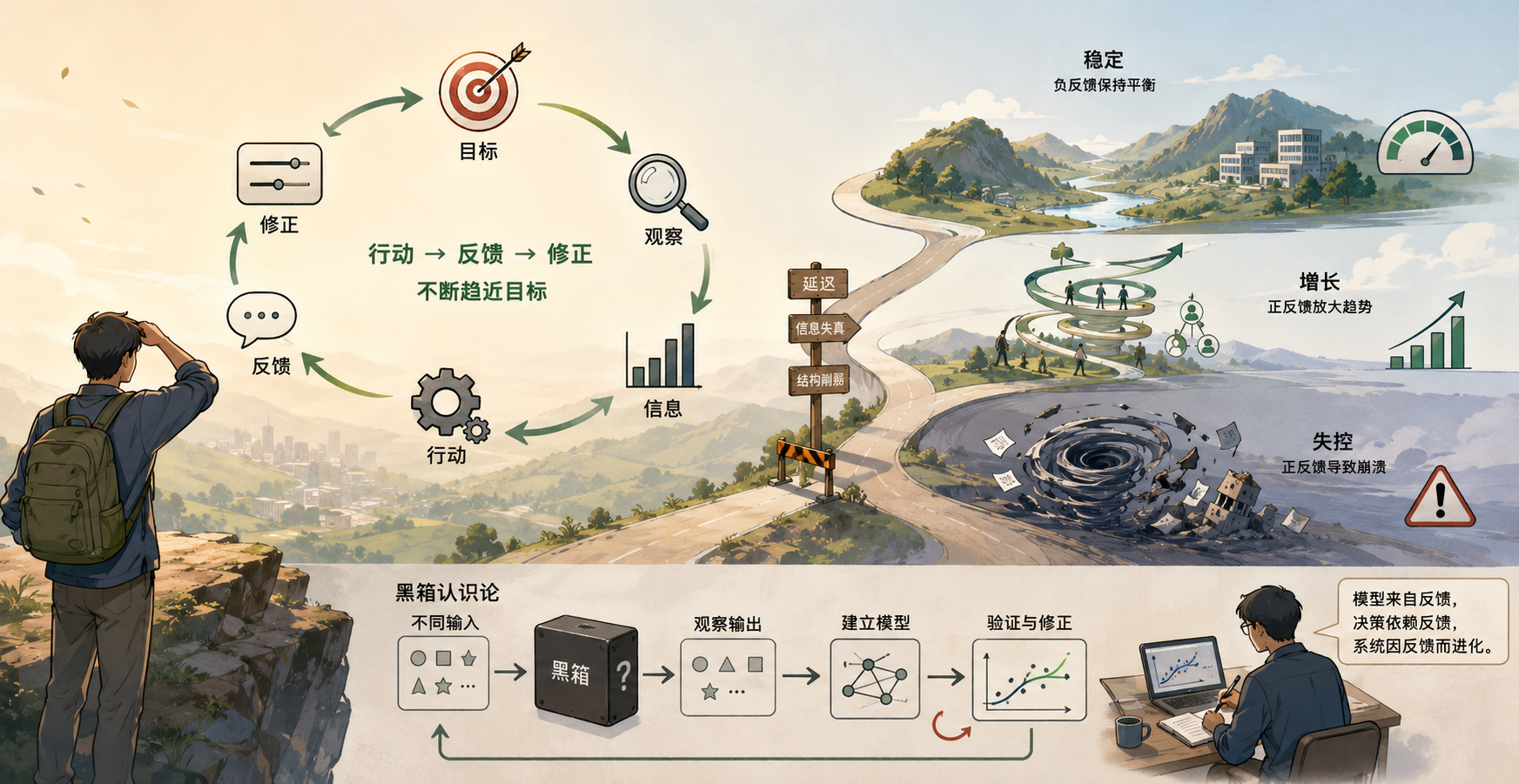
In complex worlds, perfect answers rarely emerge upfront. A more realistic approach is: act, observe feedback, adjust - and repeat.
Cybernetics and the Scientific Methodology, by Jin Guantao and Hua Guofan, offers a practical framework for this. Using cybernetics, information theory, and systems thinking, it tackles one central question: How can humans effectively understand, intervene in, and steer complex systems - even when full knowledge is impossible?
1. The Core Feedback Loop
Compress the entire book into one cycle: Define goal -> Observe state -> Gather information -> Take action -> Receive feedback -> Adjust action
Example: Running a SaaS company. Goal: Increase renewal rate -> Observe current user behavior -> Collect usage stats, NPS, churn reasons, support tickets -> Revise onboarding and support workflows -> Measure renewal rate change -> Refine further.
This is a control system - not about rigid command, but about guiding outcomes amid uncertainty.
2. Two Kinds of Feedback
- Negative feedback corrects deviation and stabilizes: e.g., project falling behind -> team adds resources -> pace recovers. Logic: Deviation detected -> counter-action applied -> system returns toward target.
- Positive feedback amplifies trends: e.g., more users -> more content -> more users. It fuels growth loops - or vicious cycles. Long-term stability hinges on having timely, truthful, actionable feedback mechanisms.
3. Information Is the Foundation
Without information, a system cannot know:
- Its current state
- Distance from goal
- Which actions work - or backfire
Information value isn’t just about volume - it’s about reducing uncertainty, revealing differences, and enabling action.
A powerful insight: An organization is, fundamentally, an information structure. People sharing an office != an effective organization. Only when information flows accurately, gets processed meaningfully, is stored reliably, and feeds back authentically does coordination emerge.
This reframes common management failures:
- Silos = broken information channels
- Distorted reporting = corrupted feedback signals
- Repeated mistakes = absent organizational memory
- Slow decisions = insufficient information processing capacity
- Micromanagement = information bottleneck at the top
4. Stability, Change, and Collapse
Why do systems stay stable? Because they maintain homeostatic structures: body temperature, company operations, ecosystems - all absorb shocks and self-correct. Stability != stasis. A company changes daily - yet endures because core functions hold.
Why do systems oscillate? Feedback delays cause overshoot and correction: Demand rises -> factory expands capacity -> supply floods market -> demand drops -> capacity shrinks -> shortage returns. Economic cycles, inventory swings, and org restructuring all follow this pattern.
Why do systems collapse? Self-reinforcing pathologies take root: bureaucracy rewarded -> copied -> normalized -> entrenched. Low-quality content, fake metrics, internal politics - all replicate when they yield short-term advantage.
How do systems self-organize? Order emerges not only from top-down design - but from local rules + interaction: markets, languages, open-source communities, online forums.
5. When Gradual Change Becomes Sudden Shift
Why do some systems appear static - then abruptly transform? Water heats slowly - then boils. A startup burns cash steadily - then hits liquidity crisis.
The book frames this with four concepts: gradual change, leap, stable state, and tipping point. Imagine a ball resting in a valley:
- Deep valley = stable system
- Shallower valley = increasing instability
- Valley vanishes = tipping point reached
- Ball rolls into new valley = qualitative shift
This reminds us: watch not just how fast things change - but whether the structures holding the current state are weakening.
6. Black-Box Epistemology
Some systems - brains, large organizations, recommendation engines, LLMs, customer decisions - are too complex to map fully. We see inputs and outputs, but not internals.
To study them, use this method:
- Apply varied inputs
- Record outputs
- Identify stable input-output relationships
- Build a predictive model
- Test with new inputs
- Refine model based on feedback
This mirrors how we study LLMs today: we can’t trace all 100B+ parameters - but through benchmarking, prompt experiments, red-teaming, real-world task evaluation, and live feedback, we map capability boundaries.
Understanding the world means continuously building - and correcting - models. Most failures stem from broken feedback. So managing complexity - or building complex products - starts with designing robust feedback loops.
Training Prediction Skill
Practicing prediction is deeply valuable. It sharpens judgment, exposes cognitive bias, calibrates confidence, and improves decision-making under uncertainty.
Yet we often say “I think it might…” or “It’ll probably happen” - without assigning probabilities or later checking our accuracy.
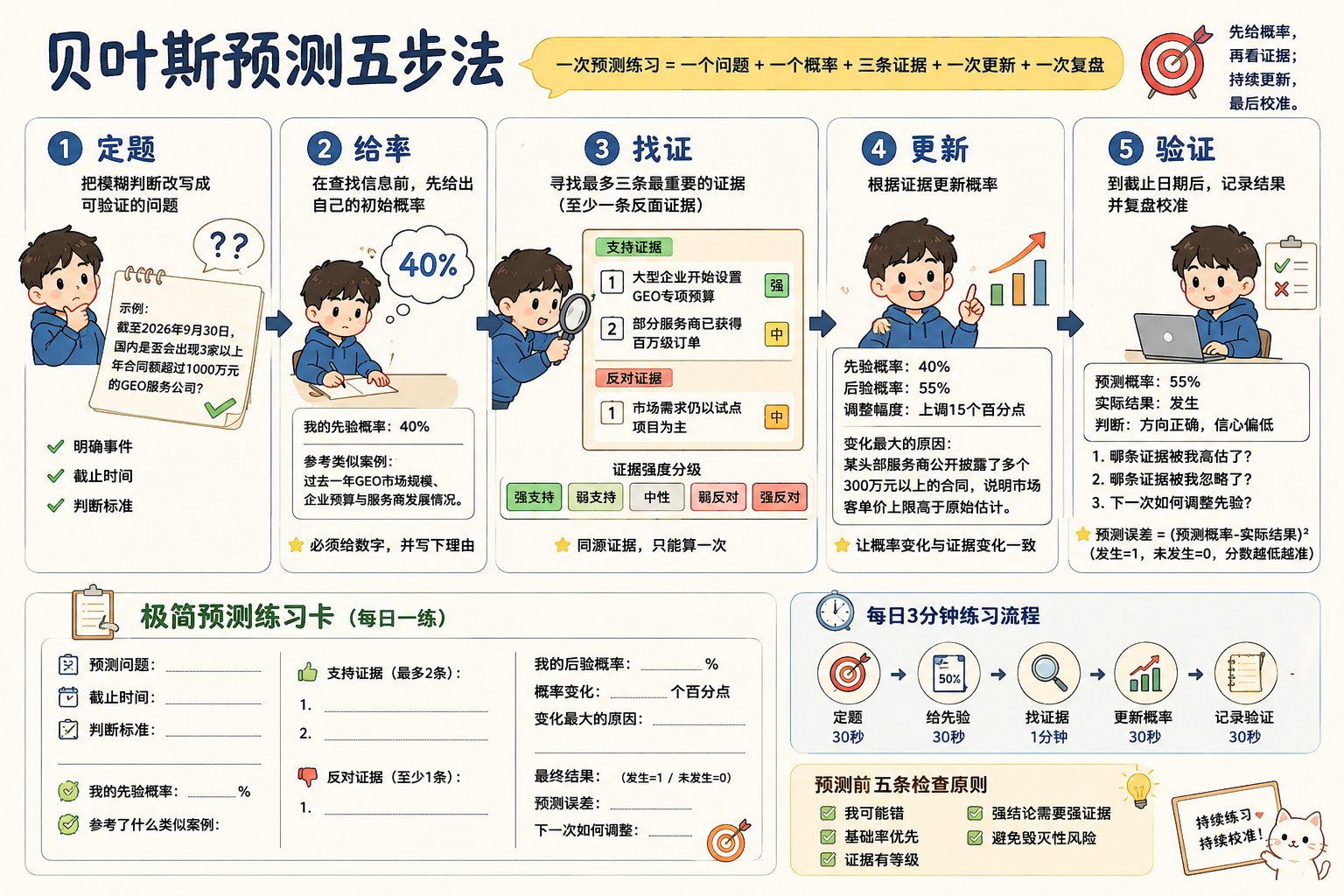
Drawing from earlier discussions of Bayesian skill, here’s a minimalist 5-step prediction training method: Frame -> Assign -> Gather -> Update -> Verify
One full cycle requires only:
- A testable question
- An initial probability estimate
- Three key pieces of evidence
- One probability update
- One post-result debrief
Assign probability before reviewing evidence. Update iteratively. Then verify.
Repeat - and over time, you train your brain to navigate ambiguity with greater precision and humility.
Means vs. Ends
I used to tell my team: “Master AI.” Because AI is becoming foundational - teams fluent in it gain real efficiency and competitive edge.
But I noticed a subtle risk: people began treating using more AI tools or building more automation as goals in themselves.
So someone asked: “Is mastering AI more important than serving customers or delivering business results?”
That’s a false dichotomy. AI is a means - a capability, method, tool. Solving real problems, creating value, and serving customers are the ends.
AI’s value isn’t in its complexity - it’s in what it enables:
- Does it improve speed, accuracy, or quality?
- Does it lift customer experience - or cut costs, boost revenue, unlock previously impossible tasks?
If an AI system is technically impressive but changes nothing in real workflows, its sophistication is irrelevant.
This reminds me: always clarify the goal first - then discuss tools. Leadership emphasis shapes behavior. Prioritize tool count, usage frequency, or automation depth - and teams build elegant systems that don’t move the needle.
Of course, AI’s value isn’t only about next-quarter revenue:
- Short term: Does it lift efficiency, quality, or performance?
- Medium term: Does it produce reusable processes, products, or capabilities?
- Long term: Does it forge new, defensible advantages?
Mature teams rarely debate “AI vs. business.” They ask:
- What level of business impact can AI help us achieve?
- What was impossible before - and now possible?
- Can we deliver higher-quality outcomes with fewer people?
- Can customers get faster, more reliable, more measurable results?
- Is there a simpler, more direct solution - without AI?
AI defines how fast and well we run. Purpose defines where we’re running. Results determine whether the run mattered at all.