Aha Case
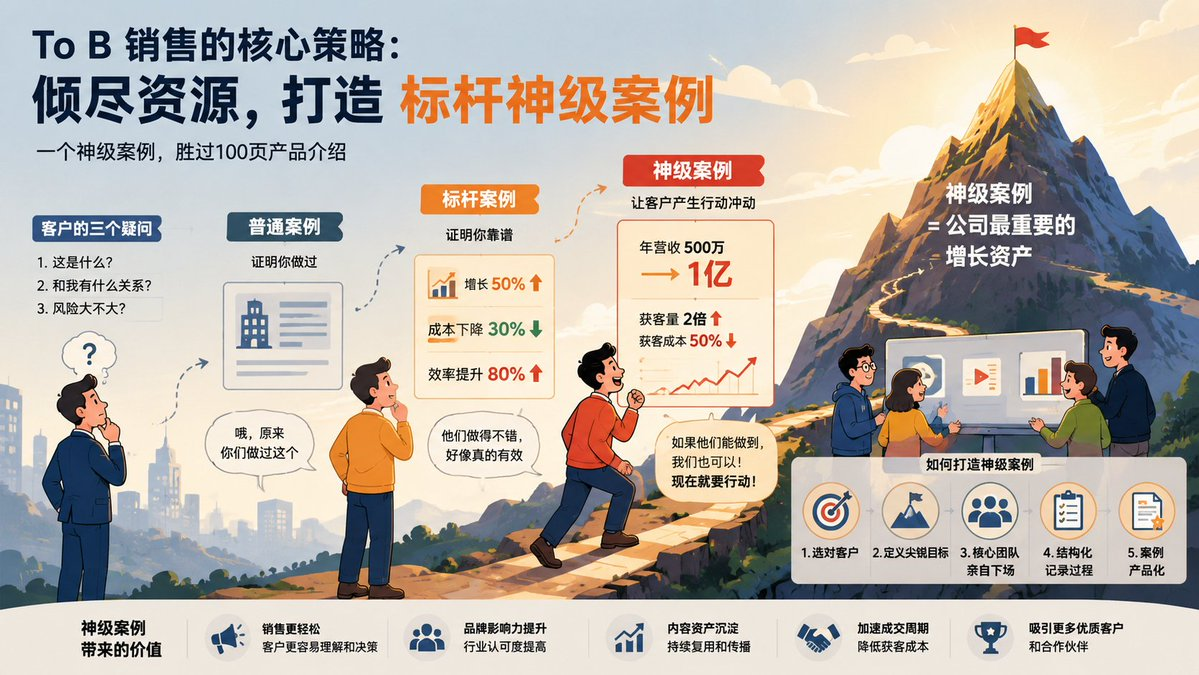
For B2B companies, a critical sales strategy isn’t just building a reference case - it’s going all-in to build a legendary one.
In China, the strategic weight of real-world cases is vastly underestimated - especially for new products. When target enterprises struggle to grasp unfamiliar concepts, models, or jargon, the cost of education and alignment is high. But tell them a legendary case - a vivid, outcome-driven story - and understanding clicks instantly. Decisions follow just as fast.
What makes a case “legendary”? It triggers that visceral aha moment.
For example:
- A previously unknown startup grows annual revenue from RMB 5 million to RMB 100 million in one year - using your product.
- A listed company doubles core channel acquisition volume while cutting customer acquisition cost by 50% - by adopting your model.
One such case outweighs 100 pages of feature specs. With just one or two, your sales team gains momentum; prospects gain clarity and confidence.
Here’s how to build one - five steps:
- Select the right client: High potential, high collaboration, willing to go public.
- Define a sharp, measurable goal.
- Deploy core team + resources personally - no delegation, no half-measures.
- Document everything, end-to-end.
- Productize the case: Turn it into reusable assets - narrative, metrics, visuals, talking points.
That’s what we call an Aha Case.
The Boundary of Product
I recently hosted a channel partner who shared a prospective product collaboration. Its pitch? “We serve any client - and guarantee results.”
That logic is flawed. Every product has boundaries: what it can do, what it cannot, who it serves well, and who it doesn’t serve at all.
At our company, we’ve internalized this principle - and enforced it rigorously:
- We don’t take projects below a minimum price threshold.
- We decline all bid-tender processes.
- We avoid high-sensitivity or gray-area industries.
- We walk away when core requirements fall outside our capability scope.
These boundaries aren’t constraints - they’re quality safeguards. They directly shape delivery integrity and, over time, reputation.
One of my biggest takeaways from the past year of entrepreneurship? Riding trends matters - but so does differentiation. Even within a hot trend, standing out requires deliberate choices. And true differentiation isn’t built on features alone. It’s forged through consistent boundary-setting: saying “no” clearly, repeatedly, and with conviction. Each refusal sharpens your positioning - and deepens user trust.
Good Relationships
A friend shared his reflections on relationships - particularly romantic ones.
A good relationship leaves lasting value - even if it doesn’t last. Years later, you don’t recall resentment. You remember warmth: being understood, cherished, held gently.
Initial attraction - looks, charm - is just the entry ticket. What sustains connection is mutual admiration, deep trust, and safety. That safety lets people relax, drop pretense, and show up authentically.
I asked: What stays with you? He listed subtle but consequential things - life perspectives, practical habits, even small skills - that reshaped his daily thinking and choices.
He observed that many people in China live externally - performing for “face” or defaulting to self-sacrificing “saintly” behavior - making it hard to ask for what they need or claim what’s rightfully theirs.
Examples he gave:
- Seek diverse experiences: Reading about Kyoto isn’t the same as walking its alleys at dawn. Immersion changes perception.
- Taste widely - but lightly: Savor variety without overindulgence. One bite can be revelation.
- Speak up at fine dining: If a dish misses the mark, describe exactly why - not “it’s okay.” Chefs often replace it immediately.
- Use hotel service proactively: Half the price of luxury hotels is service premium. Call front desk before frustration builds - you’ll likely get resolution in under 90 seconds.
- Pay for expertise: A travel consultant or dedicated driver costs little but transforms itinerary quality. Don’t DIY complexity you don’t enjoy.
- Mine your financial perks: Gold card benefits (golf access, lounge entry) hide in app menus. Spend 3 minutes finding them - it pays back instantly.
- Guard what enters your body: In unfamiliar places, never lose sight of water, drinks, or food - especially if unsealed.
- Pre-read before cultural travel: Knowing the history behind Angkor Wat or the Forbidden City turns stone into story.
Good relationships don’t just soothe - they expand your life radius. They quietly transfer lived wisdom: judgment frameworks, boundary instincts, aesthetic sensibilities, even how to hold space for uncertainty.
Of course, relationships aren’t all light. Having experienced depth, you also learn discernment: who deserves closeness - and who doesn’t.
Some red flags stand out:
- For men: chronic gamblers, emotionally stunted adults, or those with volatile moods.
- For women: partners with chaotic relationship histories, extreme materialism, or who consistently drain their current family to subsidize their original one.
All these point to the same core deficits: responsibility, boundary awareness, emotional stability, and basic goodwill.
Choosing a partner isn’t about initial spark - it’s about observing how they show up over time: Do they own mistakes? Respect limits? Recover gracefully? And - crucially - do they help you grow without erasing you?
But the most important question isn’t “Who should I choose?” It’s: Am I becoming someone worthy of being chosen by someone excellent?

Four Human Traits Most Scarce in the AI Era
Hudson, one of Silicon Valley’s most sought-after executive coaches, now spends most of his time advising OpenAI’s research teams. His insider view reveals something counterintuitive: success in AI-augmented environments depends less on knowledge or grit - and more on emotional clarity.
As AI rapidly commoditizes information and effort, four distinctly human traits are becoming increasingly rare - and valuable:
- Discernment: Knowing what to pursue, what to abandon, and when to pivot - not just what to do, but whether to do it at all.
- Trustful conflict: In high-leverage small teams, unresolved tension explodes. The ability to initiate and navigate tough conversations - without defensiveness or avoidance - is now mission-critical.
- Willingness to fail: Humans excel at rapid iteration. Here, “failure” isn’t catastrophe - it’s negative feedback, a data point for learning. Courage to ship, test, and revise fast is irreplaceable.
- Positive self-dialogue: Self-flagellation kills creativity and judgment. The capacity to speak to yourself with curiosity, kindness, and agency - not shame - is the bedrock of sustained creation.
AI Interview System
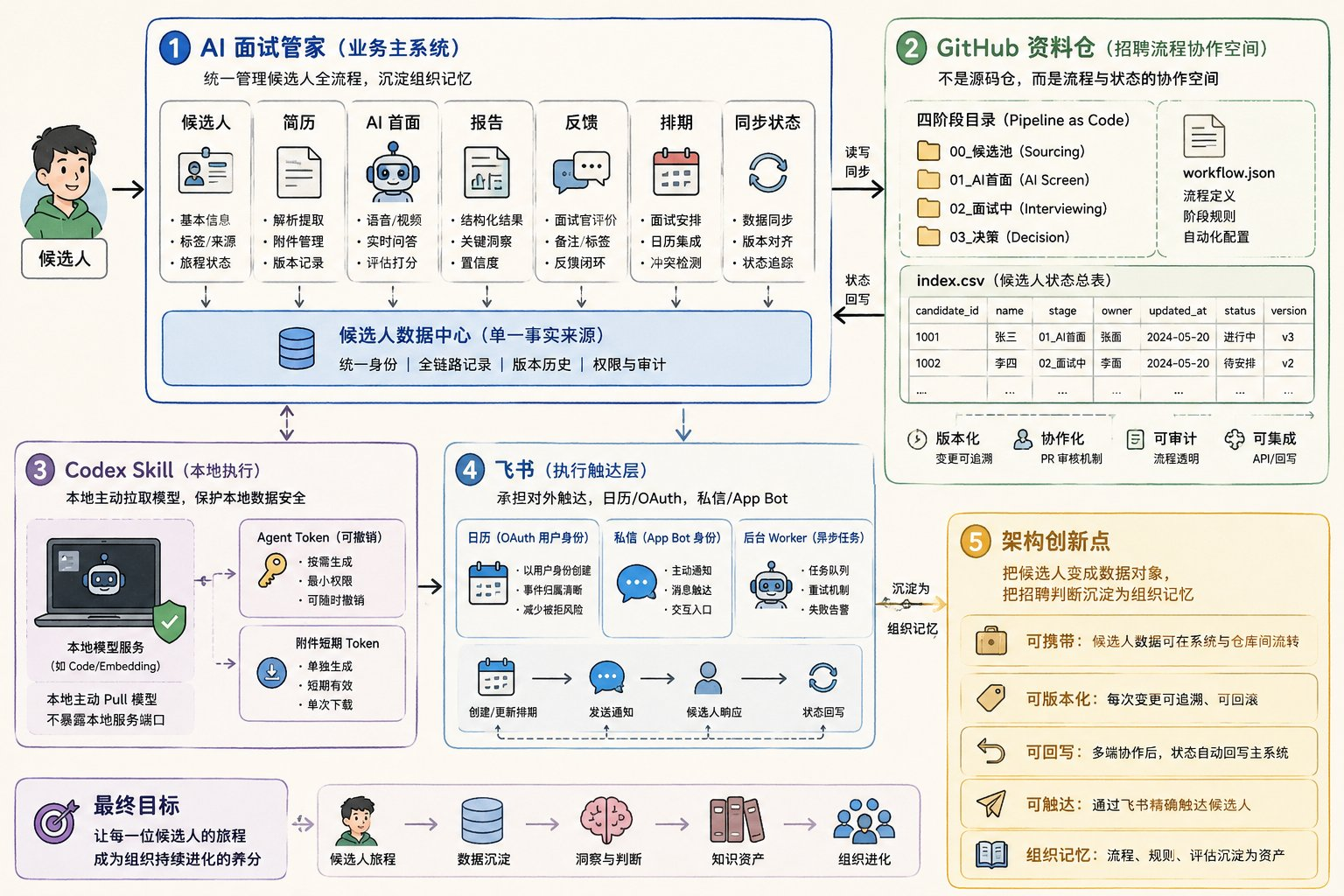
Our hiring volume keeps rising. So we upgraded our “AI Interview Manager” - not just adding features, but rearchitecting for four-way synergy: AI Interview System + GitHub + Feishu + Codex.
-
AI Interview Manager (core) The operational hub: manages candidates, resumes, AI-first interviews, auto-generated reports, feedback loops, scheduling, analytics, and cross-system status sync.
-
GitHub Repository (collaboration layer) Each candidate gets a dedicated directory. Workflow stages auto-record via folder structure,
workflow.json,candidate-index.csv, and Git commits - creating a versioned, auditable evidence chain. -
Codex Skill (local intelligence layer) Interviewers pull candidate packages locally, generate evaluations, write first/second-round feedback, save schedules, and push tasks/feedback/reports to Feishu - all from one interface.
-
Feishu Execution Layer Via Feishu CLI: auto-create calendar invites, send private reminders, trigger post-interview nudges (e.g., “Please submit feedback within 1 hour”). Background workers handle async retries, status updates, and weekly report syncs.
The flow:
- Resume uploaded -> parsed asynchronously.
- Candidate completes AI-first interview -> Q&A, transcripts, keywords, and scores saved.
- Report generator produces HR & candidate versions -> auto-synced to GitHub.
- Team views candidate data in GitHub or Codex -> generates evaluation -> writes feedback.
- If “pass”, candidate moves to next-stage GitHub folder; if “reject” or “hold”, only status/feedback updates.
- Once scheduled, Feishu calendar task created -> worker triggers 1h & 3h feedback reminders post-interview.
For interviewers, Codex becomes the primary interface - all other systems coordinate silently in the background.
What makes this architecture compelling:
- Business data lives in the database; collaboration provenance lives in GitHub.
- Hiring is GitOps-native: every stage shift, feedback update, or folder move is traceable.
- Local agents pull data on demand - enabling smart collaboration without exposing credentials or raw data.
- Feishu tasks run async - calendar, notifications, and reminders are fault-isolated.
- AI handles fact extraction and suggestions; humans own judgment, reasoning, and accountability.
- Candidates transform from database rows into stateful, versioned, portable objects - carrying history, context, and touchpoints across systems.
In short: candidates are now modeled as living entities - flowing through AI assessment, GitHub collaboration, Codex evaluation, and Feishu engagement. This gives hiring four superpowers: automation speed, human accountability, organizational memory, and full-stack operability.
DouBao Diagnostic Skill
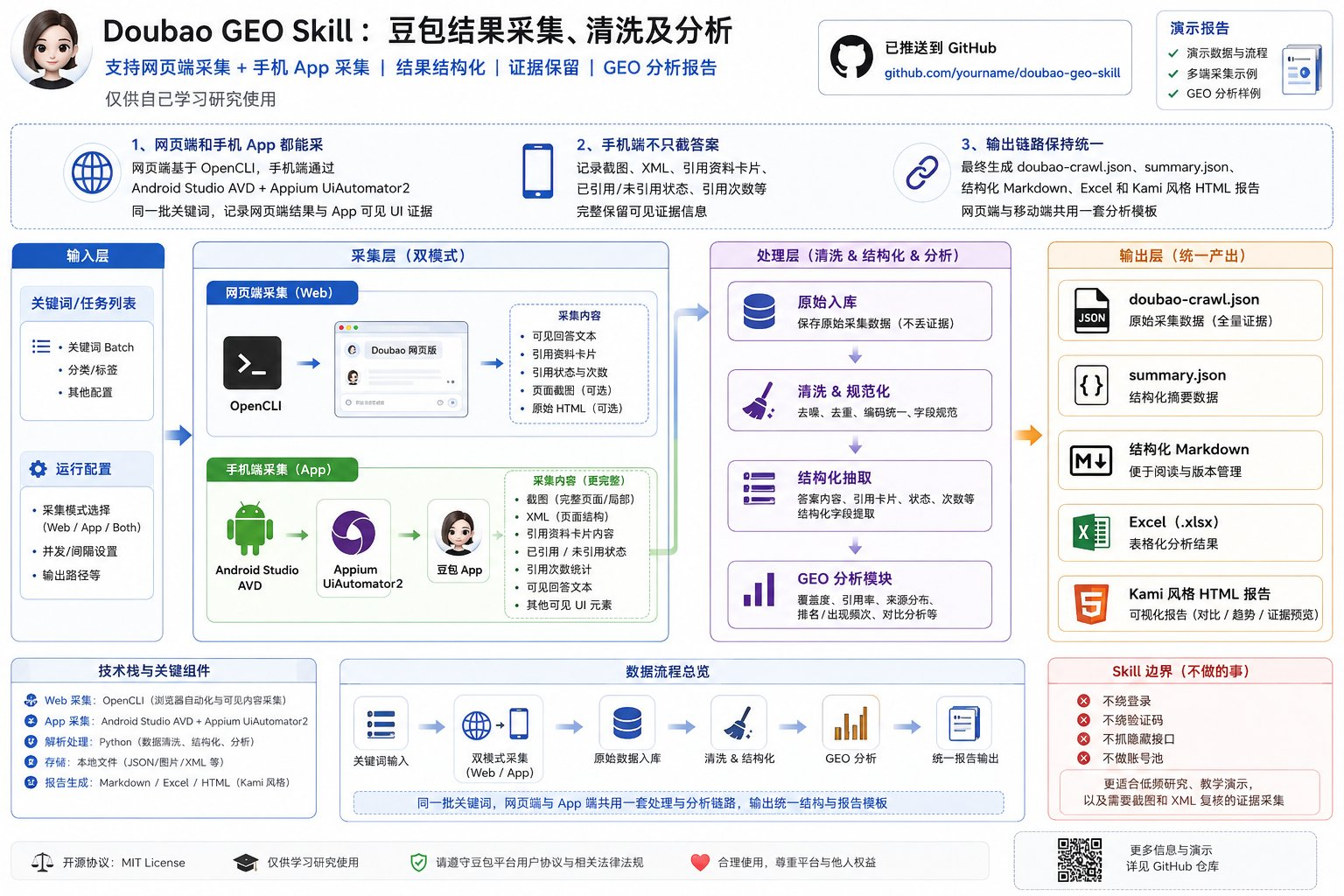
I built a GEO-focused skill to collect, clean, and analyze outputs from DouBao (ByteDance’s AI assistant). Designed for personal research - not production use.
It supports two collection modes:
- Web interface: via OpenCLI.
- Mobile app: via Android Studio AVD + Appium UiAutomator2.
Same keyword queries yield both web results and mobile UI evidence - screenshots, XML DOM trees, citation cards, and precise tracking of “cited vs. uncited” sources and citation counts.
Output is unified:
doubao-crawl.json(raw data)summary.json(aggregated insights)- Structured Markdown
- Excel tables
- Kami-style HTML reports
Downstream GEO analysis uses one shared template - regardless of source.
Skill boundaries:
- No login bypasses.
- No CAPTCHA cracking.
- No hidden API scraping.
- No account pooling.
Best suited for low-frequency research, teaching demos, or forensic validation where screenshots + XML are required.
If you study GEO and want to compare how DouBao’s mobile app surfaces citations versus its web version - try it.
GitHub repo: github.com